Key takeaways
- Ceyo AI starts at $49/mo with transparent pricing; BrandRank.AI has no public pricing and requires a sales conversation, which typically means enterprise-level costs.
- Both tools are monitoring platforms -- they track how your brand appears in AI responses but neither offers built-in content generation or answer gap analysis to help you fix what you find.
- BrandRank.AI goes deeper on brand health with dedicated "Brand Vulnerability" and "Content Readiness" scoring -- useful if you need to report on trust and sentiment, not just visibility counts.
- Ceyo AI is built for marketing teams and agencies that want quick setup and real-time alerts without a lengthy procurement process.
- BrandRank.AI's client list (Nestlé, P&G, Bitdefender) signals it's designed for large organizations with complex brand monitoring needs across multiple product lines.
- If you need to go beyond tracking and actually improve your AI visibility with content, neither tool covers that loop -- you'd need to look elsewhere for that capability.
Overview
BrandRank.AI
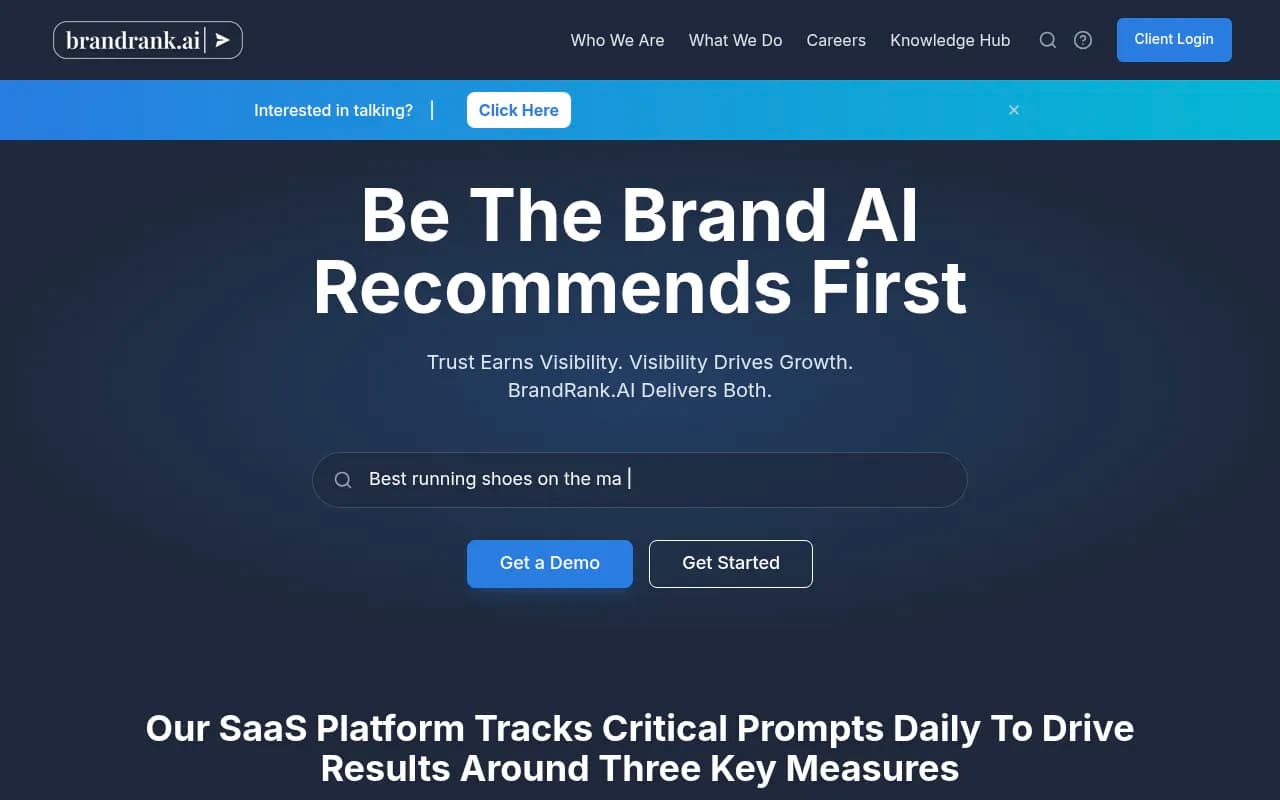
BrandRank.AI positions itself around what it calls the "Answer Economy" -- the idea that AI chatbots are becoming the primary recommendation layer between brands and consumers. The platform tracks daily prompt performance across ChatGPT, Perplexity, Claude, Gemini, and other answer engines, and organizes its analysis into three pillars: AI Search Visibility (do you show up?), Brand Vulnerability (what does AI say about you?), and Content Readiness (is your site structured for AI crawlers?). It's clearly built for enterprise marketing and brand teams -- the demo-first sales model, the Nestlé and P&G logos on the homepage, and the language around "trust gaps" all point to a product that's sold into larger organizations with dedicated brand strategy resources.
Ceyo AI
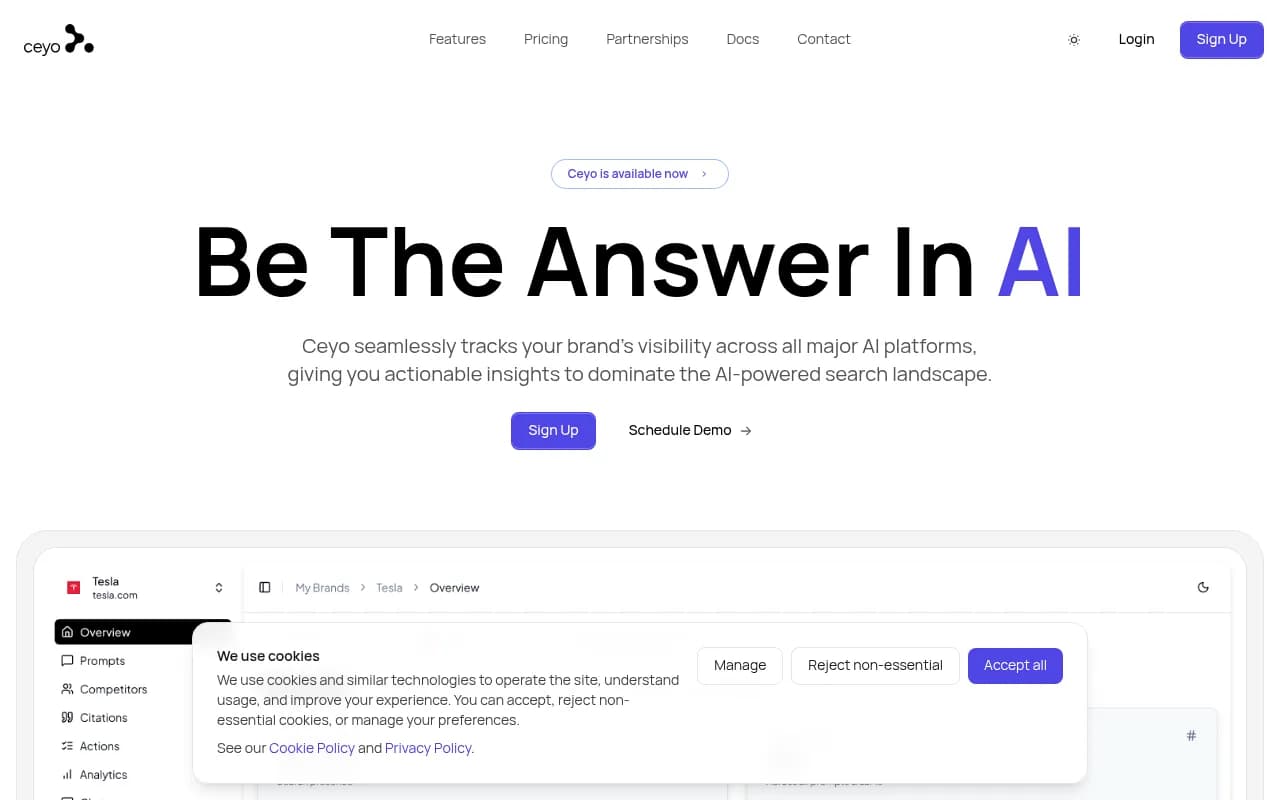
Ceyo AI takes a more direct approach: monitor your brand's mentions across the major LLMs, track sentiment and competitive positioning, and surface real-time alerts when something changes. It's aimed at marketing teams and agencies that want to get started quickly without a sales cycle. The $49/mo entry point puts it in reach of smaller teams, and the focus on actionable recommendations makes it feel more like a self-serve tool than a managed enterprise platform.
Side-by-side comparison
| Feature | BrandRank.AI | Ceyo AI |
|---|---|---|
| Starting price | Custom (contact sales) | $49/mo |
| Free trial / free tier | Demo only | Available |
| Target audience | Enterprise brands | Marketing teams, agencies |
| LLMs monitored | ChatGPT, Perplexity, Claude, Gemini + others | ChatGPT, Perplexity, Claude, Gemini |
| Brand sentiment analysis | Yes (accuracy + sentiment scoring) | Yes |
| Competitive positioning | Yes (Category Answer Share) | Yes |
| Content readiness scoring | Yes (dedicated pillar) | Not prominently featured |
| Brand vulnerability analysis | Yes (dedicated pillar) | Basic |
| Real-time alerts | Not prominently featured | Yes |
| Content generation / gap analysis | No | No |
| AI crawler log analysis | Not mentioned | Not mentioned |
| Self-serve onboarding | No (demo required) | Yes |
| API access | Not publicly documented | Not publicly documented |
| Reporting / exports | Enterprise-grade (implied) | Standard |
Head-to-head feature deep-dive
Pricing and accessibility
This is where the two tools diverge most sharply. Ceyo AI publishes its pricing -- $49/mo for the Core plan -- which means you can sign up, try it, and decide without talking to anyone. That matters a lot for smaller teams or agencies that need to move fast and justify spend without a lengthy approval process.
BrandRank.AI doesn't publish any pricing. You request a demo, talk to their team, and get a custom quote. That's not inherently bad -- enterprise software often works this way -- but it does mean you're committing time before you know if the cost is even in your ballpark. Given the client roster (Nestlé, P&G, Fifth Third Bank), it's reasonable to assume the price is well above $49/mo.
Verdict: Ceyo AI wins on accessibility and price transparency. BrandRank.AI is likely the right choice if budget isn't the primary constraint and you need enterprise-level account management.
AI model coverage
Both platforms cover the four models that matter most right now: ChatGPT, Perplexity, Claude, and Gemini. BrandRank.AI's homepage mentions "other answer engines" without specifying which, suggesting some flexibility in what gets tracked. Ceyo AI's coverage appears focused on those four core models.
Neither platform publicly lists the kind of comprehensive model count you'd see from tools that explicitly track 10+ models. For most brands, the four major LLMs cover the vast majority of AI search traffic, so this gap is less critical than it sounds -- but it's worth asking both vendors directly if you need coverage of Grok, DeepSeek, or Mistral.
Verdict: Roughly equal for standard use cases. Ask both vendors about extended model coverage if you need it.
Brand analysis depth
This is where BrandRank.AI has a real edge. The three-pillar framework -- AI Search Visibility, Brand Vulnerability, Content Readiness -- gives enterprise brand teams a structured way to report upward. The Brand Vulnerability pillar in particular (covering credibility, trust, product performance, accuracy, and sentiment) goes beyond simple mention counting. If your brand has been misrepresented by an AI model, or if there's a gap between what AI says about you and what's actually true, BrandRank.AI is built to surface that.
Ceyo AI tracks sentiment and competitive positioning, but the framing is more operational than strategic. It's better suited to "are we showing up and is the sentiment positive?" than "what are the specific trust gaps we need to address in our content strategy?"
Verdict: BrandRank.AI goes deeper on brand health and trust analysis. Ceyo AI covers the basics well.
Content readiness and optimization
BrandRank.AI has a dedicated Content Readiness pillar that scores your site on content accessibility, schema depth, and what they call "content liquidity" (essentially how bot-friendly your pages are). This is useful diagnostic information -- it tells you whether your site is structured in a way that AI crawlers can actually read and cite.
Ceyo AI surfaces "actionable recommendations" but doesn't appear to have a structured content readiness framework. The recommendations are more likely to be prompt-level or competitive insights than technical content audits.
Neither tool generates content for you or runs answer gap analysis to show you which prompts competitors rank for that you don't. That's a meaningful gap in both platforms -- monitoring tells you where you stand, but it doesn't tell you what to write or how to close the gap. If that workflow matters to you, it's worth knowing that tools like Promptwatch are built specifically around that action loop: find gaps, generate content, track results.

Verdict: BrandRank.AI has more structured content readiness diagnostics. Neither tool helps you act on the findings with content creation.
Alerts and real-time monitoring
Ceyo AI explicitly features real-time alerts, which is a practical feature for marketing teams that need to know immediately when brand sentiment shifts or a competitor gains ground. This kind of operational monitoring is core to the Ceyo value proposition.
BrandRank.AI tracks prompts daily, which is solid for trend analysis and reporting, but daily cadence is slower than real-time. For enterprise brands, daily tracking with historical trend data is often more useful than real-time pings -- you're looking at patterns, not reacting to individual responses. But for smaller teams that want to stay on top of changes quickly, Ceyo's real-time approach is more practical.
Verdict: Ceyo AI for real-time operational monitoring. BrandRank.AI for daily trend analysis and strategic reporting.
Onboarding and ease of use
Ceyo AI is self-serve. You sign up, connect your brand, and start monitoring. That's a significant advantage for teams that don't have time for a sales process or don't want to involve procurement.
BrandRank.AI requires a demo request. The upside is that you get a guided onboarding experience and presumably dedicated support. The downside is friction -- you can't evaluate the product on your own terms before committing to a conversation.
Verdict: Ceyo AI is faster to start. BrandRank.AI offers more hand-holding for enterprise teams that want it.
Pricing comparison
| Plan | BrandRank.AI | Ceyo AI |
|---|---|---|
| Free tier | No | Available (trial) |
| Entry-level | Custom (contact sales) | $49/mo (Core) |
| Mid-tier | Custom | ~$89/mo |
| Enterprise | Custom | Custom |
| Annual discount | Unknown | Yes |
| Billing | Custom | Monthly and yearly |
BrandRank.AI's pricing opacity is a real barrier for teams that need to budget quickly. Ceyo AI's transparent pricing makes it easy to get started and scale up.
Pros and cons
BrandRank.AI
Pros:
- Deep brand vulnerability and trust analysis, not just mention counting
- Structured three-pillar framework useful for executive reporting
- Content readiness scoring with schema and bot-friendliness diagnostics
- Enterprise-grade client list suggests proven reliability at scale
- Competitive positioning and Category Answer Share metrics
Cons:
- No public pricing -- requires a sales conversation before you can evaluate cost
- No self-serve trial or free tier
- Daily tracking cadence, not real-time
- No content generation or answer gap analysis
- Limited public documentation on API, integrations, or model coverage
Ceyo AI
Pros:
- Transparent pricing starting at $49/mo
- Self-serve onboarding -- no sales call required
- Real-time alerts for brand mention changes
- Built for marketing teams and agencies, not just enterprise
- Covers the four major LLMs
Cons:
- Less depth on brand vulnerability and trust analysis
- No structured content readiness framework
- No content generation or answer gap analysis
- Smaller feature surface than enterprise-focused competitors
- Limited public information on advanced features like API access or custom reporting
Who should pick which tool
Pick BrandRank.AI if:
- You're at a large enterprise brand (think Fortune 500 or equivalent) with a dedicated brand strategy team
- You need to report on brand trust and AI sentiment to senior stakeholders, not just track mention counts
- You want a managed, consultative relationship with your vendor rather than a self-serve tool
- Content readiness and schema diagnostics are part of your AI search strategy
- Budget is less of a constraint than depth of analysis
Pick Ceyo AI if:
- You're a marketing team or agency that needs to get started quickly without a sales process
- Your primary need is monitoring brand mentions and sentiment across the major LLMs
- You want real-time alerts when something changes
- You're working with a limited budget and need transparent, predictable pricing
- You don't need deep brand vulnerability analysis or executive-level reporting frameworks
Final verdict
BrandRank.AI and Ceyo AI are solving the same core problem -- tracking how brands appear in AI responses -- but they're aimed at very different buyers. BrandRank.AI is a strategic tool for enterprise brand teams that need depth, structure, and a consultative vendor relationship. Ceyo AI is a practical tool for marketing teams that need to start monitoring quickly and affordably.
The honest limitation of both: they're monitoring platforms. They tell you where you stand but don't help you improve your position. If you're serious about growing your AI visibility and not just measuring it, you'll eventually need something that closes the loop between insight and action -- and neither of these tools does that today.