Key Takeaways
- Ceyo AI starts at $49/mo and targets small-to-mid teams with straightforward monitoring, while AthenaHQ starts at $95/mo annual ($295/mo monthly) and positions itself as an enterprise-grade optimization platform
- AthenaHQ monitors 8+ AI engines with deeper analytics and executive dashboards, while Ceyo tracks 4 major LLMs (ChatGPT, Gemini, Claude, Perplexity) with real-time alerts
- Ceyo emphasizes ease of use -- sign up, add prompts, start tracking. AthenaHQ is built for teams that want strategic oversight, ROI tracking, and cross-functional workflows
- Neither platform offers content generation -- both are monitoring-focused. If you need to actually create content that ranks in AI search, you'll need a separate tool or a platform like Promptwatch that combines tracking with AI content generation
- Ceyo has no free trial, AthenaHQ has no free trial either -- both require commitment upfront, though Ceyo's lower entry price makes it easier to test
- AthenaHQ's client roster (ZoomInfo, Coinbase, Volkswagen) signals it's built for larger orgs, while Ceyo's partner list (agencies like Brandfirm, Zigt) suggests agency and SMB focus
Overview
Ceyo AI
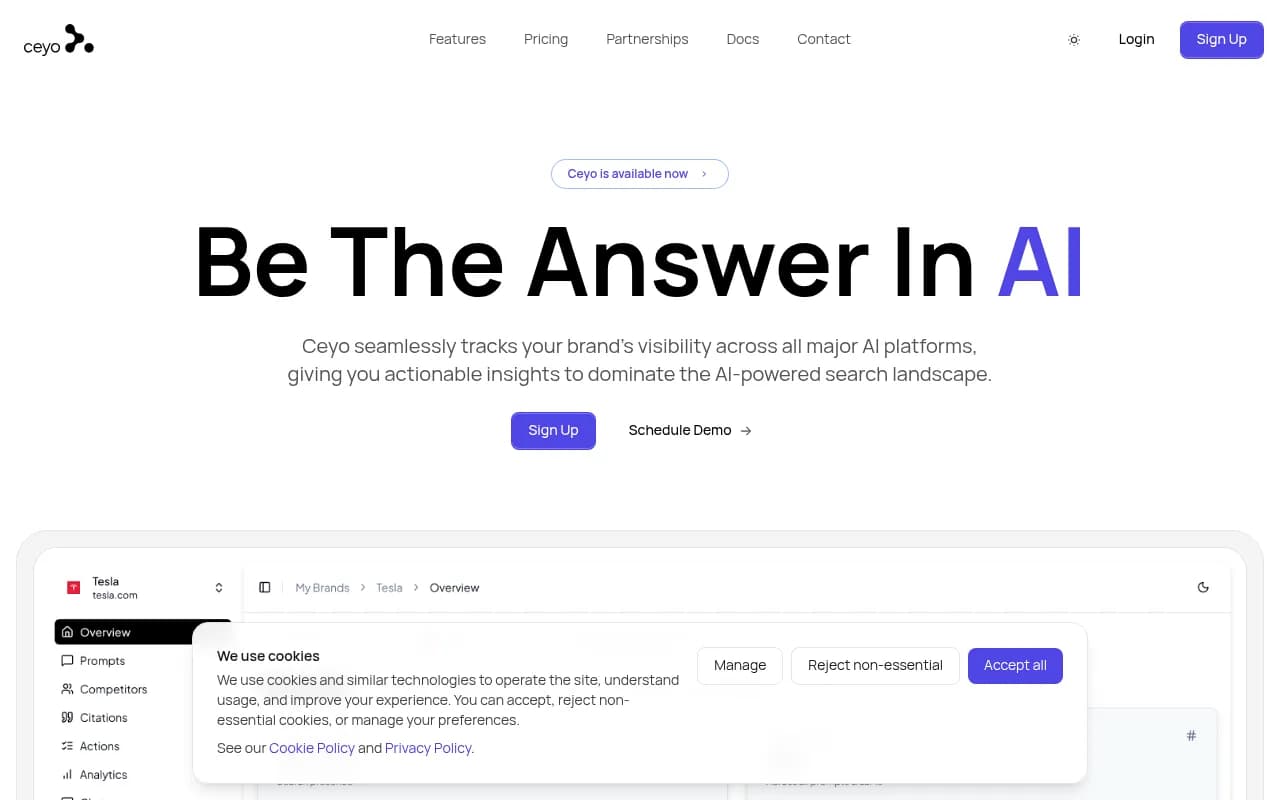
Ceyo positions itself as the accessible way to track your brand's AI visibility. It monitors how your brand shows up across ChatGPT, Gemini, Claude, and Perplexity -- the four LLMs most people actually use. The pitch is simple: add your prompts, see where you rank, get alerts when things change, and get actionable recommendations to improve.
The platform is built for marketing teams and agencies that want visibility without complexity. Pricing starts at $49/mo, which makes it one of the cheaper entry points in the AI monitoring space. The interface leans into tables and dashboards -- you can see visibility percentages, sentiment scores, average position, and which competitors are mentioned alongside your brand.
AthenaHQ

AthenaHQ calls itself an "end-to-end AEO & GEO platform" and targets a different audience. It monitors 8+ AI search engines (the big four plus Google AI Overviews, Copilot, and others) and frames itself as a strategic command center for AI search optimization.
The platform is used by enterprise brands like ZoomInfo, Coinbase, and Volkswagen. It's built around workflows -- executive dashboards for CMOs, detailed analytics for SEO teams, citation source analysis for content teams. Pricing reflects the positioning: $295/mo for self-serve or $95/mo if you pay annually. There's also custom enterprise pricing, which tells you who they're really after.
AthenaHQ emphasizes ROI tracking, cross-platform visibility, and "automated content optimization recommendations" (though it's not clear how deep those recommendations go or if they actually help you create content).
Side-by-Side Comparison
| Feature | Ceyo AI | AthenaHQ |
|---|---|---|
| Starting price | $49/mo | $95/mo annual ($295/mo monthly) |
| Free trial | No | No |
| AI engines monitored | 4 (ChatGPT, Gemini, Claude, Perplexity) | 8+ (includes Google AI Overviews, Copilot, others) |
| Real-time alerts | Yes | Not explicitly mentioned |
| Sentiment tracking | Yes | Not explicitly mentioned |
| Competitor tracking | Yes (shows brands mentioned alongside yours) | Yes (cross-platform visibility) |
| Citation source analysis | Not mentioned | Yes |
| Content optimization | Actionable recommendations | Automated recommendations |
| Executive dashboards | Not mentioned | Yes (ROI tracking, strategic oversight) |
| Target audience | SMBs, agencies, marketing teams | Enterprise, mid-market, CMOs |
| Ease of use | Emphasized ("seamlessly tracks") | Workflow-focused (command center) |
| GEO-specific features | Prompt analytics, visibility %, avg position | End-to-end GEO workflow management |
| Multi-language/region | GEO flags shown in UI | Not mentioned |
Pricing breakdown
| Plan | Ceyo AI | AthenaHQ |
|---|---|---|
| Entry tier | $49/mo (Core plan) or $89/mo depending on source | $95/mo (annual billing only) |
| Monthly billing | Available | $295/mo |
| Annual billing | Available (discount not specified) | $95/mo ($1,140/year) |
| Enterprise | Not mentioned | Custom pricing |
| Free trial | No | No |
Ceyo's pricing is straightforward but inconsistent across sources -- one mentions $49/mo, another $89/mo. Assuming the lower number is accurate, Ceyo is roughly half the cost of AthenaHQ's annual plan and about one-sixth the cost of AthenaHQ's monthly plan. That's a significant gap.
AthenaHQ's pricing structure (cheap annual, expensive monthly) is a classic enterprise move -- they want annual commitments. The $295/mo monthly option exists to push you toward the annual plan.
Feature depth and monitoring capabilities
Ceyo tracks 4 AI engines: ChatGPT, Gemini, Claude, and Perplexity. For most brands, that covers the bases -- these are the LLMs people actually use day-to-day. The platform shows you:
- Visibility percentage per prompt
- Sentiment (positive, neutral, negative)
- Average position (where you rank in the response)
- Impact score (high relevance, medium volume, etc.)
- Competitor brands mentioned in the same responses
- Category and GEO tagging
The UI is table-heavy, which makes it easy to scan hundreds of prompts at once. Real-time alerts mean you know when your visibility drops or a competitor overtakes you.
AthenaHQ monitors 8+ AI engines, including Google AI Overviews and Copilot, which Ceyo doesn't cover. The extra engines matter if you're a large brand that needs comprehensive coverage, but for most teams, the incremental value is debatable -- ChatGPT and Perplexity drive the bulk of AI search traffic.
Where AthenaHQ pulls ahead is in citation source analysis. It shows you which pages, domains, and sources the AI models are pulling from when they mention (or don't mention) your brand. That's a level deeper than Ceyo's visibility tracking -- you can see the actual content that's influencing AI responses and potentially optimize or replicate it.
AthenaHQ also has executive dashboards with ROI tracking, which Ceyo doesn't mention. If you need to report AI visibility metrics to a CMO or board, AthenaHQ is built for that. Ceyo feels more like a tool for the person doing the work, not the person presenting the results.
Content optimization and recommendations
Both platforms claim to offer "actionable recommendations" or "automated content optimization recommendations," but neither explains what that actually means.
Ceyo's website says you get "actionable insights to improve your AI presence," but there's no detail on whether that's a list of prompts to target, content gaps to fill, or specific changes to make to existing pages.
AthenaHQ mentions "automated content optimization recommendations" in its feature list, but again, no specifics. The citation source analysis suggests you could manually figure out what content to create by seeing what competitors are doing, but that's not the same as the platform telling you what to write.
Here's the gap: neither platform generates content for you. They show you where you're invisible, but they don't help you fix it. If you want to actually create articles, listicles, or comparison pages that rank in AI search, you need a separate tool or a platform like Promptwatch that combines monitoring with AI content generation.

User experience and workflows
Ceyo emphasizes ease of use. The pitch is: sign up, add your prompts, start tracking. The interface is clean, table-based, and focused on getting you to insights fast. Real-time alerts mean you don't have to log in every day -- the platform tells you when something changes.
The downside: there's no mention of advanced workflows, team collaboration features, or integrations. It feels like a single-player tool.
AthenaHQ is built around workflows for different roles: AEO/GEO managers get a command center, CMOs get executive dashboards, SEO teams get detailed analytics, content teams get citation source analysis. The platform is designed for cross-functional teams where multiple people need different views of the same data.
That's more powerful but also more complex. If you're a solo marketer or a small team, the extra structure might feel like overkill. If you're a 50-person marketing org, it's exactly what you need.
Competitor and sentiment tracking
Ceyo shows you which competitor brands are mentioned alongside yours in AI responses. That's useful for understanding who you're up against in each prompt. The sentiment tracking (positive, neutral, negative) tells you whether the AI is saying good things or bad things about your brand.
AthenaHQ has cross-platform visibility tracking but doesn't explicitly mention sentiment analysis. The focus seems to be on presence (are you mentioned?) and citation sources (where is the AI getting its info?) rather than tone.
For most brands, sentiment matters. If ChatGPT is mentioning you but saying your product is overpriced or buggy, that's worse than not being mentioned at all. Ceyo's sentiment tracking is a clear advantage here.
Who should pick Ceyo AI
- Small-to-mid marketing teams that need straightforward AI visibility tracking without enterprise complexity
- Agencies managing multiple clients -- the lower price point makes it easier to add AI monitoring to your service stack
- Brands focused on the big four LLMs (ChatGPT, Gemini, Claude, Perplexity) who don't need exhaustive coverage of every AI engine
- Teams that value real-time alerts and sentiment tracking -- you want to know when your brand perception shifts, not just when your visibility changes
- Budget-conscious teams -- at $49-89/mo, Ceyo is one of the cheapest ways to get into AI monitoring
Who should pick AthenaHQ
- Enterprise brands (ZoomInfo, Coinbase, Volkswagen are current clients) that need comprehensive coverage across 8+ AI engines
- Cross-functional marketing orgs where CMOs, SEO teams, and content teams all need different views of AI visibility data
- Teams that need to report ROI -- the executive dashboards and strategic oversight features are built for this
- Brands that want citation source analysis -- if you need to see exactly which pages and domains are influencing AI responses, AthenaHQ goes deeper
- Companies willing to commit annually -- the $95/mo annual pricing is reasonable, but the $295/mo monthly option is steep
Pros and cons
Ceyo AI pros:
- Lower entry price ($49-89/mo vs $95-295/mo)
- Real-time alerts keep you informed without constant checking
- Sentiment tracking tells you if AI mentions are positive or negative
- Clean, table-based UI makes it easy to scan hundreds of prompts
- Competitor tracking shows who you're up against in each response
Ceyo AI cons:
- Only 4 AI engines (misses Google AI Overviews, Copilot, others)
- No free trial -- you have to commit upfront
- No citation source analysis -- you see visibility but not the underlying content driving it
- No mention of team collaboration or advanced workflows
- "Actionable recommendations" are vague -- unclear how much help you actually get
AthenaHQ pros:
- 8+ AI engines covered, including Google AI Overviews and Copilot
- Citation source analysis shows the actual content influencing AI responses
- Executive dashboards with ROI tracking for strategic oversight
- Built for cross-functional teams with role-specific workflows
- Enterprise client roster (ZoomInfo, Coinbase, Volkswagen) signals platform maturity
AthenaHQ cons:
- Expensive -- $295/mo monthly or $95/mo annual (still 2x Ceyo's price)
- No free trial -- high barrier to entry
- More complex -- the workflow-focused design might be overkill for small teams
- "Automated content optimization recommendations" are vague -- unclear if they actually help you create content
- No explicit mention of sentiment tracking or real-time alerts
Final verdict
If you're a small team or agency that needs affordable AI visibility tracking across the LLMs that matter most, Ceyo AI is the better pick. It's half the price, has real-time alerts, tracks sentiment, and gets you up and running fast. The lack of citation source analysis and advanced workflows won't matter if you're just trying to understand where you stand.
If you're an enterprise brand or mid-market company that needs comprehensive coverage, strategic oversight, and the ability to drill into citation sources, AthenaHQ is worth the premium. The executive dashboards, cross-functional workflows, and 8+ engine coverage justify the higher price -- but only if you'll actually use those features.
The bigger issue: both platforms are monitoring-only. They show you the problem but don't help you fix it. If you want to actually improve your AI visibility by creating content that ranks, you'll need a separate solution or a platform that combines tracking with content generation. That's the gap neither Ceyo nor AthenaHQ fully addresses.