Key Takeaways
- Atomic AGI is a complete SEO platform that tracks both Google and AI search engines, with built-in technical audits, AI agents, and workflow automation. Ceyo AI is a specialized AI search monitoring tool focused exclusively on tracking brand mentions across LLMs.
- Pricing difference is significant: Atomic AGI starts at $10/mo (Starter) with a free tier available. Ceyo AI starts at $49/mo with no free option -- 5x more expensive at entry level.
- Atomic AGI offers automation and content intelligence through AI agents that can execute SEO tasks and workflows. Ceyo provides monitoring and alerts but no automation or content generation capabilities.
- Ceyo has stronger sentiment analysis and focuses heavily on brand positioning and competitive tracking within AI responses. Atomic AGI tracks visibility but emphasizes actionable SEO data and technical optimization.
- If you need an all-in-one SEO solution that covers traditional search, AI search, technical audits, and automation, Atomic AGI is the clear choice. If you only care about monitoring how your brand appears in AI search results and want detailed sentiment tracking, Ceyo is more focused.
- Both platforms track the same core LLMs (ChatGPT, Perplexity, Claude, Gemini), but Atomic AGI also integrates Google Search Console data and traditional SEO metrics that Ceyo doesn't touch.
Overview
Atomic AGI
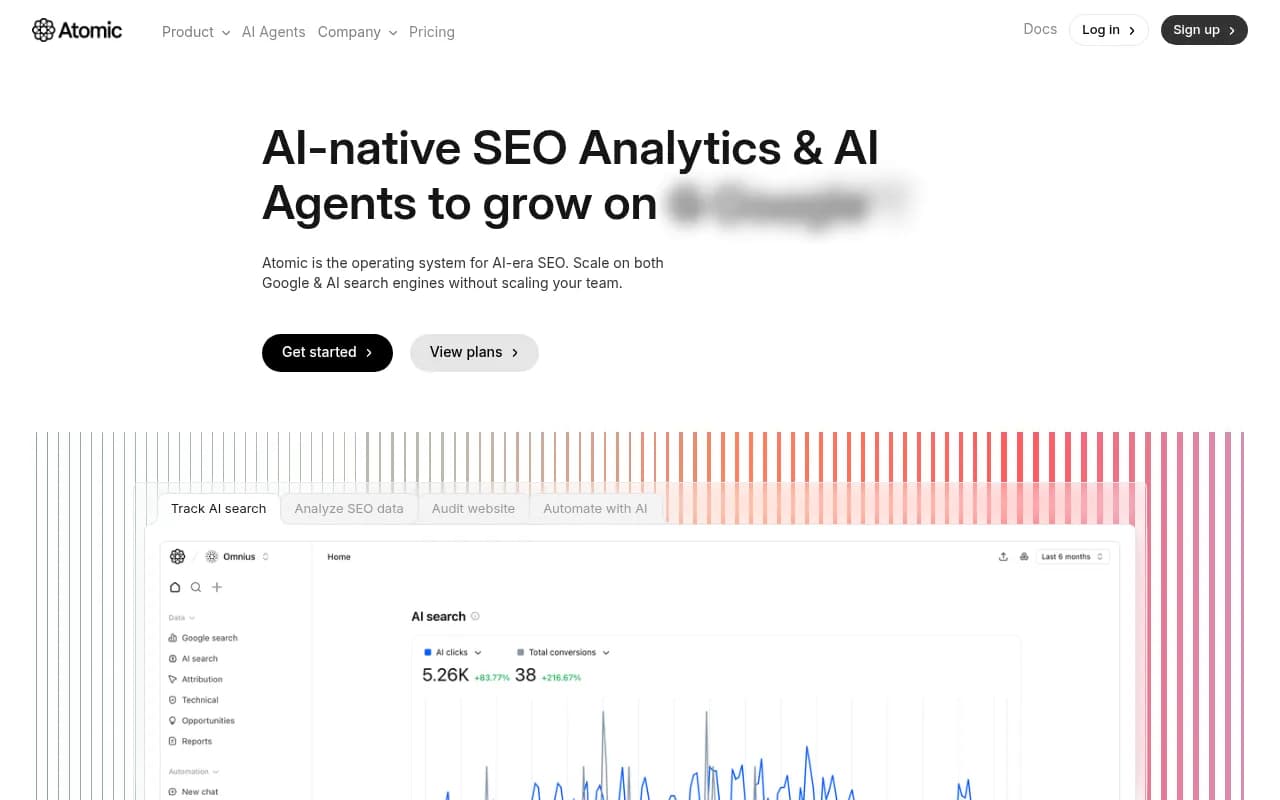
Atomic AGI positions itself as an "AI-native SEO platform" that bridges traditional Google search and the emerging world of AI search engines. It's built for marketing teams that want to scale organic growth without scaling headcount. The platform combines multi-engine tracking (Google + ChatGPT + Perplexity + Gemini + Claude), technical SEO audits, AI agents for task automation, and workflow builders. Clients include Accenture, Booking.com, Payoneer, Samsung, MIT, and Loom.
The core value proposition: instead of juggling separate tools for Google Analytics, Search Console, technical audits, AI search tracking, and content workflows, you get everything in one interface. Atomic AGI's AI agents can execute SEO tasks autonomously -- analyzing data, generating recommendations, and even drafting content based on what's working across both traditional and AI search.
Ceyo AI
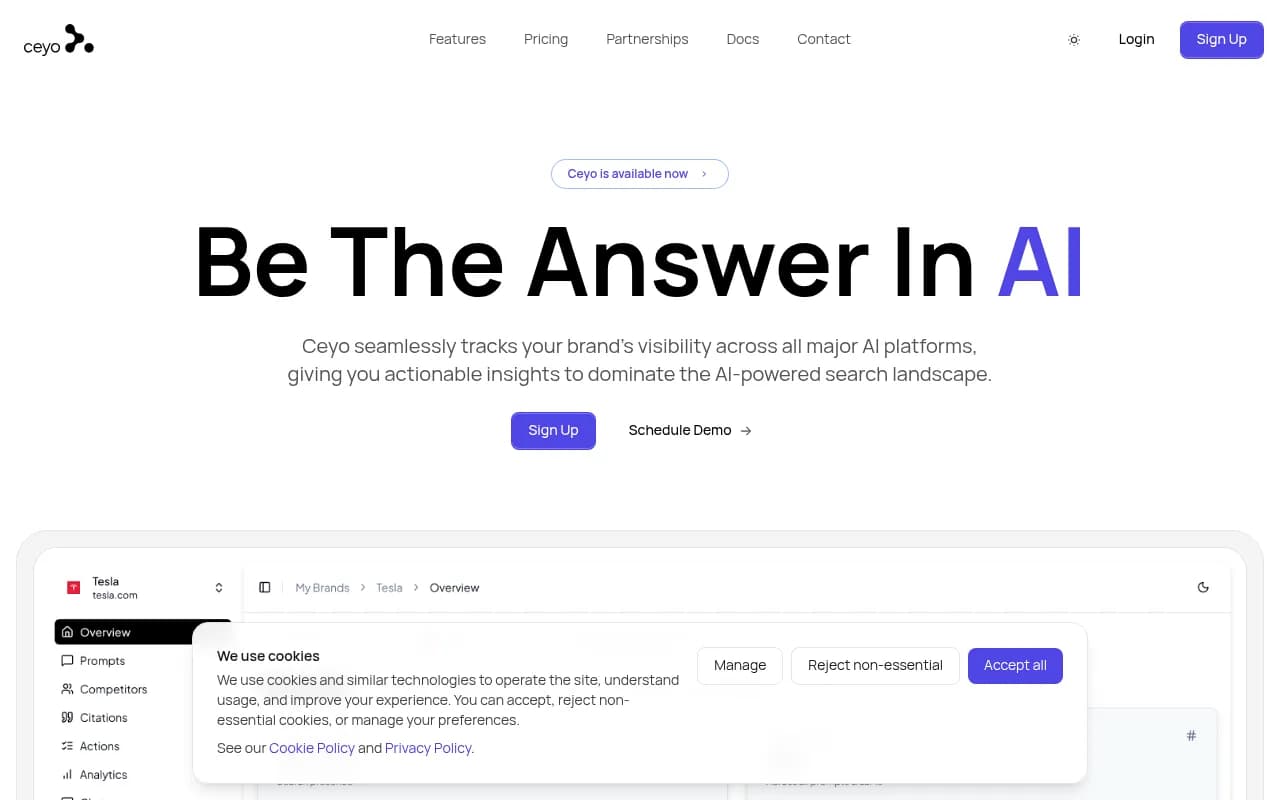
Ceyo AI is a specialized brand visibility tracker for AI search engines. It monitors how your brand appears in responses from ChatGPT, Gemini, Claude, and Perplexity, with a strong focus on sentiment analysis, competitive positioning, and prompt-level insights. The platform is built for marketing teams and agencies that want to understand and improve their presence in LLM-generated answers.
Ceyo's approach is more focused than Atomic AGI's -- it doesn't try to be a full SEO platform. Instead, it goes deep on AI search monitoring with features like comprehensive prompt analytics, sentiment tracking across thousands of queries, real-time alerts when your brand is mentioned (or not mentioned), and competitive benchmarking to see how you stack up against rivals in AI responses. Partners include Brandfirm, Zigt, and Enreach.
Side-by-Side Comparison
| Feature | Atomic AGI | Ceyo AI |
|---|---|---|
| Starting price | $10/mo (Starter) | $49/mo (Core) |
| Free tier | Yes | No |
| Google search tracking | ✓ Full GSC integration | ✗ AI search only |
| AI search engines tracked | ChatGPT, Perplexity, Claude, Gemini | ChatGPT, Perplexity, Claude, Gemini |
| Technical SEO audits | ✓ Built-in site audits | ✗ Not included |
| AI agents/automation | ✓ Workflow automation + AI agents | ✗ Monitoring only |
| Sentiment analysis | Basic visibility tracking | ✓ Detailed sentiment + brand positioning |
| Content intelligence | ✓ AI-powered content recommendations | ✗ Alerts only |
| Competitive tracking | ✓ Cross-engine comparison | ✓ Prompt-level competitor mentions |
| Real-time alerts | ✓ Custom triggers | ✓ Brand mention alerts |
| API access | Not specified | Not specified |
| Target audience | SEO teams, content ops, growth teams | Marketing teams, agencies, brand managers |
Platform scope and positioning
Atomic AGI: The SEO operating system
Atomic AGI is trying to be your single source of truth for all SEO activity in 2026. That means traditional Google search metrics (rankings, traffic, GSC data) sit alongside AI search visibility (how often you're cited in ChatGPT responses, which prompts trigger your brand, sentiment in Perplexity answers). The technical audit module scans your site for crawl errors, broken links, page speed issues, and indexing problems -- the same stuff you'd use Screaming Frog or Sitebulb for.
What sets it apart is the AI agent layer. These aren't just dashboards showing you data -- they're autonomous workers that can analyze trends, generate content briefs, identify optimization opportunities, and execute repetitive tasks. For example, an agent might notice that your competitors are getting cited for "best project management tools" but you're not, then automatically generate a content outline targeting that gap. The workflow builder lets you chain these actions together: monitor prompt → detect gap → generate brief → alert team → track results.
The platform also tracks attribution -- connecting AI search visibility to actual website traffic and conversions. This is critical for proving ROI to leadership. Most AI search tools (including Ceyo) show you visibility scores but can't tie that back to revenue.
Ceyo AI: The brand monitoring specialist
Ceyo takes a narrower but deeper approach. It's not trying to replace your SEO stack -- it's the layer that sits on top to monitor how AI engines perceive your brand. The core workflow: Ceyo runs thousands of prompts across ChatGPT, Gemini, Claude, and Perplexity, then analyzes where your brand appears, what sentiment is attached, and how you compare to competitors.
The prompt analytics table is the heart of the platform. Each row shows a specific query ("Best laptop for developers", "Top project management tools"), your visibility percentage for that prompt, sentiment (positive/neutral/negative), average position, impact score (high relevance, medium volume, etc.), which competing brands appear, category, and geographic region. This level of granularity is useful if you're trying to understand exactly which queries drive your AI presence and which ones you're losing to competitors.
Ceyo's strength is in the brand positioning angle. It's not just "are we mentioned?" but "how are we positioned relative to competitors?" and "what's the sentiment around our brand in AI responses?" This matters for brand managers and PR teams who care about perception, not just traffic.
The weakness: Ceyo doesn't help you fix the gaps it identifies. It shows you the problem ("you're not appearing for this high-value prompt") but doesn't generate content, optimize pages, or automate workflows. You're on your own for the action step.
If you're also tracking how your brand shows up in AI search and want tools that help you close the gaps -- not just identify them -- Promptwatch is worth a look. It combines monitoring with content gap analysis and an AI writing agent that generates articles grounded in citation data.

Pricing comparison
| Plan | Atomic AGI | Ceyo AI |
|---|---|---|
| Free tier | ✓ Available (limited features) | ✗ None |
| Entry plan | $10/mo (Starter) | $49/mo (Core) |
| Mid-tier | Not publicly listed | $89/mo (depending on source) |
| Enterprise | Custom pricing | Custom pricing |
| Billing options | Monthly | Monthly or yearly |
Atomic AGI's pricing is significantly more accessible. The $10/mo Starter plan gets you in the door with basic tracking across Google and AI search engines. The free tier lets you test the platform before committing. Ceyo starts at $49/mo with no free option, which is a harder sell for small teams or solo marketers testing the waters.
Neither platform publishes full pricing tiers publicly, so you'll need to contact sales for mid-tier and enterprise details. Based on the entry-level gap, Atomic AGI is likely cheaper across the board -- but Ceyo's pricing might reflect deeper sentiment analysis and more granular prompt tracking.
Feature deep-dive
AI search engine coverage
Both platforms track the same four major LLMs: ChatGPT (OpenAI), Perplexity, Claude (Anthropic), and Gemini (Google). This is table stakes in 2026 -- any AI search monitoring tool that doesn't cover these four is incomplete.
The difference is in what they do with that data. Atomic AGI treats AI search as one component of a larger SEO picture. It tracks visibility across LLMs but also pulls in Google Search Console data, traditional keyword rankings, and technical health metrics. The goal is a unified view: here's how you're performing across all search surfaces, traditional and AI.
Ceyo treats AI search as the entire picture. It doesn't touch Google rankings or technical SEO. The focus is entirely on LLM responses -- which prompts trigger your brand, what sentiment is attached, how you rank against competitors in those responses. If you only care about AI search and already have tools for traditional SEO (Ahrefs, Semrush, etc.), Ceyo's focus might be an advantage. If you want everything in one place, Atomic AGI makes more sense.
Technical SEO and site audits
Atomic AGI includes a full technical audit module. It crawls your site, identifies issues (broken links, slow pages, indexing errors, mobile problems), and flags them for fixing. This is the same functionality you'd get from Screaming Frog, Sitebulb, or Semrush's site audit tool.
Ceyo has no technical SEO features. It's purely a monitoring and analytics layer. If your site has crawl errors or indexing problems that prevent AI engines from reading your content, Ceyo won't tell you. Atomic AGI will.
Verdict: If you need technical SEO audits, Atomic AGI is the only option here.
AI agents and automation
This is where Atomic AGI pulls ahead. The platform includes AI agents that can autonomously execute SEO tasks: analyzing data, generating content briefs, identifying optimization opportunities, and triggering workflows. For example, you can set up an agent to monitor competitor visibility in AI search, detect when they start appearing for a new prompt category, and automatically generate a content brief to compete.
The workflow builder chains these actions together. Monitor → Analyze → Generate → Alert → Track. This is powerful for teams that want to scale SEO output without hiring more people.
Ceyo has no automation layer. It's a monitoring dashboard with alerts. When your brand is mentioned (or not mentioned) in an AI response, Ceyo sends an alert. But it doesn't generate content, optimize pages, or execute tasks. You have to do that manually.
Verdict: If you want automation and AI-powered task execution, Atomic AGI is the clear winner. If you just want monitoring and alerts, Ceyo covers that.
Sentiment analysis and brand positioning
Ceyo's strength is in sentiment tracking. For each prompt, it analyzes whether your brand is mentioned positively, neutrally, or negatively in AI responses. It also shows your average position (are you the first brand mentioned or the fifth?) and competitive context (which other brands appear alongside yours).
This is valuable for brand managers and PR teams who care about perception. If ChatGPT consistently mentions your brand in a negative context ("X is expensive compared to Y"), you need to know that. Ceyo surfaces this at a granular, prompt-by-prompt level.
Atomic AGI tracks visibility (are you mentioned?) but doesn't go as deep on sentiment or positioning. It's more focused on actionable SEO metrics: which prompts drive traffic, which pages are getting cited, what content gaps exist.
Verdict: If sentiment and brand positioning are your top priority, Ceyo has the edge. If you care more about traffic and conversions, Atomic AGI's approach is more useful.
Content intelligence and gap analysis
Atomic AGI's AI agents can identify content gaps -- prompts where competitors are visible but you're not -- and generate content briefs to fill those gaps. This is the "action loop" that turns monitoring into optimization. You're not just seeing the problem, you're getting a roadmap to fix it.
Ceyo identifies gaps ("you're not appearing for this high-value prompt") but doesn't help you create content to close them. You get the data, but the next step is manual.
Verdict: Atomic AGI's content intelligence is a major advantage if you're actually trying to improve your AI search presence, not just monitor it.
User interface and learning curve
Atomic AGI's interface is more complex because it does more. You're navigating between Google search data, AI search tracking, technical audits, AI agents, and workflow builders. The learning curve is steeper, but the payoff is a unified SEO command center.
Ceyo's interface is simpler and more focused. The prompt analytics table is the main view -- easy to scan, easy to understand. If you're a brand manager who just wants to check sentiment and visibility without learning a full SEO platform, Ceyo is more approachable.
Verdict: Ceyo is easier to learn. Atomic AGI is more powerful but requires more time to master.
Pros and cons
Atomic AGI
Pros:
- All-in-one platform covering Google search, AI search, technical SEO, and automation
- AI agents that execute tasks and generate content briefs autonomously
- Significantly cheaper entry point ($10/mo vs $49/mo)
- Free tier available for testing
- Workflow automation for scaling SEO without scaling headcount
- Attribution tracking to connect AI visibility to actual traffic and revenue
- Used by major brands (Booking.com, Accenture, Samsung, MIT)
Cons:
- Steeper learning curve due to broader feature set
- Sentiment analysis is less detailed than Ceyo's
- Pricing for higher tiers not publicly listed
- May be overkill if you only care about AI search monitoring
Ceyo AI
Pros:
- Deep sentiment analysis and brand positioning tracking
- Prompt-level granularity showing exactly which queries drive visibility
- Simpler, more focused interface -- easier to learn
- Strong competitive benchmarking within AI responses
- Real-time alerts for brand mentions
- Geographic and category segmentation for prompt analytics
Cons:
- No free tier -- $49/mo minimum with no way to test first
- Monitoring only -- no automation, content generation, or workflow tools
- Doesn't cover Google search or traditional SEO metrics
- No technical audit capabilities
- Can't tie AI visibility back to website traffic or conversions
- More expensive than Atomic AGI at every tier
Who should pick which tool
Choose Atomic AGI if:
- You want a complete SEO platform that covers both traditional and AI search
- You need technical audits and site health monitoring
- You want AI agents and workflow automation to scale output
- You care about attribution -- connecting AI visibility to actual traffic and revenue
- You're a small team or solo marketer on a budget (the $10/mo entry point and free tier make it accessible)
- You want content intelligence and gap analysis, not just monitoring
- You're managing SEO holistically and don't want to juggle multiple tools
Choose Ceyo AI if:
- You only care about AI search visibility and already have tools for traditional SEO
- Sentiment analysis and brand positioning are your top priorities
- You're a brand manager or PR team focused on perception, not traffic
- You want prompt-level granularity and competitive benchmarking within AI responses
- You prefer a simpler, more focused tool over an all-in-one platform
- You don't need automation or content generation -- just monitoring and alerts
- You're willing to pay more for specialized sentiment tracking
Choose something else if:
- You want monitoring plus content optimization and generation: Promptwatch combines tracking with content gap analysis and an AI writing agent that generates articles grounded in citation data. It's the middle ground between monitoring-only tools and full SEO platforms.
- You need enterprise-scale AI search tracking with custom integrations: Both Atomic AGI and Ceyo offer custom enterprise plans, but you'll need to talk to sales to understand what's included.
Final verdict
Atomic AGI and Ceyo AI are solving different problems. Atomic AGI is a full SEO operating system that happens to include AI search tracking. Ceyo AI is a specialized brand monitoring tool focused exclusively on AI search.
If you're choosing between them, the decision comes down to scope. Do you want an all-in-one platform that covers traditional SEO, AI search, technical audits, and automation? Pick Atomic AGI. Do you want deep sentiment analysis and brand positioning tracking within AI responses, and you're fine handling traditional SEO elsewhere? Pick Ceyo.
For most teams, Atomic AGI is the better value. It's cheaper, more comprehensive, and includes automation that actually helps you improve your AI search presence instead of just monitoring it. The free tier and $10/mo entry point make it low-risk to test.
Ceyo makes sense for brand managers and agencies that are laser-focused on perception and competitive positioning in AI responses. The sentiment tracking is more detailed, and the prompt-level granularity is useful if you're trying to understand exactly how AI engines talk about your brand. But you're paying more for a narrower tool, and you'll need to handle the optimization step yourself.
One-liner: Atomic AGI is the SEO platform that includes AI search tracking. Ceyo AI is the AI search tracker that doesn't try to be an SEO platform. Pick based on whether you want breadth or depth.