Key takeaways
- B2B buyers increasingly start their vendor research in AI search engines like ChatGPT and Perplexity, making AI citation a new form of top-of-funnel visibility.
- GEO (Generative Engine Optimization) is not a replacement for SEO -- it's a parallel discipline with different success metrics and different content requirements.
- The path from AI citation to pipeline requires three connected steps: getting cited, earning clicks, and converting visitors who arrive pre-educated about your brand.
- Most GEO tools only show you where you're invisible. The ones that help you fix it are a much shorter list.
- Measuring GEO's contribution to pipeline requires new attribution methods -- AI crawler logs, UTM tagging for AI referrals, and CRM-level source tracking.
Why B2B lead gen has a new front door
Something changed in how B2B buyers research software and services. It didn't happen all at once, but by early 2026 it's hard to ignore: a meaningful chunk of the research phase now happens inside AI chat interfaces before a prospect ever opens a browser tab.
A 2025 Elon University survey found that 52% of U.S. adults now use AI large language models like ChatGPT. That's not a niche behavior anymore. And in B2B contexts, where buyers are trying to quickly shortlist vendors, compare categories, and understand pricing models, AI search is genuinely useful. It synthesizes. It compares. It answers "what's the best project management tool for a 50-person engineering team?" in a way that a traditional SERP just doesn't.
The implication for B2B marketers is uncomfortable but clear: if your brand isn't being cited in those AI-generated answers, you're invisible at the moment when buying intent is forming.
This is the core problem that Generative Engine Optimization (GEO) is designed to solve. And in 2026, it's no longer a theoretical future concern -- it's an active gap in most B2B marketing programs.
GEO vs SEO: what's actually different
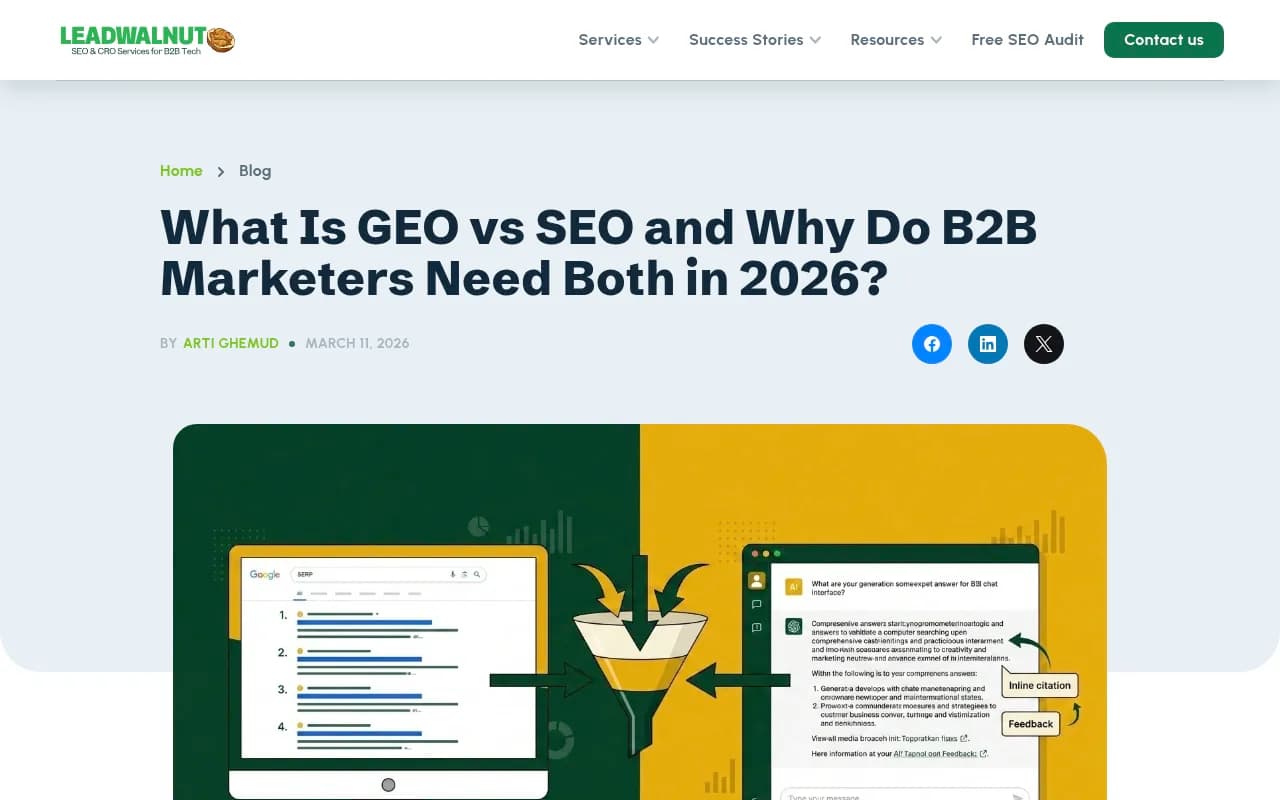
SEO and GEO share some DNA -- both care about content quality, authority signals, and being findable. But they optimize for fundamentally different things.
SEO optimizes for ranking positions in traditional search results. The goal is to appear on page one, earn clicks, and drive traffic. Success is measured in rankings, organic sessions, and conversions from that traffic.
GEO optimizes for citation in AI-generated answers. The goal is to be the source an AI model references when it answers a question relevant to your category. Success is measured in mention rate, citation frequency, sentiment of the mention, and -- eventually -- traffic from AI referrals.
Here's a practical comparison:
| Dimension | SEO | GEO |
|---|---|---|
| Target system | Google/Bing search index | LLMs (ChatGPT, Perplexity, Claude, Gemini, etc.) |
| Success metric | Keyword rankings, organic traffic | Citation rate, mention sentiment, AI share of voice |
| Content format | Keyword-optimized pages | Answer-dense, fact-rich, structured content |
| Authority signals | Backlinks, domain authority | Third-party citations, expert quotes, structured data |
| Measurement tools | GSC, rank trackers | AI monitoring platforms, crawler logs |
| Time to results | Weeks to months | Weeks to months (similar lag) |
| Buyer journey stage | All stages | Primarily awareness and consideration |
The important thing: these aren't competing strategies. A B2B company that abandons SEO for GEO will lose organic traffic. One that ignores GEO will lose the consideration phase to competitors who are being cited. You need both, and they reinforce each other -- content that earns backlinks tends to also get cited by AI models.
How AI search actually affects B2B buying behavior
Before getting into tactics, it's worth being specific about where in the funnel AI search matters most for B2B.
The awareness and consideration stages are where AI search has the biggest impact. A VP of Marketing asking ChatGPT "what are the best ABM platforms for mid-market SaaS?" is in early research mode. They're not ready to fill out a demo form. But the brands that appear in that answer are now on their mental shortlist. The ones that don't appear aren't.
By the time that same buyer reaches your website, they may already have a formed opinion about your brand based on what AI told them. This is a fundamentally different dynamic than traditional SEO, where the website visit is often the first real brand interaction.
The practical consequence: GEO affects pipeline quality and velocity, not just top-of-funnel volume. Buyers who arrive having already seen your brand cited as a credible solution are easier to convert. They ask better questions on demo calls. They're further along in their evaluation.
This is why the GEO-to-pipeline connection isn't just about generating more leads -- it's about generating better ones.
The content types that actually get cited
Not all content is equally likely to be cited by AI models. Based on how LLMs are trained and how they retrieve information, certain content patterns consistently outperform others.
Direct answer blocks
AI models love content that directly answers a question in the first paragraph or two. If someone asks "what is account-based marketing?" and your page answers that question clearly and concisely before going into depth, you're a much better citation candidate than a page that buries the definition in paragraph six.
The practical move: audit your key category pages and ask whether the first 150 words would satisfy the question implied by the page title. If not, restructure.
Fact density with attribution
LLMs are trained to prefer content that includes specific, verifiable claims. Vague assertions ("our platform helps teams work better") get ignored. Specific claims with sources ("companies using ABM report 208% higher revenue from marketing, according to Marketo's 2024 benchmark") get cited.
For B2B content, this means including real statistics, named customer outcomes, and third-party research. Not because it makes your content sound impressive, but because it makes it citable.
Comparison and "best of" content
When buyers ask AI "what's the best [category] tool for [use case]?", the AI needs to pull from somewhere. Pages that directly compare tools, list alternatives, or evaluate options for specific use cases are disproportionately cited in these responses.
This is why comparison content ("X vs Y", "best tools for Z") has outsized GEO value for B2B marketers. It matches the exact query pattern that buyers use during vendor evaluation.
Structured data and schema markup
Schema markup (FAQ schema, HowTo schema, Article schema) helps AI models parse your content correctly. It's not a magic bullet, but it reduces ambiguity about what your content is and what questions it answers.
Freshness signals
AI models, particularly those with web access like Perplexity and ChatGPT with browsing, weight recent content. A post dated 2022 about "best practices for remote team management" will lose to a 2026 version. Keep your high-value pages updated with current dates and fresh data.
Building the GEO-to-pipeline funnel
Getting cited is step one. Converting that visibility into actual pipeline requires thinking through the full journey.
Step 1: Identify which prompts matter for your category
Start by mapping the questions your buyers actually ask AI systems during their research. These aren't keyword lists -- they're conversational queries like:
- "What's the difference between [your category] and [adjacent category]?"
- "What are the best [your category] tools for [specific use case]?"
- "How do I evaluate [your category] vendors?"
- "What should I look for in a [your category] platform?"
Tools like Promptwatch can surface prompt volume estimates and show you which of these queries your competitors are being cited for but you're not. That gap is your content roadmap.

Step 2: Create content engineered for citation
Once you know which prompts matter, create content that directly addresses them. This isn't about publishing more pages -- it's about making existing pages denser, more structured, and more answer-forward.
Directive Consulting's B2B GEO guide makes a useful point here: treat GEO like a cluster-by-cluster upgrade, not a "publish more content" mandate. Pick your most important topic clusters, audit them for answer density and fact richness, and upgrade them systematically.
For net-new content, prioritize:
- Comparison pages that position your tool against alternatives
- Use-case pages that answer "best tool for [specific scenario]" queries
- Category definition pages that establish your brand as an authority on the problem you solve
- Customer outcome pages with specific, named results
Step 3: Track your AI citation rate
You can't improve what you can't measure. Before you can connect GEO to pipeline, you need baseline visibility data: which AI models cite you, for which prompts, and with what sentiment.
Several platforms handle this. For B2B teams that want to go beyond monitoring into actual optimization, Promptwatch tracks citations across 10 AI models (ChatGPT, Perplexity, Claude, Gemini, Grok, DeepSeek, and others) and includes crawler logs that show you which pages AI bots are actually reading.
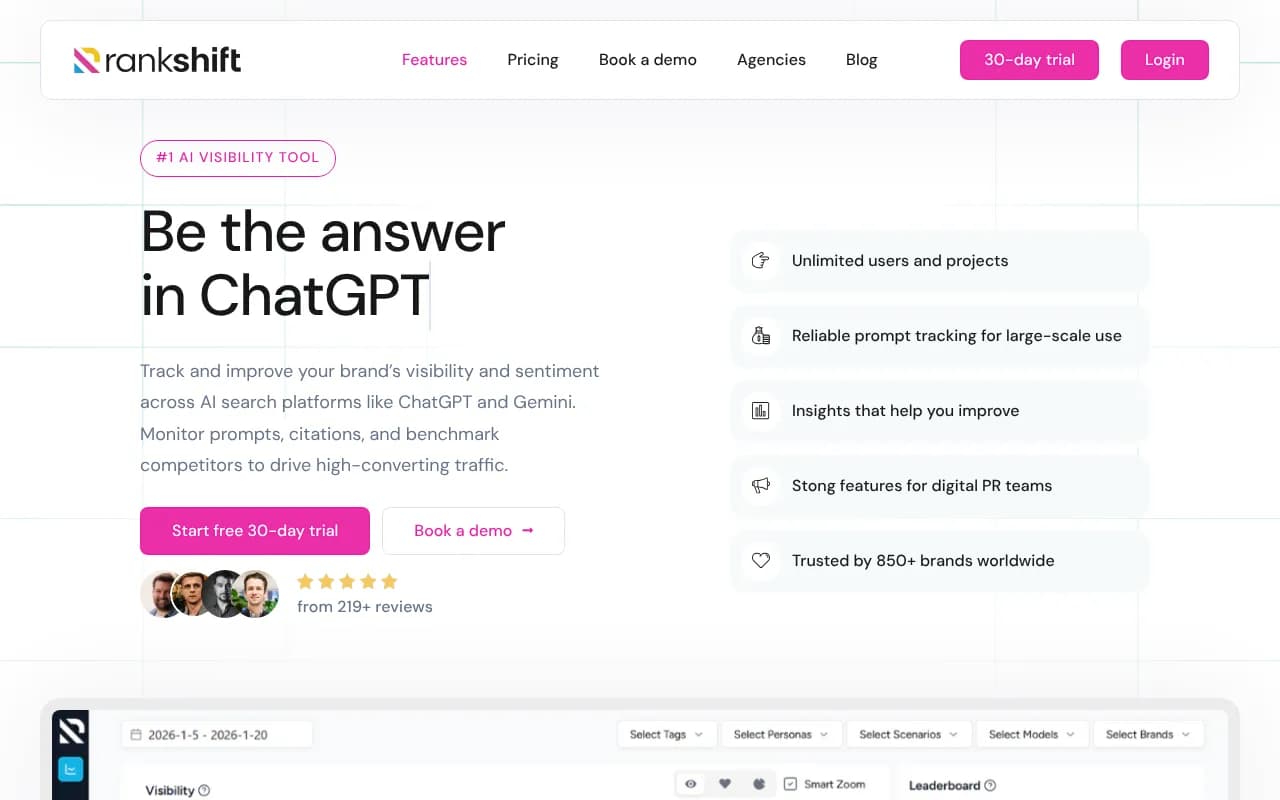
Other solid options depending on your needs:


Step 4: Connect AI visibility to website traffic
This is where most GEO programs fall apart. Teams track citation rates but never close the loop to actual traffic and pipeline.
The mechanics:
- AI referral traffic shows up in GA4 under sources like
chatgpt.com,perplexity.ai,claude.ai. Set up segments for these sources now if you haven't. - For ChatGPT specifically, Promptwatch's ChatGPT Shopping tracking captures when your brand appears in product recommendations and shopping carousels -- a newer but growing B2B surface.
- AI crawler logs (available in Promptwatch's Professional plan) show you which pages AI bots visit, how often, and whether they encounter errors. If Perplexity is crawling your pricing page but not your comparison pages, that's actionable.
Step 5: Convert AI-referred visitors
Visitors arriving from AI referrals are different from cold organic traffic. They've already received a recommendation. They're in evaluation mode, not discovery mode.
Your landing pages and conversion paths should reflect this. Consider:
- Removing friction from demo request flows for visitors who arrive from AI sources
- Adding social proof elements (case studies, named customer outcomes) that reinforce what the AI said about you
- Using progressive CTAs that match evaluation-stage intent ("compare plans", "see how it works") rather than pure awareness CTAs
For B2B teams using HubSpot or similar CRMs, tagging AI-referred leads at the source level lets you track whether they convert at higher rates and close faster -- which is the data you need to justify continued GEO investment.

Measuring GEO's contribution to pipeline
This is the hardest part, and most teams skip it. But without measurement, GEO stays a "nice to have" rather than a budget-justified program.
Here's a practical measurement framework:
| Metric | What it measures | How to track |
|---|---|---|
| AI citation rate | % of target prompts where you're cited | GEO monitoring platform |
| AI share of voice | Your citations vs competitors' | GEO platform with competitor tracking |
| AI referral sessions | Traffic from AI sources | GA4 (filter by AI referral sources) |
| AI-referred conversion rate | % of AI visitors who convert | GA4 goal tracking by source |
| AI-influenced pipeline | Deals where AI was a touchpoint | CRM source tagging + multi-touch attribution |
| Citation sentiment | Whether AI mentions are positive, neutral, or negative | GEO platform with sentiment analysis |
The last metric -- AI-influenced pipeline -- is the one that matters to leadership. It requires connecting your GEO monitoring data to your CRM, which takes some setup but is achievable with tools like HubSpot's source tracking or a B2B attribution platform.
Common mistakes B2B teams make with GEO
Treating GEO as a separate content program
GEO works best when it's integrated with your existing content strategy, not bolted on as a separate workstream. The same pages that rank well in Google tend to get cited by AI models. Improving answer density and fact richness helps both.
Optimizing for the wrong prompts
Not every AI query is worth chasing. A B2B SaaS company optimizing to appear in "what is machine learning?" queries is wasting effort. Focus on prompts that match buyer intent in your specific category -- evaluation queries, comparison queries, and use-case queries.
Ignoring Reddit and YouTube
AI models, particularly Perplexity and ChatGPT, frequently cite Reddit threads and YouTube videos in their responses. If your category has active Reddit communities (r/marketing, r/sales, r/devops, etc.), being present and helpful there has real GEO value. This is a channel most B2B teams completely ignore.
Measuring only citation rate, not sentiment
Being cited negatively ("Company X has been criticized for...") is worse than not being cited at all. Track the sentiment of your AI mentions, not just the frequency.
Not auditing AI crawler access
If AI crawlers can't access your key pages -- because of robots.txt rules, login walls, or JavaScript rendering issues -- you won't get cited regardless of how good your content is. Check your AI crawler logs and fix access issues before spending time on content optimization.
Tools worth knowing about
Beyond the core monitoring platforms, a few tools are worth calling out for specific GEO use cases in B2B:
For content creation grounded in citation data, Promptwatch's built-in AI writing agent generates articles based on real citation patterns and competitor analysis -- useful for teams that need to produce comparison and category content at scale.
For technical SEO foundations that support GEO, Screaming Frog remains the go-to for crawl audits, and it's worth running specifically to check for issues that might block AI crawlers.
For tracking AI visibility alongside traditional SEO metrics in one place:
For teams that want a focused, affordable starting point for AI visibility monitoring:

A practical 90-day GEO program for B2B teams
Days 1-30: Audit and baseline
- Set up AI monitoring for your brand and top 3-5 competitors
- Identify the 20-30 prompts most relevant to your category and buying journey
- Audit current citation rate and sentiment across ChatGPT, Perplexity, and Google AI Overviews
- Check AI crawler access to your key pages
Days 31-60: Content upgrades
- Identify your top 10 pages by traffic and upgrade them for answer density and fact richness
- Create or update 3-5 comparison pages targeting evaluation-stage queries
- Add schema markup to key category and product pages
- Publish at least one piece of content directly targeting a high-value prompt where competitors are cited but you're not
Days 61-90: Measure and iterate
- Track changes in citation rate for upgraded pages
- Set up GA4 segments for AI referral traffic
- Tag AI-referred leads in your CRM
- Calculate AI-referred conversion rate vs other sources
- Identify the next batch of prompts to target based on gap analysis
The goal by day 90 isn't to have "solved" GEO -- it's to have a measurement baseline and a repeatable process. GEO is a long game, but the teams that start building the muscle now will have a significant head start on the ones that wait.
The bottom line
B2B buyers are using AI search to shortlist vendors before they ever visit a website. That's not a prediction anymore -- it's what's happening. The question for B2B marketing teams is whether they're visible in those moments or invisible.
GEO is the discipline that closes that gap. But it only turns into pipeline if you close the loop: track citations, connect them to traffic, and convert AI-referred visitors with content and flows that match their evaluation mindset.
The teams winning in 2026 aren't the ones who picked GEO over SEO. They're the ones who built both into a single, integrated program -- and who can actually prove the revenue contribution of each.