Key takeaways
- Most "AI visibility" platforms, including Promptwatch, Peec AI, and Otterly.ai, only segment data by country. True city or state-level tracking is rare and usually locked behind higher-priced tiers or sales calls.
- Local Falcon and BrightLocal are the two tools that actually built hyperlocal AI tracking into their core product, because they started as map-rank tools and bolted AI visibility onto existing geo-grid infrastructure.
- Promptwatch gates state and city-level tracking behind its $579/mo Business plan; the $95 and $245 tiers only go down to country level.
- Profound requires a sales conversation for anything below country granularity; it's not a self-serve feature at any published price point.
- IP-based geolocation, which most AI chatbots rely on for "near me" personalization, is only 20-75% accurate at the city level, so even the best local GEO tool is working with imperfect signal.
Why "local GEO" has become its own messy category
Every AI visibility vendor now claims some version of location tracking. Scroll through a few comparison pages and you'll see phrases like "50+ countries," "region-based prompting," or "local AI visibility" used almost interchangeably. They are not the same thing. Country-level tracking tells you whether ChatGPT recommends a competitor when someone in the US asks a question. City-level tracking tells you whether that happens specifically in Tampa versus Orlando, which matters a lot if you run a multi-location HVAC company or a regional law firm.
I went through the pricing pages, documentation, and third-party reviews of the platforms that show up in every "best GEO tool" roundup this year, and the gap between marketing copy and what you actually get at checkout is bigger than I expected.
The core distinction: geo-grid tools vs. enterprise GEO platforms
There are really two lineages of software claiming to do this.
The first grew out of local SEO and map-pack rank tracking. Tools like Local Falcon and BrightLocal already had the infrastructure to simulate searches from thousands of specific coordinates, because that's how Google Business Profile rank tracking has always worked. When AI answers started showing up for local intent queries, they extended the same geo-grid or per-location model to ChatGPT, Gemini, and Google AI Overviews. City-level granularity was basically free for them, architecturally speaking.
The second lineage is the newer wave of enterprise GEO and brand-visibility platforms, Profound, Promptwatch, Peec AI, Otterly.ai, RadarKit. These were built to answer "is my brand mentioned in AI answers," a problem that's inherently national or global in scope. Location got added later, often as a premium feature, and in several cases it's still not available without talking to sales.
Tool-by-tool: what you actually get
Local Falcon
Local Falcon tracks AI visibility at the location level across eight engines, including ChatGPT, Gemini, Perplexity, Grok, Google AI Mode, Google AI Overviews, and Apple Intelligence, alongside the traditional Local Map Pack. It runs geo-grid scans from real GPS coordinates, with grid sizes from a tiny 3x3 up to a dense 21x21. That's the thing competitors can't replicate easily: you're not simulating "a search from Texas," you're scanning 81 or 441 actual points across a neighborhood.
Pricing is credit-based rather than location-based, starting at $24.99/mo for 7,500 credits, up to $199.99/mo for roughly 63,000 credits, with unlimited keywords and unlimited locations on every tier. AI visibility scans draw from the same credit pool as regular rank tracking, so there's no separate upsell for the AI piece. A 9x9 grid costs 81 credits regardless of whether you're checking map rank or asking what ChatGPT says.
BrightLocal
BrightLocal's Local AI Visibility feature gives a 0-100 score per individual location, not a blended average across your whole business, across ChatGPT, Google AI Mode, and Google AI Overviews. It runs up to 20 branded and unbranded prompts per location and includes a sources leaderboard showing which domains AI cites for your category. That leaderboard feeds directly into BrightLocal's citation-building workflow, which is a nice loop if you're already using the platform for NAP consistency.
It's bundled into plans starting around $31/month. BrightLocal's own 2026 consumer survey found 58% of consumers have used AI to find or get a recommendation for a local business, and AI is now the fourth most common starting point for local search, closing in on Google Search, Google Maps, and social media.
Profound
Profound's region feature supports country-level analysis out of the box, using geo-distributed servers in 80+ countries to replicate real local browsing conditions. But state, province, or city-level granularity is explicitly not self-serve. Profound's own announcement of the feature says teams that need that level of detail should "contact our sales team." Pricing starts at $99/mo for a ChatGPT-only Starter plan and $399/mo for Growth, with Enterprise unpublished. If hyperlocal tracking is the reason you're buying a GEO tool, Profound isn't the fast path to it.

Promptwatch
Promptwatch is one of the more complete GEO platforms on the market, with crawler log analytics, content gap analysis, and automated content publishing that most pure trackers don't offer. But on location granularity specifically, it follows the same pattern as Profound. The Essential ($95/mo) and Professional ($245/mo) plans only support country-level tracking. State and city-level tracking is reserved for the Business plan at $579/mo, which is a six-times jump from the entry price just to unlock that one capability. If you're a national or global brand that cares about share of voice across models, the lower tiers are genuinely good value. If your whole reason for buying is "does ChatGPT recommend us in Austin," you need the Business tier or you're not getting what you came for.

Otterly.ai
Otterly.ai markets itself as one of the few monitoring platforms letting you track by country, covering 50+ countries and languages. That's genuinely useful for international brands, but it stops at country. There's no city or state breakdown here at any price point. Pricing runs from $29/mo (Lite) to $489/mo (Premium).

Peec AI
Peec AI's Starter plan, around $95-103/mo, includes unlimited regions and countries tracked, but again, this is country-level segmentation, not sub-national. Tracking additional models beyond the core three costs extra per month. The Pro plan runs about $230/mo. Peec is a solid multi-engine tracker, just not a local one.

RadarKit
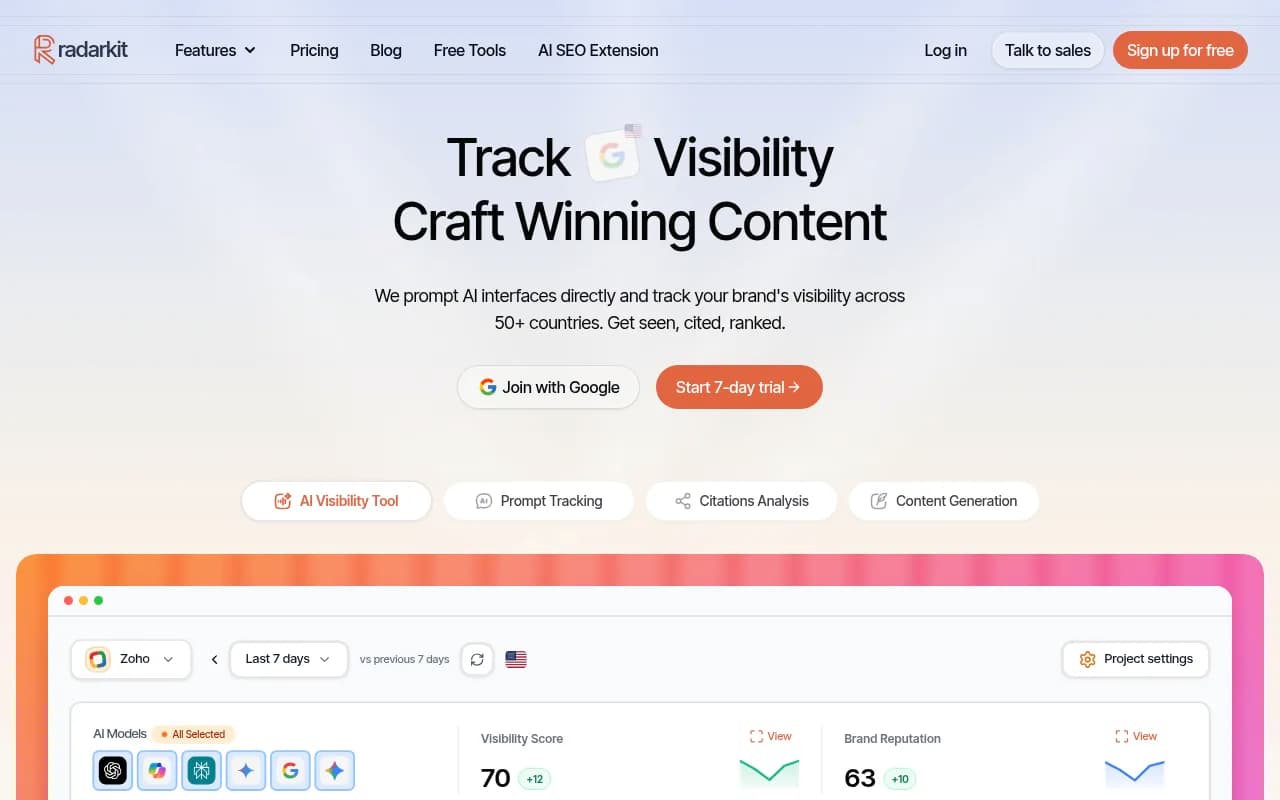
RadarKit's Local Radar feature is the closest a non-local-native tool comes to Local Falcon's approach: it runs prompts through actual consumer-facing chat interfaces using residential IPs across 50+ countries, and reports an Appearance Rate plus a competitor leaderboard. The catch is that RadarKit's Lite, Growth, and Pro plans ($29, $79, and $139/mo) all explicitly list "State & city level tracking: No." Only the custom Enterprise tier adds it. So the feature called "Local Radar" is really country/region-level unless you're paying enterprise rates.
Side-by-side comparison
| Tool | True city/state tracking | Entry price | Method | Best for |
|---|---|---|---|---|
| Local Falcon | Yes, on every plan | $24.99/mo | Geo-grid GPS scans | Multi-location local businesses, franchises |
| BrightLocal | Yes, on every plan | $31/mo | Per-location AI score | Agencies managing local clients |
| Promptwatch | Yes, Business tier only | $579/mo for granularity ($95/mo entry) | Prompt sampling + crawler logs | Brands needing city data plus content execution |
| RadarKit | Enterprise only | Custom (plans start $29/mo without it) | Residential-IP prompt runs | Teams testing country-level first |
| Profound | Sales-gated, no price shown | Custom | Geo-distributed proxies | Enterprises with a sales relationship already |
| Otterly.ai | No | $29/mo | Country-level only | International brand monitoring |
| Peec AI | No | ~$95/mo | Country-level only | Multi-engine tracking without local needs |
What to actually do with this
If your business is a single-location dentist, a national SaaS company, or anything that doesn't care whether AI answers differently in Phoenix versus Pittsburgh, skip this whole problem. Country-level tools like Otterly.ai or Peec AI, or Promptwatch's lower tiers, will tell you everything you need.
If you're running a franchise, a multi-location retailer, or a service business with distinct local markets, the calculus changes. Promptwatch's own research notes a pattern worth knowing: 89% of cited URLs in AI answers appear in only one LLM, not consistently across engines, which means a single blended visibility score can hide real problems in specific markets. A franchise doing well in ChatGPT but invisible in Google AI Overviews in three states needs territory-level reporting, not a brand-wide average.
For that, start with Local Falcon or BrightLocal. Both bake city-level AI tracking into their base pricing instead of treating it as an upsell, and both grew out of local SEO tooling that was already built to handle geography properly. If you later need the deeper content optimization and crawler-log diagnostics that come with a full GEO platform, Promptwatch's Business tier adds that granularity on top of agentic content publishing, which the pure local trackers don't offer.
A caveat worth flagging before you trust any of these numbers
Every one of these tools, Local Falcon included, is simulating location through IP geolocation or proxy networks. That's worth remembering because IP-based location accuracy is excellent at the country level (above 99%) but only 20-75% accurate at the city level, better in dense urban areas, worse on mobile networks where a device's apparent location can shift by hundreds of kilometers in minutes. When a tool says it scanned "from downtown Seattle," it's relying on infrastructure with real limits. Treat city-level AI visibility scores as a directional signal, not a precise measurement, and weight trends over single snapshots.
It's also worth noting that AI Overviews and AI Mode only personalize heavily for local-intent queries. Research cited by Search Engine Journal found informational local queries trigger AI Overviews about 92% of the time, and hybrid queries like "average cost of dental implants in Phoenix" hit around 97%, while simple transactional "near me" searches still default to the traditional Local Pack. So the local-GEO problem is real, but it's concentrated in a specific slice of queries, not every search someone runs in your city.
If you want to browse more options beyond the ones covered here, the GEO software directory at bestgeosoftware.com tracks a wider set of platforms by feature, and ai-rank-tools.com is a good place to compare rank-tracking-style tools if location granularity isn't your top priority.