Key takeaways
- Promptwatch covers 10+ AI models on every paid plan; Bear AI's Basic tier is limited to GPT-5 only, with full multi-model access gated behind custom Enterprise pricing.
- Both tools start at roughly $100/mo, but Promptwatch's $99 Essential plan includes 50 prompts across all models, while Bear AI's $100 Basic plan caps you at 30 prompts on a single model.
- Promptwatch has a full content optimization loop: Answer Gap Analysis identifies where competitors appear and you don't, then an AI writing agent generates content grounded in 880M+ real citations. Bear AI generates blog content too, but at just 2 posts/month on Basic and without the same citation-data backbone.
- Promptwatch includes AI Crawler Logs (real-time logs of ChatGPT, Claude, Perplexity bots hitting your site), Reddit and YouTube citation tracking, and ChatGPT Shopping monitoring -- features Bear AI doesn't clearly offer.
- Bear AI is Y Combinator-backed and has a sharper focus on lead identification from AI traffic, which is a genuinely useful angle that Promptwatch handles differently (via traffic attribution rather than visitor-level identification).
- For most marketing teams and agencies, Promptwatch is the more complete platform. Bear AI could appeal to early-stage startups that want a simpler entry point and care specifically about lead capture from AI traffic.
Overview
Promptwatch

Promptwatch is the largest dedicated AI search visibility platform right now, used by 7,000+ brands including Booking.com, Yelp, Typeform, and Rabobank. It's built around a three-step loop: find the prompts where you're invisible (Answer Gap Analysis), generate content that fixes those gaps (AI writing agent grounded in citation data), and track the results at the page level with traffic attribution. The platform monitors 10 AI models -- ChatGPT, Perplexity, Claude, Gemini, Grok, DeepSeek, Copilot, Mistral, Meta AI, and Google AI Overviews -- and has processed over 1.1 billion citations, clicks, and prompts. It's rated 4.7/5 on G2 and has been referenced in the Wall Street Journal and Axios.
Bear AI
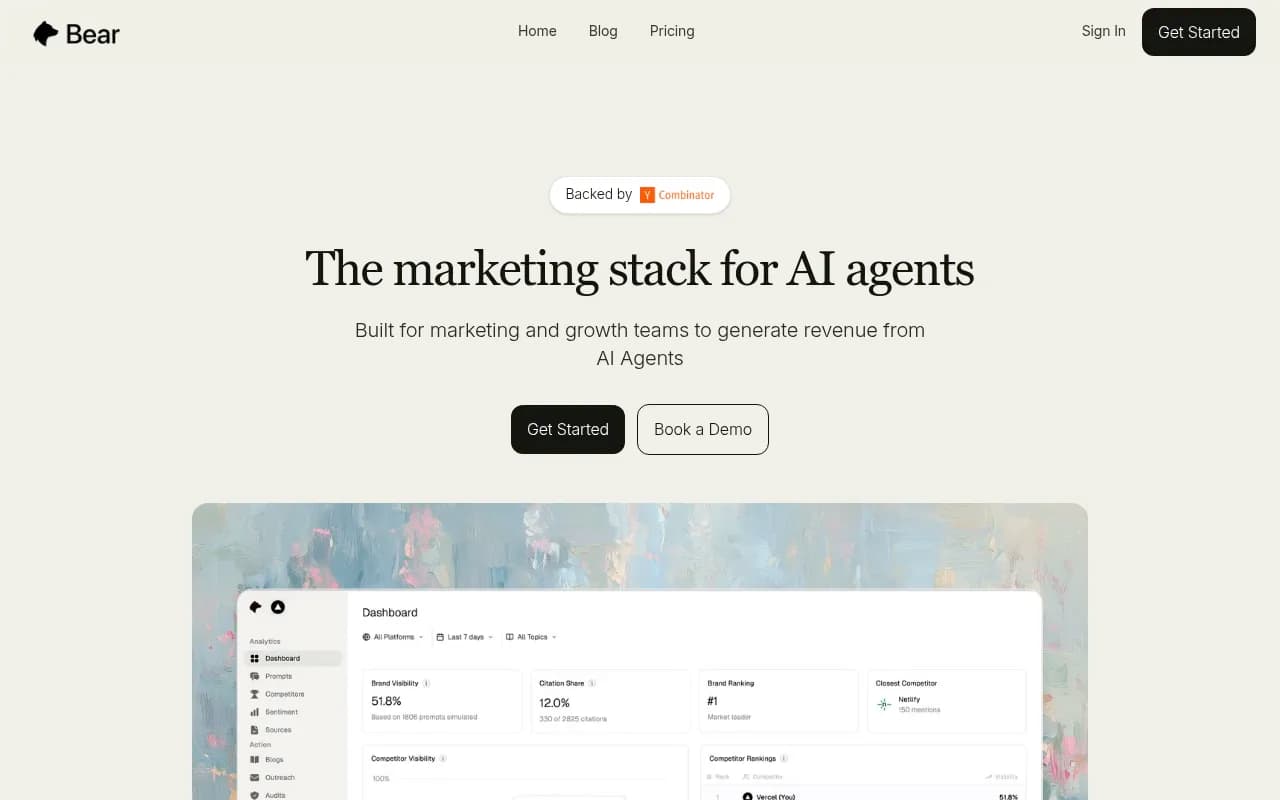
Bear AI is a newer, Y Combinator-backed GEO platform aimed at marketing and growth teams. Its pitch is "the marketing stack for AI agents" -- meaning it goes beyond monitoring to help you convert AI-driven traffic into leads. The platform tracks brand mentions across ChatGPT, Claude, Perplexity, Google AI, and Gemini, surfaces trending prompts, generates AI-optimized blog content, and includes automated PR outreach. It also claims to identify high-intent visitors arriving from AI sources, which is a more sales-focused angle than most GEO tools take. Customers include Peerspace, Groww, and Wispr Flow. It's a smaller, earlier-stage product -- but the YC backing and lead-capture focus make it interesting for growth-oriented teams.
Side-by-side comparison
| Feature | Promptwatch | Bear AI |
|---|---|---|
| Starting price | $99/mo | $100/mo |
| Free trial | 7-day free trial | Not clearly stated |
| AI models covered (entry plan) | 10+ (all models) | GPT-5 only |
| Prompts (entry plan) | 50 | 30 |
| Content generation (entry plan) | 5 articles/mo | 2 blogs/mo |
| Answer Gap / content gap analysis | Yes, full feature | Limited |
| AI Crawler Logs | Yes (Professional+) | Not clearly available |
| Reddit & YouTube citation tracking | Yes | No |
| ChatGPT Shopping tracking | Yes | No |
| Traffic attribution | Yes (GSC, snippet, server logs) | Visitor identification from AI traffic |
| PR outreach automation | No | Yes |
| Multi-site support | Yes (up to 5 on Business) | Enterprise only |
| Agency pricing | Yes, dedicated tier | Enterprise custom only |
| Prompt volume & difficulty scores | Yes | Not clearly available |
| Query fan-out analysis | Yes | No |
| Competitor heatmaps | Yes | Limited |
| Multi-language / multi-region | Yes | Not clearly available |
| Looker Studio / API | Yes | Not clearly available |
| G2 rating | 4.7/5 | Not listed |
| Company stage | Established (7,000+ customers) | Early-stage (YC-backed) |
Head-to-head feature deep-dive
AI model coverage
This is the sharpest difference between the two tools at the entry level.
Promptwatch monitors ChatGPT, Perplexity, Claude, Gemini, Grok, DeepSeek, Copilot, Mistral, Meta AI, and Google AI Overviews on every plan, including the $99 Essential tier. You're not paying more to unlock models -- they're all there from day one.
Bear AI's Basic plan ($100/mo) covers GPT-5 only. To get Claude, Gemini, Perplexity, and Google AI, you need Enterprise pricing, which isn't published. That's a meaningful limitation if you care about how your brand appears across the full AI search landscape -- and most teams should, because different models have very different citation patterns.
Verdict: Promptwatch wins clearly here. Paying roughly the same price and getting one model vs. ten is not a close call.
Content gap analysis and content generation
Both platforms generate AI-optimized content, but the approach is different.
Promptwatch's Answer Gap Analysis identifies specific prompts where competitors appear in AI responses but you don't. It shows you the exact topics and angles missing from your site -- not just "you should write more content" but "here's the prompt, here's who's winning it, here's what your page is missing." The AI writing agent then generates articles, listicles, and comparisons grounded in real citation data from 880M+ analyzed citations. The output is engineered to get cited by specific models, not just generic SEO content.
Bear AI generates blog posts (2/month on Basic, more at Enterprise) and includes PR outreach automation -- a feature Promptwatch doesn't have. The PR angle is interesting: if getting cited in AI responses partly depends on getting covered by publications that AI models trust, automating that outreach makes sense. But the content generation itself doesn't appear to be tied to the same depth of citation data.
Verdict: Promptwatch's content loop is more complete and data-driven. Bear AI's PR automation is a genuinely useful differentiator, but it's unclear how accessible it is outside Enterprise.
Traffic attribution and lead capture
This is where Bear AI takes a different angle. Its pitch includes identifying high-intent visitors arriving from AI sources -- essentially, knowing which companies or individuals came to your site via an AI recommendation. That's a sales and growth use case, not just a marketing analytics one.
Promptwatch handles traffic attribution through three methods: a JavaScript snippet, Google Search Console integration, or server log analysis. You can see which pages are getting AI-driven traffic and connect that to revenue. But it's aggregate traffic data, not visitor-level identification.
If you're a B2B company that wants to know "which specific companies are finding us through ChatGPT," Bear AI's approach is more directly useful. If you want to understand overall AI traffic patterns and optimize content to drive more of it, Promptwatch's attribution is more actionable.
Verdict: Different tools for different goals. Bear AI for visitor-level lead capture; Promptwatch for traffic pattern analysis and optimization.
Technical monitoring (crawler logs, citation sources)
Promptwatch's AI Crawler Logs feature is one of the more technically useful things in this space. It shows real-time logs of AI crawlers (ChatGPT-User, ClaudeBot, PerplexityBot, etc.) hitting your website -- which pages they read, how often they return, and any errors they encounter. This tells you whether AI models can actually access and index your content, which is foundational before worrying about whether they cite it.
Bear AI's website mentions analyzing AI traffic, but the same level of crawler-specific logging isn't clearly part of the product. It's possible this exists in the Enterprise tier, but it's not called out as a feature.
Promptwatch also tracks Reddit threads and YouTube videos that AI models cite -- useful because a lot of AI recommendations are influenced by community content, not just official brand pages. Bear AI doesn't appear to cover this.
Verdict: Promptwatch has significantly more depth on the technical monitoring side.
Prompt intelligence
Promptwatch assigns volume estimates and difficulty scores to prompts, similar to how traditional SEO tools score keywords. It also shows query fan-outs -- how a single prompt branches into related sub-queries -- so you can understand the full search intent landscape around a topic. This helps teams prioritize which prompts are worth targeting rather than tracking everything and getting lost in noise.
Bear AI surfaces "trending prompts" (23 shown in their dashboard screenshot), which is useful for staying current, but the depth of scoring and fan-out analysis isn't clearly present.
Verdict: Promptwatch has more structured prompt intelligence for teams that need to prioritize.
Ease of use and setup
Bear AI's simpler feature set likely means faster onboarding. If you're a small team that wants to get up and running quickly without configuring crawler logs, multi-region settings, and persona targeting, Bear AI's more focused scope is an advantage.
Promptwatch has more to configure, but the payoff is more actionable data. The 7-day free trial gives you enough time to see whether the depth is worth it for your use case.
Verdict: Bear AI is probably quicker to set up. Promptwatch takes more time but gives you more to work with.
Pricing comparison
| Plan | Promptwatch | Bear AI |
|---|---|---|
| Entry tier | $99/mo (Essential) | $100/mo (Basic) |
| Entry: prompts | 50 | 30 |
| Entry: AI models | 10+ | GPT-5 only |
| Entry: content generation | 5 articles/mo | 2 blogs/mo |
| Entry: sites | 1 | Not specified |
| Mid tier | $249/mo (Professional) | -- |
| Mid: prompts | 150 | -- |
| Mid: sites | 2 | -- |
| Mid: extras | Crawler logs, state/city tracking | -- |
| Upper tier | $579/mo (Business) | -- |
| Upper: prompts | 350 | -- |
| Upper: sites | 5 | -- |
| Enterprise / Agency | Custom pricing | Custom pricing |
| Free trial | 7-day | Not clearly stated |
| Annual discount | Yes | Not specified |
Bear AI's pricing structure is thin on public detail above the Basic tier. The jump from $100/mo to "contact us for Enterprise" with no middle tier is a gap that makes budgeting harder. Promptwatch's transparent three-tier structure is easier to plan around.
Pros and cons
Promptwatch
Pros:
- All 10+ AI models covered on every plan, including the entry tier
- Full content optimization loop: gap analysis, AI writing agent, citation data
- AI Crawler Logs give technical insight most competitors lack
- Reddit and YouTube citation tracking
- ChatGPT Shopping monitoring
- Transparent, predictable pricing with three public tiers
- 7,000+ customers and strong G2 rating (4.7/5)
- Multi-language, multi-region, persona targeting
- Looker Studio integration and API for custom workflows
Cons:
- More features means more to learn -- not the quickest setup
- No visitor-level lead identification (aggregate traffic attribution only)
- No built-in PR outreach automation
- Entry plan limited to 1 site and 50 prompts
Bear AI
Pros:
- Y Combinator-backed with a clear growth-team focus
- Visitor-level lead identification from AI traffic is a genuinely useful B2B feature
- PR outreach automation is a unique angle in this space
- Simpler product scope means faster onboarding
- Trending prompts surface timely opportunities
Cons:
- Basic plan limited to GPT-5 only -- major limitation for multi-model visibility
- Only 30 prompts and 2 blog posts on the entry plan
- No clear mid-tier pricing -- jumps straight to custom Enterprise
- No AI Crawler Logs (as far as publicly documented)
- No Reddit/YouTube citation tracking
- Smaller customer base and less established track record
- Fewer technical monitoring capabilities
Who should pick which tool
Choose Promptwatch if:
- You need visibility across multiple AI models, not just ChatGPT
- You want a complete optimization loop, not just a monitoring dashboard
- You're an agency managing multiple client sites
- Technical details like crawler logs and citation source analysis matter to your workflow
- You want transparent, scalable pricing without a sales call to get a number
- You're a mid-size to large brand that needs depth and reliability
Choose Bear AI if:
- You're an early-stage startup primarily focused on ChatGPT visibility for now
- Identifying specific high-intent visitors from AI traffic is a priority for your sales team
- You want PR outreach automation built into the same platform
- You prefer a simpler, more focused tool and don't need the full technical stack
- You're comfortable with custom Enterprise pricing for anything beyond the basics
Final verdict
Promptwatch is the more complete platform by a significant margin -- more models, more prompts, deeper content tools, better technical monitoring, and clearer pricing. For most marketing teams and agencies, it's the right choice.
Bear AI has one genuinely interesting differentiator: visitor-level lead identification from AI traffic, combined with PR outreach automation. If your primary goal is converting AI-driven visitors into sales leads rather than optimizing content for AI citations, Bear AI's angle is worth a look. But the Basic plan's single-model limitation is a real constraint, and the pricing cliff between $100/mo and "call us for Enterprise" makes it hard to plan around.
If you're evaluating both seriously, run Promptwatch's 7-day free trial and see how much of your content gap it surfaces. That alone tends to make the decision clear.