Key Takeaways
- Bear AI focuses exclusively on AI agent tracking (ChatGPT, Perplexity, Claude, Gemini) with no traditional SEO features, while Nightwatch combines traditional rank tracking with AI search monitoring in one platform
- Nightwatch is significantly cheaper: $32/mo starter plan vs Bear AI's $100/mo minimum, making it more accessible for small teams and agencies
- Bear AI includes content generation (2 blogs/mo on Basic plan) as part of its offering, while Nightwatch focuses purely on tracking and reporting
- Nightwatch tracks 107,000+ locations and offers real-time keyword refresh, giving it an edge for local SEO and traditional search -- Bear AI has no traditional search tracking at all
- If you only care about AI agent visibility and want content help, Bear AI is the specialized choice. If you need both traditional SEO and AI tracking in one tool, Nightwatch delivers better value
- Both tools are relatively new to the AI tracking space compared to established players, so expect feature sets to evolve rapidly through 2026
Overview
Bear AI
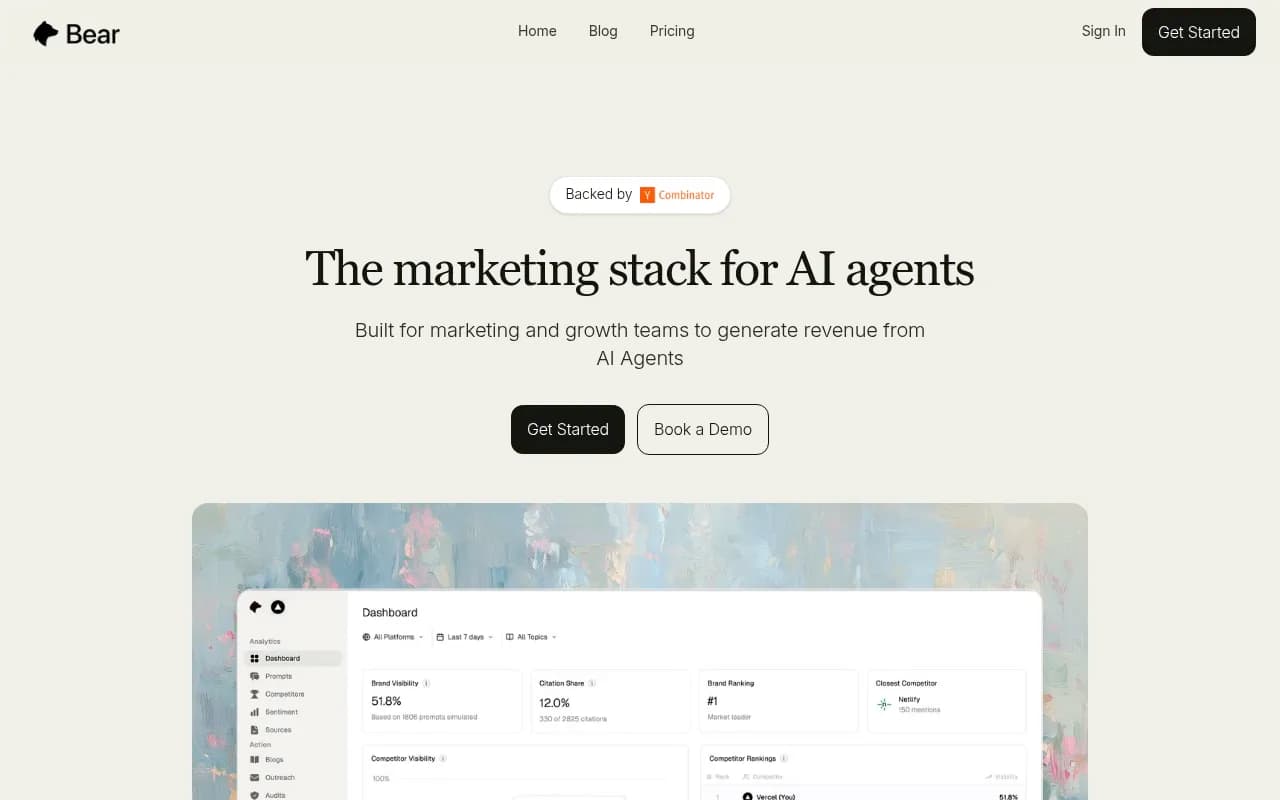
Bear AI is a Y Combinator-backed platform that positions itself as "the marketing stack for AI agents." It's built specifically for tracking how brands appear in generative AI search results across ChatGPT, Perplexity, Claude, and Google's AI products. The company targets marketing and growth teams looking to generate revenue from AI agent traffic. Bear AI combines visibility tracking with content generation -- even the basic plan includes 2 blog posts per month to help improve your AI search presence.
The platform shows trending prompts, tracks when AI models mention your brand, and provides optimization guidance. It's a pure-play AI visibility tool with no traditional SEO features.
Nightwatch
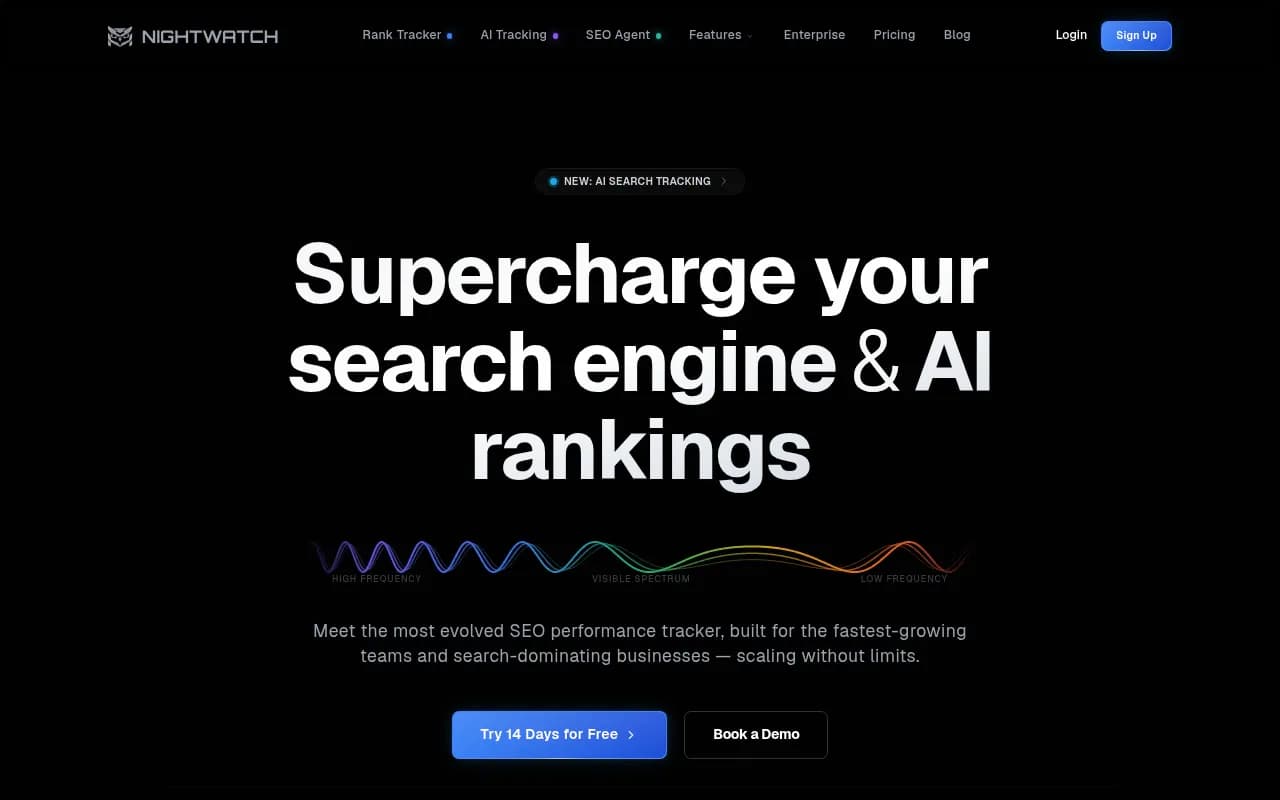
Nightwatch started as a traditional SEO rank tracker and has evolved into what they call "the most evolved SEO performance tracker" with AI search monitoring added to the mix. The platform tracks both traditional search engine rankings (Google, Bing, Yahoo, DuckDuckGo) and AI-powered search results (ChatGPT, Gemini, Claude, Perplexity).
Nightwatch emphasizes data accuracy and real-time updates. You can track 107,000+ locations down to zip code level, refresh critical keywords on demand, and scale to millions of keywords. The platform includes site audits, keyword research, reporting, and a new "SEO Agent" feature for workflow automation. It's designed for teams that need comprehensive search visibility -- both traditional and AI.
Side-by-side comparison
| Feature | Bear AI | Nightwatch |
|---|---|---|
| Starting price | $100/mo | $32/mo |
| Free trial | Not specified | 14 days |
| AI platforms tracked | ChatGPT, Perplexity, Claude, Gemini, Google AI | ChatGPT, Gemini, Claude, Perplexity |
| Traditional SEO tracking | ✗ None | ✓ Google, Bing, Yahoo, DuckDuckGo |
| Content generation | ✓ 2-30 blogs/mo depending on plan | ✗ None |
| Keyword research | Not specified | ✓ Included |
| Site audit | ✗ None | ✓ Included |
| Location tracking | Not specified | 107,000+ locations |
| Real-time updates | Not specified | ✓ On-demand refresh |
| White-label reporting | Not specified | ✓ Agency plan |
| API access | Not specified | Not specified |
| Target audience | Marketing/growth teams focused on AI | SEO teams, agencies, data-driven marketers |
Platform coverage and AI tracking
Both tools track the major AI platforms, but they approach it differently.
Bear AI covers ChatGPT (they specifically mention "GPT-5" in their Basic plan, though that's likely a typo for GPT-4), Perplexity, Claude, and Google's AI products including Gemini and AI Overviews. The platform shows you trending prompts and how AI agents are discovering your brand. You can see which prompts are high-volume and track your visibility across these platforms. The focus is entirely on AI -- there's no traditional search engine tracking.
Nightwatch tracks the same core AI platforms (ChatGPT, Gemini, Claude, Perplexity) but positions this as an add-on to their traditional rank tracking. They call it "Complete SEO Spectrum Coverage" -- you get both worlds in one dashboard. The AI tracking includes prompt analysis and entity tracking. Their marketing emphasizes that most legacy trackers are blind to AI search, while pure AI tools miss traditional search data.
The practical difference: if you're only interested in AI visibility, both tools cover the bases. If you also need to track traditional Google rankings, Nightwatch is the only option here. Bear AI made a deliberate choice to focus exclusively on AI agents.
Pricing breakdown
| Plan | Bear AI | Nightwatch |
|---|---|---|
| Entry plan | $100/mo - Basic: GPT-5 only, 30 prompts, 2 blogs/mo | $32/mo - Starter: 200 keywords, 1 site |
| Mid-tier | Not specified | $79/mo - Professional: 500 keywords, AI tracking |
| Agency/Team | Not specified | $199/mo - Agency: 2000 keywords, white-label |
| Enterprise | Custom pricing - All AI platforms, unlimited tracking | Custom pricing |
Nightwatch is substantially cheaper at the entry level. For $32/mo you get 200 keywords tracked, which is enough for a small business or startup to monitor their core terms. The Professional plan at $79/mo adds AI tracking capabilities.
Bear AI starts at $100/mo and limits you to 30 prompts and a single AI platform ("GPT-5") on the Basic plan. To get access to all AI platforms and unlimited tracking, you need to jump to Enterprise pricing, which isn't published.
The content generation is Bear AI's differentiator on pricing. Even the $100/mo plan includes 2 blog posts per month. If you value that content creation service, the pricing gap narrows. If you just want tracking data, Nightwatch is the clear value winner.
User interface and dashboard
Nightwatch shows a polished, data-dense dashboard in their marketing materials. You get pinned metrics, graphs showing average position and search visibility over time, keyword distribution charts, and the ability to toggle between traditional search and AI performance views. The interface looks like a mature SEO tool -- lots of data, customizable views, and the ability to drill down into specific keyword sets or competitors.
Bear AI's website shows a cleaner, more marketing-focused interface. You see trending prompts with volume indicators, AI platform icons showing where your brand appears, and a feed-style view of how AI agents are talking about you. It feels more like a social listening tool adapted for AI search. Less data density, more narrative.
For teams that live in dashboards and want to slice data 20 different ways, Nightwatch's approach will feel more powerful. For marketing teams that want quick insights and actionable prompts to target, Bear AI's simpler interface might be less overwhelming.
Neither tool has extensive public documentation or demo videos available, so it's hard to judge the actual user experience without signing up.
Tracking accuracy and data freshness
Nightwatch makes a big deal about data accuracy. They claim most tools "approximate data to save costs" while Nightwatch is "engineered for precision." They offer real-time keyword refresh on demand, which means you can force an update for critical terms instead of waiting for the next scheduled check. They also track 107,000+ locations down to zip code level, which matters if you're doing local SEO.
Bear AI doesn't publish specific claims about update frequency or data accuracy. Their focus is on showing you trending prompts and tracking brand mentions across AI platforms. The lack of detail here is notable -- if you're the type of team that needs to know exactly when data was last refreshed and how often checks run, Bear AI's marketing doesn't answer those questions.
For traditional SEO tracking, Nightwatch has years of infrastructure and credibility. For AI tracking, both tools are relatively new entrants, so neither has a proven track record yet. Nightwatch's emphasis on accuracy in their traditional product suggests they're applying the same rigor to AI tracking, but that's an assumption.
Content generation and optimization
This is where Bear AI differentiates itself. Every plan includes blog content generation -- 2 posts per month on Basic, scaling up on higher tiers. The idea is that Bear AI doesn't just show you where you're invisible in AI search; it helps you create content to fix the gaps.
Nightwatch has no content generation features. It's purely a tracking and reporting tool. You get data, insights, and recommendations, but you're on your own for creating the content to act on those insights.
If you're a small team without dedicated content resources, Bear AI's included blog posts could be valuable. If you already have writers or an agency handling content, you're paying for a feature you won't use.
Worth noting: if you're looking for a more comprehensive approach to AI visibility that includes both tracking and content optimization, Promptwatch offers answer gap analysis to show exactly which prompts competitors rank for but you don't, plus an AI writing agent that generates content grounded in real citation data. It's a different model than either Bear AI or Nightwatch -- more focused on the full optimization loop rather than just monitoring.

Reporting and integrations
Nightwatch has mature reporting capabilities. The Agency plan includes white-label reporting, which is critical if you're managing client accounts. They also offer Looker Studio integration, so you can pull Nightwatch data into custom dashboards alongside other marketing metrics. This is a big deal for agencies and in-house teams that need to show ROI to stakeholders.
Bear AI's website doesn't mention reporting features or integrations. There's no information about exporting data, API access, or connecting to other tools. For a Y Combinator startup, this makes sense -- they're likely focused on core functionality first. But if you need to integrate AI tracking data with your existing marketing stack, the lack of detail is a red flag.
Keyword and prompt research
Nightwatch includes keyword research tools as part of the platform. You can discover new keywords, see search volumes, and analyze difficulty. They also have a "Prompt Research" feature specifically for AI search, which helps you find the prompts people are using in AI platforms.
Bear AI shows "trending prompts" in their interface, which gives you visibility into high-volume queries. But it's not clear if they offer dedicated research tools to discover new prompts or analyze prompt difficulty. The marketing focuses more on tracking what's already happening than on discovery.
For teams building out an AI search strategy from scratch, research tools matter. You need to know which prompts are worth targeting before you can track your visibility for them. Nightwatch's inclusion of both traditional keyword research and prompt research gives you a fuller toolkit.
Site audit and technical SEO
Nightwatch includes a site audit feature that crawls your website and identifies technical SEO issues. This is standard for comprehensive SEO platforms -- you need to fix technical problems before you can rank well in traditional search.
Bear AI has no site audit or technical SEO features. This makes sense given their exclusive focus on AI agent visibility. AI models don't care about your site speed or broken links in the same way Google's crawler does. They're reading your content through a different lens.
If you need technical SEO monitoring, Nightwatch is the only option here. If your site is already technically sound and you're purely focused on AI visibility, Bear AI's lack of site audit isn't a problem.
Enterprise and agency features
Nightwatch's Agency plan at $199/mo includes white-label reporting and support for 2,000 keywords. This is clearly designed for agencies managing multiple client accounts. The ability to brand reports with your own logo and remove Nightwatch branding is table stakes for agency work.
Bear AI offers Enterprise pricing but doesn't detail what's included beyond "all AI platforms" and "unlimited tracking." There's no mention of white-label capabilities, multi-user permissions, or other agency-specific features. For a newer product, this isn't surprising, but it means agencies should ask detailed questions before committing.
Nightwatch has the more mature agency offering right now. If you're running an agency and need to manage 10+ client accounts with branded reporting, Nightwatch is the safer bet.
Pros and cons
Bear AI pros
- Laser focus on AI agent visibility without the distraction of traditional SEO metrics
- Includes content generation (blog posts) as part of the service, not just tracking
- Y Combinator backing suggests strong product development velocity
- Clean, marketing-friendly interface that's easy to explain to stakeholders
- Shows trending prompts to help you understand what people are asking AI agents
Bear AI cons
- Higher starting price ($100/mo) compared to alternatives
- Basic plan limits you to a single AI platform, which defeats the purpose of comprehensive tracking
- No traditional SEO tracking if you need to monitor Google rankings alongside AI visibility
- Limited public information about data accuracy, update frequency, and reporting capabilities
- No site audit or technical SEO features
- Unclear integration and API story
Nightwatch pros
- Significantly cheaper entry point ($32/mo) makes it accessible for small teams
- Combines traditional SEO tracking with AI search monitoring in one platform
- Mature reporting features including white-label options for agencies
- Real-time keyword refresh and 107,000+ location tracking for precision
- Includes keyword research, prompt research, and site audit tools
- Looker Studio integration for custom dashboards
- 14-day free trial to test before committing
Nightwatch cons
- AI tracking is an add-on feature, not the core focus -- may lag behind pure-play AI tools in innovation
- No content generation capabilities; you're on your own for creating optimized content
- Interface looks data-dense, which could be overwhelming for non-technical marketers
- Less clarity on which plan includes full AI tracking features (Professional tier required)
Who should choose which tool
Choose Bear AI if:
- You only care about AI agent visibility and have zero interest in traditional Google rankings
- You're a small marketing team that needs content creation help alongside tracking
- You want a simple, focused tool that does one thing (AI tracking) without the complexity of a full SEO platform
- You're willing to pay more for a specialized solution with content generation included
- Your budget allows for $100+/mo and you value the Y Combinator pedigree
Choose Nightwatch if:
- You need both traditional SEO tracking and AI search monitoring in one platform
- You're price-sensitive and want the most features for the lowest cost
- You're an agency managing multiple clients and need white-label reporting
- You want mature reporting, integrations (Looker Studio), and research tools
- You need technical SEO monitoring (site audits) alongside rank tracking
- You prefer a data-dense dashboard with lots of customization options
- You want to test with a free trial before committing
Consider alternatives if:
- You need the full optimization loop (tracking + content gap analysis + AI-generated content + traffic attribution) -- tools like Promptwatch offer a more complete workflow
- You're looking for the most comprehensive AI platform coverage (10+ AI models) -- some competitors track more platforms
- You need advanced features like AI crawler logs or Reddit/YouTube citation tracking -- neither Bear AI nor Nightwatch offers these
Final verdict
Nightwatch wins on value and versatility. For $32-79/mo you get both traditional SEO tracking and AI search monitoring, plus research tools, site audits, and mature reporting. It's the better choice for most teams, especially agencies and businesses that need comprehensive search visibility.
Bear AI is the specialist pick for teams that only care about AI agents and want content creation bundled in. The higher price and platform limitations on the Basic plan are hard to justify unless you really value the included blog posts or want the simplicity of a pure-play AI tool.
The bigger question is whether either tool offers enough depth for serious AI search optimization. Both are tracking tools first -- they show you where you stand but don't deeply integrate content creation, gap analysis, or traffic attribution. If you're serious about AI visibility as a channel, you'll likely need to supplement either tool with content strategy and optimization capabilities that go beyond basic tracking.