Key Takeaways
- Bear AI starts at $100/mo (GPT-5 only, 30 prompts) while LLM Pulse starts at €49/mo (~$53, 40 prompts across multiple models) -- LLM Pulse is nearly half the price at entry level
- LLM Pulse tracks 10+ AI models on all plans; Bear AI's Basic plan only covers GPT-5, requiring Enterprise pricing for full coverage
- Bear AI positions itself as a "marketing stack for AI agents" with traffic analytics focus; LLM Pulse is a pure visibility tracker with optimization recommendations
- LLM Pulse offers a 14-day free trial and transparent pricing tiers; Bear AI has no trial and Enterprise pricing is custom/undisclosed
- Both track ChatGPT, Perplexity, Gemini, and Google AI, but LLM Pulse includes DeepSeek, Grok, Claude, Copilot, and Meta AI on higher tiers
- Neither platform offers content generation or gap analysis -- they're monitoring tools, not optimization platforms
Overview
Bear AI
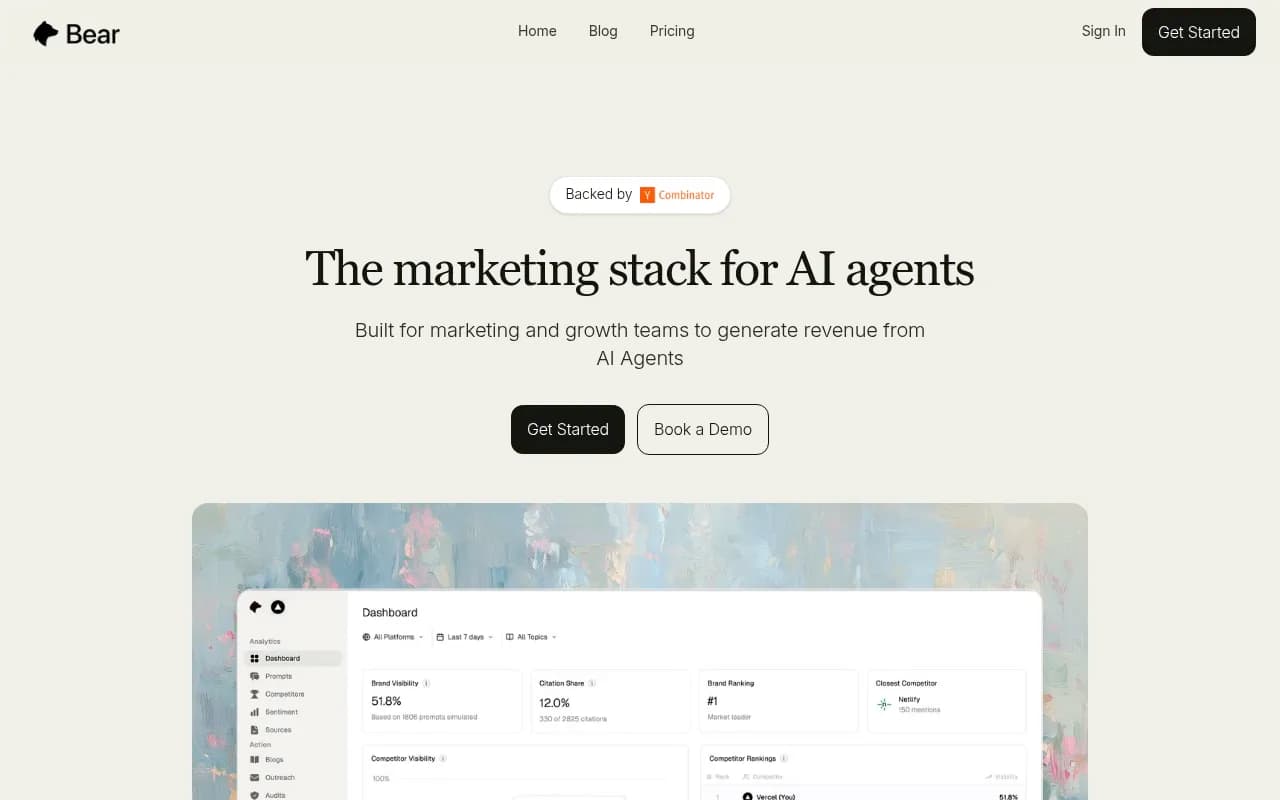
Bear AI calls itself "the marketing stack for AI agents" and targets marketing and growth teams looking to generate revenue from AI-driven traffic. Backed by Y Combinator, Bear AI focuses on showing how AI agents discover your brand and tracking traffic from major LLMs. The platform emphasizes trending prompts, user search patterns, and visibility across ChatGPT, Claude, Google AI Overviews, and Perplexity. Customer logos include Peerspace, Medal, Wispr Flow, and several other startups.
The pitch is traffic-centric: see how AI talks about you, what users ask AI agents about your brand, and optimize visibility to boost traffic. It's positioned as a marketing analytics tool first, visibility tracker second.
LLM Pulse
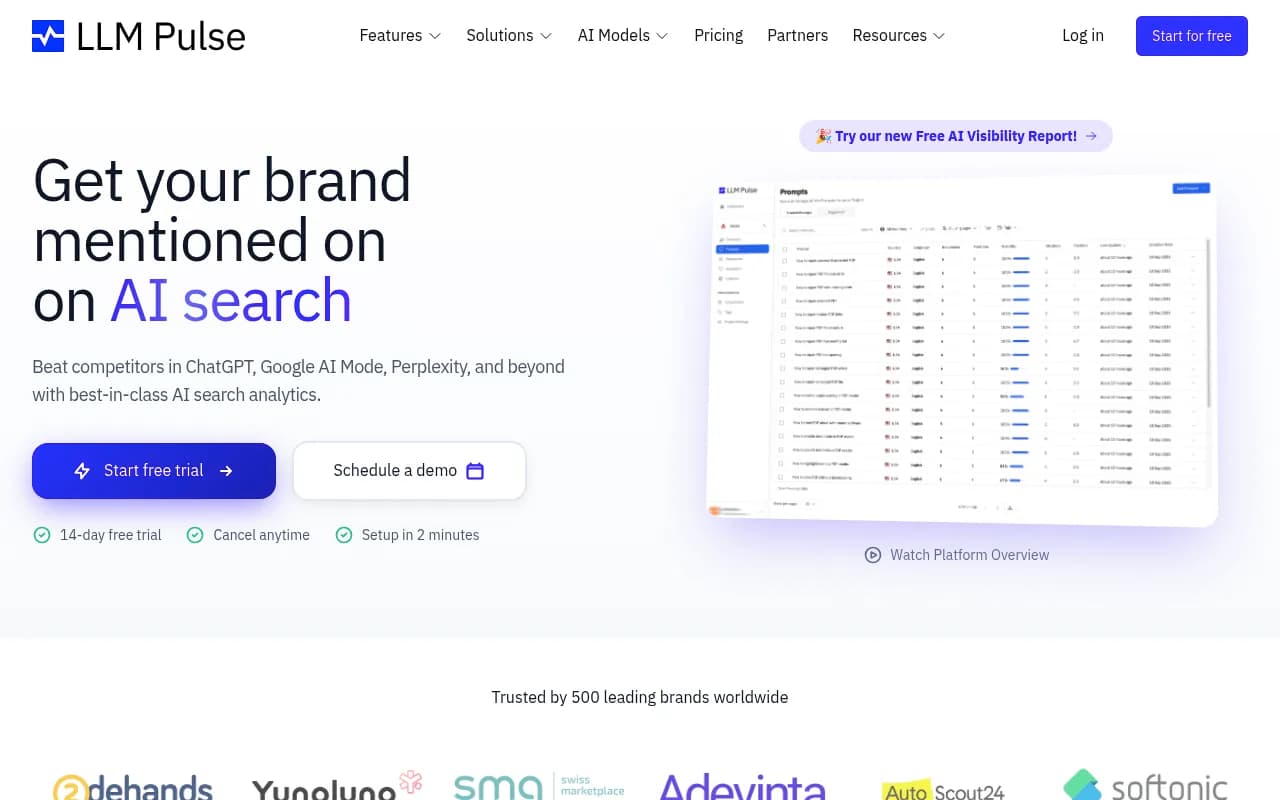
LLM Pulse is a straightforward AI search visibility tracker that monitors what large language models say about your brand. The platform tracks 10+ AI models (ChatGPT, Perplexity, Gemini, Google AI Mode, AI Overviews, plus DeepSeek, Grok, Claude, Copilot, and Meta AI on Enterprise) and provides weekly prompt tracking, citation analysis, sentiment scoring, and share of voice metrics. Used by 500+ brands worldwide, LLM Pulse positions itself as "your radar in the world of generative AI."
The workflow is simple: track key prompts over time, analyze your visibility score and citation rate, and get AI-powered content recommendations to improve how you appear in LLM responses. It's a monitoring and analysis tool with optimization guidance, not a full content creation platform.
Side-by-Side Comparison
| Feature | Bear AI | LLM Pulse |
|---|---|---|
| Starting price | $100/mo | €49/mo (~$53) |
| Free trial | No | 14 days |
| Entry-level AI coverage | GPT-5 only | 5 models (ChatGPT, Perplexity, Gemini, Google AI Mode, AI Overviews) |
| Full AI model coverage | Enterprise (custom pricing) | Enterprise tier |
| Prompt limit (entry) | 30 prompts | 40 prompts |
| Citation analysis | Yes | Yes |
| Competitor benchmarking | Implied | Yes (share of voice) |
| Sentiment tracking | Not mentioned | Yes |
| Content recommendations | Not specified | AI-powered suggestions |
| Traffic analytics | Yes (core feature) | Not emphasized |
| Pricing transparency | Basic public, Enterprise hidden | Fully transparent (Starter/Growth/Scale) |
| Setup time | Not specified | 2 minutes |
| Target audience | Marketing/growth teams | Brands, agencies, marketers |
Pricing breakdown
Here's where the two platforms diverge sharply.
| Plan | Bear AI | LLM Pulse |
|---|---|---|
| Entry tier | $100/mo (Basic: GPT-5 only, 30 prompts, 2 blogs/mo) | €49/mo (Starter: 40 prompts, 5 models) |
| Mid tier | Not disclosed | €99/mo (Growth: 100 prompts, 5 models) |
| High tier | Not disclosed | €299/mo (Scale: 300 prompts, 5 models) |
| Enterprise | Custom pricing (all AI platforms, unlimited tracking) | Custom (adds DeepSeek, Grok, Claude, Copilot, Meta AI) |
| Annual discount | Not mentioned | 17% off |
| Free trial | No | 14 days |
LLM Pulse wins on transparency and entry cost. Bear AI's Basic plan at $100/mo only covers GPT-5, which is a significant limitation if you want to track Perplexity, Gemini, or Claude. You're forced into Enterprise pricing to get full coverage, and that number isn't public. LLM Pulse gives you five major models at €49/mo and scales predictably.
Bear AI does include "2 blogs/mo" in the Basic plan, which suggests some content generation capability, but details are sparse. LLM Pulse doesn't generate content -- it gives you recommendations on what to create.
AI model coverage
This is a critical difference.
Bear AI's Basic plan ($100/mo) tracks GPT-5 only. That's ChatGPT. If you want Perplexity, Gemini, Claude, or Google AI Overviews, you need Enterprise pricing. The website lists "all major LLMs" in the hero section (Google Gemini, Claude, ChatGPT, AI Search, Perplexity) but doesn't clarify which plans include which models. The Enterprise tier promises "all AI platforms, unlimited tracking."
LLM Pulse's Starter plan (€49/mo) includes ChatGPT, Perplexity, Gemini, Google AI Mode, and AI Overviews out of the gate. The Growth and Scale tiers keep the same five models but increase prompt limits. Enterprise adds DeepSeek, Grok, Claude, Copilot, and Meta AI. You know exactly what you're getting at each tier.
If you need multi-model tracking from day one, LLM Pulse is the obvious choice. Bear AI makes you pay for Enterprise to get there.
Feature depth: tracking and analytics
Both platforms track prompts, citations, and visibility, but they emphasize different things.
Bear AI focuses on:
- Trending prompts (high-volume queries)
- How AI agents discover your brand
- Traffic analytics from LLMs
- User search patterns ("See What Users Ask AI Agents About Your Brand")
The traffic angle is Bear AI's differentiator. It's not just "are you mentioned?" but "how much traffic are you getting from AI agents?" This matters if you're trying to tie AI visibility to actual revenue or conversions. The website shows a "Trending Prompts" feed with volume indicators, which is useful for prioritizing what to track.
LLM Pulse focuses on:
- Visibility score (how often you're mentioned)
- Citation rate (how often sources about you are cited)
- Sentiment analysis (positive/negative/neutral)
- Share of voice (your mentions vs competitors)
- Detailed response tracking (exact words AI uses)
- AI-powered content recommendations
LLM Pulse is more analytical. You get a visibility score, sentiment breakdown, and competitor benchmarking. The "share of voice" metric is particularly useful if you're in a crowded space and want to see how you stack up. The content recommendations are AI-generated suggestions on what to write or optimize, but you still have to create the content yourself.
Neither platform offers built-in content generation or gap analysis like Promptwatch does -- they show you the data but leave the optimization work to you.

User experience and setup
LLM Pulse advertises "Setup in 2 minutes" and a 14-day free trial. You can test the platform risk-free and see if it fits before committing. The interface (based on screenshots) looks clean and dashboard-focused: prompt lists, visibility charts, citation breakdowns.
Bear AI has no free trial. You're paying $100/mo upfront to test it. The website shows a polished dashboard with trending prompts and AI model logos, but without a trial, you're buying blind. The "Book a Demo" CTA suggests a sales-led process for Enterprise, which is standard but adds friction.
If you want to kick the tires before spending, LLM Pulse is the safer bet.
Content optimization and recommendations
Bear AI mentions "2 blogs/mo" in the Basic plan, which implies some content generation or optimization feature, but the website doesn't explain what this means. Is it AI-written blog posts? Optimization suggestions? Unclear.
LLM Pulse explicitly offers "AI-powered content recommendations to improve how you appear in LLM responses." This is guidance, not generation. The platform tells you what to write or fix, but you still need to produce the content. It's a monitoring tool with optimization hints, not a full content engine.
If you need actual content creation, neither platform is a complete solution. You'd want something that does gap analysis and generates optimized content based on what's missing -- that's where a platform like Promptwatch comes in, combining tracking with content generation grounded in citation data.
Competitor benchmarking
LLM Pulse has explicit "share of voice" metrics, letting you compare your brand visibility against competitors. You can see who's winning for specific prompts and track changes over time.
Bear AI's website doesn't mention competitor tracking directly, though the "Trending Prompts" feature implies you can see what's popular in your space. It's not clear if you can add competitor brands and benchmark against them.
If competitive analysis is a priority, LLM Pulse is more transparent about offering it.
Transparency and trust signals
LLM Pulse lists "500 leading brands worldwide" as customers and shows a grid of client logos (though they're generic placeholder images on the website, which is odd). Pricing is fully public. The 14-day trial and "Cancel anytime" messaging signal confidence.
Bear AI is backed by Y Combinator, which is a strong trust signal in the startup world. Customer logos include recognizable names like Peerspace and Medal. But the lack of a free trial and hidden Enterprise pricing creates friction. You don't know what full coverage costs until you talk to sales.
Pros and cons
Bear AI pros:
- Y Combinator backing and startup pedigree
- Traffic analytics focus (ties visibility to actual traffic)
- Trending prompts with volume indicators
- Includes some content generation ("2 blogs/mo" on Basic)
Bear AI cons:
- $100/mo entry price only covers GPT-5 (ChatGPT)
- No free trial
- Enterprise pricing hidden
- Multi-model tracking requires Enterprise tier
- Less transparency on features and capabilities
LLM Pulse pros:
- €49/mo entry price (~$53) with 5 AI models included
- 14-day free trial, no credit card required
- Transparent pricing across all tiers
- Sentiment analysis and share of voice metrics
- AI-powered content recommendations
- 10+ AI models on Enterprise (including DeepSeek, Grok, Claude)
- Fast setup (2 minutes)
LLM Pulse cons:
- No content generation (recommendations only)
- Enterprise tier required for full model coverage (DeepSeek, Grok, Claude, etc.)
- Fewer traffic analytics features compared to Bear AI
- Customer logos on website are generic placeholders
Who should pick which tool
Pick Bear AI if:
- You only care about ChatGPT (GPT-5) visibility and $100/mo fits your budget
- Traffic analytics from AI agents is your primary goal
- You want trending prompt data with volume indicators
- You're okay with Enterprise pricing for multi-model coverage
- You value Y Combinator backing and want a startup-focused tool
Pick LLM Pulse if:
- You need multi-model tracking (ChatGPT, Perplexity, Gemini, Google AI) from day one
- You want to test the platform with a free trial before committing
- Transparent pricing matters to you
- Sentiment analysis and competitor benchmarking are priorities
- You're budget-conscious and want the lowest entry price
- You want AI-powered optimization recommendations without paying for Enterprise
Final verdict
LLM Pulse is the better value for most teams. You get five AI models at €49/mo (~$53), transparent pricing, a 14-day trial, and clear feature breakdowns at every tier. Bear AI's $100/mo entry plan only covers ChatGPT, forcing you into undisclosed Enterprise pricing for full model coverage. Unless you're specifically focused on ChatGPT traffic analytics and don't care about Perplexity or Gemini, LLM Pulse gives you more visibility for less money.
That said, neither platform is a complete optimization solution. They're monitoring tools that show you the data but leave content creation and gap analysis to you. If you want to close the loop -- find the gaps, generate optimized content, and track the results -- you'd need to layer in a platform like Promptwatch that combines tracking with content generation and answer gap analysis. But for pure visibility monitoring, LLM Pulse wins on price, transparency, and multi-model coverage out of the box.