Key Takeaways
- Bear AI starts at $100/mo for basic ChatGPT tracking, while Bluefish requires $4,000+/mo minimum with annual contracts -- a 40x price difference
- Bluefish is built exclusively for Fortune 500 enterprise teams with custom audiences and deep segmentation; Bear AI targets growth-stage startups and SMBs
- Bear AI includes built-in content generation (2 blogs/mo on Basic, more on higher tiers); Bluefish focuses purely on monitoring and measurement with no content creation tools
- Bluefish passes enterprise infosec reviews and offers white-glove service; Bear AI is self-service with faster onboarding
- Both track major AI platforms (ChatGPT, Perplexity, Claude, Gemini), but Bluefish adds agentic commerce tracking that Bear AI lacks
- For most teams under 50 people, Bear AI delivers 80% of the value at 2.5% of the cost
Overview
Bear AI
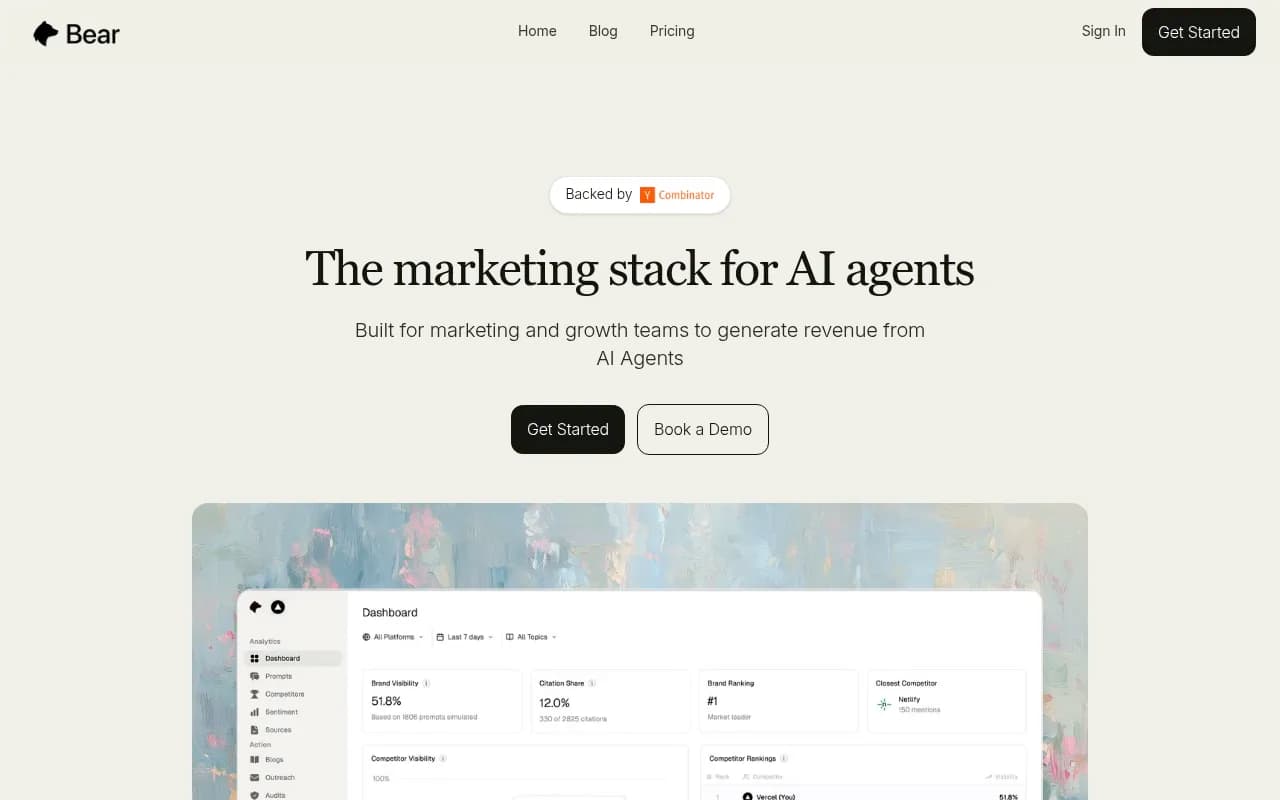
Bear AI is a Y Combinator-backed AI visibility platform designed for marketing and growth teams at startups and mid-market companies. It tracks how AI agents like ChatGPT, Perplexity, Claude, and Gemini discover and recommend your brand, with a focus on actionable insights and content optimization. The platform includes prompt tracking, traffic analysis from LLMs, and built-in blog generation to help you create content that ranks in AI search results.
Pricing starts at $100/mo for the Basic plan (ChatGPT-only tracking, 30 prompts, 2 blogs/mo), with Enterprise plans offering unlimited tracking across all AI platforms. Bear AI positions itself as the accessible option for teams that want AI visibility without enterprise budgets.
Bluefish
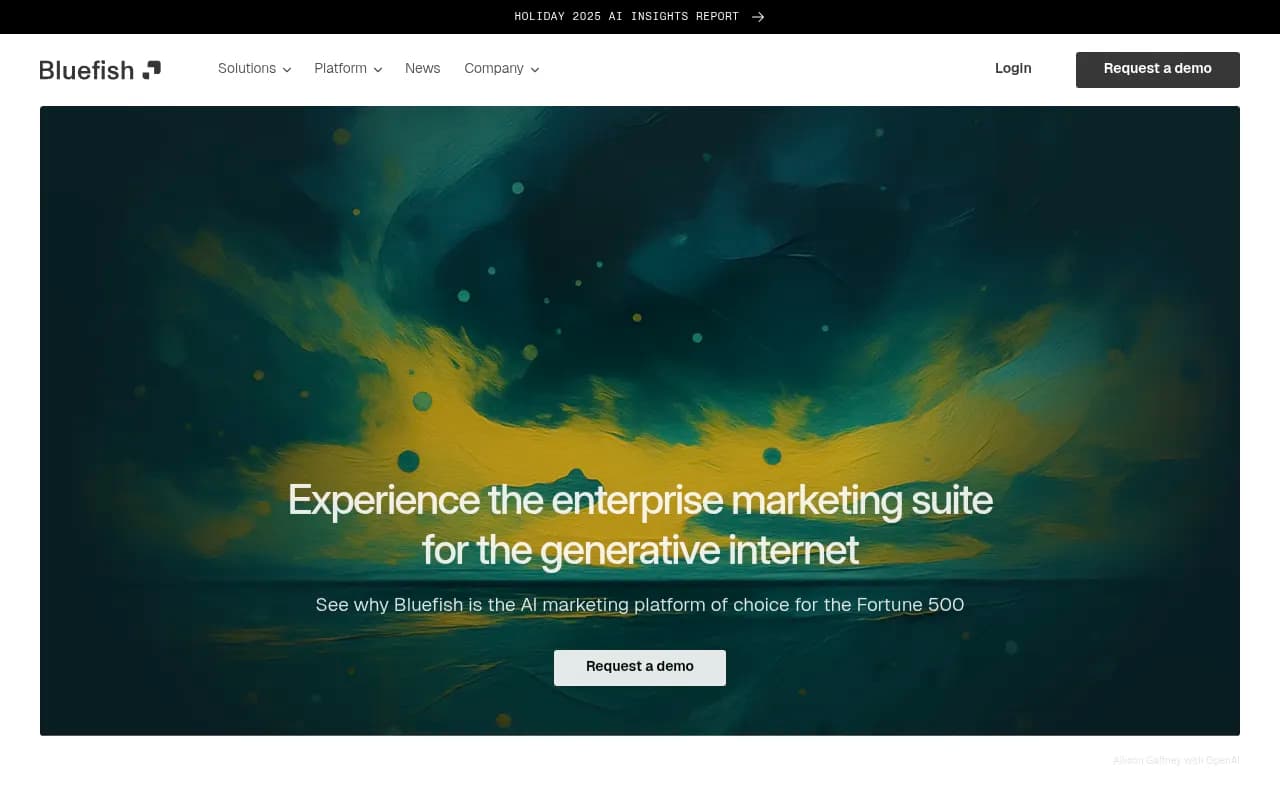
Bluefish is an enterprise-grade AI marketing platform built specifically for Fortune 500 brands. It provides deep visibility into brand reputation across AI search engines and agentic commerce platforms, with advanced features like custom audience segmentation, tailored prompt sets, and white-glove optimization support. Bluefish emphasizes control and differentiation -- the ability to measure not just visibility but influence and sentiment across AI channels.
Pricing is quote-based, starting around $4,000/mo with annual contracts standard. Bluefish consistently passes enterprise infosec reviews and offers dedicated account management. The platform is designed for large marketing teams managing multiple brands across global markets.
Side-by-side comparison
| Feature | Bear AI | Bluefish |
|---|---|---|
| Starting price | $100/mo | ~$4,000/mo |
| Contract terms | Monthly | Annual (typically) |
| Target customer | Startups, SMBs, growth teams | Fortune 500, enterprise |
| AI platforms tracked | ChatGPT, Perplexity, Claude, Gemini, Google AI Overviews | ChatGPT, Perplexity, Claude, Gemini, Google AI Overviews, agentic commerce |
| Content generation | Yes (2-15+ blogs/mo depending on plan) | No |
| Custom audiences | Limited | Yes (deep segmentation) |
| Infosec compliance | Standard | Enterprise-grade (passes Fortune 500 reviews) |
| Onboarding | Self-service | White-glove, dedicated CSM |
| Prompt tracking | 30-unlimited depending on plan | Custom, tailored to brand |
| Traffic attribution | Yes (LLM traffic analysis) | Yes (advanced measurement frameworks) |
| API access | Not specified | Yes (enterprise) |
| Support | Email, chat | Dedicated account team |
Pricing breakdown
Bear AI pricing
| Plan | Price | Platforms | Prompts | Content |
|---|---|---|---|---|
| Basic | $100/mo | ChatGPT only | 30 prompts | 2 blogs/mo |
| Growth | ~$300/mo (estimated) | Multiple LLMs | More prompts | More blogs |
| Enterprise | Custom | All platforms | Unlimited | Custom |
Bluefish pricing
| Plan | Price | Details |
|---|---|---|
| Enterprise | Quote-based, ~$4,000/mo starting | Custom based on brands, markets, features |
| Enterprise Plus | Quote-based, higher | Multi-brand, global markets, advanced features |
Bluefish does not offer public pricing tiers. All deals are custom and require annual commitments. The $4,000/mo figure is a rough starting point based on market research -- actual pricing varies significantly based on scope.
Target audience and positioning
The most obvious difference is who these platforms are built for.
Bear AI targets startups, growth-stage companies, and SMBs that want to start tracking AI visibility without blowing their budget. The self-service model, monthly billing, and included content generation make it accessible for lean marketing teams. If you're a 5-person startup trying to figure out if ChatGPT is recommending you, Bear AI gets you answers fast.
Bluefish is explicitly positioned for Fortune 500 brands. The pricing reflects this -- $4,000/mo is table stakes for enterprise software, and Bluefish's customers are managing multi-million dollar marketing budgets across dozens of markets. The platform's emphasis on custom audiences, tailored prompts, and passing infosec reviews signals that it's built for organizations with complex requirements and procurement processes.
This isn't a subtle difference. Bear AI's website shows logos from Peerspace, Medal, and Wispr Flow -- recognizable startups but not household names. Bluefish's messaging is all about "Fortune 500" and "enterprise marketers." They're playing in different leagues.
Feature depth and customization
Both platforms track the major AI engines (ChatGPT, Perplexity, Claude, Gemini, Google AI Overviews), but the depth of what you can do with that data diverges sharply.
Prompt tracking and audiences
Bear AI gives you prompt tracking with volume indicators ("high-volume" tags on trending prompts). You can see what users are asking AI agents about your brand and your category. The Basic plan caps you at 30 prompts; higher tiers increase that limit.
Bluefish offers custom audience segmentation and tailored prompt sets. Instead of tracking generic prompts, you can define specific customer personas, geographic markets, and use cases, then track how AI responds to those segments. This matters for global brands where a prompt in the US might get a different answer than the same prompt in Germany.
Verdict: For most teams, Bear AI's prompt tracking is enough. You'll see the high-volume queries and can act on them. Bluefish's custom audiences are overkill unless you're managing a portfolio of brands across multiple countries.
Content optimization and generation
Bear AI includes built-in blog generation as part of every plan. The Basic plan gives you 2 blogs/mo; higher tiers increase that. The idea is to close the loop: track where you're missing, generate content to fill the gaps, then track the results.
Bluefish has no content generation tools. It's purely a monitoring and measurement platform. You get the insights, but you're responsible for creating the content to act on them.
Verdict: This is a big differentiator. If you want an all-in-one platform that helps you create content, Bear AI wins. If you have a content team and just need visibility data, Bluefish's lack of content tools isn't a problem.
Measurement and influence tracking
Bear AI focuses on visibility and traffic: Are AI agents mentioning you? How often? What prompts drive traffic to your site?
Bluefish goes deeper into influence and sentiment. The platform emphasizes understanding how AI "thinks" about your brand -- not just whether you're mentioned, but how you're positioned, what context you appear in, and how your reputation compares to competitors. Bluefish's "Collections" feature (announced Feb 2026) lets you measure the ROI of specific marketing campaigns in the AI channel.
Verdict: Bluefish's measurement framework is more sophisticated, but most teams won't need that level of granularity. Bear AI's visibility and traffic metrics answer the core question: "Is this working?"
Agentic commerce tracking
Bluefish tracks agentic commerce -- AI agents that make purchase recommendations or facilitate transactions (think ChatGPT suggesting products or services). This is a newer channel and matters for e-commerce brands and consumer products.
Bear AI doesn't explicitly mention agentic commerce tracking. The focus is on search and discovery, not transactional recommendations.
Verdict: If you're a consumer brand worried about AI agents recommending competitors' products over yours, Bluefish's agentic commerce tracking is valuable. For B2B SaaS or service businesses, it's less relevant.
Ease of use and onboarding
Bear AI is self-service. You sign up, connect your site, define your prompts, and start tracking. The interface looks clean and startup-friendly based on the dashboard screenshot on their site. Onboarding is fast -- you can be up and running in a day.
Bluefish requires a sales call, a custom quote, and typically an annual contract. Onboarding includes a dedicated customer success manager and white-glove setup. This is standard for enterprise software, but it means you're looking at weeks (or months) from first contact to live data.
Verdict: Bear AI wins on speed and simplicity. Bluefish's onboarding process is appropriate for its target market but feels heavy if you just want to start tracking.
Enterprise requirements and compliance
Bluefish explicitly highlights that it "consistently passes infosec reviews with ease" and is "built for enterprise." This matters if you're at a large company with strict security and compliance requirements. Bluefish can handle SSO, custom data retention policies, and whatever else your IT team throws at it.
Bear AI doesn't emphasize enterprise compliance on its website. That doesn't mean it's insecure, but it signals that enterprise procurement isn't the primary focus.
Verdict: If you need to pass a Fortune 500 infosec review, Bluefish is the safer bet. For everyone else, this isn't a deciding factor.
Support and service model
Bear AI appears to offer standard support (email, chat) based on typical startup SaaS models. The self-service nature means you're expected to figure things out on your own for the most part.
Bluefish includes dedicated account management and white-glove service. You have a CSM who knows your business and can help you interpret data, build custom reports, and optimize your strategy.
Verdict: Bluefish's support model justifies some of the price premium. If you're paying $4,000+/mo, you should get a human who answers your questions. Bear AI's support is fine for the price point.
Who should pick Bear AI
- Startups and SMBs with marketing budgets under $50k/year
- Teams that want to start tracking AI visibility without a big commitment
- Companies that need content generation tools built in
- Growth teams that prefer self-service tools over managed services
- Anyone who wants to test AI visibility tracking before going all-in
Bear AI delivers the core value -- tracking how AI agents talk about your brand -- at a price point that makes sense for smaller teams. The included content generation is a nice bonus that helps you act on the insights.
Who should pick Bluefish
- Fortune 500 brands managing multiple products across global markets
- Marketing teams with budgets over $500k/year
- Companies that need custom audience segmentation and tailored prompt sets
- Brands in competitive categories where nuanced sentiment tracking matters
- Organizations with strict infosec and compliance requirements
- Teams that value white-glove service and dedicated account management
Bluefish is overkill for most companies, but if you're operating at enterprise scale with complex requirements, it's built for you. The depth of customization and measurement frameworks justify the price if you're making million-dollar marketing decisions based on the data.
Pros and cons
Bear AI pros
- Affordable entry point at $100/mo
- Fast self-service onboarding
- Built-in content generation (2+ blogs/mo)
- Monthly billing, no long-term commitment
- Clean, startup-friendly interface
- Tracks major AI platforms (ChatGPT, Perplexity, Claude, Gemini)
Bear AI cons
- Limited customization vs enterprise platforms
- Basic plan restricted to ChatGPT only
- No agentic commerce tracking
- Less sophisticated measurement frameworks
- Support is standard email/chat, not dedicated CSM
Bluefish pros
- Deep customization (custom audiences, tailored prompts)
- Enterprise-grade security and compliance
- Tracks agentic commerce in addition to AI search
- White-glove service with dedicated account management
- Advanced measurement frameworks (influence, sentiment, ROI)
- Built for multi-brand, multi-market complexity
Bluefish cons
- Extremely expensive ($4,000+/mo starting price)
- Requires annual contracts
- Slow onboarding (weeks to months)
- No content generation tools
- Overkill for most companies
The pricing reality check
Let's be blunt about the math. Bear AI's Basic plan is $100/mo. Bluefish starts around $4,000/mo. That's a 40x difference.
For a startup with a $10k/mo marketing budget, spending $4,000 on AI visibility tracking is insane. You'd be allocating 40% of your budget to monitoring a channel that might drive 5% of your traffic. Bear AI at $100/mo (1% of budget) makes sense.
For a Fortune 500 brand spending $5 million/year on digital marketing, $48k/year for Bluefish is less than 1% of budget. If AI search is driving even 10% of your traffic, having deep visibility and control is worth it.
The platforms are priced for their markets. The question is which market you're in.
Alternative worth considering
If you're evaluating AI visibility platforms and want something between Bear AI's simplicity and Bluefish's enterprise depth, Promptwatch is worth a look. It tracks AI search visibility across 10 LLMs (ChatGPT, Perplexity, Claude, Gemini, and more), includes AI crawler logs to see how bots are discovering your content, and has a built-in content generation engine that creates articles based on real citation data. Pricing starts at $99/mo for the Essential plan, with Professional at $249/mo and Business at $579/mo -- more features than Bear AI's Basic plan at a similar price point.

Final verdict
Pick Bear AI if you're a startup or SMB that wants to start tracking AI visibility without a massive investment. The $100/mo entry point, built-in content generation, and self-service model make it the obvious choice for lean teams. You'll get 80% of the value at 2.5% of the cost.
Pick Bluefish if you're a Fortune 500 brand with complex requirements, multi-market operations, and a budget that can absorb $50k+/year for AI visibility. The custom audiences, advanced measurement, and white-glove service justify the premium if you're operating at that scale.
For everyone in between -- mid-market companies, agencies, B2B SaaS companies with $50k-$500k marketing budgets -- the choice depends on whether you value simplicity (Bear AI) or depth (Bluefish). Most teams will find Bear AI sufficient. The few who need Bluefish's enterprise features will know it immediately.
The real insight here is that these platforms barely compete. They're serving different markets at wildly different price points. Comparing them is like comparing a Honda Civic to a Bentley -- both get you from A to B, but the target buyer is completely different.