Key Takeaways
- Bear AI starts at $100/mo with limited features (ChatGPT-only tracking, 30 prompts, 2 blog posts). Profound requires custom enterprise pricing estimated at $1,000-$3,000+/month with no public tiers or free trial.
- Profound covers more AI platforms out of the box (ChatGPT, Perplexity, Claude, Gemini, Grok, Copilot, Meta AI, DeepSeek, Google AI Overviews). Bear AI's basic plan only tracks ChatGPT; full coverage requires Enterprise.
- Bear AI positions itself as a "marketing stack for AI agents" with traffic analytics and agent discovery features. Profound focuses on Answer Engine Optimization (AEO) with prompt volume data, AI crawler analytics, and autonomous content agents.
- Profound is built for enterprise teams at MongoDB, Ramp, and Zapier. Bear AI targets startups and growth-stage companies (Peerspace, Medal, Wispr Flow).
- Neither platform offers a free trial. Bear AI has transparent starter pricing; Profound requires a sales call for any pricing information.
- If you need full AI search coverage and can afford $1k+/month, Profound delivers more depth. If you're testing AI visibility on a tighter budget, Bear AI gets you in the door for $100/mo.
Overview
Bear AI
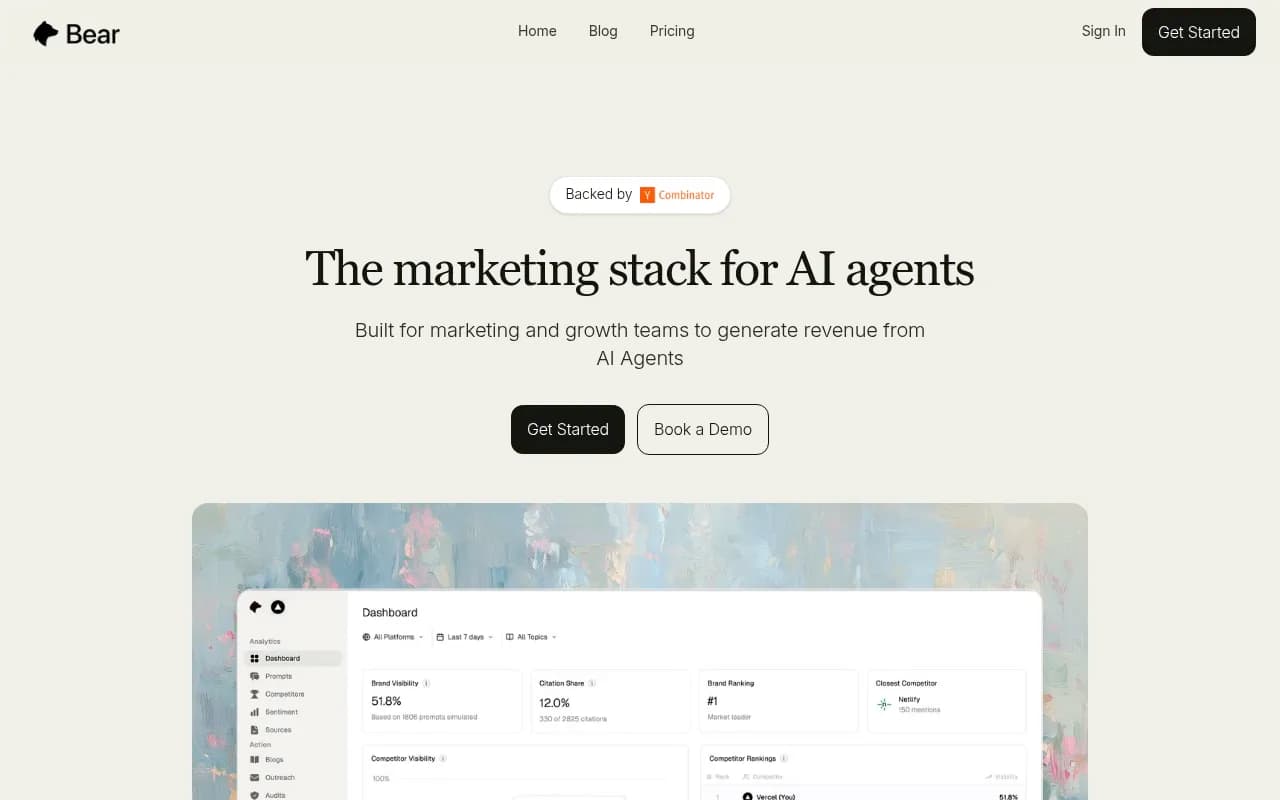
Bear AI calls itself "the marketing stack for AI agents" and targets marketing and growth teams trying to generate revenue from AI search. Backed by Y Combinator, it's used by companies like Peerspace, Medal, and Wispr Flow. The platform tracks how AI agents discover your brand and promises to help you optimize visibility to boost traffic. Bear AI emphasizes traffic analytics -- seeing which AI platforms send users to your site and how those users behave.
The pricing is tiered: Basic starts at $100/mo but only covers ChatGPT with 30 prompts and 2 blog posts per month. Enterprise pricing is custom and unlocks all AI platforms plus unlimited tracking. This makes Bear AI accessible for smaller teams testing AI visibility, but the feature limits on the basic plan are tight.
Profound

Profound is an enterprise Answer Engine Optimization (AEO) platform used by MongoDB, Ramp, and Zapier. It monitors how your brand appears across ChatGPT, Perplexity, Claude, Gemini, Grok, Copilot, Meta AI, DeepSeek, and Google AI Overviews. Profound combines visibility tracking, prompt volume data (what millions of people ask AI), AI crawler analytics, and autonomous content creation agents.
The platform has no public pricing tiers or free trial. You have to request a demo and go through sales. Based on their enterprise positioning and feature set, pricing likely starts around $1,000-$3,000+ per month. Profound is built for teams that already know they need AI search visibility and have the budget to pay for a full-featured platform.
Side-by-side comparison
| Feature | Bear AI | Profound |
|---|---|---|
| Starting price | $100/mo (Basic) | Custom (est. $1,000-$3,000+/mo) |
| Free trial | No | No |
| AI platforms tracked (Basic/Starter) | ChatGPT only | All (ChatGPT, Perplexity, Claude, Gemini, Grok, Copilot, Meta AI, DeepSeek, Google AI Overviews) |
| AI platforms tracked (Enterprise) | All major LLMs | All major LLMs |
| Prompt tracking (Basic/Starter) | 30 prompts | Unlimited |
| Prompt volume data | Yes (trending prompts) | Yes (millions of queries) |
| AI crawler analytics | Not mentioned | Yes |
| Content generation | 2 blogs/mo (Basic), more on Enterprise | Autonomous agents, AEO-optimized FAQ generator |
| Traffic attribution | Yes (LLM traffic analytics) | Not explicitly mentioned |
| Target customer | Startups, growth-stage companies | Enterprise (Series B+) |
| Public pricing transparency | Partial (Basic tier public, Enterprise custom) | None (all custom) |
| Shopping/product tracking | Not mentioned | Yes (ChatGPT Shopping) |
| Integrations | Not detailed | Yes (multiple integrations listed) |
| Support | Standard | Enterprise-level |
Pricing breakdown
This is where the two platforms diverge sharply.
| Plan | Bear AI | Profound |
|---|---|---|
| Entry tier | $100/mo (Basic: ChatGPT only, 30 prompts, 2 blogs/mo) | No entry tier |
| Mid tier | Not listed | No mid tier |
| Enterprise | Custom (all AI platforms, unlimited tracking) | Custom (estimated $1,000-$3,000+/mo, all features) |
| Free trial | No | No |
| Annual discount | Not mentioned | Not mentioned |
Bear AI's $100/mo Basic plan is the cheapest way into AI search visibility tracking, but you're limited to ChatGPT and 30 prompts. If you want Perplexity, Claude, Gemini, and the rest, you need Enterprise pricing (undisclosed). Profound has no public pricing at all -- everything is custom, which usually means higher minimums and annual contracts.
For a startup testing the waters, Bear AI's $100/mo entry point is more realistic. For an established company that needs full coverage and can commit to a larger budget, Profound's enterprise approach makes sense.
AI platform coverage
Profound wins on breadth right out of the gate. Even on their base offering, you get ChatGPT, Perplexity, Claude, Gemini, Grok, Microsoft Copilot, Meta AI, DeepSeek, and Google AI Overviews. That's nine AI engines tracked from day one.
Bear AI's Basic plan only tracks ChatGPT. You see trending prompts and traffic from ChatGPT, but nothing from Perplexity, Claude, or Gemini. To get full AI platform coverage, you have to upgrade to Enterprise (custom pricing). This makes Bear AI's entry tier less useful if you care about how Claude or Perplexity represent your brand.
If your audience primarily uses ChatGPT, Bear AI's Basic plan might be enough. But most brands want visibility across multiple AI engines, which means either paying for Bear AI Enterprise or going straight to Profound.
Prompt tracking and volume data
Both platforms offer prompt tracking, but the implementation differs.
Bear AI shows "trending prompts" -- the most-searched queries across AI agents related to your brand or category. On the Basic plan, you can track 30 prompts. This is useful for spotting what users ask about your space, but 30 prompts fills up fast if you're in a competitive category. Enterprise unlocks unlimited prompt tracking.
Profound emphasizes prompt volumes at scale. They claim to show "what millions of people ask AI" and help you align strategy with demand. The platform surfaces high-volume queries and lets you prioritize which prompts to optimize for. There's no mention of a prompt limit, even on their base enterprise tier. Profound also ties prompt data to their content agents, so you can generate AEO-optimized content targeting high-volume queries.
Profound's approach feels more data-driven and scalable. Bear AI's 30-prompt limit on Basic is a bottleneck.
Content creation and optimization
Bear AI includes 2 blog posts per month on the Basic plan. These are presumably AI-generated articles optimized to rank in AI search results. Enterprise plans include more content generation, but specifics aren't public. The focus seems to be on giving you a few pieces of content to test, not automating your entire content pipeline.
Profound takes content creation further with "autonomous agents" and an "AEO-Optimized FAQ Generator." The platform describes these as workers for every function of your marketing team. The FAQ generator scrapes your web pages, determines core search queries, researches FAQs on Perplexity, and publishes optimized content. This is closer to a full content automation system than a blog-post-per-month add-on.
If you want a few articles to test AI visibility, Bear AI's approach works. If you want to systematically generate content at scale based on prompt volume data, Profound's agents are more powerful.
For teams serious about content optimization for AI search, tools like Promptwatch also offer AI content generation grounded in citation data and competitor analysis, which can complement either platform.

Traffic analytics and attribution
Bear AI emphasizes traffic analytics heavily. The platform shows you which AI agents are sending traffic to your site and how those users behave. This is a key differentiator -- you're not just tracking visibility, you're seeing actual traffic and conversions from AI search. Bear AI positions this as the "marketing stack" angle: understand the full funnel from AI discovery to website visit to conversion.
Profound doesn't highlight traffic attribution in their public materials. The focus is on visibility (how AI represents your brand) and optimization (improving your presence in AI answers). There's no mention of tracking which AI platforms send traffic or how that traffic converts. This might exist in the platform, but it's not a core selling point.
If you care about connecting AI visibility to actual website traffic and revenue, Bear AI has the edge here.
AI crawler analytics
Profound includes "Agent Analytics" as a feature, which covers AI crawler activity. This means you can see which AI engines are crawling your site, how often, and which pages they're reading. This is useful for diagnosing indexing issues or understanding how AI models discover your content.
Bear AI doesn't mention AI crawler analytics in their public materials. The focus is on tracking how AI agents recommend your brand in responses, not on the crawling and indexing layer.
For technical SEO teams that want to optimize how AI engines crawl their site, Profound's crawler analytics are valuable. Bear AI seems to skip this layer entirely.
Shopping and product recommendations
Profound explicitly lists "Shopping" as a feature, which likely refers to tracking how your products appear in ChatGPT Shopping and other AI-powered product recommendation flows. This is critical for e-commerce brands and SaaS companies that want to show up when users ask AI for product recommendations.
Bear AI doesn't mention shopping or product tracking. The platform seems more focused on brand visibility and traffic, not product-level recommendations.
If you're an e-commerce brand or SaaS company that sells through AI recommendations, Profound's shopping tracking is a must-have.
Target audience and positioning
Bear AI targets startups and growth-stage companies. The $100/mo entry price, Y Combinator backing, and customer logos (Peerspace, Medal, Wispr Flow) all point to early-stage companies testing AI visibility on a budget. The messaging is about "generating revenue from AI agents" -- a growth-focused pitch.
Profound targets enterprise teams. Customer logos include MongoDB, Ramp, and Zapier (all well-funded, established companies). The lack of public pricing, emphasis on custom demos, and feature depth (crawler analytics, autonomous agents, integrations) all signal an enterprise product. Profound is for teams that already have buy-in and budget for AI search optimization.
This positioning difference matters. If you're a 10-person startup, Profound's sales process and likely price point will feel like overkill. If you're a 500-person company with a dedicated SEO team, Bear AI's Basic plan will feel too limited.
Integrations and ecosystem
Profound lists integrations and a partner program prominently. They have a "Profound Partners" page and mention integrations with other marketing tools. The platform also has developer docs and an API, which suggests you can build custom workflows on top of Profound.
Bear AI doesn't detail integrations in their public materials. The focus is on the core platform, not on connecting to other tools.
For teams that need to plug AI visibility data into their existing marketing stack (CRM, analytics, content management), Profound's integration ecosystem is more mature.
Pros and cons
Bear AI pros
- $100/mo entry price makes it accessible for startups
- Traffic analytics show actual visits and conversions from AI search
- Transparent pricing for the Basic tier
- Y Combinator backing and startup-friendly positioning
Bear AI cons
- Basic plan only tracks ChatGPT (need Enterprise for full coverage)
- 30-prompt limit on Basic is restrictive
- Only 2 blog posts per month on Basic
- No AI crawler analytics
- No shopping/product tracking mentioned
- Enterprise pricing not public
Profound pros
- Tracks all major AI platforms from day one (ChatGPT, Perplexity, Claude, Gemini, Grok, Copilot, Meta AI, DeepSeek, Google AI Overviews)
- Prompt volume data at scale (millions of queries)
- AI crawler analytics for technical optimization
- Autonomous content agents and AEO-optimized FAQ generator
- Shopping/product recommendation tracking
- Integrations and API for custom workflows
- Built for enterprise teams with mature feature set
Profound cons
- No public pricing (all custom, likely $1,000-$3,000+/month)
- No free trial
- Requires sales demo to access platform
- Overkill for small teams or startups testing AI visibility
- Traffic attribution not emphasized (unclear if it exists)
Who should choose Bear AI
Pick Bear AI if you're a startup or growth-stage company testing AI search visibility on a budget. The $100/mo Basic plan gets you into the game with ChatGPT tracking, trending prompts, and traffic analytics. You can see if AI search is driving meaningful traffic before committing to a bigger investment.
Bear AI also makes sense if traffic attribution is your top priority. The platform emphasizes showing you which AI agents send visitors and how those visitors convert. If you want to connect AI visibility directly to revenue, Bear AI's analytics are built for that.
Finally, choose Bear AI if you want to avoid a lengthy sales process. You can sign up for Basic online and start tracking immediately. Enterprise requires a demo, but at least there's a self-serve entry point.
Who should choose Profound
Pick Profound if you're an established company (Series B+, 100+ employees) with budget for a full-featured AI search optimization platform. Profound is built for teams that need comprehensive coverage across all AI engines, prompt volume data at scale, AI crawler analytics, and autonomous content generation.
Profound also makes sense if you're an e-commerce brand or SaaS company that cares about product recommendations in AI search. The shopping tracking feature is critical for understanding how ChatGPT and other AI engines recommend your products.
Finally, choose Profound if you need integrations and API access to connect AI visibility data to your existing marketing stack. The platform is designed for enterprise workflows, not standalone use.
Final verdict
Bear AI and Profound serve different markets. Bear AI is the budget-friendly entry point for startups testing AI search visibility. Profound is the enterprise platform for companies that already know they need comprehensive AI search optimization and have the budget to pay for it.
If you're a startup with under $500/mo to spend on AI visibility, Bear AI is your only realistic option. The $100/mo Basic plan gets you ChatGPT tracking and traffic analytics, which is enough to validate whether AI search matters for your business. Just know you'll hit limits fast (30 prompts, 2 blogs/mo, ChatGPT-only) and need to upgrade to Enterprise for full coverage.
If you're an established company with $1,000+/month to invest, Profound delivers more depth. You get all AI platforms tracked from day one, unlimited prompt tracking, AI crawler analytics, autonomous content agents, and shopping tracking. The lack of public pricing and free trial is annoying, but the feature set justifies the enterprise positioning.
The middle ground is awkward. If you need more than Bear AI's Basic plan but can't afford Profound's enterprise pricing, you're stuck requesting custom quotes from both platforms. Neither offers a transparent mid-tier option.
Bottom line: Bear AI for startups on a budget, Profound for enterprise teams with serious AI search ambitions.