Key Takeaways
- Bear AI starts at $100/mo and focuses on traffic attribution from AI agents, while Otterly.AI starts at $29/mo and emphasizes affordable monitoring
- Otterly.AI tracks 6 AI platforms (ChatGPT, Perplexity, Google AI Overviews, AI Mode, Gemini, Copilot) vs Bear AI's focus on ChatGPT/GPT-5 in the basic tier
- Bear AI positions itself as a "marketing stack for AI agents" with revenue generation focus, while Otterly.AI is a pure monitoring and auditing tool
- Otterly.AI includes a GEO Audit tool analyzing 25+ on-page factors -- Bear AI doesn't mention audit capabilities
- Bear AI's basic plan is limited to 30 prompts and 2 blogs/month, making it restrictive for active monitoring
- Otterly.AI offers a 14-day free trial, Bear AI doesn't advertise one
Overview
Bear AI
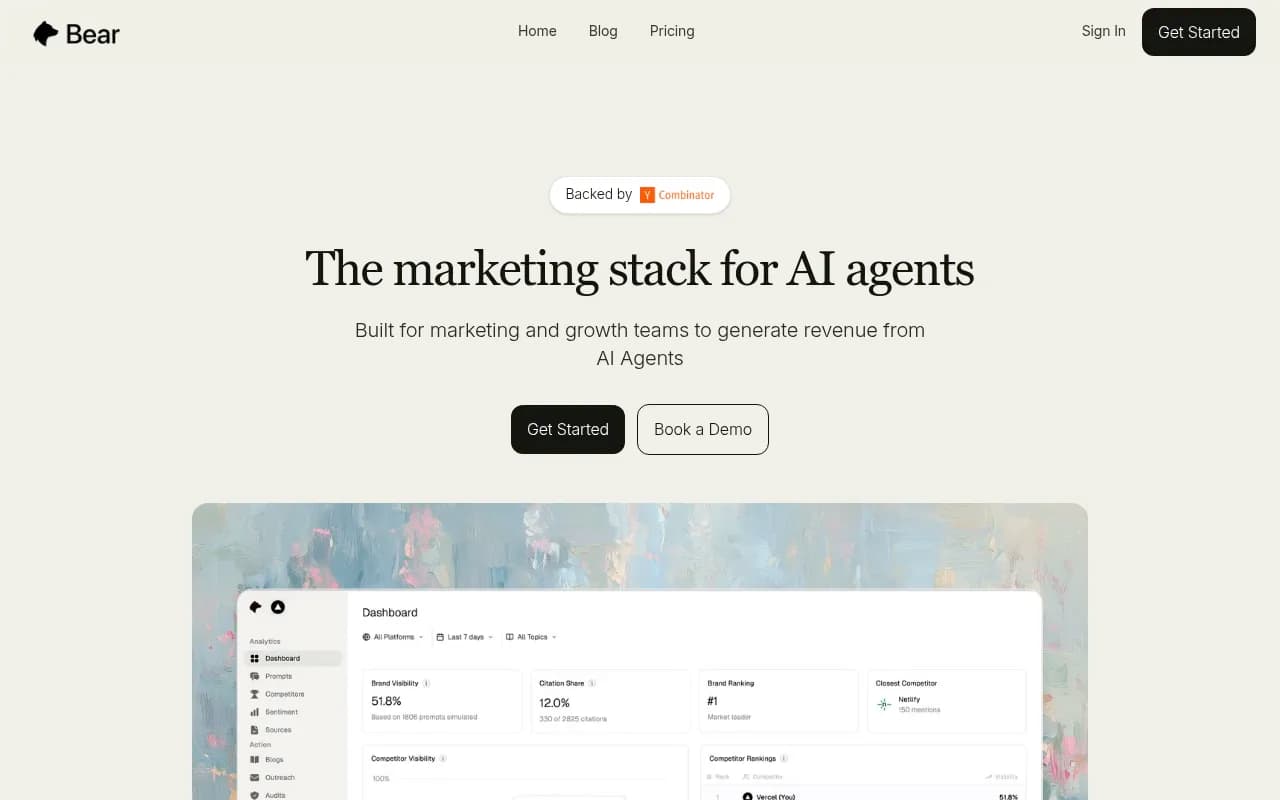
Bear AI calls itself "the marketing stack for AI agents" and targets marketing and growth teams looking to generate revenue from AI search. Backed by Y Combinator, it's used by companies like Peerspace, Medal, and Wispr Flow. The platform tracks how AI agents discover your brand and promises to help you optimize visibility to boost traffic. Bear AI emphasizes traffic analysis from "all major LLMs" and shows trending prompts users are asking about your brand.
The pitch is less about monitoring and more about understanding the customer journey through AI search -- seeing what users ask AI agents about your brand and how that translates to actual visits.
Otterly.AI

Otterly.AI is a straightforward AI search monitoring platform that tracks brand mentions and website citations across six major AI engines: ChatGPT, Perplexity, Google AI Overviews, Google AI Mode, Gemini, and Copilot. It positions itself as the "#1 rated AI search monitoring platform" and focuses on helping you see where you show up, what's being said, and which content gets cited.
The core value is visibility and auditing. Otterly.AI includes a GEO Audit tool that analyzes 25+ on-page factors to reveal what's holding your site back from earning more citations. It's built for teams that want to monitor their AI search presence without breaking the budget.
Side-by-Side Comparison
| Feature | Bear AI | Otterly.AI |
|---|---|---|
| Starting price | $100/mo | $29/mo |
| Free trial | Not advertised | 14 days |
| AI platforms monitored | GPT-5 only (Basic), all platforms (Enterprise) | 6 platforms (ChatGPT, Perplexity, Google AI Overviews, AI Mode, Gemini, Copilot) |
| Prompt tracking | 30 prompts (Basic) | 15 prompts (Lite), 100 prompts (Standard), unlimited (Premium) |
| Content generation | 2 blogs/mo (Basic) | Not included |
| GEO audit tool | Not mentioned | Yes (25+ factors) |
| Traffic attribution | Yes (core feature) | Not mentioned |
| Keyword research | Yes (trending prompts) | Yes (conversational keywords) |
| Citation tracking | Yes | Yes |
| Brand monitoring | Yes | Yes |
| Share of voice | Not mentioned | Yes |
| Team collaboration | Not specified | Yes |
| Enterprise pricing | Custom | Custom |
Pricing breakdown
The pricing gap between these two tools is significant and reflects different philosophies.
| Plan | Bear AI | Otterly.AI |
|---|---|---|
| Entry tier | $100/mo (Basic: GPT-5 only, 30 prompts, 2 blogs/mo) | $29/mo (Lite: 15 prompts, 6 platforms) |
| Mid tier | Not specified | $189/mo (Standard: 100 prompts, 6 platforms) |
| Top tier | Custom (Enterprise: all platforms, unlimited tracking) | Custom (Premium: unlimited prompts, 6 platforms) |
Bear AI's $100/mo entry point gets you only ChatGPT/GPT-5 monitoring, 30 prompts, and 2 blog posts per month. That's restrictive if you're trying to monitor a competitive category or track multiple product lines. You need to jump to Enterprise pricing (undisclosed) to get access to all AI platforms.
Otterly.AI's $29/mo Lite plan gives you 15 prompts across all 6 platforms. The $189/mo Standard plan bumps you to 100 prompts, which is enough for most mid-sized brands. The pricing is transparent and scales predictably.
For a small team just starting with AI search monitoring, Otterly.AI is 3.4x cheaper and gives you broader platform coverage. For a larger team that needs traffic attribution and content generation, Bear AI's Enterprise tier might make sense, but you'll need to talk to sales to find out what it costs.
Platform coverage
Bear AI's website says it analyzes "traffic from all major LLMs" and shows logos for Google Gemini, Claude, ChatGPT, AI Search, and Perplexity. But the Basic plan ($100/mo) only includes GPT-5. You need Enterprise pricing to get the other platforms.
Otterly.AI monitors 6 platforms at every tier: ChatGPT, Perplexity, Google AI Overviews, Google AI Mode, Gemini, and Copilot. Even the $29/mo plan gives you full platform coverage.
This is a big difference. If you're trying to understand your overall AI search visibility, you need to see how you're performing across multiple engines. Bear AI's basic tier doesn't give you that. Otterly.AI does.
Neither tool mentions tracking Claude, DeepSeek, Grok, or Meta AI -- platforms that tools like Promptwatch cover if you need more comprehensive monitoring.

Monitoring and tracking features
Both tools track brand mentions and website citations, but they present the data differently.
Bear AI emphasizes "trending prompts" -- showing you what users are asking AI agents about your brand. The dashboard appears to focus on high-volume queries and traffic attribution. You can see which prompts are driving actual visits to your site. This is useful if you're trying to connect AI visibility to revenue.
Otterly.AI focuses on Share of Voice -- showing you which brands get recommended and where you stand relative to competitors. The platform tracks which websites get cited for specific prompts and gives you a baseline to measure improvement. The GEO Audit tool (unique to Otterly.AI) analyzes your site's on-page factors and tells you what's holding you back from earning more citations.
Bear AI's approach is more traffic-focused. Otterly.AI's approach is more competitive-intelligence-focused.
If you care about "how many people clicked through from ChatGPT" -- Bear AI. If you care about "am I being mentioned more than my competitors" -- Otterly.AI.
Optimization and content tools
Bear AI includes content generation: 2 blog posts per month on the Basic plan. The website doesn't detail how this works or what the AI writer is optimizing for, but it's positioned as part of the "marketing stack" to help you create content that ranks in AI search.
Otterly.AI doesn't generate content. Instead, it gives you a GEO Audit that analyzes 25+ on-page factors and tells you what to fix. The idea is you take those insights and optimize your existing content or create new pages based on the gaps.
Bear AI's content generation is a nice add-on if you're resource-constrained and need help producing articles. But 2 posts per month is not much -- most brands publishing for AI search need to ship more than that. Otterly.AI's audit tool is more diagnostic: it tells you what's wrong, but you have to fix it yourself.
Neither tool offers the kind of deep content gap analysis or AI-powered writing agent you'd get from a platform like Promptwatch, which shows you exactly which prompts competitors rank for but you don't, then helps you generate content to fill those gaps.
Keyword research and prompt discovery
Bear AI shows "trending prompts" with volume indicators ("high-volume") and surfaces what users are asking AI agents about your brand. This is reactive -- you see what's already happening.
Otterly.AI offers "AI Keyword Research" to discover search prompts your audience is asking on ChatGPT, Perplexity, and Google. It positions this as a way to "uncover fresh conversational keywords" and guide your content strategy. This is more proactive -- you're finding new opportunities before competitors do.
Both approaches have value. Bear AI's trending prompts help you understand current demand. Otterly.AI's keyword research helps you find untapped queries. The difference is whether you want to react to what's working or discover what could work.
User interface and ease of use
Bear AI's website shows a clean dashboard with prompt cards, AI platform logos, and traffic metrics. The design feels modern and the focus on "trending prompts" makes it easy to see what's hot. The interface appears built for marketers who want quick insights without digging through data.
Otterly.AI's screenshots show a more data-dense interface with tables, charts, and audit results. It looks like a tool built for SEO teams who want to analyze and compare. The GEO Audit feature adds complexity but also depth -- you're not just seeing mentions, you're seeing why you're not getting mentioned.
Bear AI feels lighter and faster to scan. Otterly.AI feels more comprehensive and analytical. Your preference depends on whether you want a dashboard you check weekly or a tool you dig into for optimization projects.
Who should pick Bear AI
Bear AI makes sense if:
- You're a growth or marketing team focused on revenue attribution from AI search
- You primarily care about ChatGPT/GPT-5 visibility and are willing to pay for Enterprise to get other platforms
- You want some content generation help (even if it's just 2 posts/month)
- You need to show executives how AI search traffic translates to business outcomes
- You're backed by funding and $100+/mo is not a budget concern
Bear AI is the better choice for teams that want to connect AI visibility to actual traffic and revenue. The traffic attribution focus is its differentiator. If you're trying to prove ROI on AI search optimization, Bear AI gives you the data to do that.
Who should pick Otterly.AI
Otterly.AI makes sense if:
- You're on a tight budget and need affordable monitoring across multiple AI platforms
- You want broad platform coverage (6 engines) without paying for Enterprise pricing
- You need a GEO Audit tool to diagnose on-page issues and guide optimization
- You care about Share of Voice and competitive positioning in AI search
- You're an SEO team or agency managing multiple clients and need scalable prompt tracking
- You want to try before you buy (14-day free trial)
Otterly.AI is the better choice for teams that need comprehensive monitoring without breaking the budget. The $29/mo entry point and full platform coverage make it accessible for small teams. The GEO Audit tool adds diagnostic value that Bear AI doesn't offer.
Pros and cons
Bear AI pros
- Traffic attribution from AI agents (unique focus)
- Trending prompts with volume indicators
- Includes content generation (2 blogs/mo)
- Clean, marketer-friendly interface
- Y Combinator backing and brand-name customers
Bear AI cons
- Expensive entry point ($100/mo for GPT-5 only)
- Limited prompt tracking (30 prompts on Basic)
- No GEO audit or diagnostic tools
- Enterprise pricing required for full platform coverage
- No free trial advertised
- Only 2 blog posts per month on Basic (not enough for active content strategies)
Otterly.AI pros
- Affordable entry point ($29/mo)
- Full platform coverage (6 AI engines) at every tier
- GEO Audit tool analyzing 25+ on-page factors
- Share of Voice tracking for competitive analysis
- 14-day free trial
- Transparent pricing that scales predictably
Otterly.AI cons
- No content generation features
- No traffic attribution or revenue tracking
- Interface looks more data-dense and less polished
- Lite plan limited to 15 prompts (need Standard for 100)
- Doesn't track Claude, DeepSeek, Grok, or Meta AI
Final verdict
Otterly.AI wins for most teams. The $29/mo entry point, full platform coverage, and GEO Audit tool make it a better value for brands just starting with AI search monitoring. You get diagnostic insights and competitive intelligence without paying Enterprise prices.
Bear AI wins if you're a well-funded growth team that needs to prove AI search is driving revenue. The traffic attribution focus is valuable if you're trying to justify budget or show executives that AI visibility translates to business outcomes. But you'll need to pay for Enterprise to get full platform coverage, and the $100/mo Basic plan is too limited for serious monitoring.
For most marketing and SEO teams, Otterly.AI's combination of affordability, breadth, and audit capabilities makes it the smarter pick in 2026.