Key Takeaways
- Bear AI starts at $100/mo (Basic plan, GPT-5 only, 30 prompts) while LLMrefs starts at $79/mo with broader AI engine coverage from day one
- LLMrefs tracks 8+ AI engines on all plans (ChatGPT, Claude, Gemini, Perplexity, AI Overviews, Copilot, Meta AI, Grok), Bear AI's Basic plan only covers GPT-5
- Bear AI positions itself as a "marketing stack for AI agents" with traffic analytics focus, LLMrefs is built as a traditional SEO-style keyword ranking tracker
- LLMrefs automatically generates prompt variations from real conversations, Bear AI shows "trending prompts" but less detail on variation generation
- Both are monitoring-focused platforms -- neither offers built-in content generation or optimization workflows to fix visibility gaps
- LLMrefs has a stronger enterprise client roster (eBay, HubSpot, IKEA, Shopify) suggesting better traction with larger brands
Overview
Bear AI
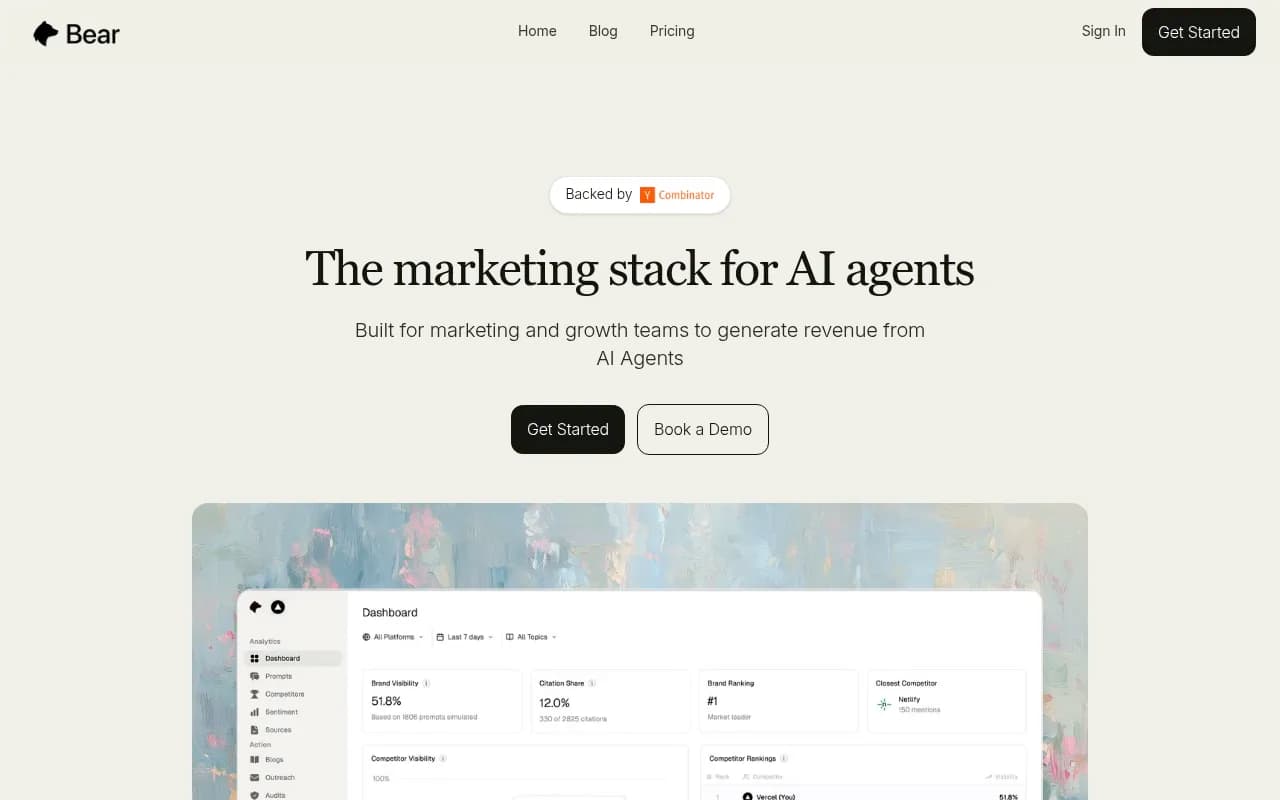
Bear AI is a Y Combinator-backed GEO platform that calls itself "the marketing stack for AI agents." It tracks how AI engines like ChatGPT, Perplexity, Claude, and Google AI Overviews discover and recommend your brand. The platform emphasizes traffic analytics -- seeing how AI agents are driving actual visits to your site. Bear AI is used by companies like Peerspace, Medal, and Wispr Flow. The interface shows trending prompts, citation tracking, and visibility metrics across major LLMs.
LLMrefs
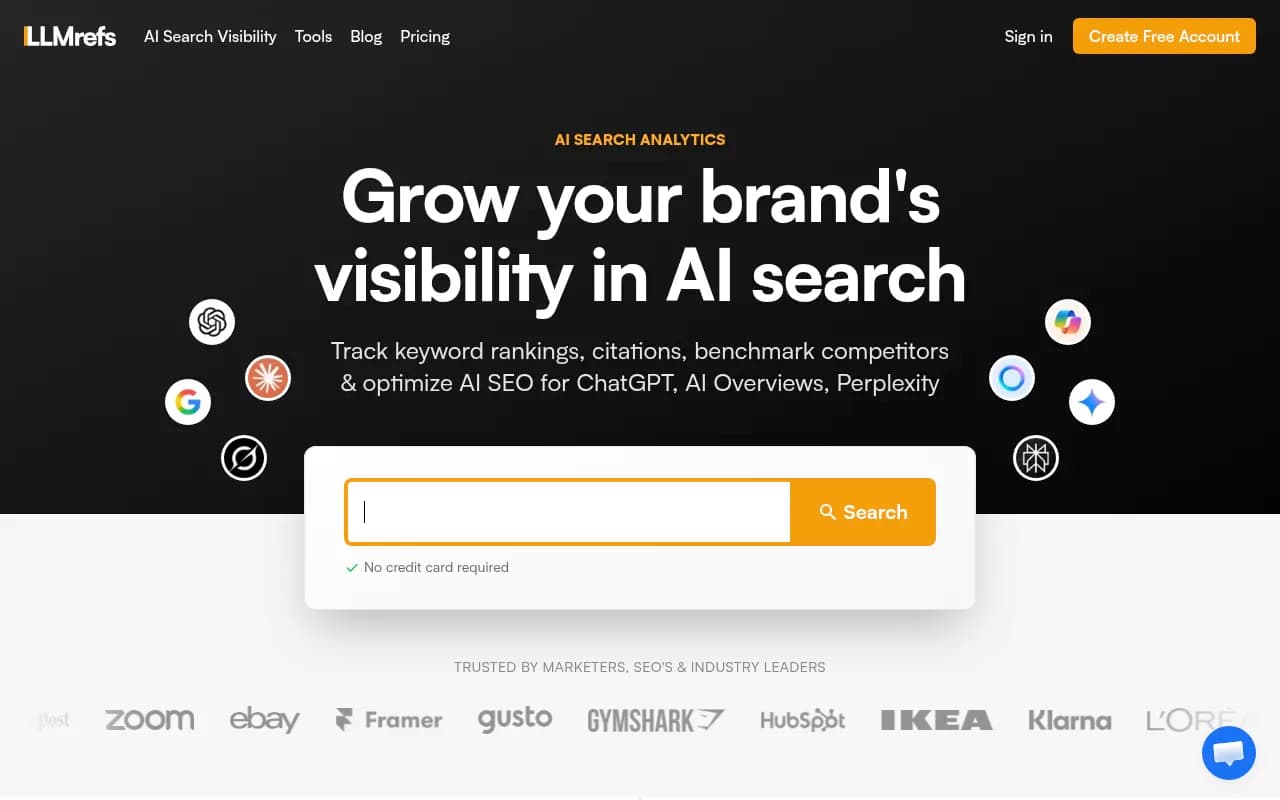
LLMrefs takes a keyword-first approach to AI search tracking. It monitors brand visibility, rankings, and citations across ChatGPT, Google AI Overviews, Perplexity, Claude, Gemini, Copilot, Meta AI, and Grok. Built for SEO teams and agencies, it automatically generates prompt variations from real user conversations and benchmarks your performance against competitors. The client list includes major brands like eBay, HubSpot, IKEA, Shopify, Gymshark, and The Washington Post. LLMrefs positions itself as an "AI search analytics" platform with a traditional SEO workflow feel.
Side-by-side comparison
| Feature | Bear AI | LLMrefs |
|---|---|---|
| Starting price | $100/mo | $79/mo |
| AI engines (Basic plan) | GPT-5 only | 8+ engines (ChatGPT, Claude, Gemini, Perplexity, AI Overviews, Copilot, Meta AI, Grok) |
| Prompt/keyword tracking | 30 prompts (Basic) | Not publicly specified |
| Content generation | 2 blogs/mo (Basic) | None mentioned |
| Competitor benchmarking | Yes | Yes |
| Citation tracking | Yes | Yes |
| Traffic analytics | Yes (emphasized) | Not emphasized |
| Prompt variation generation | Trending prompts shown | Auto-generated from real conversations |
| Enterprise clients | Startups/mid-market | eBay, HubSpot, IKEA, Shopify, etc. |
| Free trial | Not mentioned | Yes (no credit card) |
| API access | Not mentioned | Not mentioned |
| Multi-language support | Not specified | Not specified |
Pricing comparison
| Plan | Bear AI | LLMrefs |
|---|---|---|
| Entry plan | $100/mo (Basic: GPT-5 only, 30 prompts, 2 blogs/mo) | $79/mo (details not public) |
| Mid-tier | Not specified | Not specified |
| Enterprise | Custom pricing (all AI platforms, unlimited tracking) | Not specified |
| Free trial | Not mentioned | Yes (no credit card required) |
Bear AI's pricing is more transparent on their site, but the Basic plan's limitation to GPT-5 only is a significant constraint. LLMrefs doesn't publish full pricing tiers publicly but starts $21/mo cheaper and includes all major AI engines from the start.
AI engine coverage
This is where the two platforms diverge most sharply.
Bear AI's Basic plan ($100/mo) only tracks GPT-5. You need to upgrade to Enterprise (custom pricing) to get "all AI platforms." This is a tough sell if you're trying to understand your overall AI search visibility -- ChatGPT is important, but so are Perplexity, Claude, and Google AI Overviews. Limiting the entry plan to one engine means you're flying blind on the rest.
LLMrefs covers 8+ AI engines on all plans: ChatGPT, Claude, Gemini, Perplexity, Google AI Overviews, Microsoft Copilot, Meta AI, and Grok. This is the standard you'd expect from an AI search analytics tool in 2026. Different AI engines cite different sources and have different ranking behaviors, so tracking just one gives you an incomplete picture.
Verdict: LLMrefs wins on coverage. Bear AI's single-engine Basic plan is a non-starter for most teams.
Tracking and analytics approach
Bear AI frames itself around "traffic from AI agents" -- the homepage emphasizes seeing how AI agents are discovering your brand and driving visits. The dashboard shows trending prompts, visibility metrics, and what appears to be traffic attribution. The positioning is less about keyword rankings and more about understanding the customer journey from AI recommendation to site visit.
LLMrefs takes a classic SEO approach: track keyword rankings, monitor citations, benchmark competitors. The interface looks like it's built for SEO teams who are used to tracking keyword positions in Google and want the same workflow for AI search. It auto-generates prompt variations from real conversations, which is useful for discovering the long-tail of how people actually ask questions.
Both show you when and how AI engines mention your brand. The difference is framing: Bear AI emphasizes traffic and conversion, LLMrefs emphasizes rankings and visibility.
Verdict: Depends on your mental model. If you think like a performance marketer (traffic, attribution), Bear AI's framing will click. If you think like an SEO (keywords, rankings, SERP positions), LLMrefs will feel more familiar.
Prompt and keyword management
Bear AI's Basic plan tracks 30 prompts. The site shows "trending prompts" with volume indicators ("High-volume") but doesn't detail how prompts are sourced or how variations are generated. The focus seems to be on showing you what's popular rather than building a comprehensive keyword strategy.
LLMrefs "automatically generates prompt variations from real conversations." This is a key feature for AI search -- unlike Google where you can target exact keywords, AI engines respond to natural language with infinite variation. Auto-generating variations means you're tracking the semantic cluster around a topic, not just one phrasing. LLMrefs doesn't publish prompt limits on the $79/mo plan, which could mean more flexibility or could mean they're not competing on volume.
Verdict: LLMrefs' auto-variation generation is more sophisticated. Bear AI's 30-prompt limit on Basic is tight if you're tracking multiple product lines or topics.
Content generation and optimization
Bear AI includes 2 blog posts per month on the Basic plan, which suggests some kind of AI writing or content optimization feature. The site doesn't detail what this entails -- is it full articles, outlines, optimization suggestions? It's a differentiator on paper but hard to evaluate without more info.
LLMrefs doesn't mention content generation at all. It's a pure analytics and tracking play.
Neither platform offers the kind of end-to-end optimization workflow you'd get from a tool like Promptwatch, which combines tracking with content gap analysis and AI-generated articles designed to rank in AI search results.

Verdict: Bear AI has some content features, LLMrefs has none. But both are primarily monitoring tools, not optimization platforms.
Competitor benchmarking
Both platforms offer competitor tracking. Bear AI's site mentions seeing "how AI agents recommend your brand" with implied comparison to competitors. LLMrefs explicitly calls out "benchmark competitors" as a core feature.
Without hands-on access, it's hard to say which implementation is better. LLMrefs' enterprise client roster (eBay, HubSpot, IKEA) suggests their competitive analysis is robust enough for large brands with serious competitive intelligence needs.
Verdict: Likely similar capabilities, but LLMrefs' client list suggests more mature competitive features.
User interface and workflow
Bear AI's homepage shows a clean, modern dashboard with AI engine logos, trending prompts, and what looks like a prompt search interface. The design is polished and the "marketing stack" framing suggests a product built for growth teams, not just SEO specialists.
LLMrefs' homepage has a keyword search box front and center ("best womens running shoes") and emphasizes "track keyword rankings" -- the UI is clearly modeled after traditional SEO tools. The design is functional but less visually striking than Bear AI.
Verdict: Bear AI has a more modern, consumer-friendly interface. LLMrefs looks like a tool built by SEOs for SEOs.
Enterprise and scale
Bear AI lists startups and mid-market companies (Peerspace, Medal, Wispr Flow, Slashy, Defx, dabble). These are recognizable names in tech circles but not Fortune 500 brands.
LLMrefs lists eBay, HubSpot, IKEA, Shopify, Gymshark, L'Oreal, NVIDIA, Ralph Lauren, The Washington Post, and Zoom. This is a significantly stronger enterprise roster. It suggests LLMrefs has the features, reliability, and support infrastructure that large brands require.
Verdict: LLMrefs has proven enterprise traction. Bear AI is still building its client base.
Integration and API
Neither platform mentions API access or integrations on their public sites. This is a gap for both -- teams want to pipe AI search data into their existing analytics stack (Looker, Tableau, data warehouses).
Verdict: Tie, both lack public info on integrations.
Support and onboarding
Bear AI offers a "Book a Demo" option, suggesting a sales-assisted onboarding process. LLMrefs offers a free trial with no credit card required, which is more self-serve friendly.
Verdict: LLMrefs' no-card trial is lower friction. Bear AI's demo-first approach may provide more hand-holding but adds a sales step.
Pros and cons
Bear AI pros
- Modern, polished interface
- Traffic analytics and attribution focus
- Includes some content generation (2 blogs/mo on Basic)
- Y Combinator backing suggests strong product velocity
- Trending prompts feature for discovering high-volume queries
Bear AI cons
- Basic plan only tracks GPT-5 ($100/mo for one engine is expensive)
- Limited to 30 prompts on Basic
- Smaller enterprise client base
- No free trial mentioned
- Content generation details are vague
LLMrefs pros
- Covers 8+ AI engines on all plans from $79/mo
- Auto-generates prompt variations from real conversations
- Strong enterprise client roster (eBay, HubSpot, IKEA, Shopify)
- Free trial with no credit card required
- Built for SEO teams with familiar keyword-tracking workflow
- $21/mo cheaper starting price
LLMrefs cons
- No content generation or optimization features
- Less modern UI compared to Bear AI
- Pricing tiers not fully public
- Doesn't emphasize traffic attribution like Bear AI
Who should pick Bear AI
Pick Bear AI if you're a growth or performance marketing team that thinks in terms of traffic and conversion, not keyword rankings. The traffic analytics focus and modern interface will appeal to teams coming from Google Analytics or Mixpanel rather than Ahrefs or Semrush. The content generation feature (even if limited) is a bonus if you need help creating AI-optimized content.
Bear AI makes sense for startups and mid-market companies that are ChatGPT-first in their AI search strategy and can live with the Basic plan's GPT-5-only limitation. If you're planning to scale to Enterprise anyway, the broader AI engine coverage at that tier becomes viable.
Who should pick LLMrefs
Pick LLMrefs if you're an SEO team or agency that wants a keyword-tracking workflow applied to AI search. The 8+ AI engine coverage on the entry plan is the right default -- you need to see the full picture, not just ChatGPT. The auto-generated prompt variations are more sophisticated than manual prompt lists, and the enterprise client roster suggests a mature, reliable product.
LLMrefs is the better fit for larger brands, agencies managing multiple clients, and teams that need to justify AI search investment with concrete ranking and citation data. The free trial makes it easy to test before committing.
Final verdict
LLMrefs is the stronger choice for most teams in 2026. The $79/mo entry price with 8+ AI engines beats Bear AI's $100/mo single-engine plan on value and coverage. The enterprise client list (eBay, HubSpot, IKEA) proves LLMrefs can handle scale, and the auto-generated prompt variations are a more sophisticated approach to tracking AI search than static prompt lists. The free trial removes risk.
Bear AI has a more modern interface and an interesting traffic-first positioning, but the Basic plan's GPT-5-only limitation is a dealbreaker. You can't optimize what you can't measure, and measuring just one AI engine in 2026 leaves you blind to the majority of AI search traffic. If Bear AI opened up multi-engine tracking on the Basic plan, it would be a much closer race.
For teams serious about AI search visibility, LLMrefs is the practical pick today. Bear AI is worth watching as it matures and potentially adjusts its pricing tiers.