Key Takeaways
- Bear AI starts at $100/mo (GPT-5 only, 30 prompts, 2 blogs/mo) vs Rankshift at €69/mo (~$75, 150 prompts/day, 9,500 credits) -- Rankshift offers better value for prompt volume
- Rankshift includes unlimited users and projects on all plans; Bear AI's user limits are unclear but likely restricted on lower tiers
- Bear AI positions itself as a "marketing stack for AI agents" with revenue generation focus; Rankshift is a pure visibility tracking and analytics platform
- Rankshift offers a 30-day free trial; Bear AI does not mention a trial period
- Both track ChatGPT, Perplexity, Claude, and Gemini, but neither publishes a complete list of supported AI models
- Bear AI emphasizes content creation (2 blogs/mo on Basic plan); Rankshift focuses on monitoring and benchmarking without built-in content generation
Overview
Bear AI
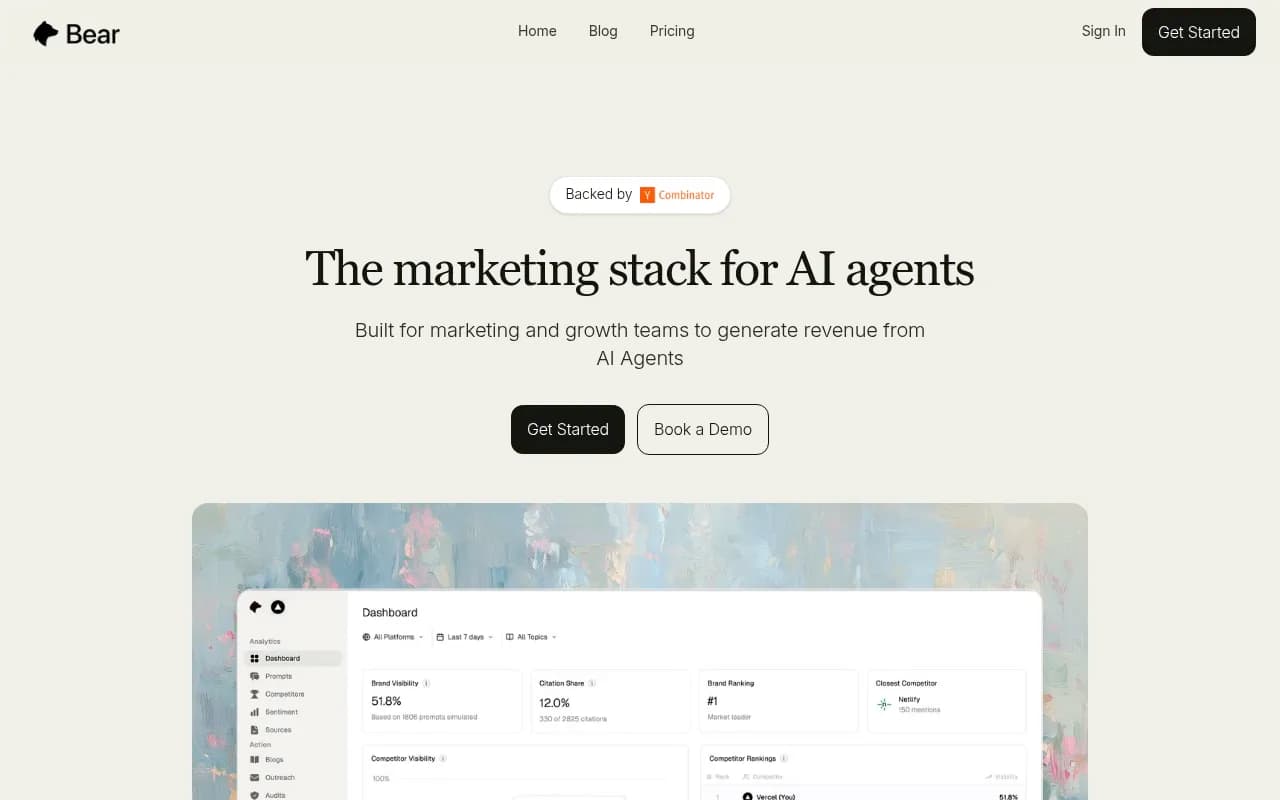
Bear AI markets itself as "the marketing stack for AI agents" and is backed by Y Combinator. The platform targets marketing and growth teams looking to generate revenue from AI search visibility. Bear AI combines tracking with content creation -- even the Basic plan includes 2 blog posts per month, suggesting an integrated approach to optimization. The company highlights clients like Peerspace, Medal, and Wispr Flow.
The platform's positioning is aggressive: it's not just about tracking where you appear, but about driving actual traffic and conversions from AI agents. This revenue-first framing sets it apart from pure monitoring tools.
Rankshift
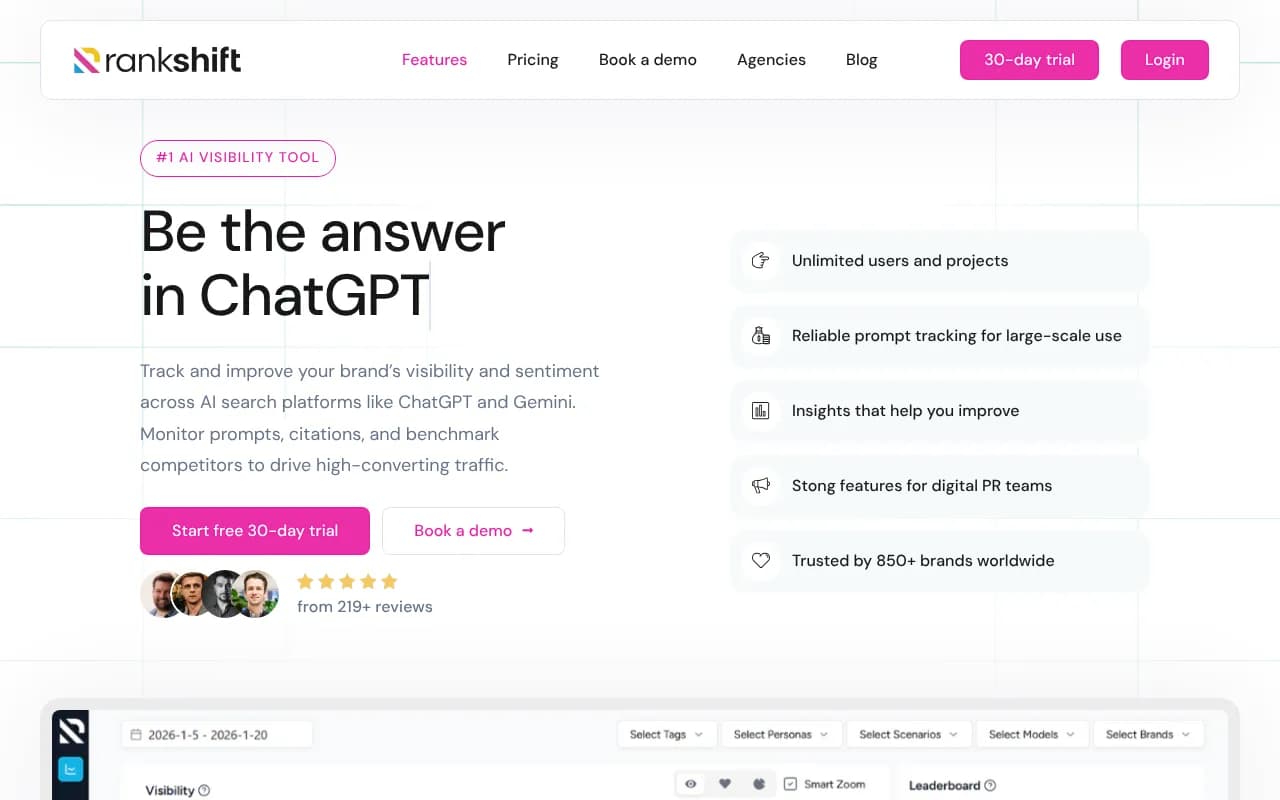
Rankshift is a European platform (pricing in euros) that describes itself as an "AI Visibility Tracking Tool" and "AI Search Analytics platform." It's used by 850+ brands including Coolblue, Orange, and Salesflare. Rankshift emphasizes reliability for large-scale prompt tracking and positions itself as particularly strong for digital PR teams.
The platform promises a 3-minute setup and focuses on helping brands "be the answer" in ChatGPT, Perplexity, AI Overviews, and Gemini. Unlike Bear AI's revenue angle, Rankshift centers on visibility metrics, sentiment tracking, and competitor benchmarking.
Side-by-side comparison
| Feature | Bear AI | Rankshift |
|---|---|---|
| Starting price | $100/mo | €69/mo (~$75) |
| Free trial | Not mentioned | 30 days |
| Entry-level prompt volume | 30 prompts/mo | 150 prompts/day (4,500/mo) |
| Users included | Unclear | Unlimited (all plans) |
| Projects included | Unclear | Unlimited (all plans) |
| AI models tracked | ChatGPT, Perplexity, Claude, Gemini, AI Overviews (partial list) | ChatGPT, Perplexity, Claude, Gemini, AI Overviews (partial list) |
| Content generation | ✓ (2 blogs/mo on Basic) | ✗ |
| Competitor benchmarking | ✓ | ✓ |
| Sentiment tracking | Not mentioned | ✓ |
| Citation tracking | ✓ | ✓ |
| Annual discount | Not mentioned | 10% |
| Target audience | Marketing/growth teams | Brands, agencies, digital PR teams |
Pricing breakdown
Both platforms use tiered pricing but structure it differently.
Bear AI pricing
| Plan | Price | Prompts | Content | AI Models |
|---|---|---|---|---|
| Basic | $100/mo | 30 prompts | 2 blogs/mo | GPT-5 only |
| Higher tiers | Not disclosed | Not disclosed | Not disclosed | Not disclosed |
| Enterprise | Custom | Unlimited tracking | Not disclosed | All platforms |
Bear AI's public pricing is sparse. The Basic plan is limited to GPT-5 (presumably ChatGPT) only, which is a significant restriction. You need to contact sales to learn about mid-tier options. The Enterprise tier unlocks all AI platforms and unlimited tracking, but no pricing is published.
Rankshift pricing
| Plan | Price | Prompts | Credits | Users/Projects |
|---|---|---|---|---|
| Starter | €69/mo | 150/day | 9,500 | Unlimited |
| Mid-tier | Not disclosed | Not disclosed | Not disclosed | Unlimited |
| Business | €359/mo | 850/day | 53,000 | Unlimited |
| Agency/Enterprise | Custom | Custom | Custom | Unlimited |
Rankshift is more transparent. The Starter plan gives you 150 prompts per day (4,500/mo) for €69 -- 150x the prompt volume of Bear AI's Basic plan at a lower price. The Business plan at €359/mo supports 850 prompts/day (25,500/mo). All plans include unlimited users and projects, which is a big deal for agencies or larger teams. Annual billing gets you 10% off.
Rankshift uses a credit system on top of prompt limits, but it's not clear from the website what credits control beyond prompt volume.
Feature comparison
AI model coverage
Both platforms track the major AI search engines: ChatGPT, Perplexity, Claude, Gemini, and Google AI Overviews. Bear AI's Basic plan only covers "GPT-5" (likely ChatGPT), which is a major limitation. You need Enterprise to get all platforms.
Rankshift doesn't restrict AI model access by plan tier -- you get all supported models from the Starter plan up. This is a cleaner approach if you want comprehensive coverage from day one.
Neither platform publishes a complete list of supported AI models. Bear AI mentions "all major LLMs" on its homepage but doesn't enumerate them. Rankshift similarly shows logos for ChatGPT, Perplexity, Claude, Gemini, and AI Overviews but doesn't confirm if that's the full list. If you need coverage for models like Grok, DeepSeek, Mistral, or Meta AI, you'll need to ask both vendors directly.
Prompt tracking and discovery
Bear AI shows "trending prompts" on its dashboard and claims to help you "see what users ask AI agents about your brand." The Basic plan limits you to 30 prompts per month, which is tight if you're trying to monitor a broad set of queries.
Rankshift gives you 150 prompts per day on the Starter plan (4,500/mo). That's enough headroom to track a wide range of branded and category queries without constantly hitting limits. The platform emphasizes "reliable prompt tracking for large-scale use," which suggests it's built for higher volume.
For prompt discovery -- finding new queries to track -- both platforms mention this capability but neither explains the mechanics in detail on their websites. You're likely relying on manual prompt entry plus some level of suggestion from the tool.
Content optimization and creation
This is where the two platforms diverge sharply.
Bear AI includes content creation in every plan. The Basic plan comes with 2 blog posts per month. The implication is that Bear AI will help you write content optimized for AI search visibility. This is a big value-add if you're a small team without dedicated content resources.
Rankshift does not offer content generation. It's purely a tracking and analytics platform. You get visibility data, competitor benchmarks, and citation analysis, but you're on your own to create content that improves your rankings.
If you want an all-in-one tool that tracks and creates content, Bear AI is the obvious choice. If you already have a content team and just need data, Rankshift is cleaner and cheaper.
Worth noting: if you're looking for a platform that goes even further on the content creation side -- with AI-powered writing grounded in citation data and prompt volumes -- Promptwatch combines tracking with a built-in content generation engine that's designed specifically to rank in AI search results.

Competitor benchmarking
Both platforms support competitor tracking. Bear AI's homepage mentions analyzing "how AI agents are discovering your brand" and implies you can compare against competitors, but details are thin.
Rankshift explicitly calls out competitor benchmarking as a core feature. The platform lets you track competitor visibility across the same prompts and see where they're outranking you. This is table-stakes for any serious GEO tool, and Rankshift makes it clear they've built for it.
Sentiment and citation analysis
Rankshift tracks sentiment -- whether AI models are saying positive, neutral, or negative things about your brand. This is critical for reputation management. If ChatGPT starts citing a negative Reddit thread about your product, you want to know immediately.
Bear AI doesn't mention sentiment tracking on its website. It does emphasize citation tracking ("see how AI talks about you"), but without sentiment analysis, you're only getting half the picture.
Both platforms show which sources AI models are citing when they mention your brand. This helps you understand what content is driving your visibility and where you might need to publish or optimize.
User and project limits
Rankshift includes unlimited users and unlimited projects on every plan, including the €69 Starter tier. This is a huge advantage for agencies managing multiple clients or for companies with large marketing teams. You're not paying per seat.
Bear AI doesn't disclose user or project limits on its pricing page. For a $100/mo tool, it's reasonable to assume the Basic plan has restrictions, but you'll need to ask sales.
Setup and ease of use
Rankshift claims a "3-minute setup" and shows a simple three-step process: add prompts and brands, choose AI models, get insights. The interface screenshots look clean and dashboard-focused.
Bear AI's website is heavier on marketing copy and lighter on product screenshots. The dashboard image shows a modern interface with trending prompts and AI model logos, but there's less transparency about the actual workflow.
Both platforms are likely easy to set up -- this is not complex software. The difference is that Rankshift is more upfront about what the setup process looks like.
Free trial
Rankshift offers a 30-day free trial. That's enough time to load in your prompts, track results for a few weeks, and decide if the data is useful.
Bear AI does not mention a free trial. You can book a demo, but it's unclear if you can test the platform hands-on before committing to $100/mo.
Pros and cons
Bear AI pros
- Includes content creation (2 blogs/mo even on Basic plan)
- Backed by Y Combinator with focus on revenue generation
- Positions itself as a full "marketing stack" rather than just a tracker
- Trending prompts feature helps with discovery
Bear AI cons
- Basic plan only covers GPT-5 (ChatGPT), not other AI models
- Only 30 prompts/mo on Basic plan -- very limiting
- No free trial mentioned
- Pricing for mid-tier plans not disclosed
- User and project limits unclear
- No mention of sentiment tracking
Rankshift pros
- Much higher prompt volume (150/day on Starter vs 30/mo on Bear Basic)
- Lower starting price (€69 vs $100)
- 30-day free trial
- Unlimited users and projects on all plans
- Sentiment tracking included
- All AI models available on all plans (no model restrictions by tier)
- 10% discount on annual billing
- Transparent pricing for Starter and Business tiers
Rankshift cons
- No built-in content generation
- Credit system is not well explained on the website
- Mid-tier pricing not disclosed (only Starter and Business shown)
- Fewer details about prompt discovery features
Who should choose Bear AI
Pick Bear AI if:
- You're a small marketing team that needs content creation help, not just tracking. The 2 blogs/mo on the Basic plan could be worth the $100 if the content is decent.
- You're only concerned with ChatGPT visibility right now. If GPT-5 is your main focus and you're okay ignoring Perplexity, Claude, and Gemini for now, the Basic plan makes sense.
- You want a platform that's explicitly focused on revenue generation and conversion, not just visibility metrics.
- You're comfortable with less transparent pricing and are willing to talk to sales to understand the full product.
Bear AI is the better fit if you're treating AI search as a growth channel and want an integrated tool that tracks and creates content. The Y Combinator backing and revenue-first positioning suggest the company is building for startups and growth teams that need to move fast.
Who should choose Rankshift
Pick Rankshift if:
- You need high prompt volume without breaking the bank. 150 prompts/day for €69 is hard to beat.
- You're managing multiple brands or clients. Unlimited users and projects on all plans is a game-changer for agencies.
- You want to test before you buy. The 30-day free trial removes risk.
- You need sentiment tracking to monitor brand reputation in AI search results.
- You already have a content team and just need visibility data to inform your strategy.
- You want access to all AI models from day one, not just ChatGPT.
Rankshift is the better choice if you're a larger brand, an agency, or a digital PR team that needs reliable tracking at scale. The platform is more mature in its analytics capabilities and more transparent in its pricing.
Final verdict
Rankshift wins on value, transparency, and flexibility. For most teams, 150 prompts/day, unlimited users, and a 30-day trial at €69/mo is a better deal than 30 prompts/mo and GPT-5-only coverage at $100/mo. The sentiment tracking and competitor benchmarking are also more developed.
Bear AI's main advantage is the integrated content creation. If you're a small team that needs the tool to write blog posts for you, that's a real differentiator. But if you have content resources in-house, you're paying for a feature you don't need while getting less tracking capability.
For teams serious about AI search visibility, Rankshift is the safer bet in 2026. It's built for scale, priced fairly, and doesn't lock core features behind higher tiers. Bear AI is worth considering if the content generation is a must-have, but most buyers will get more mileage out of Rankshift's tracking depth and prompt volume.