Key Takeaways
- Airefs is significantly cheaper -- $24/mo gets you started vs Rankscale's €20/mo credit system that can scale much higher
- Rankscale covers 10 AI engines (ChatGPT, Perplexity, Claude, Gemini, DeepSeek, Mistral, Grok, Copilot, AI Overviews, AI Mode) while Airefs appears to focus on a narrower set
- Rankscale offers deeper analysis features: citation tracking, sentiment analysis, competitor benchmarking, and website audits -- Airefs is more straightforward visibility monitoring
- Airefs has a 7-day free trial and clearer tiered pricing ($24/$49/$83/$249), making it easier to predict costs. Rankscale uses flexible credit allocation which can be confusing.
- For basic "am I showing up in AI search?" tracking on a tight budget, Airefs wins. For comprehensive analysis and optimization insights, Rankscale justifies the higher price.
- Neither platform offers content generation or gap analysis -- if you want to actually fix visibility issues (not just track them), tools like Promptwatch add that optimization layer on top of monitoring.
Overview
Rankscale
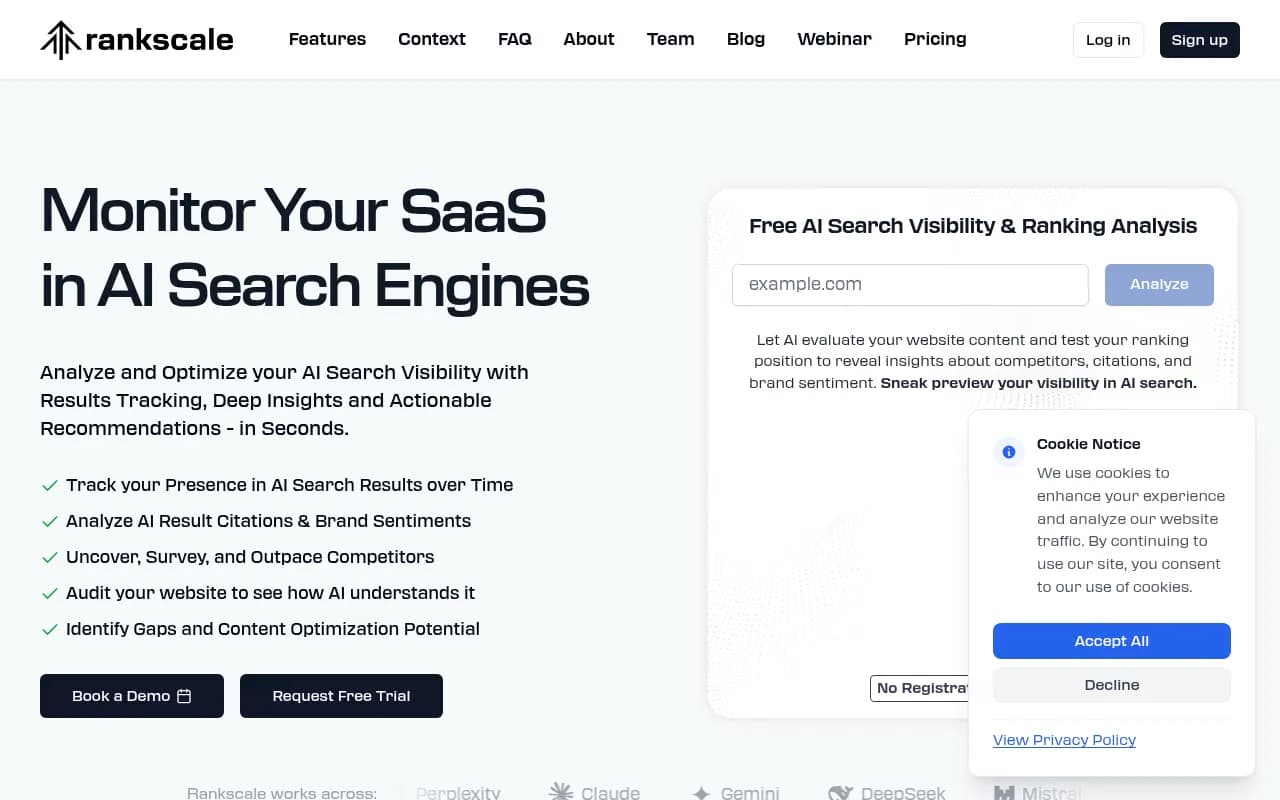
Rankscale positions itself as a comprehensive AI search visibility platform. It tracks how your brand appears across 10 different AI engines and provides detailed analytics on rankings, citations, sentiment, and competitive positioning. The platform emphasizes "deep insights" and "actionable recommendations" -- not just showing you the data, but helping you understand what it means.
The credit-based pricing model gives flexibility but makes it harder to predict monthly costs. You're essentially buying query credits that get consumed as you run searches and analyses across different AI platforms.
Airefs
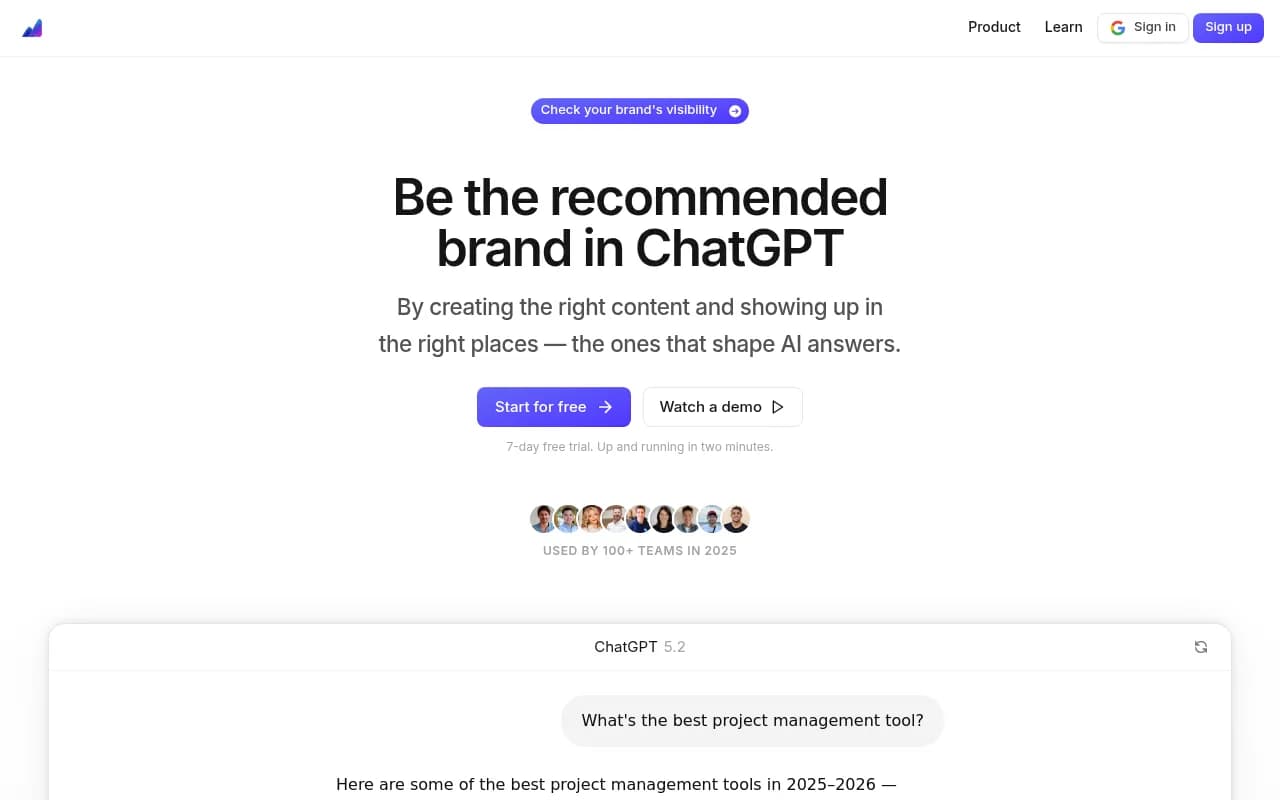
Airefs takes a simpler, more budget-conscious approach. It's built for teams that want to monitor AI search visibility without breaking the bank. The $24/mo entry point is one of the lowest in the AI visibility tracking space.
The platform offers a 7-day free trial and straightforward tiered pricing that scales from solo users to agencies. It's less about deep analysis and more about consistent monitoring -- tracking whether you're showing up and how that changes over time.
Side-by-Side Comparison
| Feature | Rankscale | Airefs |
|---|---|---|
| Starting price | €20/mo (credit-based) | $24/mo (Lite plan) |
| Free trial | Available on request | 7 days |
| AI engines covered | 10 (ChatGPT, Perplexity, Claude, Gemini, DeepSeek, Mistral, Grok, Copilot, AI Overviews, AI Mode) | Not fully specified (likely fewer) |
| Citation tracking | ✓ Deep analysis | ✓ Basic |
| Sentiment analysis | ✓ | ✗ |
| Competitor benchmarking | ✓ | Limited |
| Website audit | ✓ (AI understanding audit) | ✗ |
| Content recommendations | ✓ Actionable insights | ✗ |
| Pricing model | Credit-based (flexible but complex) | Fixed tiers (predictable) |
| Agency plans | ✓ Enterprise custom | ✓ $249/mo package |
| Best for | Teams wanting deep analysis | Budget-conscious monitoring |
Pricing breakdown
Rankscale pricing
Rankscale uses a credit system that starts at €20/month. The credits get allocated across different features:
| Plan | Price | What you get |
|---|---|---|
| Essentials | €20/mo | Base credit allocation |
| Mid-tier | Custom | More credits, more queries |
| Enterprise | Custom | Unlimited credits, dedicated support |
The challenge: you won't know exactly how many queries you can run until you start using it. Credits get consumed differently depending on which AI engines you query and how deep your analysis goes.
Airefs pricing
Airefs keeps it simple with fixed monthly tiers:
| Plan | Price | Best for |
|---|---|---|
| Lite | $24/mo | Solo users, basic tracking |
| Pro | $49/mo | Small teams, more queries |
| Expert | $83/mo | Growing businesses |
| Agency | $249/mo | Agencies managing multiple clients |
All plans include the 7-day free trial. No credit math required -- you know exactly what you're paying each month.
Feature depth: Where Rankscale pulls ahead
Citation and source analysis
Rankscale doesn't just tell you "you ranked #3 for this query." It shows you which specific pages, articles, or content pieces the AI engine cited when mentioning your brand. You can see the exact sources that influenced the AI's response.
Airefs tracks visibility but doesn't go as deep into citation-level analysis. You'll know if you appeared, but not necessarily which content drove that appearance.
Sentiment tracking
Rankscale analyzes how AI engines talk about your brand -- positive, negative, neutral. This matters because showing up in AI results with negative framing is worse than not showing up at all.
Airefs doesn't appear to offer sentiment analysis. It's focused on presence, not perception.
Website audit feature
One of Rankscale's more interesting capabilities: it audits your website to understand how AI engines interpret your content. This helps you identify gaps between what you think you're communicating and what AI models actually understand.
Airefs doesn't have this. It's a monitoring tool, not an audit tool.
Competitor benchmarking
Both platforms let you track competitors, but Rankscale goes deeper. You can see side-by-side comparisons of which queries competitors dominate, how their visibility trends compare to yours, and where you're losing ground.
Airefs offers competitor tracking but with less analytical depth. You'll see the data but won't get as much help interpreting it.
AI engine coverage
Rankscale explicitly lists 10 AI engines: ChatGPT, Perplexity, Claude, Gemini, DeepSeek, Mistral, Grok, Copilot, Google AI Overviews, and Google AI Mode. That's comprehensive coverage of the major players in 2026.
Airefs doesn't publish a full list of supported engines on its website. Based on the "AI-powered search results" language, it likely covers the major ones (ChatGPT, Perplexity, maybe Gemini), but probably not all 10. If you need to track a specific niche AI engine, verify with Airefs before signing up.
User experience and learning curve
Airefs wins on simplicity. The interface is straightforward: set up your tracking queries, check your dashboard, see if you're showing up. It's built for people who want answers fast without wading through layers of analysis.
Rankscale has more features, which means more complexity. The credit system adds a layer of mental overhead ("Do I have enough credits for this query?"). But if you're serious about understanding AI visibility, that complexity buys you deeper insights.
What's missing from both
Neither Rankscale nor Airefs helps you create content or fix visibility gaps. They're monitoring platforms -- they show you the problem but don't help you solve it.
If you discover you're not showing up for important queries, you're on your own to figure out what content to create or how to optimize existing pages. That's where platforms like Promptwatch come in -- they connect the monitoring data to actual content generation and optimization workflows.

Who should pick Rankscale
Go with Rankscale if:
- You need comprehensive coverage across all major AI engines
- Citation-level detail matters to your strategy
- You want to understand sentiment and perception, not just visibility
- You're willing to pay more for deeper analysis
- You need the website audit feature to understand how AI interprets your content
- You're managing a brand where AI visibility directly impacts revenue
Rankscale is the power user option. It's for teams that treat AI search visibility as a strategic priority and need the data to back up optimization decisions.
Who should pick Airefs
Go with Airefs if:
- Budget is your primary constraint
- You want straightforward "are we showing up?" tracking without complexity
- You don't need deep citation or sentiment analysis
- Predictable monthly costs matter more than flexible credit allocation
- You're just starting to monitor AI visibility and want to keep it simple
- You're a solo marketer or small team without dedicated AI search resources
Airefs is the practical choice for teams that need visibility monitoring but can't justify enterprise-level analytics spend.
Pricing reality check
Here's the thing about the credit-based vs fixed-tier debate: Rankscale's model can work out cheaper if you only need occasional deep dives. But it can also spiral if you're running lots of queries across multiple AI engines.
Airefs' fixed pricing means you know exactly what you're paying. The $24/mo Lite plan is genuinely affordable -- less than most SEO tools charge for a single user. But you might hit limits faster than you expect if you're tracking multiple brands or running frequent checks.
For most teams, I'd start with Airefs' 7-day trial to see if the basic monitoring meets your needs. If you find yourself wanting more depth ("Why did we drop in rankings?" "What content are they citing?"), that's when Rankscale's extra features justify the higher cost.
The bigger picture: Monitoring vs optimization
Both tools fall into the "monitoring" category. They tell you what's happening but don't help you change it. That's fine -- monitoring is valuable. You can't improve what you don't measure.
But in 2026, the AI visibility space is splitting into two camps: pure monitoring tools (Rankscale, Airefs, Otterly.AI, Peec.ai) and optimization platforms that connect monitoring to content creation and gap analysis. If you're serious about improving AI visibility (not just tracking it), you'll eventually need both pieces.
Final verdict
Airefs wins on price and simplicity. If you're budget-constrained or just starting to track AI visibility, the $24/mo entry point is hard to beat. You get basic monitoring without complexity.
Rankscale wins on depth and coverage. If AI search visibility is a strategic priority and you need detailed insights to guide optimization efforts, the extra cost buys you genuinely useful analysis.
For most teams, I'd recommend starting with Airefs' free trial. If the basic tracking feels insufficient after a week, upgrade to Rankscale. If it's enough, stick with Airefs and save the budget difference for actually creating content that improves your visibility.