Key Takeaways
- Otterly.AI is 86% cheaper for small teams -- $29/mo gets you started vs Rankscale's €20/mo credit system that burns through quickly
- Rankscale covers 10 AI engines (including DeepSeek, Mistral, Grok) while Otterly.AI tracks 6 (ChatGPT, Perplexity, Google AI Overviews, AI Mode, Gemini, Copilot)
- Both are monitoring-only platforms -- neither offers content generation, crawler logs, or traffic attribution like action-oriented tools
- Otterly.AI has transparent prompt limits (15-100+ prompts per plan) while Rankscale uses a credit system that makes costs harder to predict
- Rankscale emphasizes deep analysis with sentiment tracking and competitive benchmarking, while Otterly.AI focuses on straightforward brand mention tracking
- For pure monitoring on a budget, Otterly.AI wins. For broader LLM coverage and deeper analytics, Rankscale is worth the premium.
Overview
Otterly.AI

Otterly.AI positions itself as the affordable entry point into AI search monitoring. It tracks brand mentions and website citations across six major AI platforms -- ChatGPT, Google AI Overviews, Perplexity, Google AI Mode, Gemini, and Copilot. The pitch is simple: see where your brand shows up in AI-generated answers without breaking the bank. Plans start at $29/mo for 15 prompts, scaling up to $189/mo for 100 prompts. The platform includes a GEO audit tool that analyzes 25+ on-page factors to identify what's holding your site back from earning more citations. It's a monitoring dashboard with some diagnostic features, but no content creation or optimization tools built in.
Rankscale
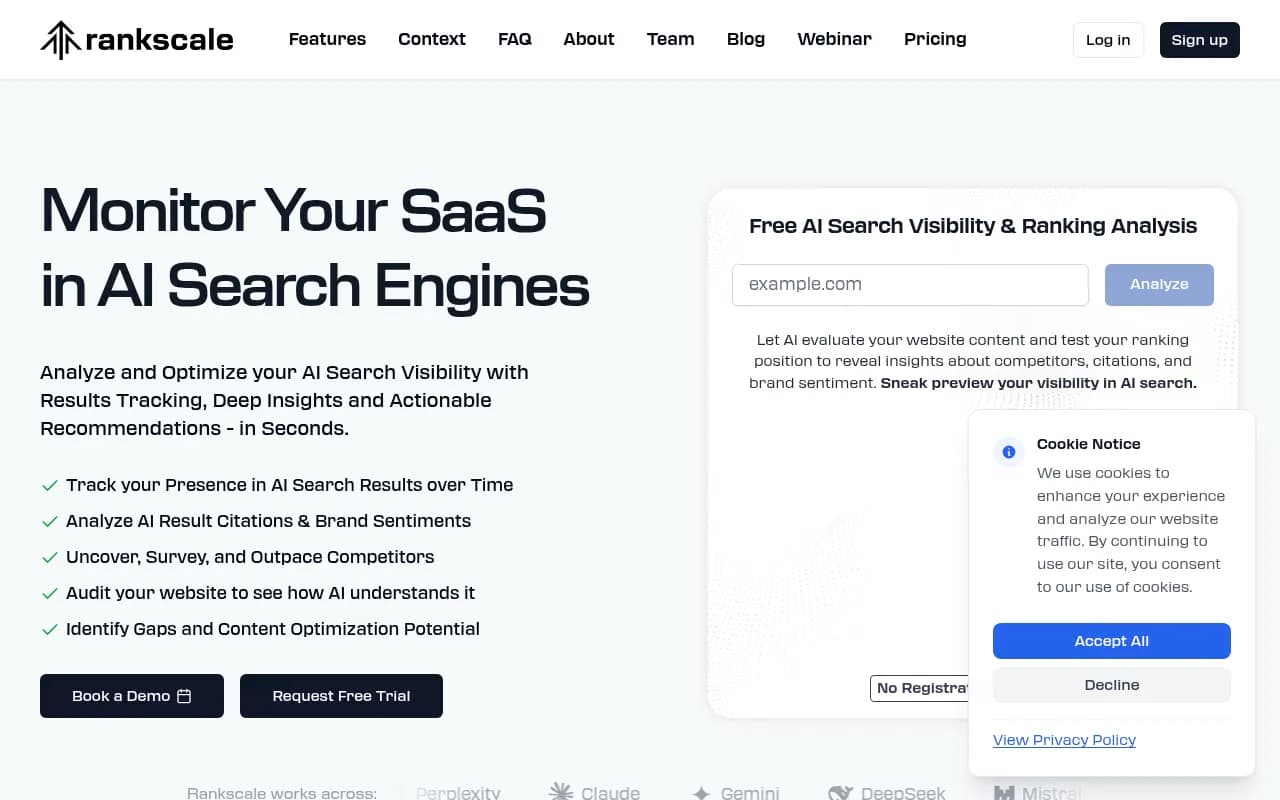
Rankscale takes a more analytical approach to AI search visibility. It monitors 10 AI engines -- ChatGPT, Google AI Overviews, Perplexity, Claude, Gemini, DeepSeek, Mistral, Grok, Copilot, and Google AI Mode. The platform emphasizes "deep insights" with sentiment analysis, competitive benchmarking, and website audits that show how AI models understand your content. Pricing is credit-based starting at €20/mo, but the actual cost depends on how many queries you run. Rankscale markets itself as a tool for brands that want detailed analytics and competitor intelligence, not just basic mention tracking.
Side-by-Side Comparison
| Feature | Otterly.AI | Rankscale |
|---|---|---|
| Starting price | $29/mo (15 prompts) | €20/mo (credit-based) |
| AI engines tracked | 6 (ChatGPT, Perplexity, AI Overviews, AI Mode, Gemini, Copilot) | 10 (adds Claude, DeepSeek, Mistral, Grok) |
| Prompt/query limits | 15-100+ prompts per plan | Credit-based (variable) |
| Free trial | 14 days | Available on request |
| Brand mention tracking | ✓ | ✓ |
| Citation tracking | ✓ | ✓ |
| Sentiment analysis | ✗ | ✓ |
| Competitor benchmarking | Basic | Advanced |
| GEO audit | ✓ (25+ factors) | ✓ (website audit) |
| Content generation | ✗ | ✗ |
| Crawler logs | ✗ | ✗ |
| Traffic attribution | ✗ | ✗ |
| Pricing transparency | High (fixed prompts) | Low (credit burn rate unclear) |
LLM coverage: Rankscale tracks 4 more AI engines
Otterly.AI covers the big six: ChatGPT, Google AI Overviews, Perplexity, Google AI Mode, Gemini, and Microsoft Copilot. That's the core set most brands care about in early 2026. If your audience primarily uses these platforms, Otterly.AI's coverage is sufficient.
Rankscale adds Claude, DeepSeek, Mistral, and Grok to the mix. Claude matters if you're targeting technical or research-heavy audiences. DeepSeek is gaining traction in Asia. Mistral and Grok are smaller but growing. The question is whether you need visibility into these additional engines or if the core six are enough.
Verdict: Rankscale wins on breadth. If you're tracking a global brand or want comprehensive LLM coverage, the extra four engines justify the higher cost. For most small-to-midsize brands, Otterly.AI's six-engine coverage hits the important platforms.
Pricing: Otterly.AI is transparent, Rankscale is opaque
Otterly.AI uses straightforward plan tiers:
- Lite: $29/mo for 15 prompts
- Standard: $189/mo for 100 prompts
- Premium: Custom pricing for unlimited prompts
You know exactly how many queries you get. If you need to track 50 prompts monthly, you can calculate the cost upfront.
Rankscale uses a credit system starting at €20/mo. The problem: it's unclear how many queries one credit buys, how fast credits burn, or what happens when you run out mid-month. The website mentions "flexible credit allocation" but doesn't publish a rate card. This makes budgeting difficult. You might start at €20/mo and discover you need €100/mo to run the queries you actually need.
Pricing comparison table
| Plan tier | Otterly.AI | Rankscale |
|---|---|---|
| Entry level | $29/mo (15 prompts) | €20/mo (credits, unclear query count) |
| Mid-tier | $189/mo (100 prompts) | Not published |
| Enterprise | Custom (unlimited prompts) | Custom |
| Free trial | 14 days | Request-based |
Verdict: Otterly.AI wins on pricing transparency. You can budget accurately. Rankscale's credit system feels like a trap -- you won't know the real cost until you're already using it.
Monitoring features: Both track mentions and citations, Rankscale adds sentiment
Both platforms do the core job: track where your brand appears in AI-generated answers and which pages get cited. You can monitor visibility over time, see which prompts trigger mentions, and identify gaps where competitors appear but you don't.
Otterly.AI keeps it simple. You get brand mention counts, citation tracking, and a GEO audit that scores your pages on 25+ factors (structured data, content depth, authority signals, etc.). The audit tells you what's missing but doesn't help you fix it -- you're on your own for content optimization.
Rankscale adds sentiment analysis and deeper competitive benchmarking. You can see whether AI models describe your brand positively, negatively, or neutrally. The competitor analysis shows not just who appears for the same prompts, but how their visibility trends compare to yours over time. Rankscale also emphasizes "deep insights" -- presumably more granular breakdowns of why certain pages get cited.
Verdict: Tie with a lean toward Rankscale. If you just need to know "are we showing up?", Otterly.AI is enough. If you want to understand sentiment and competitive positioning, Rankscale's extra analytics are worth it.
What both tools are missing: The action gap
Here's the problem with both platforms: they show you the data but leave you stuck. You see that competitors rank for 50 prompts you don't. You see your brand mentioned 30% less than last month. You see which pages get cited. Then what?
Neither Otterly.AI nor Rankscale helps you create content that fixes the gaps. No AI writing tools. No content recommendations. No crawler log analysis to see if AI bots are even reading your site. No traffic attribution to connect visibility to revenue.
You're paying for a dashboard that tells you there's a problem, then sends you off to solve it manually. For brands serious about AI search optimization, this is where tools like Promptwatch come in -- they close the loop by showing you the content gaps, generating articles grounded in citation data, and tracking the results with page-level visibility and traffic attribution.

Verdict: Both tools are monitoring-only. If you want to actually optimize for AI search, you'll need additional tools in your stack.
GEO audit capabilities: Similar features, different presentation
Otterly.AI's GEO audit analyzes 25+ on-page factors: structured data, content depth, internal linking, authority signals, mobile optimization, and more. You get a score and a list of issues. It's a diagnostic checklist -- useful for identifying problems, but it doesn't prioritize fixes or explain impact.
Rankscale's website audit shows "how AI understands your content" and identifies "gaps and content optimization potential." The marketing copy suggests more sophisticated analysis, but without hands-on testing it's hard to know if the output is meaningfully different from Otterly.AI's checklist.
Both audits are better than nothing. Neither replaces a real content strategist who can prioritize fixes based on business impact.
Verdict: Tie. Both offer basic audits. Neither is a game-changer.
User experience and onboarding
Otterly.AI emphasizes ease of use. The website copy is straightforward, the pricing is clear, and the 14-day free trial lets you test without a sales call. You can sign up and start tracking in minutes.
Rankscale requires a demo booking or trial request. The website is heavier on marketing language ("deeply analyze," "actionable recommendations") and lighter on specifics. The credit-based pricing means you'll likely need to talk to sales to understand real costs.
For small teams or solo marketers who want to start monitoring today, Otterly.AI's self-serve approach is faster. For enterprise teams with budget and a need for hand-holding, Rankscale's demo-first approach might be fine.
Verdict: Otterly.AI wins for self-serve simplicity. Rankscale feels more enterprise-sales-oriented.
Pros and cons
Otterly.AI pros
- Cheapest entry point at $29/mo
- Transparent prompt-based pricing
- 14-day free trial, no sales call required
- Covers the six most important AI engines
- Simple GEO audit with 25+ factor checklist
- Fast onboarding for small teams
Otterly.AI cons
- Only 6 AI engines (missing Claude, DeepSeek, Mistral, Grok)
- No sentiment analysis
- Basic competitor benchmarking
- Monitoring-only -- no content creation or optimization tools
- No crawler logs or traffic attribution
Rankscale pros
- Tracks 10 AI engines including Claude, DeepSeek, Mistral, Grok
- Sentiment analysis for brand mentions
- Advanced competitor benchmarking
- Emphasizes "deep insights" and detailed analytics
- Website audit to show how AI understands your content
Rankscale cons
- Credit-based pricing is opaque and hard to budget
- Higher cost for equivalent query volume
- Requires demo/trial request instead of instant signup
- Monitoring-only -- no content generation or optimization
- No crawler logs or traffic attribution
Who should pick which tool
Pick Otterly.AI if:
- You're a small team or solo marketer with a tight budget
- You need to track the core six AI engines (ChatGPT, Perplexity, Google AI Overviews, AI Mode, Gemini, Copilot)
- You want transparent pricing and predictable costs
- You prefer self-serve onboarding without sales calls
- Basic brand mention and citation tracking is enough
Pick Rankscale if:
- You need visibility into 10 AI engines including Claude, DeepSeek, Mistral, and Grok
- Sentiment analysis and advanced competitor benchmarking matter to your strategy
- You have budget flexibility and don't mind credit-based pricing
- You're willing to book a demo to understand real costs
- You want deeper analytics even if you still have to do the optimization work yourself
Skip both if:
- You need more than monitoring -- you want content gap analysis, AI-generated articles, crawler logs, and traffic attribution. In that case, look at end-to-end platforms that help you take action on the data, not just view it.
Final verdict
Otterly.AI wins for budget-conscious teams that need straightforward AI search monitoring. At $29/mo for 15 prompts, it's the cheapest way to start tracking brand visibility in ChatGPT, Perplexity, and Google's AI products. The transparent pricing and self-serve onboarding make it easy to get started.
Rankscale is the better choice if you need broader LLM coverage (10 engines vs 6) and deeper analytics like sentiment tracking and competitive benchmarking. But the credit-based pricing is a red flag -- you won't know the real cost until you're already using it.
Both tools share the same fundamental limitation: they're monitoring dashboards, not optimization platforms. You'll see the problems but you're on your own to fix them. For brands serious about ranking in AI search, that's only half the battle.