Key Takeaways
- Rankshift offers better value for money with a 30-day free trial and plans starting at €69/mo for 150 prompts/day, while Rankscale uses credit-based pricing starting at €20/mo but with less transparent credit allocation
- Both platforms track the same 10 AI models (ChatGPT, Perplexity, Claude, Gemini, AI Overviews, DeepSeek, Mistral, Grok, Copilot, AI Mode), so LLM coverage is identical
- Rankshift includes unlimited users and projects on all plans -- a major advantage for agencies and teams. Rankscale's user limits aren't clearly disclosed
- Rankshift emphasizes digital PR team features and large-scale prompt tracking reliability, making it stronger for enterprise use cases
- Rankscale highlights website auditing and content gap analysis in its messaging, positioning itself more toward content optimization
- Neither platform offers content generation capabilities -- they're both monitoring-focused tools that show you the data but leave you to act on it yourself
Overview
Rankshift
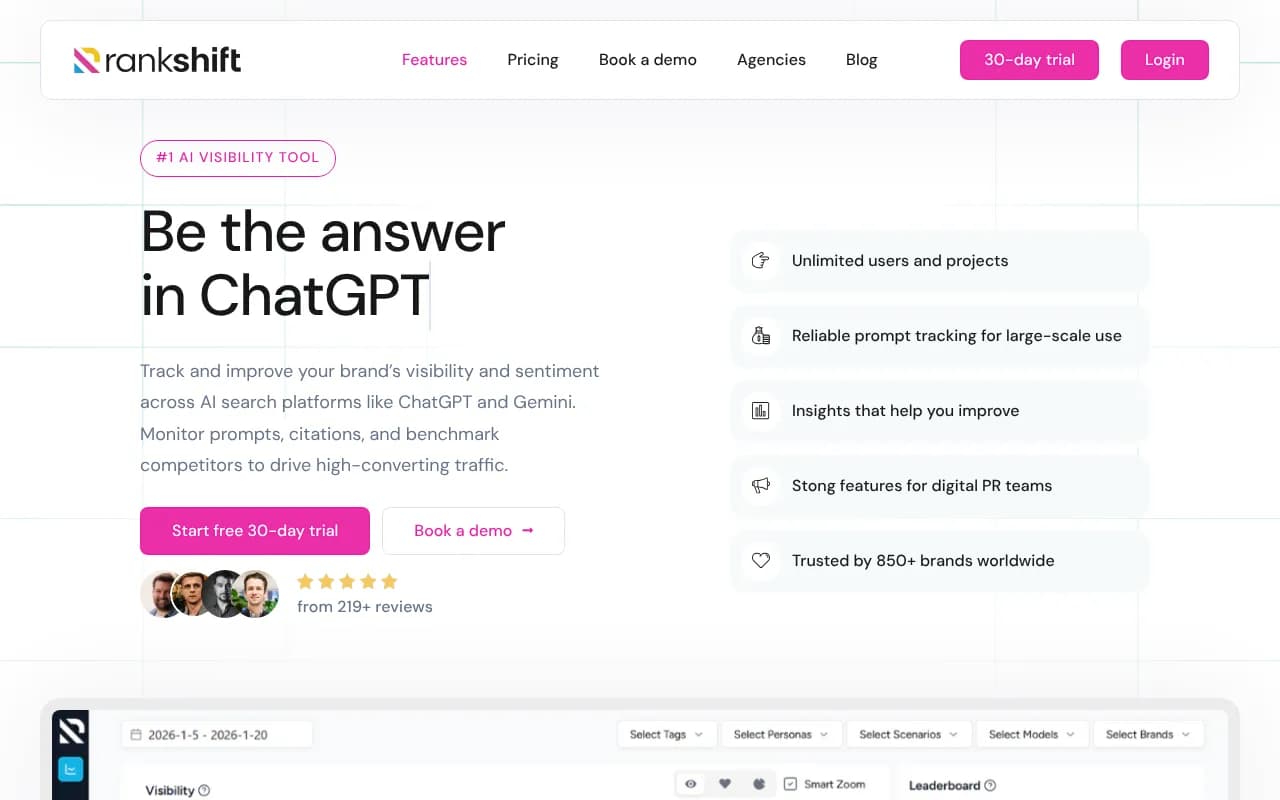
Rankshift is a specialized AI visibility tracking platform built for brands and agencies that need to monitor how they show up across large language models. The platform tracks mentions, citations, and sentiment across 10 AI search engines including ChatGPT, Perplexity, Claude, and Gemini. It's positioned as the "#1 AI visibility tool" and emphasizes reliability for large-scale prompt tracking, making it a fit for enterprise teams and digital PR departments. With over 850 brands using it and clients like Coolblue and Salesflare, Rankshift has built a reputation in the European market. The platform offers unlimited users and projects on all plans, which is a standout feature for teams.
Rankscale
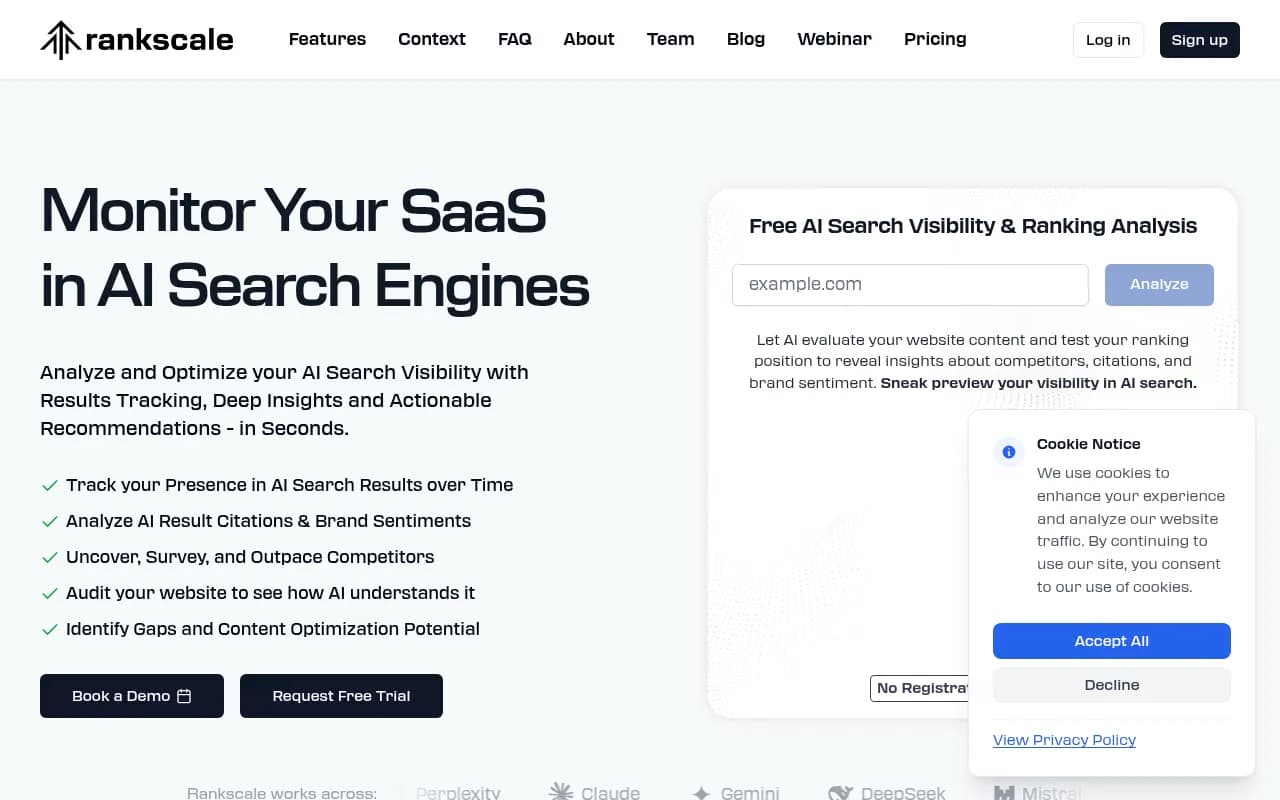
Rankscale takes a similar approach to AI search visibility tracking, monitoring the same 10 AI models as Rankshift. The platform markets itself around "deep analysis" and actionable recommendations, with a focus on website auditing and understanding how AI engines interpret your content. Rankscale uses credit-based pricing that starts lower than Rankshift (€20/mo vs €69/mo), but the credit system makes it harder to compare apples-to-apples. The platform emphasizes content gap identification and optimization potential, suggesting it's aimed at marketers who want to improve their content strategy based on AI search insights.
Side-by-Side Comparison
| Feature | Rankshift | Rankscale |
|---|---|---|
| Starting price | €69/mo (Starter) | €20/mo (Essentials) |
| Free trial | 30 days | Available (request) |
| AI models tracked | 10 (ChatGPT, Perplexity, Claude, Gemini, AI Overviews, DeepSeek, Mistral, Grok, Copilot, AI Mode) | 10 (same coverage) |
| Prompts per day (entry plan) | 150 | Credit-based (unclear) |
| Users included | Unlimited (all plans) | Not disclosed |
| Projects included | Unlimited (all plans) | Not disclosed |
| Competitor benchmarking | ✓ | ✓ |
| Citation analysis | ✓ | ✓ |
| Sentiment tracking | ✓ | ✓ |
| Website audit | Not emphasized | ✓ (highlighted feature) |
| Content gap analysis | Not emphasized | ✓ (highlighted feature) |
| Digital PR features | ✓ (emphasized) | Not emphasized |
| Annual discount | 10% | Not disclosed |
| Target audience | Agencies, enterprise teams, digital PR | Content marketers, SEO teams |
Pricing: Transparent vs credit-based
Rankshift pricing
Rankshift uses straightforward monthly pricing with clear limits:
| Plan | Price | Prompts/day | Credits | Users | Projects |
|---|---|---|---|---|---|
| Starter | €69/mo | 150 | 9,500 | Unlimited | Unlimited |
| Professional | €169/mo | 400 | 25,000 | Unlimited | Unlimited |
| Business | €359/mo | 850 | 53,000 | Unlimited | Unlimited |
| Agency/Enterprise | Custom | Custom | Custom | Unlimited | Unlimited |
All plans include a 30-day free trial and 10% discount on annual billing. The unlimited users and projects across all tiers is a real differentiator -- most competitors charge per seat or limit projects.
Rankscale pricing
Rankscale uses credit-based pricing starting at €20/month, but the website doesn't clearly break down what you get for each tier. The plans are labeled Essentials, Professional, Business, and Enterprise, with "flexible credit allocation" mentioned but no specific numbers disclosed upfront. This makes it harder to evaluate value. You need to book a demo or request a trial to understand what €20/mo actually gets you in terms of prompts tracked or features unlocked.
The credit system might work well if you have variable usage patterns, but it adds friction when you're trying to compare costs. Rankshift's transparent prompt-per-day limits are easier to plan around.
LLM coverage: Identical tracking
Both platforms track the exact same 10 AI models:
- ChatGPT (OpenAI)
- Perplexity
- Claude (Anthropic)
- Gemini (Google)
- AI Overviews (Google)
- DeepSeek
- Mistral
- Grok (xAI)
- Copilot (Microsoft)
- AI Mode (Google)
This is table stakes for any AI visibility platform in 2026. Neither tool has an edge here. If you need broader coverage -- say, Meta AI or other emerging models -- you'd need to look at alternatives like Promptwatch, which tracks 11+ models and adds capabilities like crawler log analysis and content generation.

Feature depth: Monitoring vs optimization
Rankshift's strengths
Rankshift emphasizes reliability and scale. The platform is built for teams that need to track hundreds of prompts daily without worrying about rate limits or data gaps. Key features:
- Large-scale prompt tracking: The Business plan supports 850 prompts per day, which is substantial for enterprise monitoring
- Digital PR focus: Rankshift markets itself to PR teams tracking brand mentions and sentiment across AI platforms
- Unlimited collaboration: Every plan includes unlimited users and projects, making it easy to onboard your entire team or manage multiple clients
- Competitor benchmarking: Track how you stack up against competitors across all tracked models
- Citation and source analysis: See which sources AI models are pulling from when they mention (or don't mention) your brand
What's missing: Rankshift doesn't emphasize content creation or optimization tools. It shows you the data, but you're on your own to act on it.
Rankscale's strengths
Rankscale positions itself more toward content optimization and gap analysis:
- Website audit: Rankscale highlights the ability to audit your website and see how AI engines understand your content -- useful for identifying structural issues
- Content gap identification: The platform claims to surface gaps and optimization opportunities, though specifics on how this works aren't detailed on the website
- Actionable recommendations: Rankscale emphasizes giving you next steps, not just data dumps
- Deep analysis: The marketing copy stresses "deep insights" and analysis, suggesting more interpretation layer on top of raw tracking data
What's missing: Like Rankshift, Rankscale is a monitoring tool. It doesn't generate content or help you create the assets you need to improve visibility. You get insights, but you still need to write the articles, update the pages, and optimize the content yourself.
User experience and setup
Both platforms claim quick setup -- Rankshift says "3 minutes" to get started:
- Set up your prompts and add your brands
- Choose the AI models you want to monitor
- Get insights on visibility and key sources
Rankscale's website doesn't detail the onboarding flow as clearly, but the general process is likely similar: define your brand, add prompts, select models, start tracking.
Rankshift has a slight edge in transparency here. The website shows actual dashboard screenshots and walks you through the setup visually. Rankscale's site is more abstract, with less concrete UI previews.
Team collaboration and scalability
This is where Rankshift pulls ahead. Unlimited users and projects on every plan -- even the €69/mo Starter tier -- is a huge advantage if you're an agency managing multiple clients or an in-house team that wants to give access to PR, marketing, and executive stakeholders without worrying about seat costs.
Rankscale doesn't disclose user limits on its website. If you're a solo marketer, this might not matter. But if you're a team of five or an agency with ten clients, the lack of clarity is a red flag. You'll need to ask during the demo, and there's a good chance you'll hit user caps that drive up costs.
Competitor benchmarking
Both platforms offer competitor tracking. You can see how your brand compares to rivals across the AI models you're monitoring. This is standard in the AI visibility space -- you want to know not just where you rank, but where your competitors rank too.
Neither platform goes into detail on the website about how granular this gets. Can you track 5 competitors? 20? Do you get side-by-side heatmaps showing prompt-by-prompt performance? These are questions you'd need to ask in a demo.
What's missing from both platforms
Here's the thing: Rankshift and Rankscale are both monitoring tools. They tell you where you're visible and where you're not. They show you citations, sentiment, and competitor performance. But they don't help you fix the problem.
If you discover you're invisible for 200 high-value prompts, you're stuck. You know the gap exists, but now you need to:
- Figure out what content to create
- Write that content (or hire someone to write it)
- Optimize it for AI search (which is different from traditional SEO)
- Publish it and wait weeks to see if it moves the needle
This is the action gap that most AI visibility platforms have. They're dashboards, not optimization engines. If you want a platform that not only tracks visibility but also helps you generate the content to improve it, you'd need something like Promptwatch, which combines tracking with an AI writing agent that creates articles grounded in real citation data and prompt analysis.
Pros and cons
Rankshift pros
- Transparent pricing with clear prompt limits
- 30-day free trial (no credit card required)
- Unlimited users and projects on all plans
- Strong reputation with 850+ brands using it
- Built for large-scale, reliable tracking
- 10% annual discount
Rankshift cons
- Higher entry price (€69/mo vs €20/mo)
- No content generation or optimization tools
- Less emphasis on website auditing and gap analysis
- Monitoring-only -- you're on your own to act on insights
Rankscale pros
- Lower starting price (€20/mo)
- Emphasizes website auditing and content gaps
- Claims to offer actionable recommendations
- Credit-based pricing might suit variable usage patterns
Rankscale cons
- Credit system is opaque -- hard to evaluate value
- User and project limits not disclosed
- Less transparent about features and capabilities
- No clear free trial details ("request" suggests gated access)
- Monitoring-only -- no content creation tools
Who should pick which tool
Pick Rankshift if:
- You're an agency or team that needs unlimited users and projects
- You want transparent pricing and clear prompt limits
- You're tracking at scale (hundreds of prompts per day)
- You value reliability and a proven track record (850+ brands)
- You're willing to pay more for better team collaboration features
- You want a 30-day free trial to test before committing
Pick Rankscale if:
- You're a solo marketer or small team with a tight budget
- You want website auditing and content gap analysis emphasized
- You prefer credit-based pricing and variable usage
- You're okay with less transparency and willing to book a demo to understand costs
- You don't need unlimited users or projects
Consider alternatives if:
- You want content generation built in, not just monitoring
- You need crawler log analysis to see how AI bots are indexing your site
- You want prompt intelligence (volume estimates, difficulty scores)
- You're looking for Reddit and YouTube citation tracking
- You want a platform that helps you close the loop from insight to action
In that case, Promptwatch is worth a look. It's the only platform that combines tracking with an AI content generation engine, so you can go from "we're invisible for these prompts" to "here's the article that will fix it" in one workflow.
Final verdict
Rankshift is the better choice for most teams. The transparent pricing, unlimited users and projects, and proven track record make it a safer bet, especially if you're managing multiple brands or working in an agency setting. Yes, it costs more upfront (€69/mo vs €20/mo), but you're getting clearer value and fewer surprises.
Rankscale might work if you're a solo operator on a tight budget and you're willing to navigate the credit system. But the lack of transparency around pricing, user limits, and features is a friction point. You'll spend time in demos trying to figure out what you're actually getting.
Both platforms have the same fundamental limitation: they're monitoring tools, not optimization platforms. They show you the problem but don't help you solve it. If you want to track visibility and generate the content to improve it in one place, you'll need to look beyond these two options.