Key Takeaways
- Pricing gap is massive: Rankscale starts at €20/month with credit-based plans, while Bluefish starts around $4,000/month with annual contracts -- a 200x difference that reflects fundamentally different target markets
- Bluefish is enterprise-only: Built for Fortune 500 brands with multi-brand portfolios, dedicated account teams, and custom infosec reviews. Rankscale targets SMBs, agencies, and mid-market brands with self-serve onboarding
- Feature depth vs breadth: Bluefish offers deeper customization (custom audiences, tailored prompts, advanced segmentation) but covers fewer AI models. Rankscale covers 10+ AI engines with standard tracking
- Actionability differs: Rankscale provides website audits and content gap identification. Bluefish focuses on measurement frameworks and optimization workflows for large marketing teams
- Decision point: If you're a small-to-mid-size brand or agency managing multiple clients, Rankscale is the obvious choice. If you're a Fortune 500 company with a dedicated AI marketing budget, Bluefish is built for your scale
- Neither platform generates content: Both are monitoring and optimization platforms -- they show you what's wrong but don't help you create the content to fix it. Tools like Promptwatch fill that gap with AI-powered content generation grounded in citation data
Overview
Rankscale
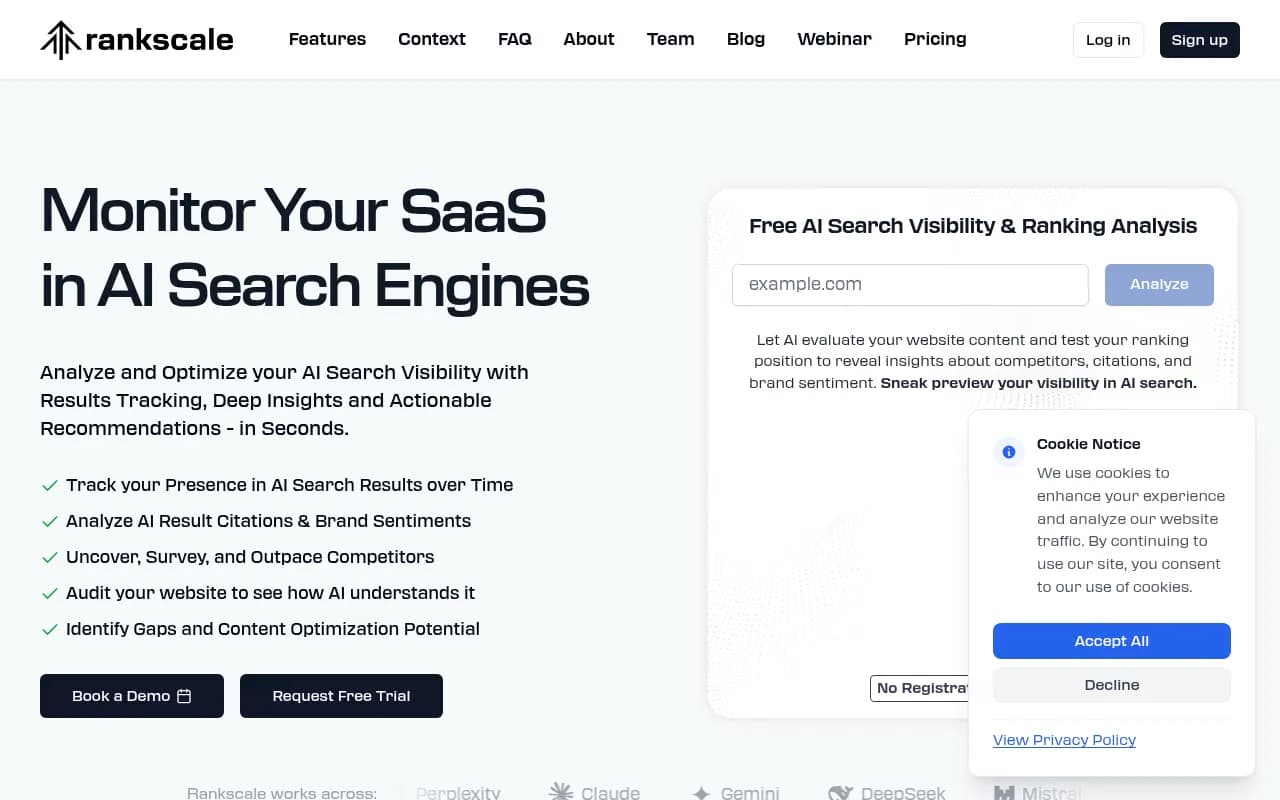
Rankscale is an AI search visibility platform designed for brands, agencies, and mid-market companies that want to track how they show up in AI-generated answers. It monitors 10 AI engines (ChatGPT, Perplexity, Claude, Gemini, AI Overviews, DeepSeek, Mistral, Grok, Copilot, AI Mode) and provides tracking, competitive benchmarking, citation analysis, and website audits. The platform uses credit-based pricing starting at €20/month, making it accessible for smaller teams and agencies managing multiple clients. Rankscale positions itself as a self-serve tool with quick setup and actionable insights delivered in seconds.
Bluefish
Bluefish is an enterprise-grade AI marketing platform built specifically for Fortune 500 brands. It focuses on deep visibility, control, and measurement across AI search and agentic commerce channels. Bluefish emphasizes going "beyond superficial metrics" with custom audiences, tailored prompts, and advanced performance tools that help large marketing teams understand how AI "thinks" about their brand. The platform is designed for multi-brand portfolios, passes enterprise infosec reviews, and provides dedicated account management. Pricing starts around $4,000/month with annual contracts and custom enterprise plans based on the number of brands and markets tracked.
Side-by-Side Comparison
| Feature | Rankscale | Bluefish |
|---|---|---|
| Starting Price | €20/month (credit-based) | ~$4,000/month (annual contract) |
| Target Audience | SMBs, agencies, mid-market | Fortune 500, enterprise brands |
| AI Engines Covered | 10+ (ChatGPT, Perplexity, Claude, Gemini, AI Overviews, DeepSeek, Mistral, Grok, Copilot, AI Mode) | Fewer models, focus on ChatGPT and Perplexity |
| Free Trial | Yes | Demo-based sales process |
| Onboarding | Self-serve | Dedicated account team |
| Custom Audiences | Standard personas | Fully customizable |
| Prompt Customization | Standard prompt sets | Tailored prompts for your brand |
| Website Audit | ✓ Included | Not emphasized |
| Content Gap Analysis | ✓ Identifies optimization potential | Not emphasized |
| Multi-Brand Management | Available in higher tiers | Core feature |
| Infosec Reviews | Standard security | Passes Fortune 500 infosec reviews |
| Data Export/API | Not specified | Advanced customization for data teams |
| Contract Terms | Monthly or annual | Annual contracts standard |
Pricing: The 200x difference
The pricing gap between these two platforms tells you everything about who they're built for.
Rankscale pricing
| Plan | Price | What You Get |
|---|---|---|
| Essentials | €20/month | Credit-based allocation, basic tracking |
| Mid-tier plans | €50-200/month (estimated) | More credits, additional features |
| Enterprise | Custom | Multi-brand, agency features |
Rankscale uses a credit system where each query or tracking action consumes credits. This model works well for agencies managing multiple clients or brands that want to control costs by tracking only high-priority prompts. You can start small and scale up as needed.
Bluefish pricing
| Plan | Price | What You Get |
|---|---|---|
| Enterprise | ~$4,000/month minimum | Custom based on brands, markets, features |
| Large Enterprise | $10,000-50,000+/month (estimated) | Multi-brand portfolios, dedicated support |
Bluefish doesn't publish pricing because every deal is custom. The $4,000/month starting point is based on market research and competitor positioning. For a Fortune 500 brand tracking 5-10 brands across multiple markets with custom audiences and dedicated account management, you're looking at mid-five-figures monthly.
Verdict: If you're spending less than $50,000/year on AI visibility, Rankscale is the only realistic option. Bluefish's pricing makes sense only if you have a dedicated AI marketing budget in the six-figure range.
Feature depth: Customization vs coverage
AI engine coverage
Rankscale monitors 10+ AI engines out of the box. You get visibility across ChatGPT, Perplexity, Claude, Gemini, Google AI Overviews, DeepSeek, Mistral, Grok, Copilot, and AI Mode. This breadth matters because different audiences use different AI tools -- B2B buyers might prefer Claude or ChatGPT, while consumers lean toward Google AI Overviews or Perplexity.
Bluefish focuses on fewer models but goes deeper. The platform emphasizes ChatGPT and Perplexity with custom audience targeting and tailored prompts. If your brand cares most about how you show up in ChatGPT for specific customer segments, Bluefish's depth wins. If you want broad coverage to see where you're visible and where you're not, Rankscale wins.
Customization and control
Bluefish's core differentiator is customization. You can define custom audiences (e.g. "enterprise IT buyers in healthcare"), create tailored prompt sets that match how your actual customers search, and segment data in ways that generic datasets can't match. This level of control matters for large brands with complex customer segments and competitive markets.
Rankscale provides standard tracking with predefined personas and prompt sets. You can benchmark competitors, analyze citations, and track sentiment, but you're working within the platform's framework. For most brands, this is enough -- the standard prompts cover 80% of what people actually ask AI engines.
Verdict: Bluefish offers more control if you need it and can afford it. Rankscale's standard approach works fine for 90% of brands.
Actionability: What happens after you see the data?
Both platforms show you where you're visible and where you're not. The question is what you do next.
Rankscale's approach
Rankscale includes website audits that show how AI engines understand your site. It identifies content gaps and optimization potential -- the topics and questions where competitors are cited but you're not. This is useful for content teams who need to know what to create next.
However, Rankscale doesn't generate content for you. You get the insights, then you're on your own to create the articles, landing pages, or resources that will get you cited.
Bluefish's approach
Bluefish focuses on measurement frameworks and optimization workflows for large marketing teams. The platform helps you define what success looks like (beyond just visibility and share-of-voice) and automate reporting. This is valuable for enterprise teams that need to justify AI marketing spend to executives.
Like Rankscale, Bluefish doesn't create content. It tells you what's working and what's not, but the actual optimization work happens outside the platform.
The content generation gap
Neither platform solves the core problem: once you know what content you're missing, you still have to create it. This is where tools like Promptwatch come in -- it not only tracks visibility but also generates AI-optimized content based on citation data and competitor analysis. If you're using Rankscale or Bluefish for monitoring, you'll likely need a separate tool for content creation.

Verdict: Rankscale gives you more actionable insights for content teams. Bluefish gives you better measurement frameworks for executive reporting.
Target audience: Who should use which platform?
Choose Rankscale if you are:
- A small-to-mid-size brand with a limited budget (under $10,000/year for AI visibility)
- An agency managing multiple clients who need cost-effective tracking
- A marketing team that wants self-serve onboarding and quick insights
- Tracking a single brand or a small portfolio (1-5 brands)
- Looking for broad coverage across 10+ AI engines
- Comfortable with standard personas and prompt sets
Choose Bluefish if you are:
- A Fortune 500 brand with a dedicated AI marketing budget ($50,000+/year)
- Managing a multi-brand portfolio (5-20+ brands)
- Operating in highly competitive markets where generic data isn't enough
- Requiring custom infosec reviews and enterprise-grade security
- Needing dedicated account management and strategic consulting
- Willing to commit to annual contracts and custom pricing
- Focused on deep measurement frameworks and executive reporting
Verdict: The decision is almost entirely budget-driven. If you can afford Bluefish, you're probably already in the Fortune 500 and need the enterprise features. Everyone else should start with Rankscale.
Platform usability and onboarding
Rankscale
Rankscale emphasizes speed: "Analyze and Optimize your AI Search Visibility with Results Tracking, Deep Insights and Actionable Recommendations - in Seconds." The platform is designed for self-serve onboarding with a free trial available. You can sign up, add your brand, and start tracking within minutes. The credit-based system means you control costs by choosing which prompts to track.
The downside is less hand-holding. If you're new to AI visibility tracking, you'll need to figure out which prompts matter and how to interpret the data on your own.
Bluefish
Bluefish uses a demo-based sales process with dedicated account teams. Onboarding involves strategic planning sessions where you define custom audiences, tailor prompts, and set up measurement frameworks. This takes longer but ensures the platform is configured for your specific needs.
The upside is expertise. You're not just buying software -- you're getting strategic consulting on how to approach AI visibility for your brand. The downside is time and cost.
Verdict: Rankscale is faster and easier for teams that want to get started now. Bluefish is better for teams that need strategic guidance and have the budget for it.
Data depth and competitive intelligence
Both platforms offer competitive benchmarking, but the depth differs.
Rankscale competitive features
- Track competitors' visibility across AI engines
- Compare citation frequency and sentiment
- Identify prompts where competitors are cited but you're not
- Standard competitive datasets
Bluefish competitive features
- Custom competitive segments (e.g. "direct competitors in EMEA" vs "category leaders globally")
- Advanced data segmentation for data teams
- Deeper analysis of how AI "thinks" about your brand vs competitors
- Custom reporting frameworks
Bluefish's advantage is customization. If you're Coca-Cola tracking against Pepsi, you can define exactly how you want to segment the data and what metrics matter. Rankscale gives you standard competitive reports that work for most brands.
Verdict: Bluefish wins on depth if you need it. Rankscale's standard reports are enough for most use cases.
Integration and data export
Bluefish explicitly mentions that "data teams get more ways to customize, segment, and optimize data in ways competitors can't match." This suggests robust API access and export capabilities for enterprise data warehouses.
Rankscale doesn't emphasize integrations or API access in its marketing materials. This is typical for mid-market tools that prioritize ease of use over data pipeline flexibility.
If you need to pipe AI visibility data into Looker, Tableau, or your own data warehouse, Bluefish is the safer bet. If you're fine with in-platform reporting and CSV exports, Rankscale works.
Verdict: Bluefish wins for enterprise data teams. Rankscale is fine for marketing teams that don't need custom integrations.
Pros and cons
Rankscale pros
- Affordable pricing starting at €20/month makes it accessible for small teams
- Covers 10+ AI engines for broad visibility
- Self-serve onboarding with free trial available
- Website audits and content gap identification help content teams prioritize
- Credit-based model gives you cost control
- Fast setup and actionable insights delivered quickly
Rankscale cons
- Less customization than enterprise platforms
- Standard personas and prompt sets may not match your specific audience
- No dedicated account management or strategic consulting
- Limited information on API access and data export
- Doesn't generate content -- just identifies gaps
Bluefish pros
- Built for Fortune 500 scale with enterprise-grade security
- Custom audiences and tailored prompts match your specific market
- Deep measurement frameworks go beyond visibility metrics
- Dedicated account teams provide strategic guidance
- Advanced data segmentation and export for data teams
- Passes enterprise infosec reviews consistently
- Multi-brand management is a core feature
Bluefish cons
- Pricing starts around $4,000/month -- prohibitive for small brands
- Annual contracts required, no month-to-month flexibility
- Demo-based sales process takes longer to get started
- Covers fewer AI engines than competitors
- Doesn't generate content -- monitoring and measurement only
- Overkill for single-brand companies or small marketing teams
Final verdict
The choice between Rankscale and Bluefish comes down to budget and scale.
Pick Rankscale if you're a small-to-mid-size brand, an agency, or a marketing team with a limited budget. You get broad AI engine coverage, actionable insights, and self-serve flexibility at a price point that makes sense for most companies. The platform does what it promises: tracks your visibility, benchmarks competitors, and identifies content gaps. It won't hold your hand, but it gives you the data you need to improve.
Pick Bluefish if you're a Fortune 500 brand with a dedicated AI marketing budget and complex requirements. You need custom audiences, tailored prompts, deep measurement frameworks, and enterprise-grade security. You're willing to pay for dedicated account management and strategic consulting. Bluefish is built for your scale and complexity.
The reality: 95% of brands reading this comparison should choose Rankscale. Bluefish's pricing and positioning make it viable only for the largest companies with six-figure AI marketing budgets. If you're debating whether you can afford Bluefish, you probably can't -- and Rankscale will serve you well.
One final note: both platforms are monitoring tools, not optimization tools. They show you the problem but don't help you fix it. If you want to close the loop from visibility tracking to content creation, you'll need a separate tool that generates AI-optimized content based on the gaps you've identified.