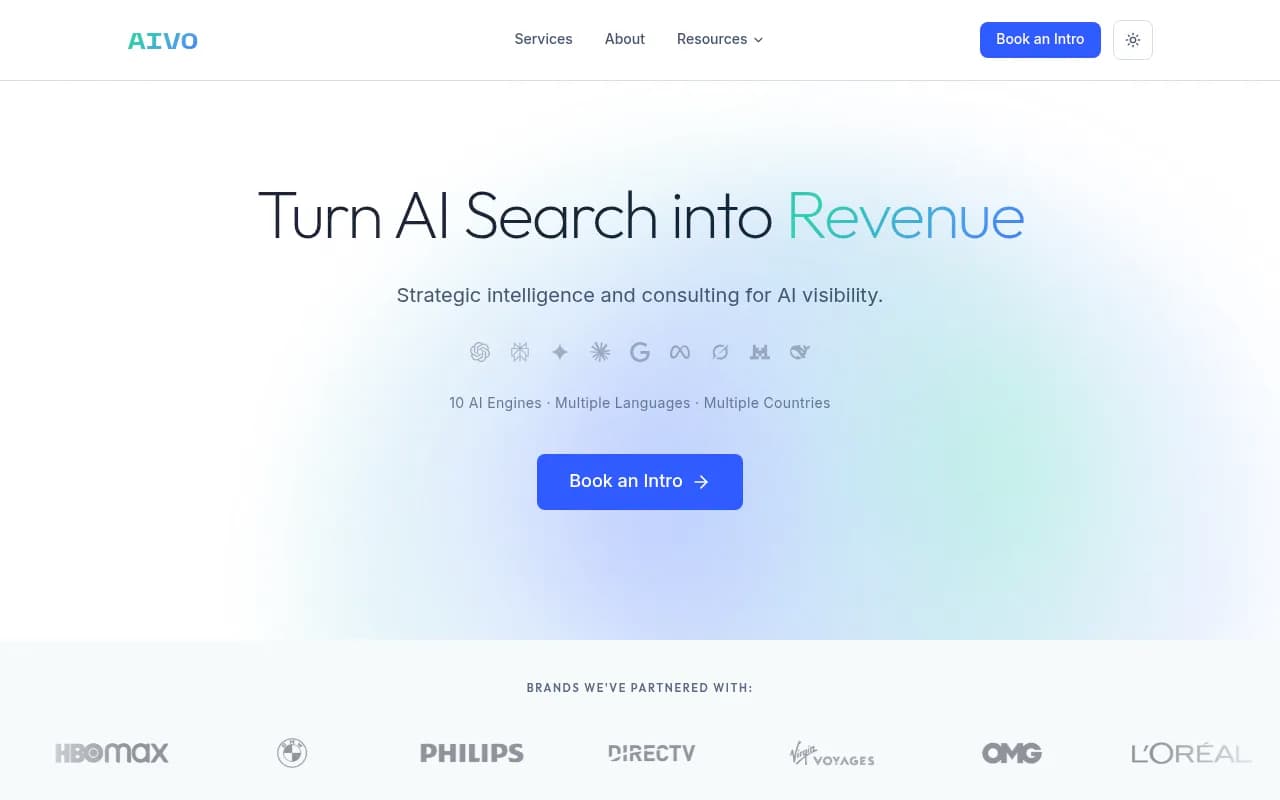
AIVO Review 2026
Scores page-level AI readiness across content dimensions and benchmarks citation performance to grow AI-driven revenue.
Key takeaways
- AIVO is part software, part consultancy, built by two ex-Omnicom/WPP/Publicis media people who pivoted into GEO after watching three platform shifts play out. The self-serve platform is thin; the real product is the human-delivered strategy work.
- Compared to Promptwatch, AIVO's self-serve tier tracks only 6 AI platforms (ChatGPT, Perplexity, Google AI Overviews, Google AI Mode, Gemini, Claude) at 60-350 queries, with no AI crawler logs, no Reddit/YouTube citation tracking, no ChatGPT Shopping or Ads Radar, and no automated content generation or CMS publishing. It's a monitoring and strategy layer, not an execution engine.
- Pricing blends two different businesses: a cheap SaaS tier ($149-$549/mo) and expensive consulting engagements ($4,000-$15,000+ for an Assessment, $3,500-$12,000+/mo for a Managed Retainer). Buyers need to know which one they're actually buying before they get on the intro call.
- It's a very young company (launched August 2025) with almost no independent review footprint and a genuinely tiny social presence. That doesn't make the work bad, but it does mean you're taking a bet on two founders rather than a proven platform with years of case studies.
- Best suited to hospitality, cruise/luxury travel, beauty, and B2B tech brands with a real marketing budget and a CMO who wants a narrative and a roadmap, not just a dashboard full of citation percentages.
AIVO is the work of two ad-agency veterans, Dan Muirhead and Sebastian Pinzon, who spent over a decade running media for brands like Visa, HBO Max, L'Oréal, and Virgin Voyages at Omnicom, WPP, and Publicis before deciding that AI search was the next platform shift worth getting ahead of. They launched tryaivo.com in August 2025 with a pitch that's explicitly not "another dashboard": a mix of a lightweight self-serve visibility tracker and a much heavier consulting practice that audits how AI engines represent a brand, why, and what to do about it.
That positioning matters because the AI visibility space got crowded fast. AIVO's own research cites roughly 73 new monitoring platforms launched in the past year, with fewer than a quarter raising meaningful funding. Rather than compete purely on query volume or platform count, AIVO leans into the idea that a spreadsheet of citation percentages doesn't tell a CMO what to actually fix. Whether that's worth paying consulting rates for is the real question this review tries to answer.
The target buyer here is not a solo SEO or a scrappy DTC brand. It's a Founder, CMO, or VP Marketing at a hospitality group, cruise line, beauty conglomerate, or B2B tech company, the kind of org that has a marketing team, a real content and PR apparatus already running, and a board asking why organic traffic has plateaued. AIVO wants to sit above those teams, not replace them.
Key features
- AI Visibility Benchmark (free): A complimentary, research-backed snapshot delivered within days of a 30-minute intro call. It's the top-of-funnel hook, and based on client quotes on the site ("I just got our snapshot and it's very insightful"), it seems to land well as a lead-gen tool even if it's necessarily shallow.
- AI Visibility Assessment ($4,000-$15,000, one-time): A 2-4 week deep dive that includes a full platform audit, competitive benchmark, source authority mapping, a content audit, a commerce-readiness score, and a 90-day roadmap. This is the core deliverable and where most of AIVO's actual intellectual property shows up, like the beauty client case study where 81 sustainability pages were analyzed against 7,133 citations and scored across six AI readiness dimensions.
- GEO Readiness Audits: AIVO scores pages across content dimensions, flagging things like narrative claims that aren't structured for AI extraction, headings that don't match how people actually phrase AI questions, and missing schema relative to top-cited competitors. In the beauty case study, this surfaced that 74% of sustainability claims were unextractable and 86% of headings didn't match real AI query phrasing.
- Share of model and hypothesis scoring: Rather than just reporting a citation percentage, AIVO frames its output around explaining why a brand is winning or losing against competitors in a given AI engine, then ranks a prioritized action queue by impact versus effort. This is the main differentiator AIVO claims against pure monitoring tools.
- Managed Retainer ($3,500-$12,000+/mo): AIVO runs AI visibility as an ongoing practice on the client's behalf: monthly intelligence reports, prioritized briefs, quarterly strategy refreshes, and coordination of the client's existing SEO, PR, content, and dev vendors. Good for teams that don't have in-house AI visibility capacity yet and don't want to build it.
- Engine Build (custom pricing): Instead of running the system forever, AIVO designs prompt architecture, content engines, and citation playbooks, then hands them off and trains the in-house team to operate them. This is the model for companies planning to build AI visibility as a permanent internal function.
- Self-serve AIVO Platform ($149-$549/mo): Starter covers 60 queries across 2 of 6 platforms with weekly intelligence emails; Growth expands query volume and competitor tracking across all 6; Scale adds multi-brand and agency support. Platforms tracked are ChatGPT, Perplexity, Google AI Overviews, Google AI Mode, Gemini, and Claude, noticeably fewer than the "10 AI engines" language used on the marketing homepage, which appears to describe the research/consulting side rather than this product tier.
- Culturalized localization: AIVO builds prompt sets that reflect how people search in Mexican Spanish versus Argentine Spanish, or Australian English versus Canadian English, rather than just translating a single English prompt set. For global travel and beauty brands, this is a genuinely useful distinction most lightweight trackers skip.
- Measurement framework: AIVO ties AI visibility movement to GA4, Google Search Console, CRM, and sales data, aiming for something a CFO will accept rather than a vanity visibility score. The site is upfront that attribution here is still limited, which is more honest than most vendors in this space.
Who is it for
AIVO fits a hotel group, airline, or cruise line worried about AI becoming a booking-influence channel alongside OTAs and GDS, or a global beauty brand trying to figure out why its product pages never get cited when someone asks ChatGPT or Perplexity what to buy. It also fits B2B tech and SaaS companies whose buyers are now building shortlists inside an AI chat before anyone talks to sales. The common thread is a company with an existing marketing org, a multi-market or multi-language footprint, and a willingness to pay consulting rates for a diagnosis rather than just a subscription.
Team size matters less than budget and maturity here. A 5-person startup marketing team can use the self-serve Starter tier, but the real value AIVO is selling sits in the $4K+ Assessment and the $3,500+/mo retainer, which prices out most small businesses and solo operators. If you're a freelancer or a single-site e-commerce store trying to figure out AI visibility on a shoestring, this isn't your tool; look at the self-serve platforms instead.
Who should skip it: anyone wanting pure self-serve software with broad model coverage and automated execution (content generation, CMS publishing, crawler logs) should look elsewhere. AIVO's own self-serve tier covers fewer platforms than several competitors, and it has no content-generation or publishing capability at all. It's a diagnosis-and-roadmap product, with execution handled by your own team, AIVO's retainer staff, or third-party tools.
Integrations and ecosystem
AIVO describes itself as platform-agnostic on the data side: it will ingest data from your existing AI visibility monitoring tool if you already have one, plus GA4, Google Search Console, CRM, and sales data for its measurement framework. There's no public API, no GitHub repo (this is not an open-source or developer-facing product), and no mobile app. No Zapier or native CMS publishing integrations are mentioned anywhere in the site content or research, which is a meaningful gap if you're comparing against platforms that push content straight to Webflow or WordPress.
There's a monthly research publication (hosted partly on Substack) covering AI search behavior by industry, which functions as both marketing and a genuinely useful free resource if you're trying to understand how engines are citing content in your category.
Pricing and value
AIVO runs two pricing tracks that don't map cleanly onto each other. The software side: Starter at $149/mo (60 queries, 2 of 6 platforms), Growth at $299/mo (all 6 platforms, deeper competitor tracking), Scale at $549/mo (multi-brand, agency support). That's competitive with Otterly.AI's $29/mo-plus range on the low end and comparable to Peec.ai's €89-349/mo tier, though it covers fewer platforms than Profound's enterprise tier or Scrunch's 9-platform coverage.
The consulting side is where the real money moves: the Assessment runs $4,000-$15,000 one-time, the Managed Retainer runs $3,500-$12,000+/mo, and Engine Build is custom quoted. A separately-advertised "AI Brand Representation Report" starts at $4,000 for one market and one language, though the specific page referencing that offer has since 404'd, suggesting some site restructuring. None of this is unreasonable for enterprise brand consulting, but it's a different budget conversation entirely than the $149/mo headline price might suggest. Buyers should get crystal clear, before the intro call, on whether they're buying software or a consulting engagement, because AIVO's own marketing blurs the two more than it should.
Strengths and limitations
What AIVO does well: the GEO Readiness Audit methodology is genuinely specific, scoring pages across content dimensions and tying scores to actual citation benchmarks rather than guesswork. The beauty case study (81 pages, 7,133 citations analyzed, score lift from 1.87 to 2.67 after an infrastructure fix) is a credible, concrete example of the work producing a measurable result. The founders' honesty about attribution limits and their blunt comparison of competitors (calling Profound "a serious enterprise platform" with "no human on the other end") suggests a team that's thought carefully about where it adds value versus where a dashboard alone falls short.
Against Promptwatch and other full-stack GEO platforms, the gaps are real. AIVO's self-serve platform has no AI crawler logs, so there's no way to see whether ChatGPTBot, ClaudeBot, or PerplexityBot are actually reading your pages before citation happens. There's no Reddit or YouTube citation tracking, no ChatGPT Shopping or Ads Radar monitoring, no prompt volume or difficulty scoring, and critically, no content generation or CMS publishing capability at all. Promptwatch's Content Agents plan, write, and publish GEO-optimized pages directly to Webflow, Framer, or WordPress; AIVO hands you a roadmap and expects your team (or its retainer staff) to execute it manually. If you want an agentic system that closes the loop from insight to published content, AIVO isn't that. It's a strategy and diagnosis layer.
The company is also simply very new, with a near-nonexistent social footprint (AIVO's X account had 4 followers as of mid-2026) and no third-party reviews on G2, Capterra, or Trustpilot to cross-check its own case studies against. That's not disqualifying, but it means you're buying into two founders' track record and methodology rather than a platform with years of accumulated proof.
Bottom line
AIVO makes sense for a mid-size-to-enterprise hospitality, beauty, or B2B brand that wants a human-led diagnosis of why AI engines aren't citing or recommending them, and is willing to pay consulting rates for a prioritized 90-day roadmap rather than a self-serve dashboard. If what you actually need is an execution platform that monitors crawler behavior, tracks Reddit and YouTube citations, and automatically writes and publishes optimized content against the gaps it finds, Promptwatch covers that ground and AIVO currently doesn't.
Tags:
Frequently asked questions
What is AIVO?
How much does AIVO cost?
Which AI platforms does AIVO track?
Who is AIVO best for?
How does AIVO compare to Promptwatch?
Is there a free plan or trial?
Similar and alternative tools to AIVO