Key takeaways
- All four platforms track brand visibility in AI search engines like ChatGPT, Perplexity, and Gemini -- but they differ significantly in what they do with that data
- Promptwatch is the only one of the four that closes the full loop: gap analysis, AI content generation, and traffic attribution in one platform
- Qwairy competes hard on AI model breadth (38+ models) and price (from €59/month), making it attractive for budget-conscious teams
- Superlines leans into content optimization workflows, while Relixir takes an AI-native CMS approach with autonomous content publishing
- Your choice depends on whether you need monitoring, content creation, or both -- and how much you want the platform to do the work for you
The GEO tool market has exploded. Two years ago, there were maybe a dozen platforms worth considering. Now there are over 200 by some counts, and the terminology alone (GEO, AEO, LLMO, AI SEO) is enough to make your head spin.
This guide focuses on four platforms that have emerged as serious contenders for teams that want to do more than just watch their brand visibility scores tick up and down: Promptwatch, Qwairy, Superlines, and Relixir. Each takes a meaningfully different approach, and picking the wrong one can mean months of wasted effort.
Let's get into it.
What these platforms actually do (and what they don't)
Before comparing features, it's worth being clear about what problem GEO platforms are solving.
When someone asks ChatGPT "what's the best project management tool for remote teams?" or "which CRM should a B2B startup use?", the AI generates an answer. It may or may not mention your brand. If it does mention you, it may describe you accurately or not. And if a competitor gets cited while you don't, that's a lost opportunity that never shows up in your Google Analytics.
GEO platforms exist to track this. The good ones go further and help you fix it.
The distinction between monitoring-only tools and optimization platforms is the most important thing to understand before you spend money in this category. A monitoring dashboard tells you where you stand. An optimization platform tells you what to do about it and helps you do it.
The four platforms, head to head
Promptwatch
Promptwatch is built around what it calls the "action loop": find gaps, create content, track results. That framing is accurate -- it's not just a dashboard.
The gap analysis feature is where it starts. You enter your brand and competitors, and Promptwatch shows you which prompts your competitors are visible for that you're not. Not just "you're missing visibility in this topic area" -- it shows you the specific questions AI models are answering where your content isn't getting cited.
From there, the built-in AI writing agent generates content grounded in citation data from 880M+ analyzed citations. The idea is that the content it produces isn't generic SEO filler but is specifically engineered to get cited by ChatGPT, Claude, Perplexity, and others.
The third leg is tracking: page-level visibility scores, which AI models are citing which pages, and traffic attribution via a code snippet, Google Search Console integration, or server log analysis. That last part -- connecting AI visibility to actual revenue -- is something most competitors don't attempt.
A few other things worth noting: Promptwatch has AI crawler logs (real-time data on when ChatGPT, Claude, and Perplexity crawl your site), Reddit and YouTube citation tracking, ChatGPT Shopping monitoring, and prompt volume/difficulty scoring. It covers 10 AI models including Google AI Mode and DeepSeek.
Pricing starts at $99/month for one site and 50 prompts. The Professional plan at $249/month adds crawler logs, city/state tracking, and 150 prompts across two sites.

Qwairy
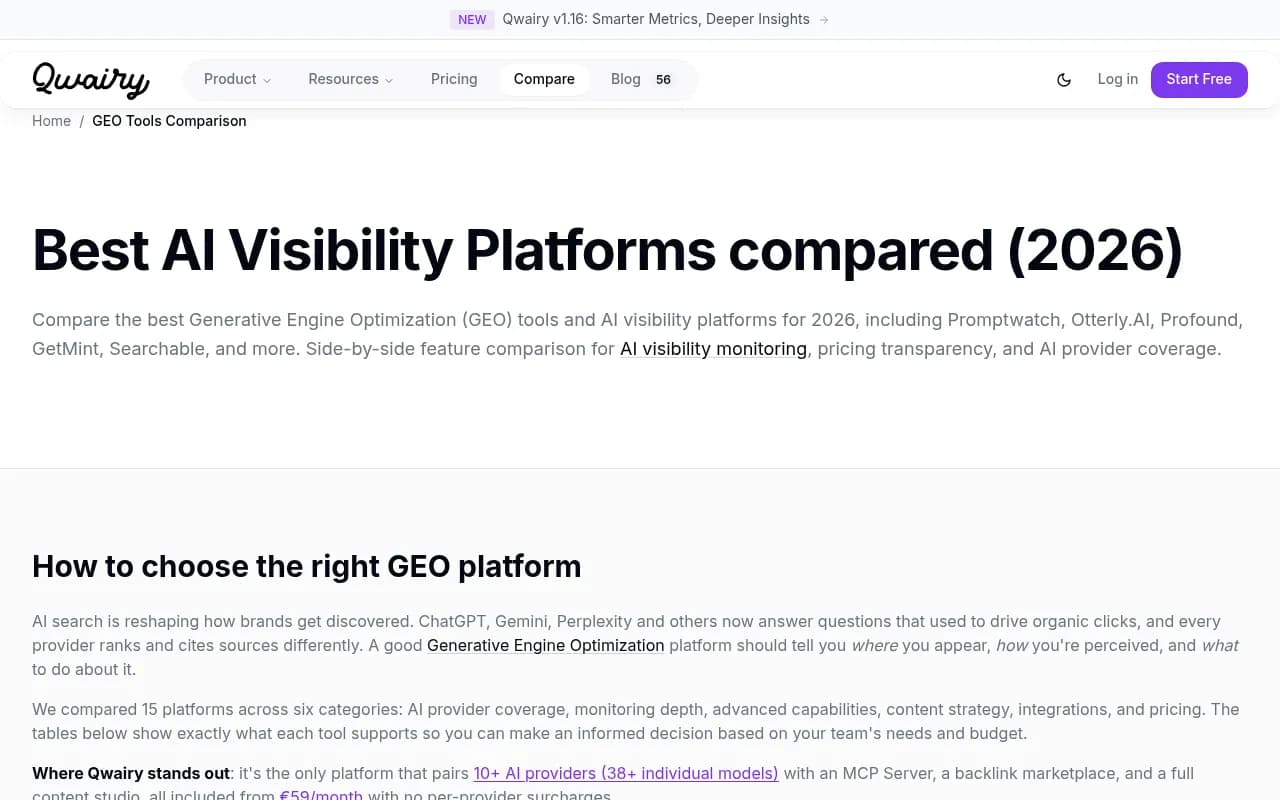
Qwairy's main pitch is breadth. It tracks 10+ AI providers across 38+ individual models, which is the widest coverage of any platform in this comparison. If you need to monitor visibility across Mistral, DeepSeek, Grok, and a dozen ChatGPT model variants simultaneously, Qwairy is built for that.
It also includes a backlink marketplace and a content studio, which puts it in similar territory to Promptwatch in terms of being more than a monitoring tool. The MCP Server integration is a differentiator -- it lets you connect Qwairy's data to other tools via the Model Context Protocol, which is useful for teams building custom workflows.
Pricing starts at €59/month, which is notably lower than Promptwatch's entry point. For teams on tight budgets who need broad model coverage, that's a real advantage.
Where Qwairy is less clear is on the depth of its content optimization. The content studio exists, but it's less documented than Promptwatch's citation-grounded writing agent. Teams that need to produce a high volume of AI-optimized content may find Promptwatch's approach more structured.

Superlines
Superlines focuses on the content optimization side of GEO. Its core workflow is built around helping you understand what AI models want to see in content for a given topic, then helping you create or optimize content to match.
It covers the major AI models (ChatGPT, Perplexity, Gemini, Claude) and provides visibility tracking, but the emphasis is on the content creation workflow rather than deep competitive intelligence. If your team already has a solid sense of where your gaps are and primarily needs help producing AI-optimized content at scale, Superlines is worth evaluating.
It's a reasonable choice for content-heavy teams that want GEO guidance baked into their writing workflow, rather than a standalone analytics platform.

Relixir
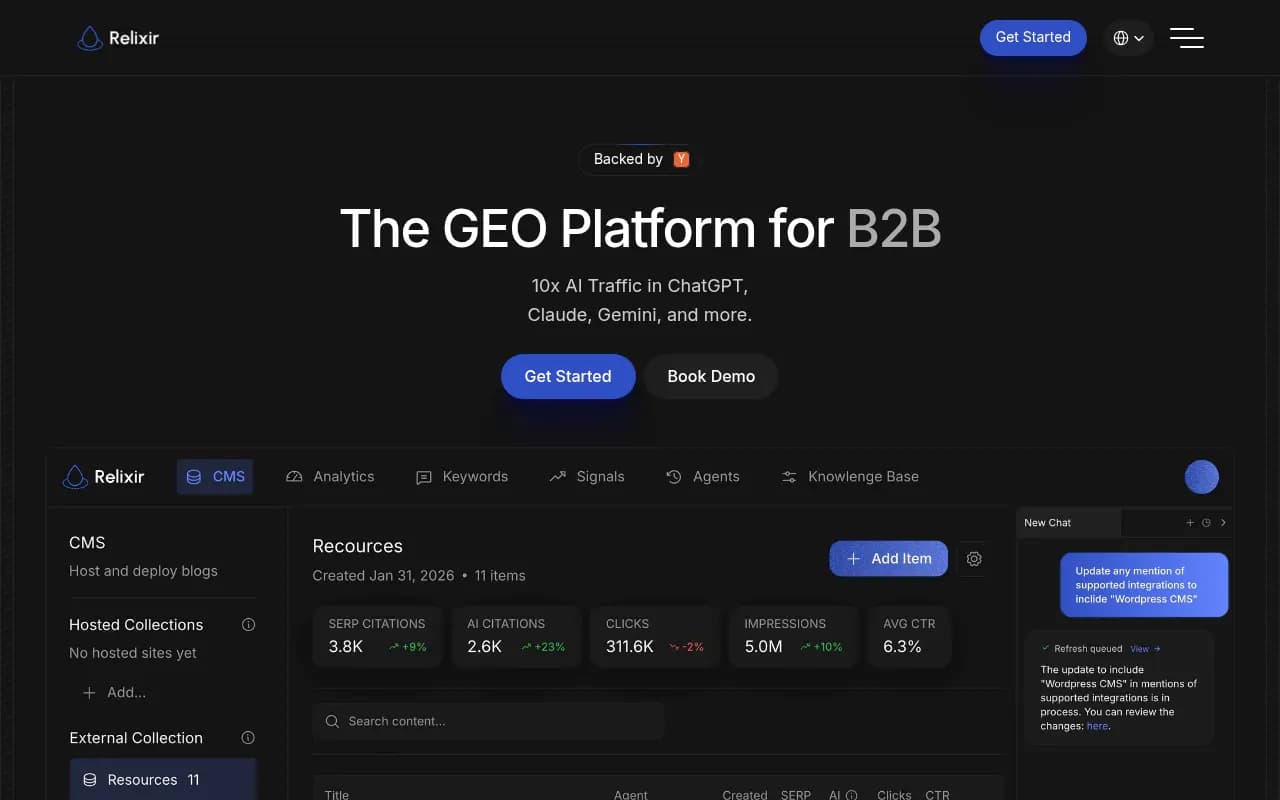
Relixir takes the most opinionated approach of the four. It's built around an AI-native CMS with autonomous content publishing -- meaning it doesn't just help you write content, it can publish it automatically based on visibility gap analysis.
That's either very appealing or slightly alarming depending on your team's content governance requirements. For startups and lean teams that want to move fast and don't have a large editorial review process, the autonomous publishing angle is genuinely useful. For enterprise teams with compliance or brand voice requirements, handing publishing control to an AI agent will require more thought.
Relixir also includes GEO monitoring and competitive tracking, so it's a full-stack platform rather than just a content tool. The AI-native CMS angle makes it distinct from the other three.
Feature comparison table
| Feature | Promptwatch | Qwairy | Superlines | Relixir |
|---|---|---|---|---|
| AI models covered | 10 (incl. DeepSeek, Grok, Mistral) | 10+ (38+ individual models) | Major 4-5 | Major 4-5 |
| Answer gap analysis | Yes | Yes | Limited | Yes |
| AI content generation | Yes (citation-grounded) | Yes (content studio) | Yes (core feature) | Yes (autonomous) |
| Autonomous publishing | No | No | No | Yes |
| AI crawler logs | Yes | Unknown | No | No |
| Reddit/YouTube tracking | Yes | No | No | No |
| ChatGPT Shopping tracking | Yes | No | No | No |
| Traffic attribution | Yes (GSC, snippet, logs) | No | No | No |
| Prompt volume/difficulty | Yes | No | No | No |
| Backlink marketplace | No | Yes | No | No |
| MCP Server integration | No | Yes | No | No |
| Starting price | $99/mo | €59/mo | Varies | Varies |
| Free trial | Yes | Yes | Yes | Yes |
| Best for | Full-loop GEO optimization | Broad model coverage, budget teams | Content-focused teams | Fast-moving teams, lean editorial |
How to choose
The honest answer is that these four platforms are solving slightly different versions of the same problem, and the right choice depends on what your team is actually bottlenecked on.
If you're bottlenecked on knowing what to fix
You need gap analysis and competitive intelligence more than content tools. Both Promptwatch and Qwairy do this well. Promptwatch's prompt volume and difficulty scoring gives you a way to prioritize -- you can see which gaps are worth closing based on actual query volume, not just the fact that a competitor is visible there. Qwairy's breadth across 38+ models is useful if you're in a category where model-specific visibility matters.
If you're bottlenecked on content production
You know what you need to write, you just need help writing it. Superlines is built for this workflow. Relixir is worth considering if you want the platform to handle publishing too.
Promptwatch's AI writing agent is also strong here -- the advantage is that it's grounded in citation data, so the content it generates is specifically designed to get cited rather than just being well-written.
If you need to connect visibility to revenue
This is where Promptwatch separates itself. Traffic attribution -- actually seeing which AI citations are driving visits and conversions -- is something most GEO platforms don't attempt. If your CMO is asking "what's the ROI of our GEO work?", Promptwatch is currently the most direct path to answering that question.
If budget is the primary constraint
Qwairy at €59/month is the most affordable entry point of the four, and it doesn't feel like a stripped-down product -- the model coverage is actually broader than more expensive competitors. For small teams or agencies testing the GEO waters, it's a reasonable starting point.
What the broader market looks like
These four aren't the only options. The GEO space has a long tail of monitoring tools, many of which are useful for specific use cases.
Profound is a solid monitoring platform with strong AI answer data, though it's more focused on tracking than optimization.

AthenaHQ covers 8+ AI engines and has good narrative tone monitoring, but it's primarily a tracking tool without the content generation capabilities of the platforms above.

Otterly.AI is one of the more affordable monitoring options and works well for teams that just need basic visibility tracking without the optimization layer.

Scrunch AI has an interesting angle on influencer signal analysis -- understanding which third-party sources shape AI recommendations -- which is a channel most platforms ignore.
The pattern across most of these alternatives is the same: they're good at telling you where you stand, but they leave the "what to do about it" question to you.
The monitoring-only trap
One thing worth saying directly: a lot of teams buy a GEO monitoring tool, watch their visibility scores for a few months, and then wonder why nothing is improving.
Monitoring is necessary but not sufficient. Knowing that ChatGPT mentions your competitor 3x more often than you in "best CRM for startups" queries doesn't help unless you know what content to create and actually create it.
The platforms that are winning in this space in 2026 are the ones that close the loop -- from gap identification to content creation to result tracking. That's the framework worth evaluating any GEO tool against, including the four in this guide.
Final take
If you want one platform that handles the full GEO workflow -- finding gaps, generating content to close them, and attributing the results to revenue -- Promptwatch is the strongest option of the four. The citation-grounded content generation and traffic attribution are capabilities that most competitors don't have.
If you need the broadest possible AI model coverage at the lowest price point, Qwairy is worth a serious look. The €59/month entry price and 38+ model coverage is genuinely competitive.
If your team is primarily a content team that needs GEO guidance built into the writing workflow, Superlines fits that use case more naturally than the others.
If you want the platform to handle autonomous publishing and you're comfortable with that level of AI involvement in your content operations, Relixir is the most aggressive option in that direction.
None of these is a bad choice. The worst outcome is picking a monitoring-only tool, watching dashboards, and calling it a GEO strategy.