Key takeaways
- Promptwatch is an end-to-end optimization platform: it finds your content gaps, generates AI-optimized content to fill them, and tracks the results. Superlines stops at the intelligence layer — excellent data, but no content tools.
- Superlines has a genuine free tier and starts at €89/mo; Promptwatch starts at $99/mo with a 7-day trial only. For budget-conscious teams that just need monitoring, Superlines is the cheaper entry point.
- Superlines' MCP server and API-first design make it the stronger pick for technical teams building custom AI workflows or feeding visibility data into agents. Promptwatch has an API but isn't positioned around it.
- Promptwatch tracks AI crawler logs in real time (which pages ChatGPT, Claude, Perplexity are crawling, errors, frequency). Superlines doesn't offer this, which is a meaningful gap for teams trying to understand how AI engines discover their content.
- Promptwatch covers Reddit and YouTube as citation sources, plus ChatGPT Shopping tracking. Superlines focuses on the core LLM interfaces and doesn't appear to surface these channels.
- If you want to go from "I'm invisible in AI search" to "here's the article that will fix it" in one platform, Promptwatch is the only option between these two.
Overview
Promptwatch

Promptwatch is the largest dedicated AI search visibility platform by user count, with 7,000+ brands including Booking.com, Yelp, Typeform, and Rabobank. It monitors how 10+ AI models (ChatGPT, Claude, Gemini, Perplexity, Grok, DeepSeek, Copilot, Mistral, Meta AI, Google AI Overviews) cite and recommend brands, then goes further: it identifies which prompts competitors rank for that you don't, generates content designed to get cited, and tracks whether that content actually drives traffic. The pitch is a closed loop from gap discovery to revenue attribution.
Superlines
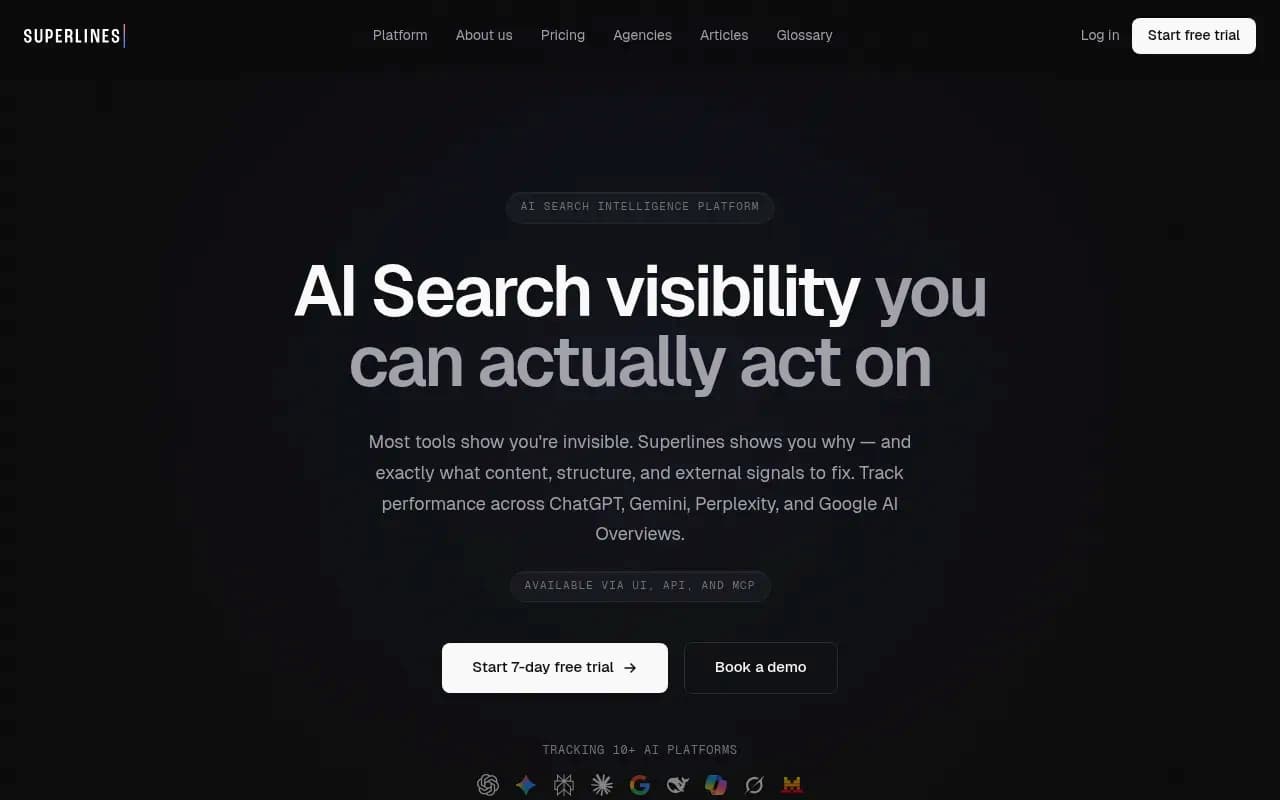
Superlines is a Finnish AI search intelligence platform that tracks brand visibility across ChatGPT, Gemini, Perplexity, Claude, Google AI Overviews, DeepSeek, Copilot, Grok, and Mistral. Its differentiator is the delivery layer: beyond a standard UI, it exposes visibility data via a REST API and a Model Context Protocol (MCP) server, letting technical teams pipe real-time AI visibility intelligence directly into their own agents, dashboards, or workflows. The customer base skews toward European enterprises and tech companies (Supabase, Tietoevry, Tallink Silja). It's a monitoring and intelligence platform, not an optimization one.
Side-by-side comparison
| Feature | Promptwatch | Superlines |
|---|---|---|
| AI models tracked | 10+ (ChatGPT, Claude, Gemini, Perplexity, Grok, DeepSeek, Copilot, Mistral, Meta AI, Google AI Overviews) | 9+ (ChatGPT, Gemini, Perplexity, Claude, Google AI Overviews, DeepSeek, Copilot, Grok, Mistral) |
| Free tier | No (7-day trial) | Yes (freemium) |
| Starting price | $99/mo | €89/mo (~$97/mo) |
| Content gap analysis | Yes | Yes (signals-based) |
| AI content generation | Yes (built-in writing agent) | No |
| AI crawler logs | Yes (real-time) | No |
| API access | Yes | Yes |
| MCP server | No | Yes |
| Reddit & YouTube tracking | Yes | No |
| ChatGPT Shopping tracking | Yes | No |
| Traffic attribution | Yes (GSC, snippet, server logs) | Not documented |
| Competitor heatmaps | Yes | Yes |
| Multi-language/region | Yes | Yes |
| Prompt volume & difficulty scores | Yes | Not documented |
| G2 rating | 4.7/5 | Not listed |
| Target audience | Marketing, SEO, agencies | Brands, agencies, technical teams |
Head-to-head feature deep-dive
Monitoring and data collection
Both platforms analyze real AI search interfaces rather than just hitting model APIs directly, which matters because the actual user-facing responses can differ from raw API outputs. Superlines makes a point of this in its positioning ("analyzes real AI Search interfaces instead of API calls"), and Promptwatch's 1.1 billion+ citations processed suggests a similarly large-scale data collection operation.
Where they diverge is depth. Promptwatch surfaces prompt-level data with volume estimates and difficulty scores, so you can prioritize which prompts are worth chasing. It also shows query fan-outs: how one prompt branches into sub-queries across AI models. Superlines focuses on brand visibility signals and competitive benchmarking at the platform level, which is useful for executive reporting but less granular for tactical content decisions.
Verdict: Promptwatch wins on prompt-level granularity. Superlines wins on clean, decision-grade data presentation for stakeholder reporting.
Content optimization and gap analysis
This is the sharpest difference between the two tools.
Promptwatch's Answer Gap Analysis identifies specific prompts where competitors appear but you don't, then shows you exactly what content is missing from your site. The built-in AI writing agent then generates articles, listicles, and comparison pages grounded in citation data from 880M+ analyzed citations. You can target specific personas, set prompt volume thresholds, and publish content that's engineered to get cited rather than just keyword-stuffed.
Superlines identifies "critical AI visibility signals" and shows which URLs AI models prefer and how your brand is framed. It tells you what to fix in terms of content structure and external signals, but it doesn't generate the content for you. You get the diagnosis; you find your own treatment.
Verdict: Promptwatch is the clear winner here. If content creation is part of your workflow, Superlines requires you to bring your own tools.
Technical access and integrations
Superlines has a genuine edge for technical teams. Its MCP server lets you feed real-time AI visibility data directly into AI agents and custom workflows, which is genuinely useful if you're building internal tooling or want to automate reporting. The REST API is well-documented and designed for integration-first use cases.
Promptwatch has an API and a Looker Studio integration, plus traffic attribution via Google Search Console, a JavaScript snippet, or server log analysis. That's solid for marketing teams. But it's not built around the API the way Superlines is.
Verdict: Superlines wins for technical and developer-oriented teams. Promptwatch wins for marketing teams who want everything in one UI.
AI crawler log tracking
Promptwatch tracks AI crawler activity in real time: which pages ChatGPT, Claude, Perplexity, and others are crawling, how frequently, and what errors they encounter. This is genuinely useful for diagnosing why certain pages aren't getting cited despite good content. If an AI crawler keeps hitting a 404 or a page is being ignored entirely, you'll see it.
Superlines doesn't appear to offer this feature. For teams trying to understand the full picture of how AI engines discover and index their content, that's a gap.
Verdict: Promptwatch wins outright. Superlines has no equivalent.
Competitive intelligence
Both platforms let you benchmark your AI visibility against competitors. Promptwatch's competitor heatmaps show who's winning for each prompt across different LLMs. Superlines' global competitive benchmarking covers market-specific levels across regions and languages, with a focus on which URLs AI models prefer and how brands are framed relative to competitors.
Superlines' regional and language granularity looks strong, particularly for European enterprises operating across multiple markets. Promptwatch also supports multi-language and multi-region monitoring, plus customizable personas.
Verdict: Roughly even, with Superlines having a slight edge on regional depth and Promptwatch having a slight edge on prompt-level competitor breakdowns.
Pricing and value
| Plan | Promptwatch | Superlines |
|---|---|---|
| Free | No (7-day trial) | Yes (freemium) |
| Entry paid | $99/mo (Essential: 1 site, 50 prompts, 5 articles) | €89/mo (~$97/mo) |
| Mid-tier | $249/mo (Professional: 2 sites, 150 prompts, 15 articles, crawler logs) | Not publicly listed |
| Business | $579/mo (Business: 5 sites, 350 prompts, 30 articles) | Not publicly listed |
| Enterprise/Agency | Custom | Custom |
| Annual discount | Yes | Not confirmed |
| Free trial | 7 days | 7 days |
Superlines' higher-tier pricing isn't publicly listed, which makes direct comparison difficult. At entry level, they're nearly identical in price. The key difference is what you get: Promptwatch's $99 plan includes 5 AI-generated articles per month, which has real dollar value if you'd otherwise be paying a writer or a separate AI tool. Superlines' entry plan gives you monitoring and data access.
For teams that only need monitoring, Superlines' free tier is a meaningful advantage. For teams that want to act on what they find, Promptwatch's pricing includes the tools to do so.
Verdict: Superlines wins on accessibility (free tier). Promptwatch wins on value-per-dollar once you factor in content generation.
Pros and cons
Promptwatch
Pros:
- Full optimization loop: gap analysis, content generation, and traffic attribution in one platform
- AI crawler log tracking is unique and genuinely useful for diagnosing indexing issues
- Reddit and YouTube citation tracking surfaces channels most competitors ignore
- ChatGPT Shopping monitoring for e-commerce brands
- 4.7/5 on G2 with 7,000+ customers including major enterprise brands
- Prompt volume and difficulty scoring helps prioritize effort
Cons:
- No permanent free tier, only a 7-day trial
- No MCP server for teams building custom AI workflows
- Higher price floor than Superlines for pure monitoring use cases
- Content generation quality depends on your prompt setup and review process
Superlines
Pros:
- Genuine free tier lowers the barrier to entry
- MCP server is a real differentiator for technical teams and AI-native workflows
- Clean, decision-grade data presentation suits executive and stakeholder reporting
- API-first design makes it easy to integrate into existing tooling
- Strong regional and multi-language competitive benchmarking
Cons:
- No content generation tools -- you get the diagnosis but not the fix
- No AI crawler log tracking
- No Reddit or YouTube citation tracking
- No ChatGPT Shopping monitoring
- Prompt-level granularity (volume, difficulty, fan-outs) not documented
- Higher-tier pricing not publicly listed, making budget planning harder
- Smaller customer base and less third-party review data than Promptwatch
Who should pick which tool
Choose Promptwatch if:
- You want to move from visibility data to published content without switching tools
- AI crawler log tracking matters to you (diagnosing why pages aren't being cited)
- You're tracking Reddit and YouTube as part of your citation strategy
- You run an e-commerce brand and want ChatGPT Shopping monitoring
- You need to connect AI visibility to actual revenue via traffic attribution
- You're an agency that needs to show clients optimization results, not just reports
Choose Superlines if:
- You're a technical team building custom AI workflows and need an MCP server or clean API
- You want a free tier to get started before committing budget
- Your primary need is monitoring and competitive benchmarking, not content creation
- You're a European enterprise that needs strong regional and multi-language tracking
- You want to feed AI visibility data into your own agents or dashboards
Final verdict
These two tools are solving adjacent problems, not the same one. Superlines is a strong intelligence platform for teams that want reliable data and the flexibility to build on top of it. If your workflow is "get the data, then figure out what to do with it elsewhere," Superlines is clean, well-designed, and cheaper to start with.
Promptwatch is for teams that want the whole loop in one place. The monitoring is comparable, but the content gap analysis, AI writing agent, crawler logs, and traffic attribution mean you're not just watching your AI visibility score -- you're actively moving it. For most marketing and SEO teams, that's the more useful tool.
If you're also thinking about how your brand shows up across the broader AI search ecosystem and want to track that visibility back to revenue, Promptwatch is the more complete platform of the two in 2026.