Key takeaways
- ChatGPT citations are driven primarily by referring domains, not keyword density. Sites with 32,000+ referring domains see citation counts nearly double, according to a November 2025 Search Engine Journal study.
- "Dark queries" -- conversational prompts with no measurable search volume -- are where most ChatGPT citations actually happen. You need a content strategy built around them.
- Ranking in ChatGPT requires a different workflow than Google SEO: authority signals, structured content, and citation-worthy source positioning all matter differently.
- Tracking visibility across AI models is not optional in 2026. Without measurement, you're optimizing blind.
- The brands winning in AI search are closing a loop: find gaps, publish targeted content, track citations, repeat.
ChatGPT hit 800 million weekly active users in 2025 -- double what it was in February of that year. It now holds roughly 17% of global search share. That's not a niche channel anymore. That's a primary discovery surface for a huge chunk of your potential customers.
And yet most brands are still trying to rank in ChatGPT the same way they rank in Google. They're optimizing title tags, stuffing keywords, and wondering why they never get cited. The problem isn't effort. It's the wrong mental model.
This guide gives you the right one.
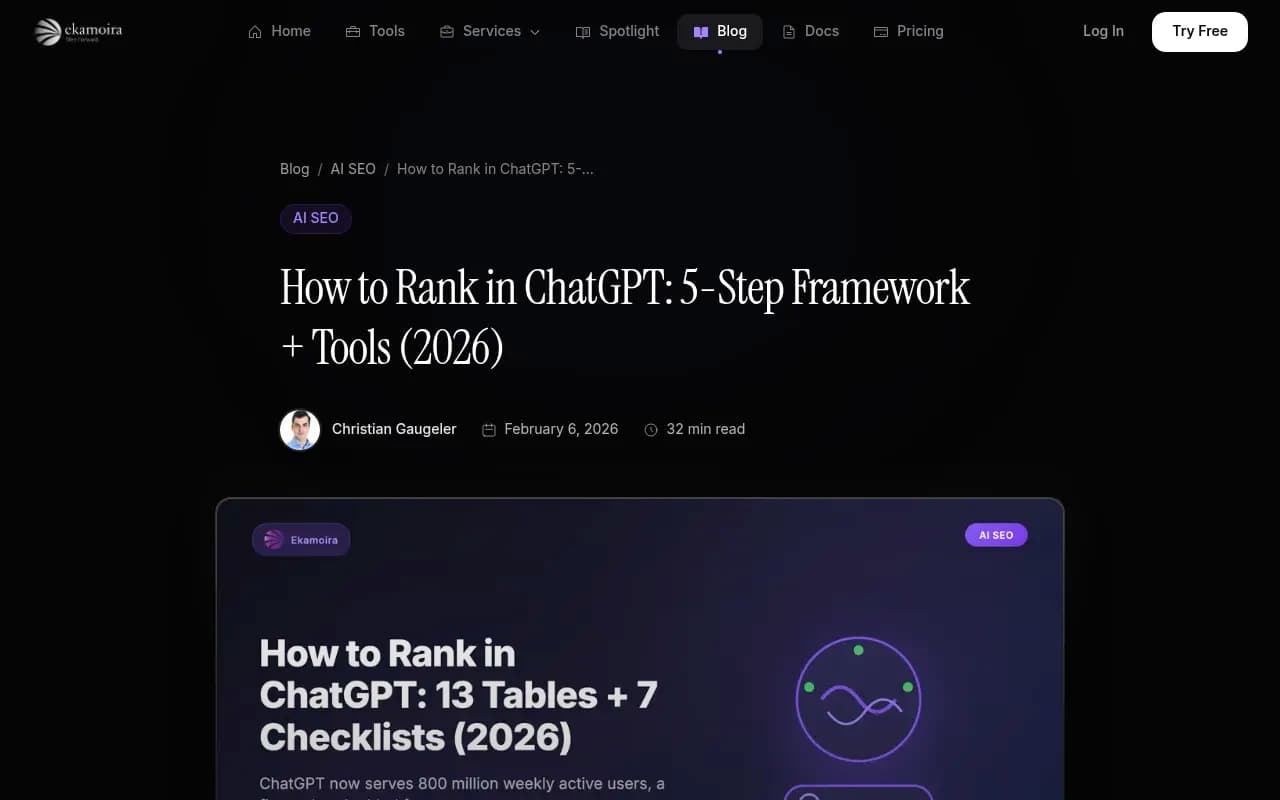
Why ChatGPT ranking is fundamentally different from Google SEO
Google ranks pages. ChatGPT cites sources. That distinction sounds small but it changes everything about how you should approach content.
When someone searches Google, they get a list of links and choose where to click. When someone asks ChatGPT a question, they get a synthesized answer -- and somewhere in that answer, a handful of sources get credited. The question isn't "can I get on page one?" It's "will ChatGPT trust my content enough to cite it?"
That trust is built on a few things that don't map neatly to traditional SEO:
Domain authority as a proxy for credibility. A November 2025 study by Search Engine Journal found that referring domains are the single strongest predictor of ChatGPT citations. Sites with 32,000+ referring domains see citation counts nearly double compared to lower-authority sites -- from 2.9 to 5.6 per query. ChatGPT's training data and retrieval systems weight authoritative sources heavily. If your domain doesn't have that authority, you're competing with one hand tied behind your back.
Answer completeness over keyword matching. ChatGPT isn't scanning for keyword density. It's looking for content that actually answers the question well. Thin content, vague claims, and marketing fluff get ignored. Specific, well-structured, factually grounded content gets cited.
Conversational query formats. People don't ask ChatGPT "best CRM software." They ask "what CRM should a 10-person B2B SaaS company use if they're already on HubSpot but outgrowing it?" Your content needs to be written in a way that maps to how real people phrase real questions -- not how keyword tools bucket search volume.
Step 1: Audit your current AI visibility
Before you optimize anything, you need to know where you stand. Most brands have no idea whether ChatGPT is citing them at all, which queries trigger citations, or how they compare to competitors.
This is where AI visibility tracking tools come in. The core metrics you want to establish as a baseline:
- Citation rate: what percentage of relevant queries does ChatGPT mention your brand?
- Mention sentiment: when you are cited, is the framing positive, neutral, or negative?
- Competitor comparison: who's getting cited instead of you, and for which queries?
- Page-level attribution: which specific pages on your site are being cited?
Promptwatch covers all of this and goes further -- it shows you exactly which prompts competitors are visible for that you're not, which is the starting point for any real optimization work.

For teams that want additional tracking options, a few other tools worth knowing:


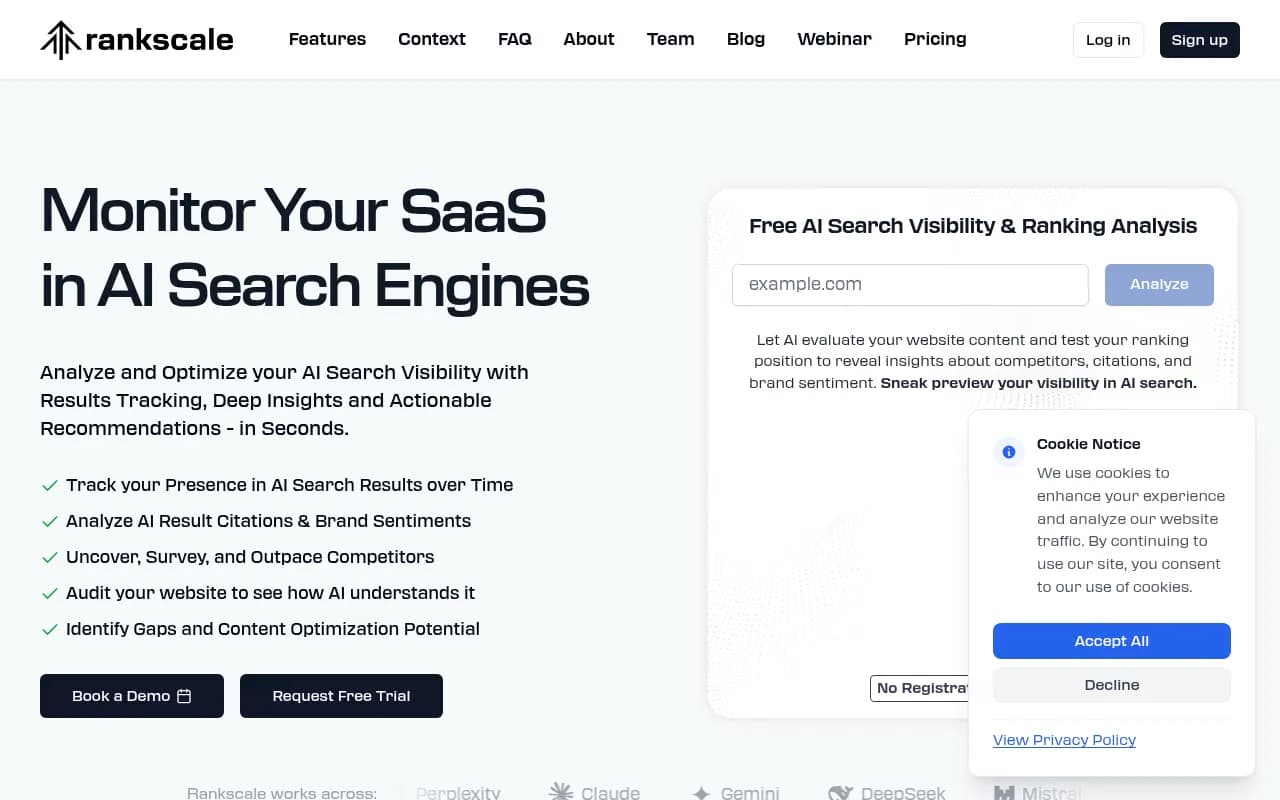
Run your baseline audit before touching any content. You need the data to know where to focus.
Step 2: Map the "dark query" landscape
Here's something most SEO guides won't tell you: a huge portion of ChatGPT queries have zero measurable search volume. They're conversational, specific, and situational. Tools like Ahrefs and Semrush can't surface them because they don't show up in traditional keyword data.
These are called "dark queries" -- and they're where a lot of ChatGPT citations actually happen.
Think about the difference between:
- "project management software" (high volume, tracked everywhere)
- "what project management tool works best for a remote engineering team that already uses Jira but needs better sprint planning?" (zero volume, but exactly what someone asks ChatGPT)
The second query is where you can win. It's specific enough that fewer competitors have content addressing it, but it's also exactly the kind of question ChatGPT gets asked constantly.
How to find dark queries
- Talk to your sales and support teams. What questions do customers actually ask? Verbatim. Write them down.
- Pull your customer interview transcripts and look for the "how do I..." and "what should I use for..." patterns.
- Use ChatGPT itself. Ask it to generate 20 questions a [your target persona] might ask about [your category]. You'll surface query patterns you'd never find in a keyword tool.
- Look at Reddit threads in your industry. The questions people ask in r/[yourindustry] are often verbatim dark queries.
- Check your site search logs. What are visitors already asking when they search your own site?
Build a spreadsheet of 50-100 dark queries. These become your content targets.
Step 3: Build the content that gets cited
Once you have your query list, the next question is: what does ChatGPT-citable content actually look like?
A few things that consistently show up in cited content:
Clear, direct answers to specific questions
ChatGPT is looking for content that answers the question completely without requiring the reader to dig through paragraphs of preamble. If someone asks "what's the difference between X and Y," your content should answer that in the first paragraph, then support it with detail. Don't bury the answer.
Structured formatting
Headers, bullet points, numbered lists, and comparison tables all help AI models parse and extract information. A wall of prose is harder to cite from than a well-structured article with clear sections.
Factual specificity
Vague claims ("our tool is great for enterprise teams") don't get cited. Specific claims ("the platform supports SSO, custom roles, and audit logs, making it suitable for enterprise compliance requirements") do. Be concrete.
First-person expertise signals
Content that demonstrates genuine expertise -- case studies, specific data points, original research, practitioner-level detail -- gets weighted more heavily than generic summaries. This is especially true in YMYL (Your Money or Your Life) categories like finance, health, and legal.
Content types that earn citations
| Content type | Why it gets cited | Example |
|---|---|---|
| Comparison articles | Answers "X vs Y" queries directly | "HubSpot vs Salesforce for SMBs" |
| Best-of lists | Answers "what's the best X for Y" | "Best CRMs for remote teams in 2026" |
| How-to guides | Answers procedural questions | "How to set up DKIM for cold email" |
| Original research | Unique data = unique citation value | "We analyzed 500 SaaS pricing pages" |
| FAQ pages | Maps directly to conversational queries | "Common questions about [topic]" |
| Glossary/definition pages | Answers "what is X" queries | "What is a conversion rate?" |
The brands winning in ChatGPT are publishing content that directly maps to the queries they want to be cited for. That sounds obvious, but most content strategies are still built around keyword clusters, not question-answer pairs.
Step 4: Build the authority signals that ChatGPT trusts
Content quality alone won't get you cited if your domain lacks authority. Remember: 32,000+ referring domains is where citation rates start to meaningfully improve. That's not a number you hit overnight, but it's a number you can work toward systematically.
Referring domain strategy
Not all backlinks are equal for ChatGPT visibility. The domains that matter most are the ones that ChatGPT's training data and retrieval systems recognize as authoritative: major publications, industry associations, well-known blogs in your vertical, and platforms like Reddit, YouTube, and Quora.
A few tactics that work:
- Guest posts on high-authority industry publications. Not for the traffic -- for the domain signal.
- Digital PR campaigns that earn coverage in outlets ChatGPT knows and trusts (trade press, national media, well-known industry blogs).
- Original research or data studies that journalists and bloggers cite naturally.
- Podcast appearances that generate show notes pages linking to your site.
Reddit and community presence
Reddit is one of the most heavily cited sources in ChatGPT responses. This isn't accidental -- Reddit has massive domain authority and contains genuine human expertise. If your brand or content is being discussed positively in relevant subreddits, that influences what ChatGPT says about you.
This doesn't mean spamming Reddit. It means genuinely participating in communities where your expertise is relevant, answering questions well, and occasionally sharing content when it's actually useful to the discussion.
YouTube and video content
YouTube is another platform ChatGPT cites frequently. If you're not creating video content that addresses the questions in your dark query list, you're leaving a citation channel unused.
Step 5: Track, measure, and close the loop
Here's where most brands fall short. They publish content, hope for the best, and have no way of knowing whether any of it is working. That's not a strategy -- that's guessing.
You need to track:
- Which of your pages are being cited by ChatGPT (and other AI models)
- How your citation rate changes over time as you publish new content
- Which competitors are gaining or losing visibility
- Whether AI-referred traffic is actually converting
The last point matters more than people realize. According to data from Superlines, visitors arriving from LLM citations convert at 4.4x the rate of traditional organic search visitors. These are high-intent people who asked a specific question and got your brand as the answer. They're worth tracking carefully.
Visibility tracking tools compared
| Tool | Citation tracking | Content gap analysis | AI traffic attribution | Crawler logs |
|---|---|---|---|---|
| Promptwatch | Yes | Yes | Yes | Yes |
| Profound | Yes | Limited | No | No |
| AthenaHQ | Yes | No | No | No |
| Otterly.AI | Yes | No | No | No |
| Peec AI | Yes | No | No | No |
| Rankscale | Yes | Limited | No | No |
Most tools stop at showing you data. Promptwatch is built around taking action on it -- the answer gap analysis shows you exactly which prompts competitors rank for that you don't, and the built-in content generation tools help you close those gaps with content engineered to get cited.


The 90-day quick-start framework
If you're starting from scratch, here's a realistic timeline:
Days 1-14: Baseline and research
- Set up AI visibility tracking (Promptwatch or equivalent)
- Run your baseline citation audit across ChatGPT, Perplexity, and Google AI Overviews
- Identify your top 5 competitors and audit their citation rates
- Build your dark query list (target: 50-100 queries)
- Prioritize queries by: relevance, competitor citation rate, and your ability to create authoritative content
Days 15-45: Content production
- Write 8-12 pieces of content directly targeting your highest-priority dark queries
- Focus on comparison articles, best-of lists, and FAQ pages first -- these get cited most often
- Ensure every piece has clear structure, specific claims, and direct answers
- Publish and submit for indexing
Days 46-60: Authority building
- Identify 10-15 high-authority publications in your vertical for outreach
- Launch a digital PR campaign around any original data or research you have
- Audit your Reddit presence and identify 3-5 subreddits where you can contribute genuinely
- Build or update your YouTube content to cover your top query topics
Days 61-90: Measure and iterate
- Pull your updated citation metrics and compare to baseline
- Identify which pieces of content are getting cited and why
- Double down on the formats and topics that are working
- Identify the next batch of dark queries to target
Common mistakes to avoid
Treating ChatGPT like a keyword search engine. It's not. Stop optimizing for keyword density and start optimizing for answer quality.
Ignoring domain authority. You can write perfect content and still not get cited if your domain doesn't have the authority signals ChatGPT trusts. Authority building is a parallel workstream, not an afterthought.
Publishing content without tracking. If you don't measure citation rates before and after publishing, you have no idea what's working. Set up tracking before you start.
Only targeting high-volume keywords. The dark query opportunity is real. Some of the easiest citation wins are on queries that traditional keyword tools show as zero volume.
Forgetting that 67% of citations are "dead" -- from sources brands can't control. According to Status Labs research from February 2026, most ChatGPT citations come from sources the brand has no direct influence over (Reddit threads, news articles, third-party reviews). That means your owned content strategy needs to be paired with a broader authority and PR strategy.
Tools to support your workflow
Beyond visibility tracking, a few other tools that fit into this workflow:
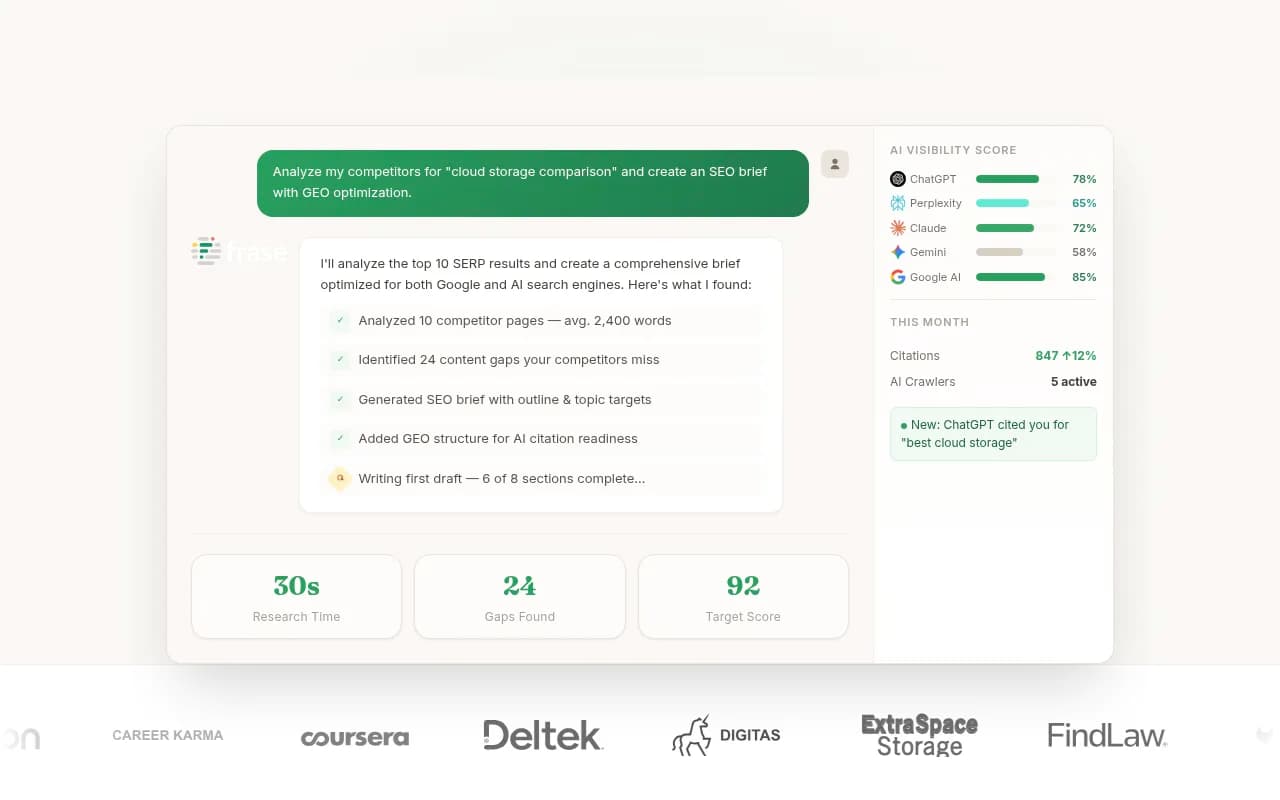
For content research and optimization:
For technical SEO and crawlability (making sure AI crawlers can actually access your content):
For brand monitoring across the web (tracking where you're being mentioned, which feeds into AI citations):
What "winning" actually looks like
A 30%+ citation rate on your core queries is a reasonable target for a mature AI visibility program, according to Averi AI's 2026 metrics guide. That means when someone asks ChatGPT a question in your category, your brand shows up as a cited source roughly one in three times.
Getting there takes 3-6 months of consistent work for most brands. The brands that get there fastest are the ones that treat AI visibility as a distinct discipline -- not just an extension of their existing SEO program -- and invest in both content quality and authority building simultaneously.
The good news: most of your competitors haven't figured this out yet. ChatGPT's 17% search share is still growing, and the brands that establish citation authority now will be much harder to displace later. The window to build a meaningful lead is open, but it won't stay open forever.
Start with your baseline audit. Build your dark query list. Publish content that actually answers questions. Track what works. Repeat.
That's the framework. The rest is execution.