Key takeaways
- Surfer SEO ($99/mo) is the best all-rounder for teams that write frequently and want real-time feedback while drafting. Its content score has a 26% correlation with Google rankings -- higher than Clearscope's 17.5%.
- Clearscope ($199/mo) wins on data quality and team usability. Its letter-grade system is intuitive for writers, and in a 90-day test across 12 tools, it consistently pushed articles to #1.
- MarketMuse is the strategic layer -- best for planning content programs, not just optimizing individual posts. It's expensive but uniquely powerful for topic authority mapping.
- None of these tools were built for AI search. They optimize for Google's traditional ranking signals, which only partially overlap with what gets you cited in ChatGPT, Perplexity, or Google AI Overviews.
- If AI search visibility is your priority in 2026, you need a separate layer on top of these tools -- or a platform built specifically for that job.
Traditional content optimization tools had a clear job: help you rank on Google's blue links. Write about the right topics, use the right terms, hit the right word count. Done.
That job still exists. But in 2026, it's only half the picture. A growing share of search happens inside ChatGPT, Perplexity, Claude, and Google's own AI Overviews -- and those systems don't rank pages the way Google's 10 blue links do. They cite sources. They pull from pages that answer questions clearly, authoritatively, and with enough topical depth to be trusted.
So the real question isn't just "which tool helps me rank on Google?" It's "which tool helps me rank everywhere search is happening?" That changes how you evaluate Surfer, Clearscope, and MarketMuse -- and whether any of them are enough on their own.
Let's get into it.
What these tools actually do
Before comparing them, it's worth being clear about what content optimization tools are and aren't.
They analyze the top-ranking pages for a target keyword, extract the topics, terms, and questions those pages cover, and give you a score or grade based on how well your content matches. The underlying assumption is that if you cover what top-ranking pages cover, you'll rank too.
That assumption holds reasonably well for traditional Google search. It holds less well for AI search, where the models are making judgment calls about authority, trustworthiness, and answer quality -- not just topical coverage.
With that framing in mind, here's how the three tools compare.
Surfer SEO
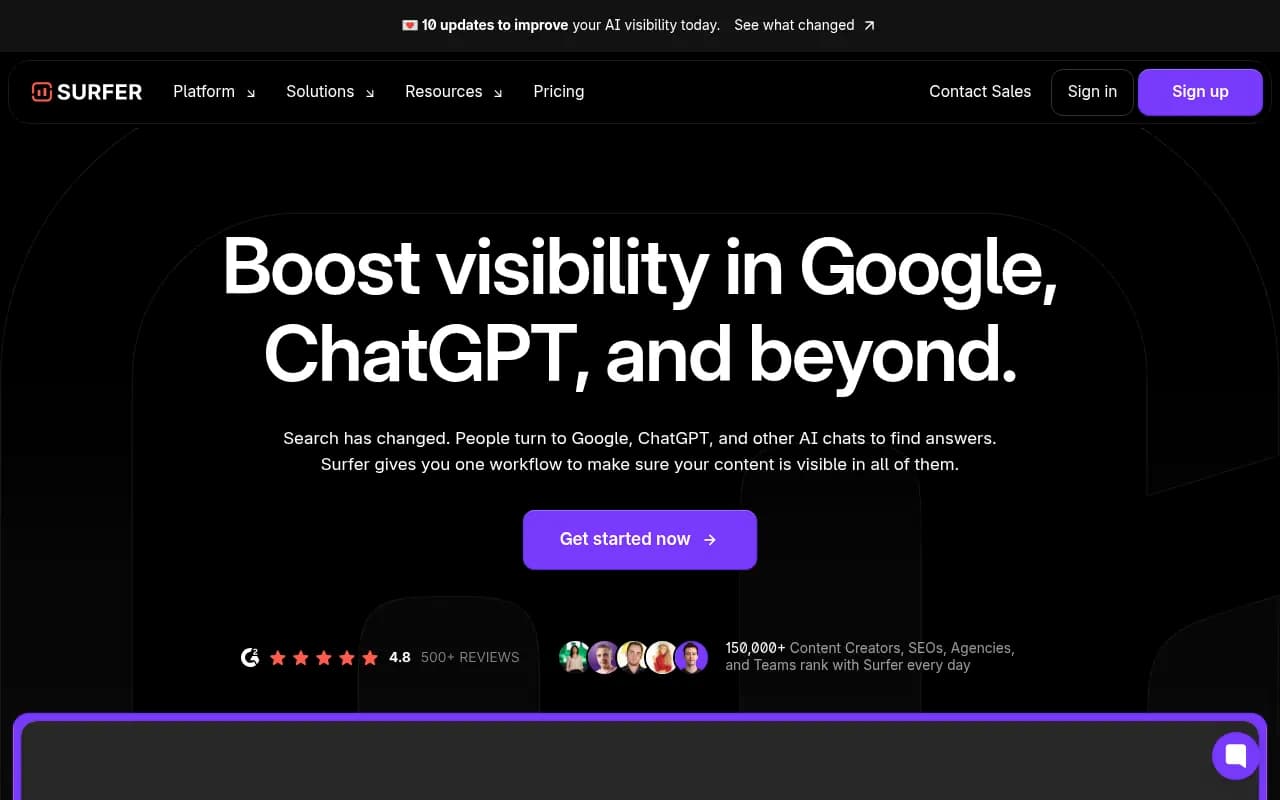
Surfer is the most popular of the three, and for good reason. Its content editor gives you a real-time score (0-100) as you write, flagging which terms to include, how long your content should be, and how many headings and images to use. It's genuinely useful while you're drafting -- not just as a post-hoc audit tool.
The data backs up its effectiveness. According to Surfer's own research (confirmed by Originality.ai), Surfer's content score has a 26% correlation with Google rankings. Clearscope's equivalent is 17.5%. That's a meaningful gap, though it's worth noting that neither number is particularly high in absolute terms. Correlation isn't causation, and a 26% correlation means 74% of ranking variance comes from other factors.
Where Surfer really shines is volume and workflow. If your team publishes frequently -- say, 10-20 articles a month -- Surfer's interface makes it practical to optimize every piece without it becoming a bottleneck. The AI writing features (Surfer AI) can generate first drafts that are already partially optimized, which saves time.
Pricing starts at $99/month (annual billing), which is the most accessible of the three for smaller teams.
The weaknesses: Surfer can push writers toward keyword stuffing if they're chasing the score rather than writing for readers. The optimization signals are also primarily Google-focused. There's no explicit guidance on what makes content citable by AI models.
Clearscope
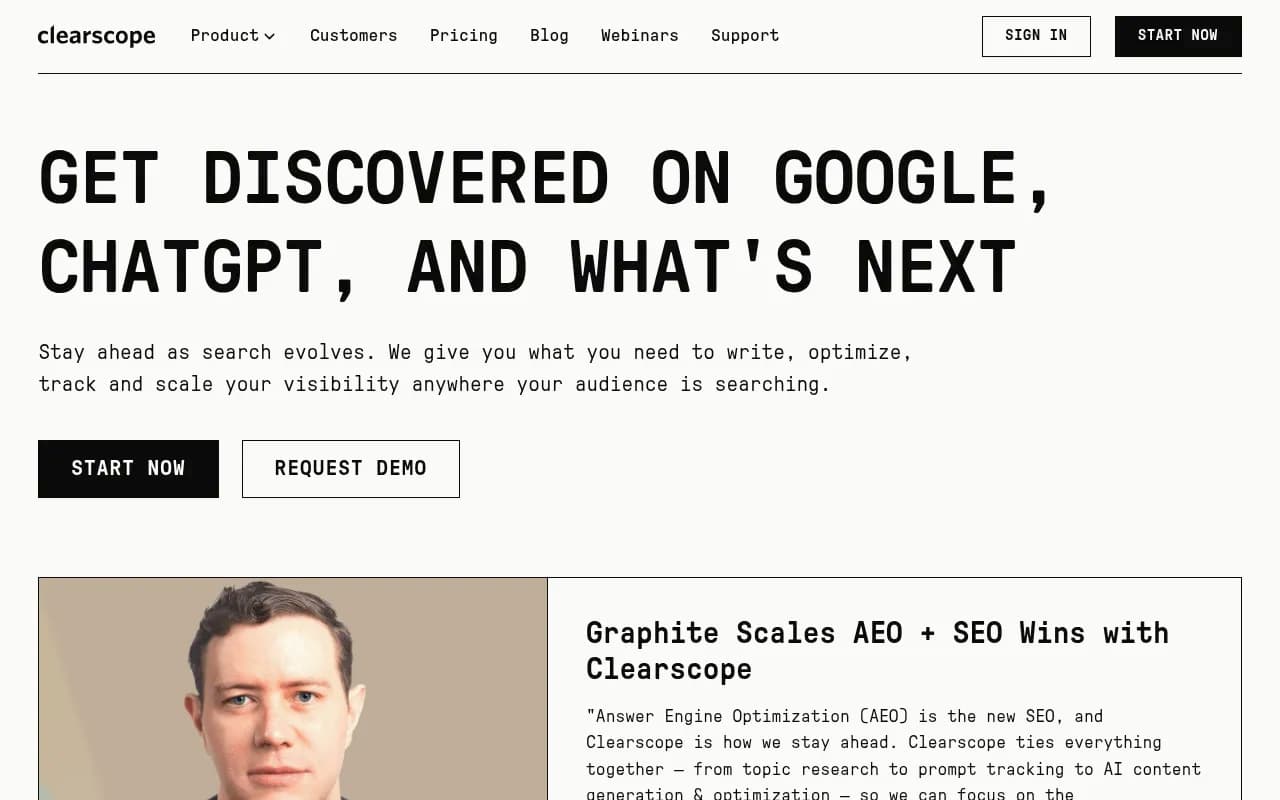
Clearscope takes a different approach. Instead of a numeric score, it uses a letter grade (A++ down to F), which many teams find more intuitive -- it's easier to explain to a writer that their draft is a "C" than that it scored 62 out of 100.
The NLP engine is genuinely strong. Clearscope doesn't just surface keywords; it identifies related concepts and questions that top-ranking content addresses. The result is recommendations that push writers toward topical depth rather than keyword frequency.
In a 90-day test of 12 content optimization tools run by MarketBetter on real B2B articles, Clearscope consistently moved pages to #1 -- more reliably than most alternatives. That's a meaningful data point, even if it's one study.
The tradeoff is price. Clearscope starts at $199/month, which is double Surfer's entry point. For teams publishing at high volume, the per-report cost adds up. It's most defensible for organizations where content quality is the bottleneck, not content quantity.
Clearscope also integrates cleanly with Google Docs and WordPress, which matters for teams that don't want to change their writing environment. Writers can stay in their normal workflow and still see Clearscope's recommendations in a sidebar.
Like Surfer, Clearscope is built for Google. It doesn't specifically optimize for AI citation patterns.
MarketMuse
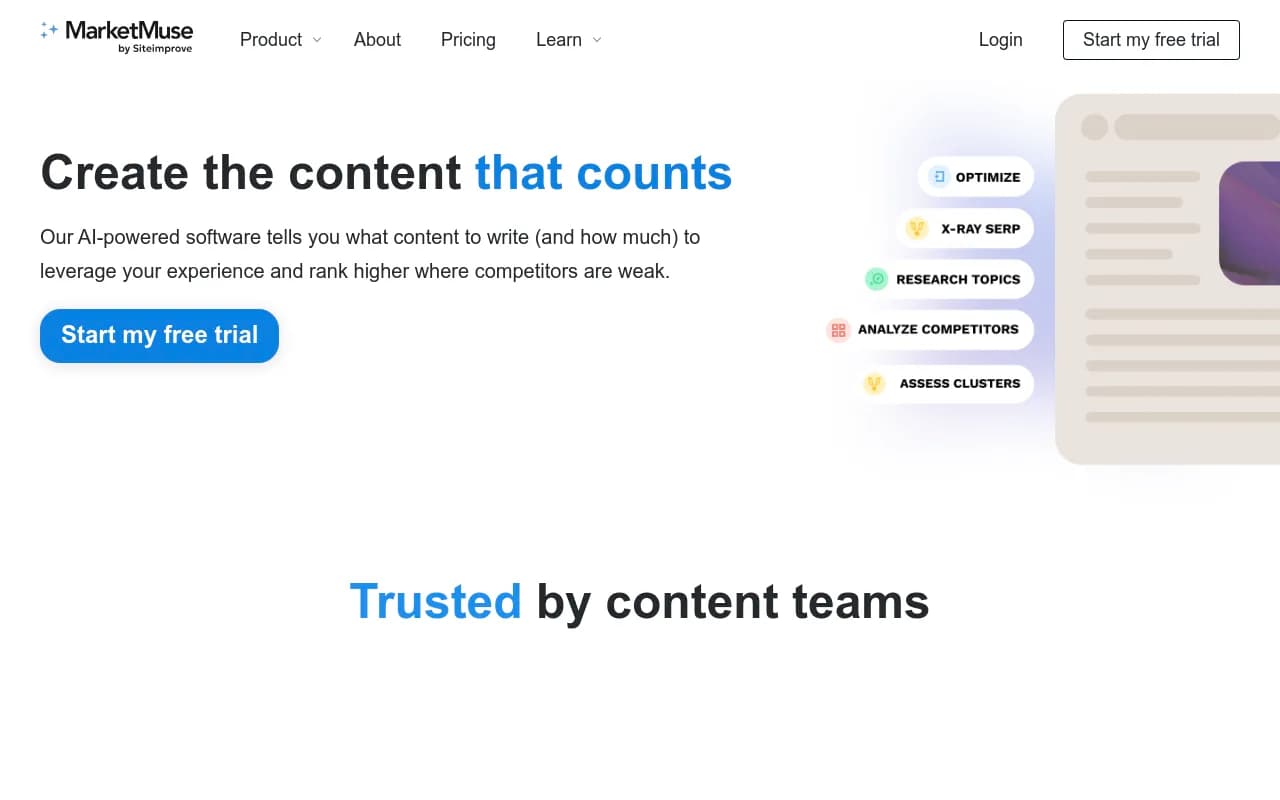
MarketMuse operates at a different level than the other two. Where Surfer and Clearscope help you optimize individual articles, MarketMuse helps you plan your entire content program.
Its topic modeling identifies which subjects your site has authority on, which topics you're missing, and where you have the best chance of competing. The "Content Score" and "Topic Authority" metrics give you a view of your site's competitive position across a whole subject area -- not just for one keyword.
This is genuinely useful for content strategists. If you're building out a new content vertical or trying to establish topical authority in a competitive space, MarketMuse's planning tools are hard to replicate with the other two.
The downside is complexity and cost. MarketMuse has a free tier that lets you test the concept, but meaningful use requires the paid plans, which are significantly more expensive than Surfer or Clearscope. The learning curve is also steeper -- it's not a tool you hand to a writer and expect them to use on day one.
For teams that need strategic content planning alongside optimization, MarketMuse is the most powerful option. For teams that just need to optimize articles they're already writing, it's probably overkill.
Head-to-head comparison
| Surfer SEO | Clearscope | MarketMuse | |
|---|---|---|---|
| Starting price | $99/mo | $199/mo | Free tier; paid plans from ~$149/mo |
| Best for | High-volume content teams | Quality-focused teams, agencies | Content strategists, enterprise |
| Scoring system | 0-100 numeric score | Letter grade (A++ to F) | Topic authority + content score |
| Real-time editor | Yes | Yes | Yes |
| AI writing features | Yes (Surfer AI) | Limited | Yes |
| Strategic planning | Basic | Basic | Strong |
| Google Docs integration | Yes | Yes | Yes |
| WordPress integration | Yes | Yes | Limited |
| AI search optimization | No | No | No |
| Correlation with Google rankings | 26% | 17.5% | Not published |
| Learning curve | Low | Low | Medium-high |
The AI search problem none of them solve
Here's the uncomfortable truth: Surfer, Clearscope, and MarketMuse were all designed for a world where "ranking" meant appearing in Google's traditional search results. That world still exists, but it's no longer the whole picture.
In 2026, a significant and growing share of search queries are answered directly by AI models -- ChatGPT, Perplexity, Claude, Google AI Overviews, Gemini, and others. These systems don't work like Google's blue links. They don't rank pages by keyword density or topical coverage scores. They decide which sources to cite based on factors like:
- Whether your content directly answers the question being asked
- Whether your brand or domain is recognized as authoritative in the space
- Whether your pages are being crawled and indexed by AI crawlers
- Whether your content appears in the training data or retrieval corpus the model uses
None of the three tools above track any of this. They can't tell you whether ChatGPT is citing your competitors instead of you, which prompts you're invisible for, or whether AI crawlers are even reaching your pages.
This is a real gap. If you're investing in content optimization and not tracking AI search visibility, you're optimizing for half the channel.
For teams that want to close that gap, platforms like Promptwatch are built specifically for AI search visibility -- tracking where you appear (and don't appear) across ChatGPT, Perplexity, Claude, Gemini, and others, identifying which prompts competitors are winning that you're not, and helping you create content that actually gets cited.

The two layers aren't mutually exclusive. Surfer or Clearscope for Google optimization, Promptwatch for AI search visibility -- that's a reasonable stack for teams that care about both channels.
Which tool should you choose?
The right answer depends on what you're actually trying to do.
Choose Surfer SEO if...
You publish frequently and need a tool that fits into a fast-moving content workflow. Surfer's real-time editor is the most practical for high-volume teams, and the $99/month price point makes it accessible without a big budget conversation. If you're writing 10+ articles a month and want optimization baked into the drafting process, Surfer is the easiest choice.
Choose Clearscope if...
Content quality is your primary concern and you're willing to pay for better data. Clearscope's NLP recommendations push writers toward genuine topical depth rather than keyword stuffing, and the letter-grade system makes it easier to communicate quality standards across a team. The Google Docs integration is also the smoothest of the three. If you're a mid-size marketing team or agency where writer experience matters, Clearscope is worth the premium.
Choose MarketMuse if...
You're thinking at the program level, not the article level. MarketMuse is for content strategists who need to understand their site's topical authority, identify gaps in their content coverage, and prioritize which topics to attack. It's not a drafting tool first -- it's a planning tool. If you're building a content strategy from scratch or trying to establish authority in a competitive space, MarketMuse's strategic layer is genuinely valuable.
Consider adding an AI search layer if...
You care about appearing in ChatGPT, Perplexity, Google AI Overviews, or other AI search engines. None of the three tools above will help you here. You need something purpose-built for AI visibility tracking and optimization -- and that's a separate category from traditional content optimization.
A few tools worth knowing about in adjacent spaces
If you're building out a broader content and SEO stack, a few other tools are worth mentioning:
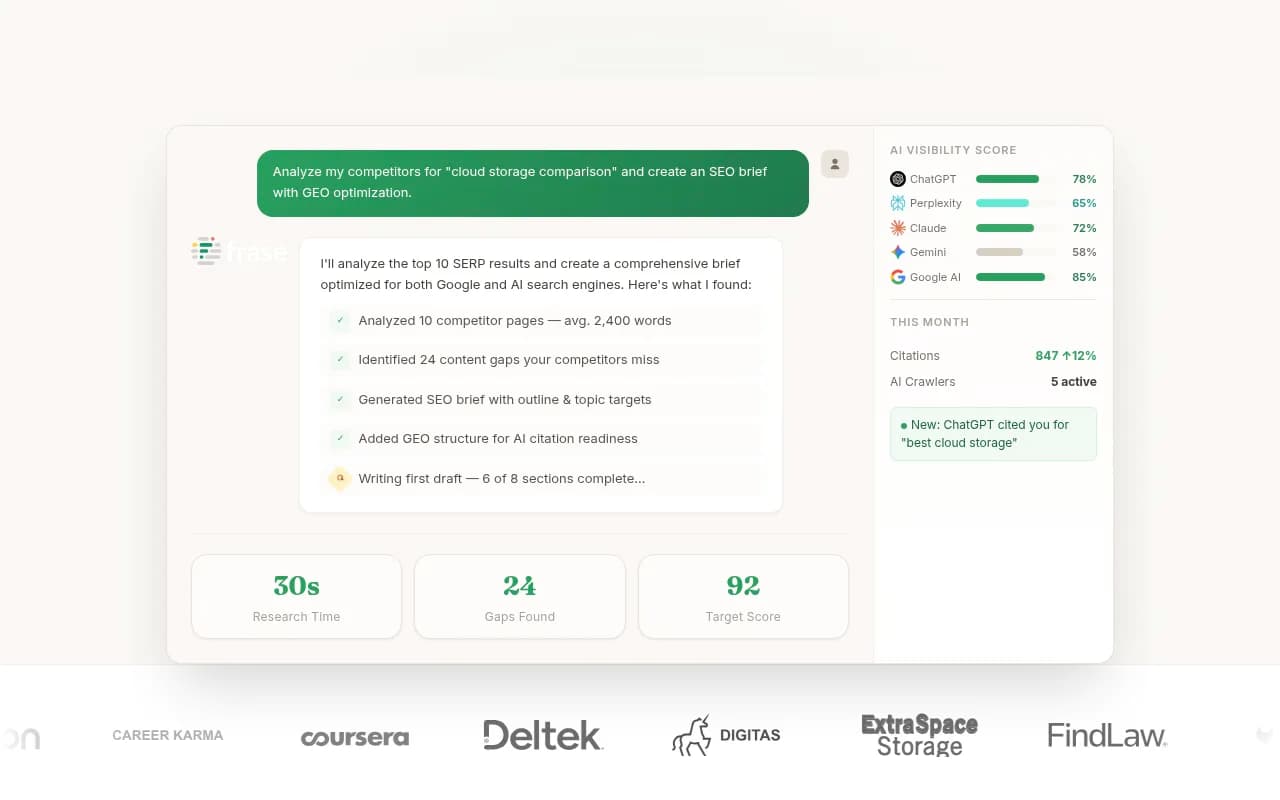
Frase is a strong alternative to Surfer at a lower price point ($15-45/month), with solid content brief generation and a built-in AI writer. It's worth considering if Surfer's price is a stretch.
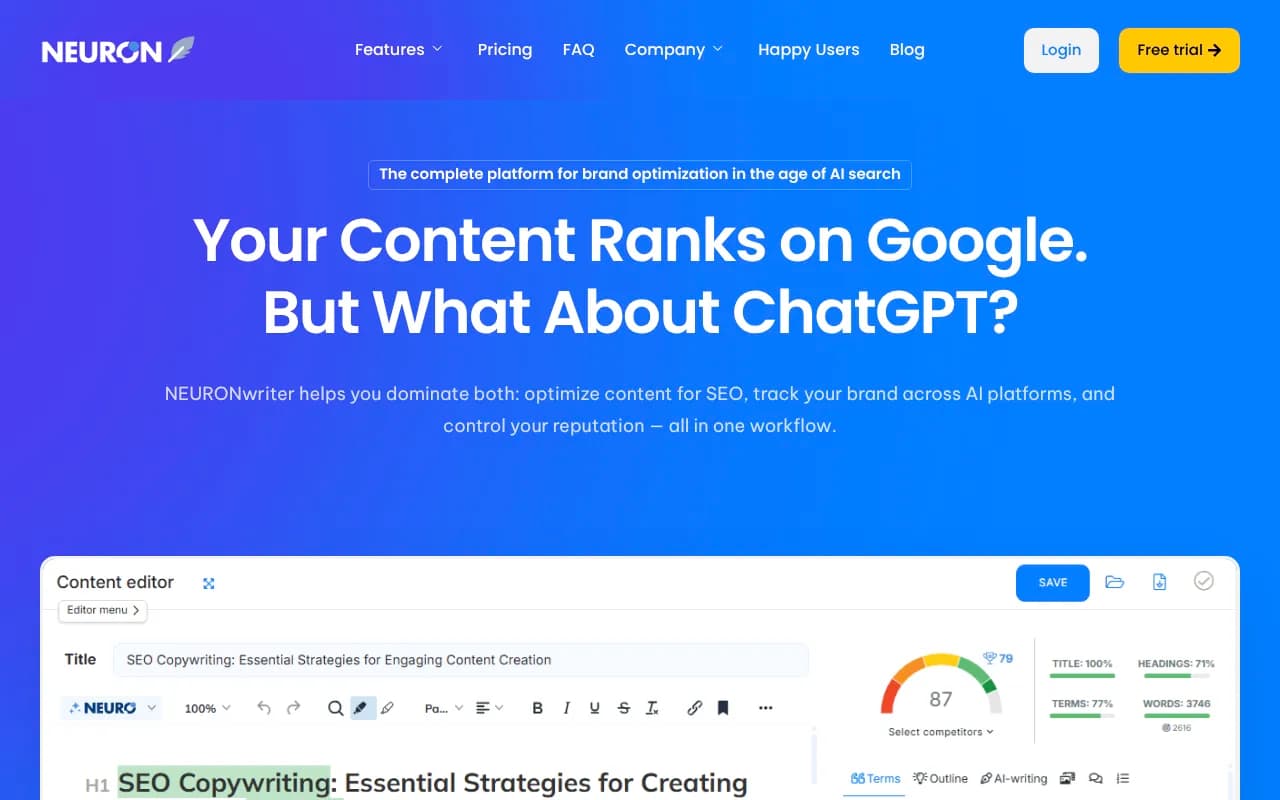
NeuronWriter is another Surfer alternative with strong semantic analysis, particularly popular in Europe.
Semrush's Writing Assistant is worth knowing about if you're already a Semrush customer -- it's included in some plans and covers the basics of content optimization without an additional subscription.
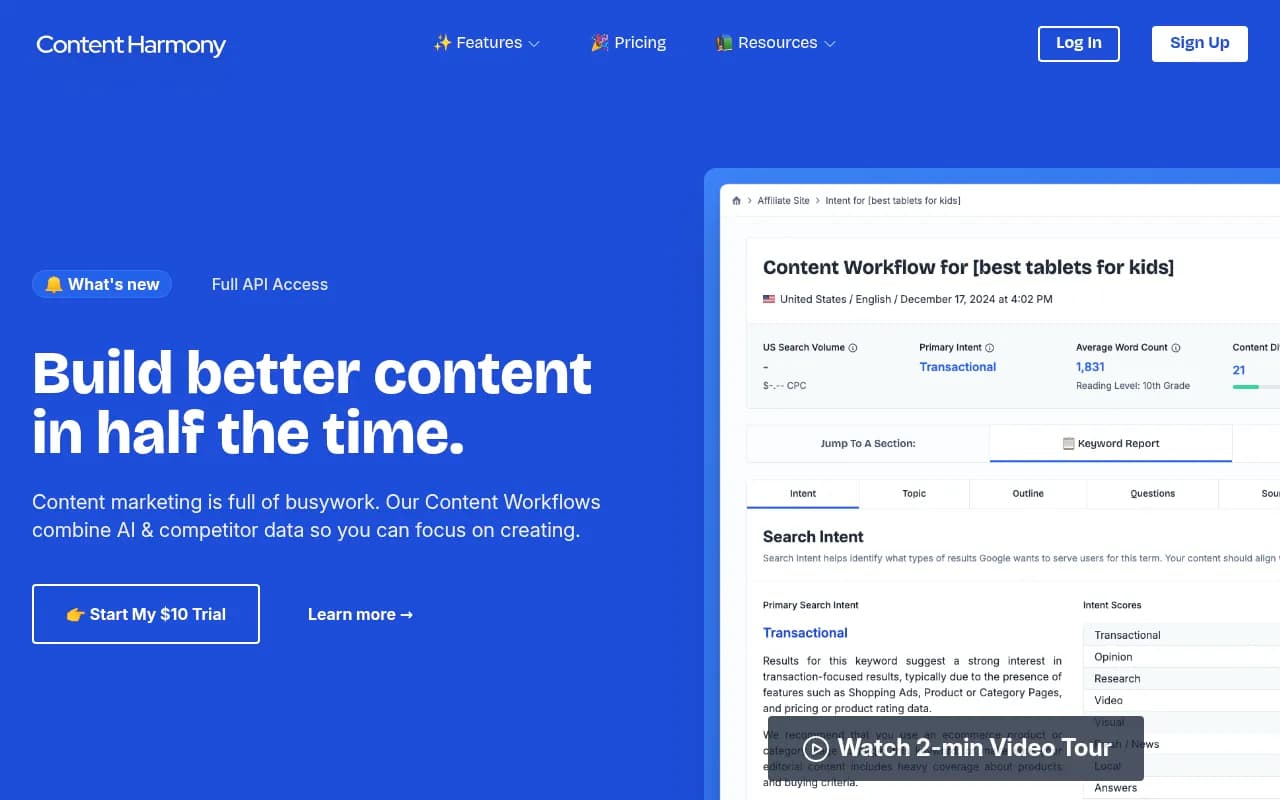
Content Harmony sits in a slightly different niche, focused on content brief creation rather than real-time optimization, but it's excellent for teams that want to front-load the research before writing starts.
The bottom line
Surfer SEO, Clearscope, and MarketMuse are all legitimate tools that do what they claim. Surfer is the most practical for high-volume teams. Clearscope has the best data quality and team usability. MarketMuse is the most powerful for strategic planning.
But in 2026, content optimization for Google's traditional search results is table stakes -- not a competitive advantage. The teams pulling ahead are the ones who also understand their AI search visibility: which prompts they're being cited for, where competitors are winning, and how to create content that AI models actually reference.
That requires a different kind of tool. The three covered here are a good foundation. They're just not the whole story anymore.