Key takeaways
- Promptwatch and Content Harmony solve fundamentally different problems -- one is built for AI search visibility, the other for traditional SEO content workflows. They barely overlap.
- If your goal is ranking in ChatGPT, Perplexity, or Claude, Promptwatch is the only option here. Content Harmony has zero AI search monitoring capabilities.
- If your goal is producing high-quality, well-researched content briefs for Google search at scale, Content Harmony is purpose-built for that workflow and Promptwatch isn't.
- Both start at $99/mo, but Content Harmony's pricing includes unlimited users -- Promptwatch's $99 tier is quite limited (1 site, 50 prompts, 5 articles) and most teams will need the $249/mo plan.
- Promptwatch goes beyond monitoring: it identifies content gaps, generates AI-optimized articles, and tracks traffic attribution. Most AI visibility tools stop at the dashboard. Content Harmony similarly goes beyond research to include brief generation and content grading.
- The honest answer for most content teams in 2026: these tools are complements, not competitors. You'd use Content Harmony for Google SEO and Promptwatch for AI search.
Overview
Promptwatch

Promptwatch is an AI Search Visibility and Generative Engine Optimization (GEO) platform. It monitors how your brand appears across 10+ AI engines -- ChatGPT, Claude, Perplexity, Gemini, Grok, DeepSeek, and others -- and then helps you do something about it. The "do something" part is what separates it from most competitors: beyond tracking, it offers content gap analysis, an AI writing agent that generates articles grounded in real citation data, crawler log monitoring, and traffic attribution. Trusted by 8,000+ brands including Booking.com and Typeform, and rated 4.7/5 on G2.
Content Harmony
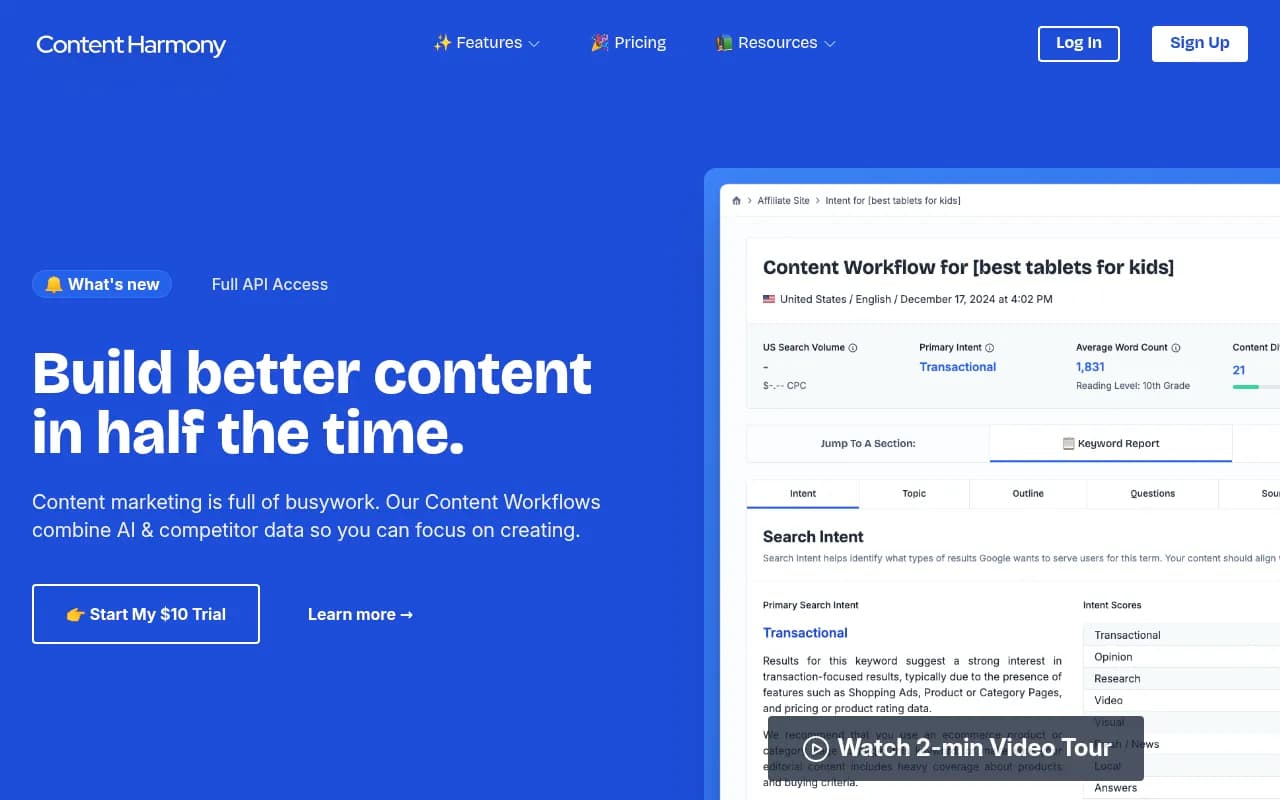
Content Harmony is a content workflow platform built by former agency operators. It covers the full SEO content production cycle: keyword research and search intent analysis, standardized content brief generation, and AI-driven content grading. The pitch is speed and consistency -- it takes the manual research process that used to take an hour per topic and compresses it into a repeatable workflow. Used by agencies like Directive and brands like K Health, it's well-regarded for making content teams faster without sacrificing quality.
Side-by-side comparison
| Feature | Promptwatch | Content Harmony |
|---|---|---|
| Primary use case | AI search visibility & GEO | SEO content briefs & workflow |
| AI search monitoring | Yes (10+ models) | No |
| Content brief generation | AI-optimized for LLM citation | Traditional SEO briefs |
| Keyword research | Prompt volume & difficulty scoring | Full keyword research reports |
| Content grading | No | Yes (AI topic model grading) |
| Competitor analysis | AI visibility heatmaps | Competitor document structure |
| Crawler log monitoring | Yes (real-time AI crawlers) | No |
| Traffic attribution | Yes (GSC, code snippet, server logs) | No |
| Reddit/YouTube insights | Yes | No |
| ChatGPT Shopping tracking | Yes | No |
| Integrations | Looker Studio, Cloudflare, Vercel, Fastly, GSC | Shareable brief links, basic integrations |
| API access | Yes | Limited |
| Free tier | 7-day free trial | $10 starter (10 workflows) |
| Unlimited users | No (seat-based) | Yes |
| Starting price | $99/mo | $99/mo |
| Target audience | Marketing/SEO teams, agencies (AI search focus) | Content teams, SEO agencies |
| G2 rating | 4.7/5 | Strong (Capterra & G2 badges) |
Head-to-head feature deep-dive
Core purpose and workflow fit
These tools don't really compete -- they serve different masters. Promptwatch is built around a specific problem: your brand is invisible in AI search, and you need to fix it. The workflow is: track where you're missing, find the content gaps, generate content that gets cited, measure the results. Every feature connects back to that loop.
Content Harmony is built around a different problem: your content team is slow, inconsistent, and spending too much time on manual research. The workflow is: research a keyword, generate a brief, share it with writers, grade the draft. Every feature connects back to that production pipeline.
If you're asking "which AI engine is recommending my competitor instead of me?" -- that's Promptwatch. If you're asking "how do I get my writers to produce better briefs faster?" -- that's Content Harmony.
Verdict: Neither wins here because they're solving different problems. Pick based on which problem you actually have.
AI search visibility
This is Promptwatch's entire reason for existing. It monitors 10 AI models, tracks prompt-level visibility, shows you sentiment and share of voice, and logs when AI crawlers hit your pages in real time. The citation analysis goes deep -- you can see which specific pages are being cited, how often, and by which models.
Content Harmony has no AI search monitoring whatsoever. It doesn't track ChatGPT, Perplexity, Claude, or any other AI engine. It was built for Google, and that's still its focus.
Verdict: Promptwatch wins by default. Content Harmony doesn't play in this space.
Content creation and optimization
Both tools help you create content, but the outputs are completely different.
Promptwatch's AI writing agent generates articles, listicles, and comparison pages grounded in citation data -- the goal is content that AI models will actually cite. It analyzes 880M+ citations to understand what types of content get recommended, then builds articles around that. The content is engineered for AI search, not Google rankings.
Content Harmony's content workflow is built for Google. It generates detailed briefs with keyword data, entity coverage, competitor document structure, and visual content requirements. The content grader then scores your draft against a topic model to make sure you're covering everything comprehensively. This is genuinely useful for producing thorough, well-structured content that ranks in traditional search.
| Capability | Promptwatch | Content Harmony |
|---|---|---|
| Content generation | Yes (AI agent, citation-grounded) | Brief generation only (no drafts) |
| Content grading | No | Yes (AI topic model) |
| Optimized for | AI search citation | Google search rankings |
| Brief standardization | No | Yes |
| Competitor content analysis | AI visibility comparison | Document structure analysis |
| Entity/keyword coverage | Prompt-based gap analysis | Traditional keyword/entity model |
Verdict: Depends entirely on your target channel. Promptwatch for AI search content, Content Harmony for Google SEO content.
Keyword and prompt research
Content Harmony has a proper keyword research module. You get detailed keyword reports with search volume, intent analysis, overlapping keywords, and entity coverage. It's designed to give SEOs everything they need to brief a topic without leaving the tool.
Promptwatch approaches this differently. Instead of traditional keywords, it tracks prompts -- the actual questions people ask AI engines. You get volume estimates and difficulty scores for each prompt, plus "query fan-outs" that show how one prompt branches into related sub-queries. This is genuinely useful for prioritizing which AI search topics to go after.
Neither tool replaces a dedicated keyword research tool like Ahrefs or Semrush for traditional SEO. But for AI search prompt research, Promptwatch is in a category of its own.
Verdict: Content Harmony for traditional keyword research; Promptwatch for AI prompt research.
Pricing and value
Both tools start at $99/mo, but the value at that price point is quite different.
Content Harmony's $99/mo gets you roughly 10 workflows per month, unlimited users, and unlimited projects. For a small team or agency, that's genuinely accessible -- you're not paying per seat, so adding writers and editors doesn't cost extra.
Promptwatch's $99 Essential plan covers 1 site, 50 prompts, and 5 AI-generated articles per month. That's enough to get started and validate the tool, but most serious users will need the $249/mo Professional plan (2 sites, 150 prompts, 15 articles, crawler logs, local tracking).
| Plan | Promptwatch | Content Harmony |
|---|---|---|
| Entry-level | $99/mo (Essential) | $99/mo (~10 workflows) |
| Mid-tier | $249/mo (Professional) | ~$299/mo (~30 workflows) |
| Business | $579/mo (5 sites, 350 prompts) | Custom / higher volume |
| Enterprise/Agency | Custom pricing | Custom pricing |
| Free option | 7-day free trial | $10 starter (10 workflows) |
| Users | Seat-based | Unlimited |
| Rollover credits | No | Yes |
Content Harmony's credit rollover policy is a nice touch -- unused workflows carry forward, so you're not penalized for a slow month. Promptwatch doesn't offer this.
Verdict: Content Harmony is more cost-effective for teams with multiple users. Promptwatch's pricing reflects its specialized capabilities, but you'll pay more to unlock the full feature set.
Analytics and reporting
Promptwatch has a proper analytics layer: visibility scores over time, share of voice vs competitors, page-level citation tracking, AI crawler logs, and traffic attribution that connects AI visibility to actual website visits. The Looker Studio integration lets you pull this into custom dashboards.
Content Harmony's reporting is more limited -- it's focused on workflow metrics (briefs created, content grades) rather than performance analytics. It doesn't track how your content performs after it's published.
Verdict: Promptwatch is significantly stronger on analytics and performance tracking.
Integrations and technical setup
Promptwatch integrates with Google Search Console, Cloudflare, Vercel, Fastly, and Looker Studio. The AI crawler log feature requires a CDN or server-level integration to capture real-time data. There's also an API for custom workflows.
Content Harmony is simpler to set up -- it's primarily a web app with shareable brief links. No complex integrations required. That simplicity is a feature for teams that just want to get briefs out the door.
Verdict: Promptwatch has more integrations but also more setup complexity. Content Harmony is plug-and-play.
Pricing comparison
| Plan | Promptwatch | Content Harmony |
|---|---|---|
| Starter/Trial | 7-day free trial | $10 for first 10 workflows |
| Entry | $99/mo (1 site, 50 prompts, 5 articles) | $99/mo (~10 workflows/mo) |
| Professional | $249/mo (2 sites, 150 prompts, 15 articles) | ~$299/mo (~30 workflows) |
| Business | $579/mo (5 sites, 350 prompts, 30 articles) | Higher volume tiers available |
| Agency/Enterprise | Custom | Custom |
| Annual discount | Yes | Yes |
| Users | Seat-based | Unlimited |
Pros and cons
Promptwatch
Pros:
- The only tool here that monitors AI search visibility across 10+ models
- Goes beyond monitoring -- content gap analysis and AI writing agent close the loop
- Real-time AI crawler logs are genuinely rare and useful
- Traffic attribution connects AI visibility to revenue
- Reddit and YouTube citation tracking covers channels most tools ignore
- Strong G2 rating (4.7/5) with a large, active customer base
Cons:
- No content grading for traditional SEO
- Entry-level plan ($99/mo) is limited; most teams need the $249/mo plan
- Seat-based pricing adds up for larger teams
- Setup requires some technical work for crawler logs and attribution
- Not useful if your primary goal is Google search rankings
Content Harmony
Pros:
- Excellent brief standardization -- genuinely speeds up content production
- Unlimited users at every pricing tier, which is rare
- Credit rollover means you don't lose unused capacity
- Content grader helps writers produce comprehensive, well-structured content
- Low barrier to entry ($10 starter offer)
- Built by practitioners who understand the agency content workflow
Cons:
- Zero AI search visibility features
- No post-publish performance tracking
- Content generation is brief-only -- no full draft writing
- Primarily Google-focused; won't help you rank in AI engines
- Reporting is limited compared to dedicated analytics tools
Who should pick which tool
Pick Promptwatch if:
- You want to track and improve how your brand appears in ChatGPT, Perplexity, Claude, or other AI engines
- You're running a GEO or AEO strategy and need data to back it up
- You want to understand which content gaps are costing you AI search visibility
- You need to show clients or stakeholders ROI from AI search (traffic attribution matters to you)
- You're an agency managing AI visibility for multiple brands
Pick Content Harmony if:
- Your primary content channel is Google search and you want to rank better there
- You run a content team or agency that produces high volumes of SEO content
- Brief standardization and consistency are pain points for your team
- You have multiple writers and editors who need access without paying per seat
- You want to grade existing content against a topic model to find gaps
Use both if:
- You're running a full content marketing program targeting both Google and AI search
- You have a content team producing briefs (Content Harmony) and a marketing team tracking AI visibility (Promptwatch)
- You're an agency that needs to deliver on both traditional SEO and AI search visibility for clients
Final verdict
Promptwatch and Content Harmony are not really competing for the same buyer. Promptwatch is the right tool if AI search visibility is your problem -- it's the most complete platform in that space, and unlike most monitoring-only tools, it actually helps you fix what's broken. Content Harmony is the right tool if you're running a Google-focused content operation and need to make your team faster and more consistent.
The question to ask yourself is simple: where do you need to win? If the answer is "AI search engines like ChatGPT and Perplexity," Promptwatch is the clear choice. If the answer is "Google search rankings through better content production," Content Harmony earns its price. If the answer is both, these tools work well alongside each other -- they don't overlap enough to create redundancy.