Key Takeaways
- Atomic AGI is a full-stack SEO platform that tracks both Google and AI search engines, while Omnia focuses exclusively on AI visibility and share of voice analytics
- Atomic AGI starts at $10/mo with a free tier, making it significantly more accessible than Omnia's custom pricing model
- Omnia provides deeper share of voice analytics and competitive benchmarking specifically for AI platforms, while Atomic AGI offers broader SEO functionality including technical audits and workflow automation
- Atomic AGI includes AI agents and automation workflows that can execute tasks, whereas Omnia focuses on monitoring and insights with an actionable roadmap
- If you need traditional SEO tools alongside AI tracking, Atomic AGI is the better choice. If you only care about AI visibility and competitor analysis, Omnia's specialized approach may be worth the premium
- Both platforms track major AI engines (ChatGPT, Perplexity, Gemini, Claude), but Atomic AGI also monitors traditional Google search performance
Overview
Omnia
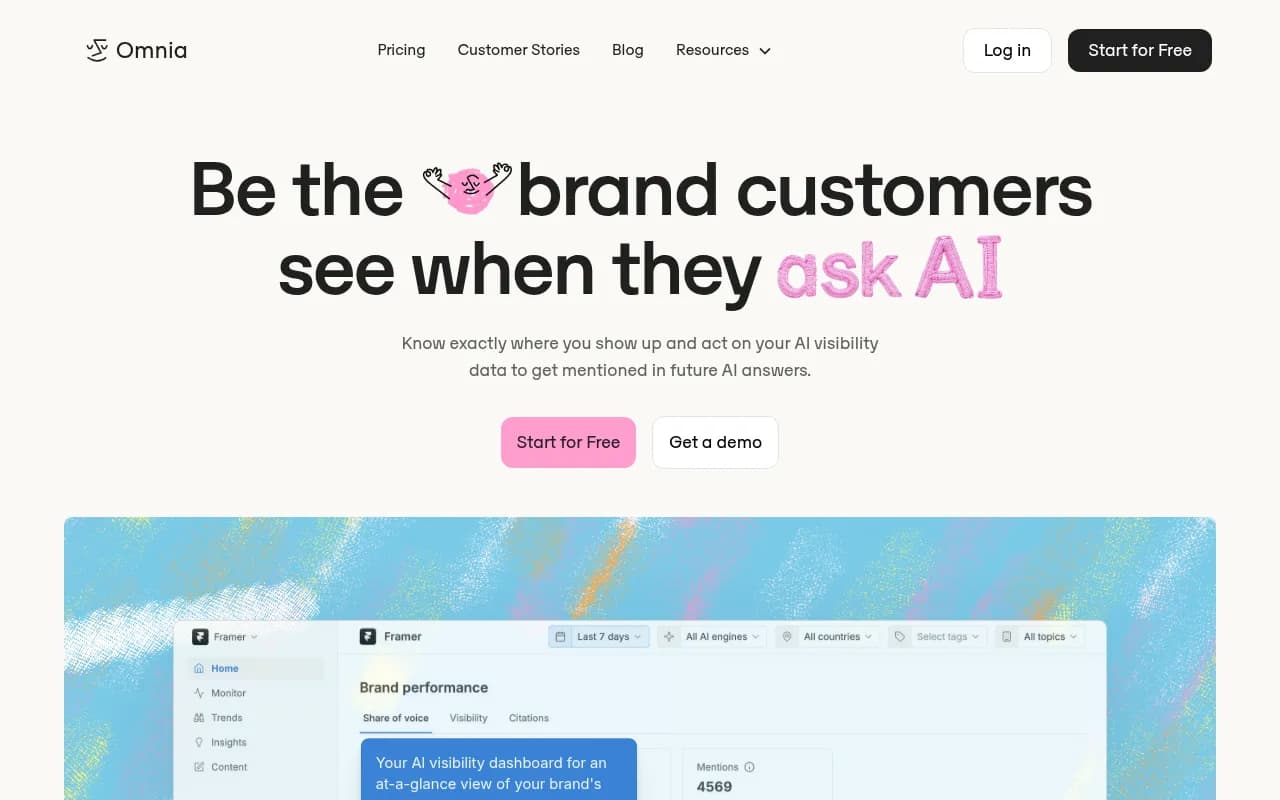
Omnia positions itself as an AI visibility platform built specifically for SEO and marketing teams who want to understand how their brand shows up in AI search results. The platform monitors citations and mentions across ChatGPT, Perplexity, Google Gemini, and Microsoft Copilot. Omnia's core value is helping you see your brand "through AI's eyes" -- tracking share of voice, competitive positioning, and the real questions people ask AI engines about your industry.
The platform translates tracking data into what they call an "AI visibility roadmap" with recommendations for content creation, technical SEO, and content placement. Clients include Exoticca, IronHack, Growth Hackers, and Pleo.
Atomic AGI
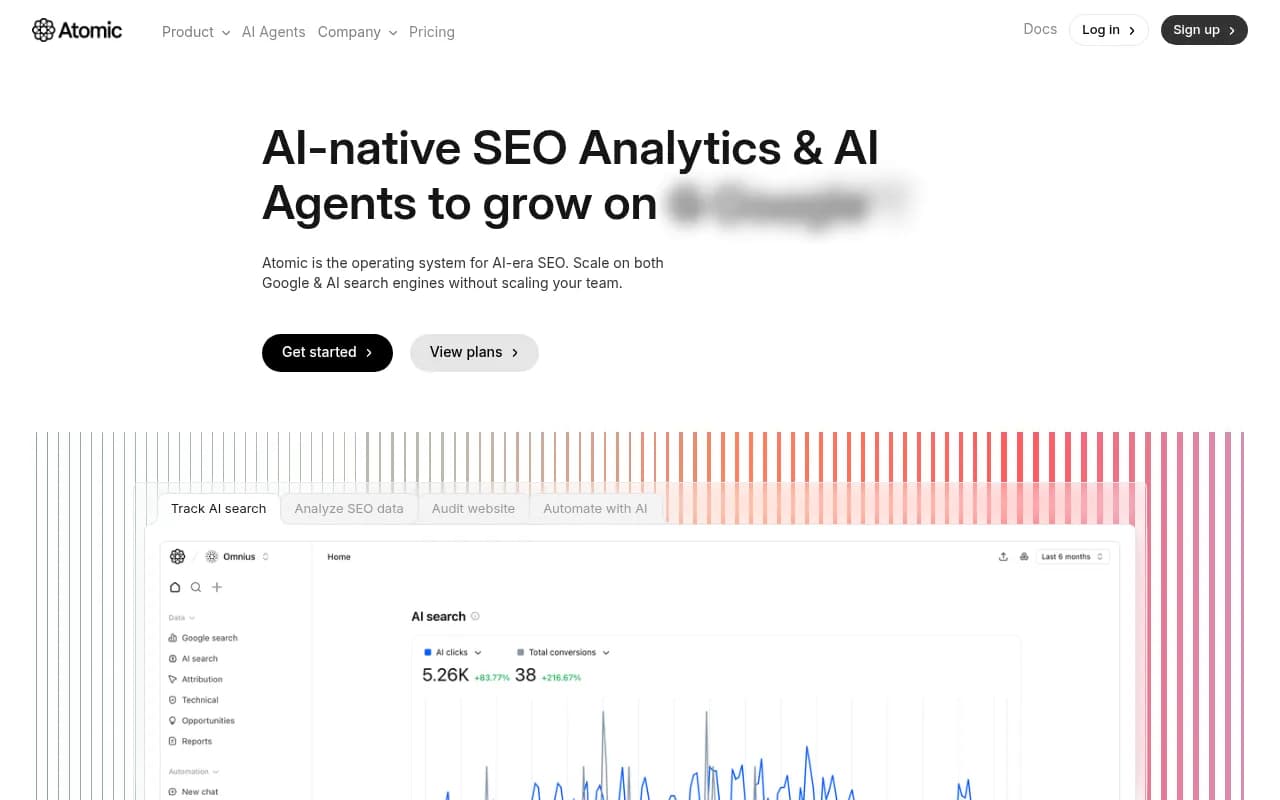
Atomic AGI takes a different approach: it's an all-in-one SEO analytics and automation platform that tracks both traditional Google search and AI search engines. The platform combines multi-engine data tracking, technical audits, AI agents, and workflow automation in a single interface. Atomic AGI calls itself "the operating system for AI-era SEO" -- the idea is you can scale organic growth across Google and LLMs without scaling your headcount.
Atomic AGI monitors ChatGPT, Perplexity, Gemini, and Claude alongside Google, and includes AI agents that can automate repetitive SEO tasks. Users include Accenture, Booking.com, Samsung, MIT, and Loom.
Side-by-Side Comparison
| Feature | Omnia | Atomic AGI |
|---|---|---|
| Pricing | Custom pricing, free trial | Free tier + paid from $10/mo |
| AI engines tracked | ChatGPT, Perplexity, Gemini, Copilot | ChatGPT, Perplexity, Gemini, Claude |
| Google search tracking | No | Yes |
| Share of voice analytics | Yes, core feature | Yes |
| Competitor benchmarking | Yes | Yes |
| Technical SEO audits | No | Yes |
| AI agents/automation | No | Yes |
| Prompt discovery | Yes | Yes |
| Citation tracking | Yes | Yes |
| Actionable insights | Roadmap recommendations | AI agents + workflows |
| Free tier | No (trial only) | Yes |
| Target audience | Marketing/SEO teams focused on AI visibility | Marketing teams managing both traditional + AI SEO |
Platform scope and focus
Omnia: AI visibility specialist
Omnia is laser-focused on one thing: helping you understand and improve how your brand appears in AI search results. The platform doesn't try to be a full SEO suite. It tracks prompts, monitors where you show up, benchmarks you against competitors, and tells you what to do about it.
The three-part structure is straightforward: discover real questions people ask AI, monitor where you show up and how you compare to competitors, and get an actionable roadmap for improving your AI visibility. That roadmap includes content creation suggestions, technical SEO fixes, and content placement strategies -- all mapped to fill specific gaps in your AI presence.
This narrow focus is both a strength and a limitation. If AI visibility is your primary concern and you already have other tools handling traditional SEO, Omnia's specialized approach makes sense. But if you need a platform that covers the full SEO picture, Omnia leaves gaps.
Atomic AGI: Full-stack SEO platform
Atomic AGI takes the opposite approach: it's a comprehensive SEO platform that happens to include AI search tracking. You get traditional SEO analytics (Google rankings, traffic analysis, keyword research), technical audits (crawl errors, site health, performance issues), AI search monitoring (ChatGPT, Perplexity, Gemini, Claude), and automation capabilities (AI agents that can execute tasks, workflow builders).
The platform's value proposition is consolidation. Instead of juggling separate tools for Google SEO, AI visibility, technical audits, and task automation, you manage everything in one place. The AI agents are particularly interesting -- they can automate repetitive SEO tasks like content optimization, link analysis, and reporting.
The downside: Atomic AGI's AI search tracking may not be as deep or specialized as Omnia's. You're getting broader coverage but potentially less depth in any single area.
AI engine coverage
Both platforms track the major AI search engines, but with slight differences:
Omnia tracks:
- ChatGPT
- Perplexity
- Google Gemini
- Microsoft Copilot
Atomic AGI tracks:
- ChatGPT
- Perplexity
- Google Gemini
- Claude
The main difference: Omnia includes Microsoft Copilot while Atomic AGI includes Claude. Neither is clearly superior -- it depends on which AI engines your audience uses. Copilot matters if you're targeting enterprise users who rely on Microsoft's ecosystem. Claude matters if your audience skews toward technical users or developers who prefer Anthropic's models.
Both platforms let you monitor prompts, track citations, and see which sources AI engines pull from when answering questions about your industry or product. Both offer competitor benchmarking so you can see how your visibility compares to rivals.
Share of voice and competitive analysis
Omnia's approach
Omnia treats share of voice as a first-class metric. The platform shows you what percentage of AI responses mention your brand versus competitors, broken down by topic, prompt category, and AI engine. You can see trends over time and identify where you're gaining or losing ground.
The competitive benchmarking is granular. Omnia doesn't just tell you that Competitor X has higher visibility -- it shows you which specific prompts they dominate, what citations AI engines use for them, and what content gaps you need to fill to compete. This level of detail is Omnia's core differentiator.
Atomic AGI's approach
Atomic AGI includes share of voice tracking but frames it as one component of a broader SEO strategy. You can see your visibility across AI engines and compare it to competitors, but the emphasis is on integrating that data with traditional SEO metrics.
The platform's strength is showing you the full picture: how your Google rankings correlate with your AI visibility, which pages drive traffic from both traditional and AI search, and where technical issues might be hurting your performance across all channels.
If you want the deepest possible dive into AI-specific share of voice, Omnia wins. If you want to understand AI visibility in the context of your overall organic strategy, Atomic AGI's integrated approach is more useful.
Automation and AI agents
This is where the platforms diverge sharply.
Omnia doesn't offer automation or AI agents. The platform gives you insights and recommendations, but you're responsible for executing them. Omnia tells you what content to create, what technical fixes to make, and where to place content -- but you have to do the work yourself or hand it off to your team.
Atomic AGI includes AI agents that can automate repetitive SEO tasks. The platform offers workflow builders where you can set up automated processes: content audits that run on a schedule, link analysis that flags issues, reporting that generates and sends itself, optimization suggestions that get applied automatically.
The AI agents can also help with content creation, keyword research, and competitive analysis -- they're not just monitoring tools, they're execution tools. This is a huge time-saver if you're managing SEO for multiple sites or trying to scale without adding headcount.
If you want a monitoring platform that tells you what to do, Omnia works. If you want a platform that can actually do some of the work for you, Atomic AGI is the only option here.
Technical SEO capabilities
Omnia doesn't include technical SEO audits. The platform focuses on AI visibility and assumes you're handling technical SEO elsewhere.
Atomic AGI includes a full technical audit suite: crawl error detection, site health monitoring, performance analysis, structured data validation, and more. You can see how technical issues affect both your Google rankings and your AI visibility -- sometimes a broken page or missing schema markup hurts you across all channels.
If you need technical SEO tools, Atomic AGI is the clear winner. If you already have technical SEO covered with another platform (Screaming Frog, Sitebulb, etc.), Omnia's lack of technical features isn't a dealbreaker.
Pricing comparison
| Plan | Omnia | Atomic AGI |
|---|---|---|
| Free tier | No (trial only) | Yes |
| Starter | Custom pricing | $10/mo |
| Pro/Professional | Custom pricing | Pricing not publicly listed |
| Enterprise | Custom pricing | Custom pricing |
| Free trial | Yes | Implied (free tier available) |
Omnia uses custom pricing, which typically means higher costs and sales conversations. The website mentions a free trial but doesn't list public pricing tiers. This pricing model usually signals an enterprise focus -- Omnia is targeting marketing teams with budget, not solo practitioners or small businesses.
Atomic AGI starts at $10/mo with a free tier available. This makes it dramatically more accessible for small teams, freelancers, or anyone who wants to test AI search tracking without committing to a sales call. The low entry point is a major advantage.
For budget-conscious teams or anyone who wants to start small and scale up, Atomic AGI wins on pricing accessibility. If you're an enterprise team with budget and you want specialized AI visibility tools, Omnia's custom pricing may be justified by the depth of its competitive analysis.
Worth noting: if you're also looking to track how your brand shows up in AI search results and need content gap analysis or AI-powered content generation to fill those gaps, Promptwatch covers that angle with a different approach -- it shows you exactly which prompts competitors rank for but you don't, then helps you create content that gets cited.

Pros and cons
Omnia pros
- Deep share of voice analytics specifically for AI platforms
- Strong competitive benchmarking with granular prompt-level insights
- Actionable roadmap that translates data into specific recommendations
- Clean interface focused on AI visibility without distractions
- Tracks Microsoft Copilot (useful for enterprise-focused brands)
Omnia cons
- Custom pricing model creates friction and likely higher costs
- No free tier, only a trial
- Doesn't include traditional Google SEO tracking
- No technical SEO audit capabilities
- No automation or AI agents -- insights only, no execution
- Narrower platform scope means you'll need other tools for full SEO coverage
Atomic AGI pros
- Comprehensive platform covering Google SEO, AI search, technical audits, and automation
- Free tier and $10/mo starter plan make it highly accessible
- AI agents and workflow automation can save significant time
- Tracks both traditional and AI search in one place
- Technical SEO audits included
- Used by major brands (Booking.com, Samsung, MIT)
Atomic AGI cons
- AI search tracking may not be as specialized or deep as Omnia's
- Broader scope means more complexity -- steeper learning curve
- Doesn't track Microsoft Copilot (tracks Claude instead)
- Free tier likely has significant limitations (not detailed on website)
Who should pick which tool
Choose Omnia if:
- Your primary goal is maximizing AI visibility and share of voice
- You already have tools handling traditional SEO and technical audits
- You want the deepest possible competitive analysis for AI search
- You have budget for custom pricing and prefer specialized tools
- Your audience uses Microsoft Copilot heavily
- You're comfortable executing recommendations manually or have a team to handle it
Choose Atomic AGI if:
- You need a single platform for both Google SEO and AI search tracking
- You want to minimize tool sprawl and consolidate your SEO stack
- Budget is a concern and you want a low entry point
- You need technical SEO audits alongside visibility tracking
- You want automation and AI agents to handle repetitive tasks
- You're managing SEO for multiple sites or trying to scale without adding headcount
- You prefer Claude tracking over Copilot tracking
Choose both if:
- You're an enterprise team with budget for specialized tools
- You want Omnia's deep AI competitive analysis alongside Atomic AGI's automation and technical capabilities
- You're serious about dominating both traditional and AI search
Final verdict
These platforms serve different needs. Omnia is a specialist tool for teams who care deeply about AI visibility and want the most detailed competitive analysis available. Atomic AGI is a generalist platform for teams who want to manage their entire SEO operation -- traditional search, AI search, technical health, and automation -- in one place.
For most teams in 2026, Atomic AGI is the better starting point. The free tier and $10/mo entry point remove friction, the platform covers both Google and AI search, and the automation capabilities help you scale without adding headcount. You get 80% of what you need in one tool.
Omnia makes sense if AI visibility is your primary focus and you're willing to pay a premium for specialized depth. The share of voice analytics and competitive benchmarking are genuinely best-in-class. But you'll need other tools to cover the rest of your SEO needs, and the custom pricing model creates friction.
If you're just starting to think about AI search visibility, start with Atomic AGI's free tier. If you're already tracking AI search and need deeper competitive insights, add Omnia to your stack. And if you want to go beyond monitoring to actually fix content gaps and optimize for AI citations, tools like Promptwatch can complement either platform by showing you exactly what's missing and helping you create content that ranks.