Key takeaways
- Most AI visibility platforms stop at monitoring. The real question in 2026 is whether a tool helps you act on what it finds.
- AirOps (via its Quill agent) and Searchable both generate content, but neither connects output back to crawler logs or citation attribution.
- Atomic AGI tracks Google and LLMs together and automates some content, but its attribution layer is thin.
- Promptwatch is the only platform in this comparison that closes the full loop: gap analysis, content generation grounded in real prompt data, crawler logs, and AI traffic attribution in one place.
- If you're an agency or brand that needs to prove ROI from AI search, the platform you choose matters more than it did six months ago.
The AI search visibility category has gotten crowded fast. In early 2025, a handful of tools were tracking ChatGPT and Perplexity mentions. By mid-2026, there are dozens of platforms claiming to "optimize your brand for AI search." But most of them are doing the same thing: running prompts, counting citations, and sending you a weekly report.
That's useful. It's not enough.
The question worth asking in 2026 isn't "which tool tracks the most AI models?" It's "which tool actually helps me improve my visibility, and then proves it worked?" That's the loop. And most platforms only cover the first half.
This guide focuses on four platforms that each take a different approach to that loop: Searchable, AirOps, Atomic AGI, and Promptwatch. They're not all direct competitors -- they come at the problem from different angles -- but they're frequently compared by teams trying to figure out where to invest. Here's what each one actually does, where it falls short, and which one closes the loop most completely.
What "closing the loop" actually means
Before comparing platforms, it's worth being specific about what the loop looks like in practice.
AI search optimization has three distinct phases:
- You find out where you're invisible -- which prompts your competitors appear in that you don't, which topics AI models can't find answers to on your site.
- You create content that fills those gaps -- pages, articles, comparisons, FAQs designed to be cited, not just ranked.
- You verify it worked -- crawler logs showing AI agents found the new content, citation tracking showing it's now being referenced, and traffic attribution connecting that visibility to actual revenue.
Most tools handle phase one reasonably well. A few handle phase two. Almost none handle phase three in any meaningful way. The platforms that do all three are genuinely rare, and that's the lens this comparison uses.
Searchable
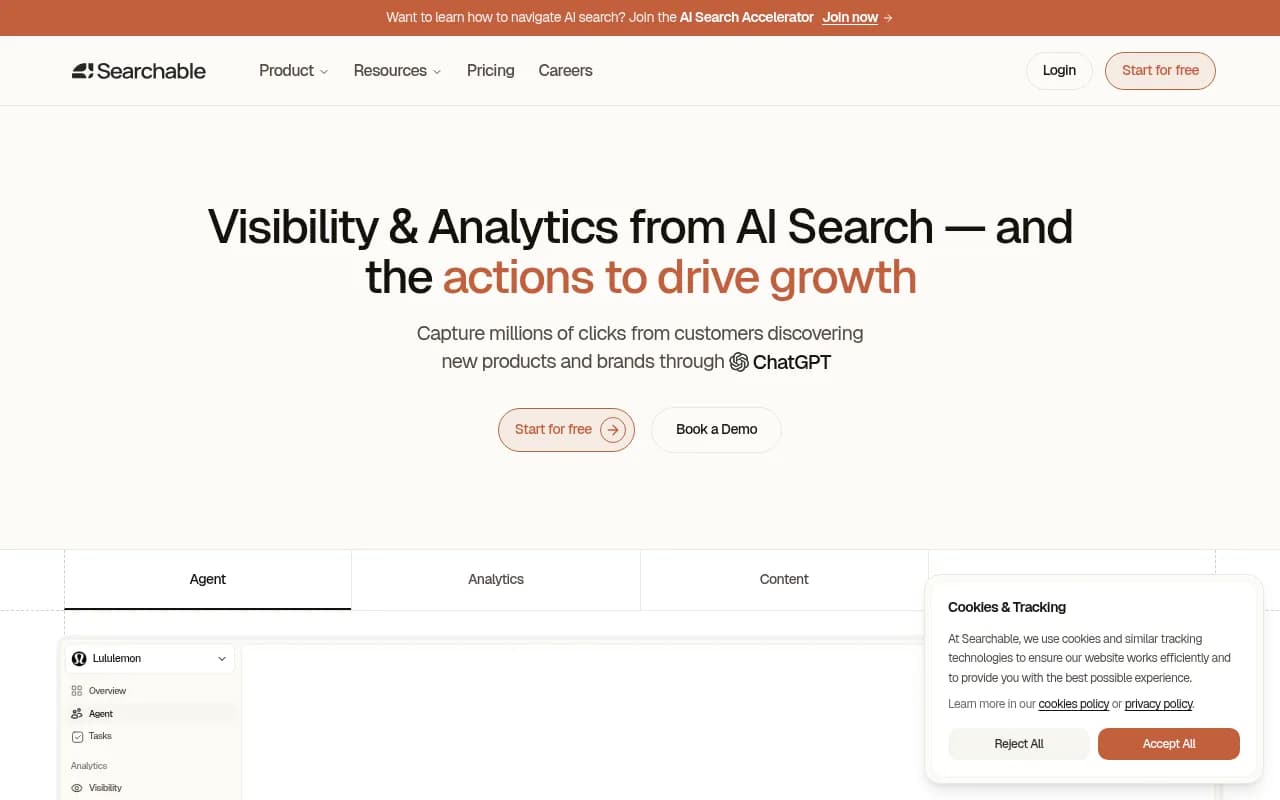
Searchable positions itself as an AI search visibility platform with both monitoring and content tools. It tracks brand mentions across several AI models and surfaces gaps in your coverage. The content side lets you create and optimize pages based on what AI models are citing.
The monitoring is solid for a mid-tier platform. You get brand mention tracking, some competitor comparison, and basic citation analysis. The content tools are functional -- you can generate briefs and articles within the platform.
Where Searchable struggles is the connection between those two halves. The content you generate doesn't feed back into a crawler log or citation timeline. You publish something, and then you're back to waiting for the monitoring dashboard to tell you if it worked -- with no clear signal about whether AI crawlers even found the page, let alone cited it. There's no prompt volume data to prioritize which gaps are worth filling first, and no Reddit or YouTube tracking to surface the off-site signals that increasingly influence AI recommendations.
For teams that want a single tool to handle both monitoring and content without a lot of complexity, Searchable is a reasonable starting point. For teams that need to prove the content investment is working, it leaves a gap.
AirOps
AirOps has been primarily known as a content workflow platform -- it helps teams build AI-powered pipelines for generating and publishing content at scale. In May 2026, it launched Quill, an agent specifically designed to close part of the AI search gap by generating content grounded in citation and prompt data.
Quill is genuinely interesting. It doesn't just produce generic articles -- it uses data about what AI models are citing to inform what content gets created. That's a meaningful step beyond most content tools, which generate based on keyword data alone.
But AirOps' roots are in content production, not visibility measurement. The monitoring side is limited compared to dedicated GEO platforms. You don't get crawler logs showing when AI agents visit your pages. You don't get page-level citation tracking that shows which specific URLs are being referenced and by which models. And the attribution layer -- connecting AI visibility to actual traffic and revenue -- isn't there.
AirOps closes part of the loop. It's strong on the content generation side, weaker on the verification side. Teams that already have a monitoring tool and want to add a content execution layer will find it useful. Teams that need the full picture in one place will find themselves stitching together multiple tools.
Atomic AGI
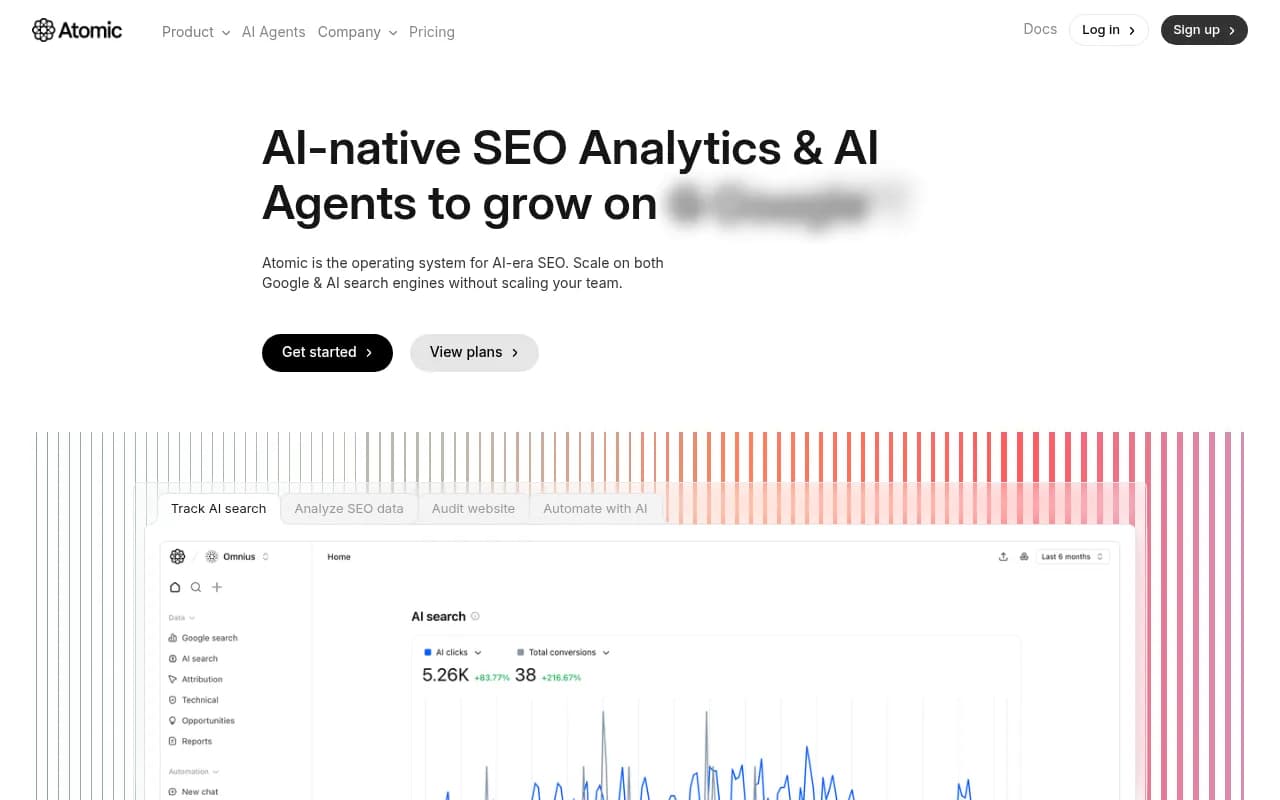
Atomic AGI takes a different angle: it tracks both Google and LLMs together, treating AI search and traditional search as a unified visibility problem. That's a smart framing for 2026, when the two are increasingly intertwined. Google AI Overviews, Google AI Mode, and traditional SERP rankings are all part of the same content strategy for most brands.
The platform automates some content creation and has rank tracking across both channels. For teams that don't want to manage separate tools for traditional SEO and AI visibility, the unified view is genuinely useful.
The limitations show up in depth. Atomic AGI's attribution layer is thin -- you can see rankings and some citation data, but the connection between AI crawler activity and your content performance isn't well developed. There's no crawler log showing which AI agents visited which pages, no prompt volume scoring to help you prioritize gaps, and no Reddit or YouTube tracking. The content generation is more templated than data-grounded.
It's a good tool for teams that want a consolidated view without going deep on any single channel. It's not the right choice if AI search visibility is your primary focus and you need to move fast on specific gaps.
Promptwatch
Promptwatch is the platform in this comparison that was built specifically around the full loop. It tracks visibility across 10 AI models (ChatGPT, Perplexity, Claude, Gemini, Google AI Overviews, Google AI Mode, Grok, DeepSeek, Copilot, and Mistral), but the monitoring is only the starting point.

The Answer Gap Analysis shows exactly which prompts competitors appear in that you don't -- not just a general sense of where you're missing, but the specific topics, questions, and angles that AI models want answers to but can't find on your site. Prompt volume estimates and difficulty scores let you prioritize which gaps are actually worth filling.
The Content Agents generate articles, listicles, comparisons, and briefs grounded in that real prompt data -- not generic SEO filler, but content engineered to answer the specific gaps the analysis identified. Brand guidance, competitor analysis, search results, and screenshots can all be fed in as context.
Then the verification layer: AI crawler logs show in real time which AI agents (ChatGPT, Claude, Perplexity, etc.) are hitting your pages, which pages they're reading, what errors they're encountering, and how often they return. The citation timeline shows when pages move from crawl to citation. Traffic attribution connects AI visibility to actual revenue.
That's the loop, closed. Most platforms in this category handle one or two of those steps. Promptwatch handles all three in one dashboard, which is why it's the only platform rated as a "Leader" across all categories in the 2026 comparison of 12 GEO platforms.
A few capabilities worth noting that don't fit neatly into the loop framing but matter in practice: Reddit and YouTube tracking (surfaces discussions that directly influence AI recommendations), ChatGPT Shopping tracking (monitors when your brand appears in product recommendations and shopping carousels), and offsite citation analysis (tracks which external pages, Reddit threads, and third-party sites are driving AI visibility outside your own domain). Most competitors don't have any of these.
Side-by-side comparison
| Feature | Searchable | AirOps | Atomic AGI | Promptwatch |
|---|---|---|---|---|
| AI model coverage | Partial | Limited | Google + some LLMs | 10 models |
| Brand mention tracking | Yes | Limited | Yes | Yes |
| Prompt volume / difficulty | No | No | No | Yes |
| Answer gap analysis | Basic | Partial (Quill) | No | Yes |
| Content generation | Yes | Yes (Quill) | Yes (templated) | Yes (data-grounded) |
| AI crawler logs | No | No | No | Yes |
| Page-level citation tracking | No | No | No | Yes |
| Traffic attribution | No | No | Partial | Yes |
| Reddit / YouTube tracking | No | No | No | Yes |
| ChatGPT Shopping tracking | No | No | No | Yes |
| Offsite citation analysis | No | No | No | Yes |
| Multi-language / region | Limited | No | No | Yes |
| Pricing starts at | Custom | Custom | Custom | $99/mo |
Which platform fits which team
The honest answer is that these tools serve different stages of maturity and different primary needs.
If your team is primarily a content production operation and you already have monitoring covered elsewhere, AirOps' Quill agent is worth looking at. It's the most sophisticated content generation tool in this group, and the citation-grounded approach is a real differentiator from generic AI writing tools.
If you're running traditional SEO alongside AI visibility and want a single tool that covers both without going deep on either, Atomic AGI's unified view is a reasonable fit. It's not the strongest at anything, but it avoids the overhead of managing separate platforms.
If you're at an early stage and want basic monitoring plus some content tools in one place, Searchable works. The loop isn't closed, but for teams that aren't yet ready to act on crawler data and attribution, that may not matter yet.
If you're a marketing team, SEO team, or agency that needs to actually improve AI visibility and prove it worked, Promptwatch is the only platform in this comparison that handles the full cycle. The gap analysis tells you what to fix. The content agents help you fix it. The crawler logs and attribution prove it's working. That's not a small difference -- it's the difference between a reporting tool and an optimization platform.
Pricing reality check
Pricing in this category is inconsistent and often opaque. AirOps, Searchable, and Atomic AGI all use custom pricing models that require a sales conversation before you know what you're paying. That's not inherently a problem, but it makes direct comparison difficult and tends to mean higher entry costs.
Promptwatch publishes its pricing: $99/month for the Essential plan (1 site, 50 prompts, 5 articles), $249/month for Professional (2 sites, 150 prompts, 15 articles, crawler logs, city/state tracking), and $579/month for Business (5 sites, 350 prompts, 30 articles). A free trial is available. For agencies and enterprises, custom pricing is available.
For most marketing teams, the Professional plan at $249/month covers the core loop. The crawler logs alone -- which no other platform in this comparison offers -- justify the step up from Essential.
The broader context
The AI search visibility category is still consolidating. A Promptwatch benchmark of 21 platforms found that most tools still cover only one slice of the AI search loop -- monitoring, content, or attribution -- but rarely more than one. AirOps' Quill and AthenaHQ's Content Agents close part of the loop, but only Promptwatch ties content execution back to crawler logs and AI visitor attribution.
That gap matters more as AI search matures. In early 2025, just knowing whether ChatGPT mentioned your brand was valuable. In 2026, with ChatGPT at roughly 900 million weekly active users (per OpenAI's February 2026 report) and Google AI Overviews reaching an estimated 2 billion-plus people monthly, the question isn't whether AI search matters -- it's whether your content strategy is actually moving the needle.
Tools that only monitor can't answer that question. Tools that monitor and generate content but don't verify the outcome can't answer it either. The platforms that will matter in 2027 are the ones that close the loop now.
Bottom line
Searchable, AirOps, and Atomic AGI each solve part of the problem. Searchable monitors and generates. AirOps generates well. Atomic AGI unifies Google and LLM tracking. None of them close the loop from content creation to verified citation with crawler logs and revenue attribution.
Promptwatch does. For teams that need to move from "we think we're improving" to "here's the crawler log showing AI agents found the page, here's the citation timeline, here's the traffic it drove" -- that's the platform that actually gets you there.
Start with a free trial and run your first 50 prompts. The gap analysis alone usually surfaces enough to justify the next step.