Key Takeaways
- Atomic AGI is 10x cheaper -- starts at $10/mo vs SearchAtlas's $99/mo, making it the clear winner for small teams and startups on a budget
- SearchAtlas has the conversational AI agent advantage -- Atlas Brain automates tasks across 60+ tools with natural language, while Atomic AGI focuses on analytics and tracking
- Atomic AGI tracks more AI engines -- monitors ChatGPT, Perplexity, Gemini, Claude, and Google, while SearchAtlas focuses primarily on LLM visibility without specifying which models
- SearchAtlas is the all-in-one play -- includes Google Ads management, local SEO, and an AI website builder that Atomic AGI doesn't touch
- Atomic AGI wins on actionable insights -- users consistently report that Atomic's data leads to clearer next steps compared to competitors
- SearchAtlas targets agencies harder -- built-in white-label reporting and multi-client management make it the better fit for agencies managing 10+ clients
Overview
Atomic AGI
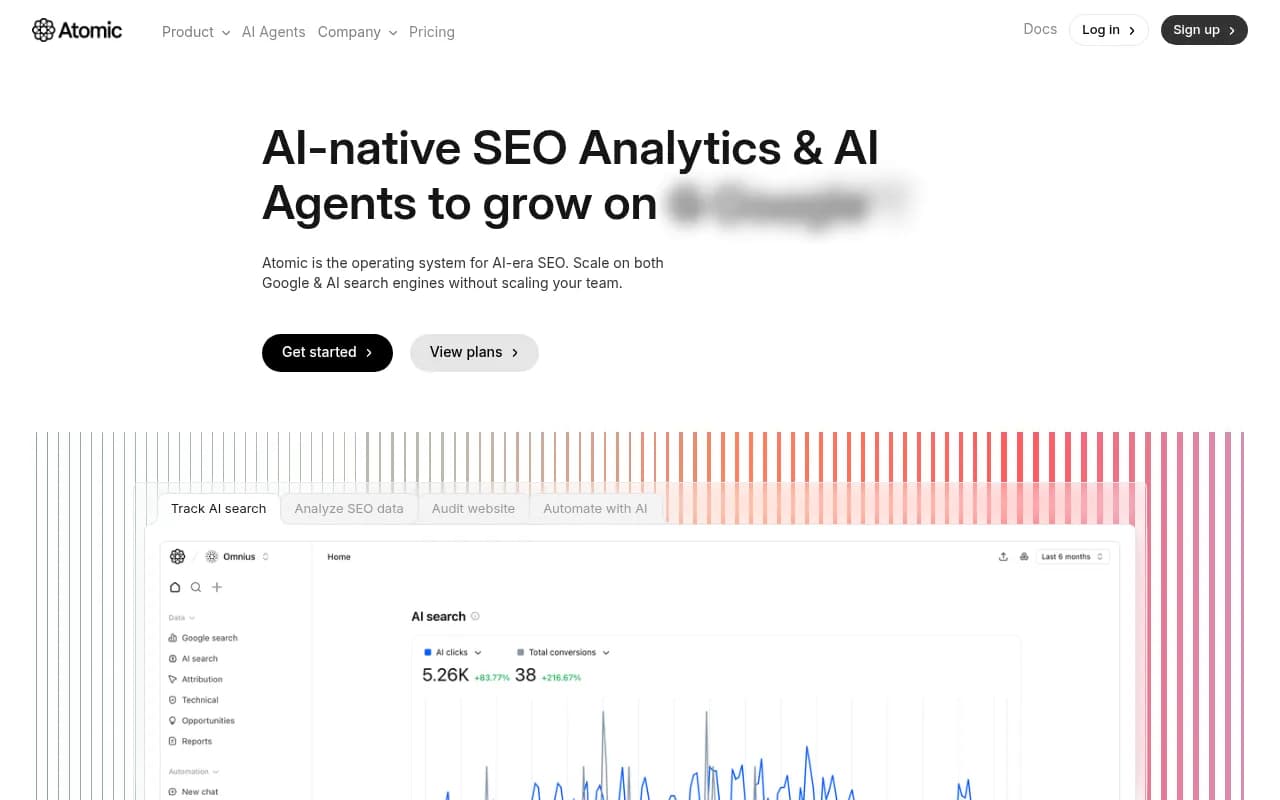
Atomic AGI positions itself as the "operating system for AI-era SEO" -- a unified platform that tracks both traditional Google search and AI search engines like ChatGPT, Perplexity, Gemini, and Claude. It combines multi-engine data tracking, technical site audits, AI agents, and workflow automation. The pitch: scale your organic growth without scaling your team. Atomic AGI has attracted clients like Accenture, Booking.com, Samsung, and MIT, which suggests it's handling enterprise-level complexity. The platform offers a free tier and paid plans starting at just $10/mo, making it one of the most accessible AI SEO platforms on the market.
SearchAtlas LLM Visibility
SearchAtlas takes a different approach -- it's an all-in-one SEO platform with a conversational AI agent called Atlas Brain at its core. Atlas Brain automates SEO tasks across 60+ integrated tools using natural language commands. Beyond AI visibility tracking, SearchAtlas bundles keyword research, content generation, site audits, rank tracking, local SEO, Google Ads management, and even an AI website builder. It's built for agencies and brands that want one dashboard for everything. Pricing starts at $99/mo after a 7-day free trial, with plans scaling to $399/mo for the Pro tier. SearchAtlas serves clients like Hyundai, Penn, and Procter & Gamble.
Side-by-Side Comparison
| Feature | Atomic AGI | SearchAtlas LLM Visibility |
|---|---|---|
| Starting price | $10/mo (Starter) | $99/mo (Starter) |
| Free tier | Yes | 7-day trial only |
| AI engines tracked | ChatGPT, Perplexity, Gemini, Claude, Google | LLM visibility (models not specified) |
| Conversational AI agent | AI agents for workflows | Atlas Brain (60+ tool automation) |
| Technical SEO audits | ✓ | ✓ |
| Content generation | Limited | Full content suite |
| Google Ads management | ✗ | ✓ |
| Local SEO tools | ✗ | ✓ |
| AI website builder | ✗ | ✓ |
| White-label reporting | Not mentioned | ✓ (agency-focused) |
| Multi-client management | Not mentioned | ✓ |
| Target audience | SEO/growth teams, startups | Agencies, enterprise brands |
Pricing comparison
| Plan | Atomic AGI | SearchAtlas LLM Visibility |
|---|---|---|
| Free tier | Yes (limited features) | 7-day trial |
| Starter | $10/mo | $99/mo |
| Growth/Mid-tier | Not specified | $199/mo |
| Pro/Top tier | Not specified | $399/mo |
| Annual discount | Not mentioned | Available |
Atomic AGI's pricing is a fraction of SearchAtlas's -- you could run Atomic for nearly a year for the cost of one month of SearchAtlas Starter. That's a massive difference for bootstrapped teams or agencies testing AI search tracking for the first time. SearchAtlas justifies the higher price with its all-in-one approach and Atlas Brain automation, but if you only need AI visibility tracking and technical SEO, Atomic AGI delivers that for $10/mo.
AI search engine tracking
Atomic AGI explicitly tracks five AI engines: ChatGPT, Perplexity, Gemini, Claude, and Google (likely Google AI Overviews). The platform shows you where your brand appears in AI-generated responses, which queries trigger citations, and how your visibility compares to competitors. Users report that Atomic's insights are more actionable than competitors -- the data points directly to content gaps and optimization opportunities instead of just showing you charts.
SearchAtlas offers "LLM visibility monitoring" but doesn't specify which models it tracks. The marketing emphasizes AI visibility as part of a broader SEO automation suite, not as the core feature. Atlas Brain can generate reports and analyze AI visibility trends, but the depth of AI engine coverage is unclear. If you're specifically focused on understanding how ChatGPT or Perplexity cite your brand, Atomic AGI gives you more transparency.
Worth noting: if you're also looking to track how your brand shows up in AI search results with deeper citation analysis and content gap identification, Promptwatch covers that angle with features like Answer Gap Analysis and AI crawler logs.

Verdict: Atomic AGI wins on AI search tracking specificity and transparency. SearchAtlas bundles it in but doesn't lead with it.
AI agents and automation
SearchAtlas's Atlas Brain is the standout feature here. It's a conversational AI agent that understands natural language commands and executes tasks across 60+ integrated tools. You can ask it to "analyze website traffic trends", "generate a topical map", "identify and fix technical issues", or "run a competitor analysis" -- and it actually does the work, not just surfaces data. This is agentic automation: the platform takes action instead of waiting for you to click through menus.
Atomic AGI offers "AI agents" and "workflow automation" but the specifics are less clear. The platform emphasizes analytics and tracking over task execution. It's built to show you what's happening across Google and AI search engines, then let you decide what to do. The automation seems focused on data collection and reporting, not on executing SEO tasks end-to-end.
For teams that want to offload repetitive SEO work -- generating content briefs, scheduling audits, pulling competitor reports -- SearchAtlas's Atlas Brain is the more mature solution. For teams that want visibility data to inform their own decisions, Atomic AGI's approach works fine.
Verdict: SearchAtlas wins on agentic automation. Atlas Brain is a real differentiator.
Technical SEO and site audits
Both platforms include technical SEO audits. Atomic AGI's audit tool scans for common issues like broken links, slow page speed, indexing problems, and mobile usability. It integrates with Google Search Console and surfaces issues in a unified dashboard alongside your AI search data. The audit reports are straightforward -- here's what's broken, here's the priority level, here's how to fix it.
SearchAtlas also includes site audits as part of its 60+ tool suite. Atlas Brain can run audits on command and generate reports with fix recommendations. The audit depth appears similar to Atomic AGI's, but SearchAtlas wraps it in a conversational interface. You can ask Atlas Brain "What technical issues are hurting my rankings?" and get a natural language summary with action items.
Neither platform is as specialized as dedicated technical SEO tools like Screaming Frog or Sitebulb, but both cover the essentials. The difference is presentation: Atomic AGI gives you a dashboard, SearchAtlas gives you a chatbot.
Verdict: Tie. Both handle technical audits competently. Choose based on whether you prefer dashboards or conversational interfaces.
Content generation and optimization
SearchAtlas includes a full content generation suite. Atlas Brain can create blog posts, product descriptions, meta tags, and content briefs based on keyword research and competitor analysis. It's integrated with the platform's keyword tools, so the content it generates is grounded in search volume and ranking difficulty data. For agencies churning out client content, this is a time-saver.
Atomic AGI's content capabilities are less developed. The platform focuses on showing you which content is working (or not working) in AI search results, but it doesn't generate content for you. You'll need to plug in a separate tool like Jasper, Copy.ai, or your own writers to act on Atomic's insights.
If content production is a bottleneck for your team, SearchAtlas's built-in generation is a clear advantage. If you already have a content workflow and just need better data to guide it, Atomic AGI's analytics are enough.
Verdict: SearchAtlas wins on content generation. Atomic AGI doesn't compete here.
Google Ads and local SEO
SearchAtlas includes Google Ads management and local SEO tools -- features that Atomic AGI doesn't touch. The Google Ads integration lets you track ad performance alongside organic search data, so you can see the full picture of your search visibility. The local SEO tools handle Google Business Profile optimization, local rank tracking, and citation management.
Atomic AGI is purely an organic search and AI visibility platform. If you're running paid search campaigns or managing local listings, you'll need separate tools.
For agencies managing clients with both organic and paid search needs, SearchAtlas's all-in-one approach reduces tool sprawl. For teams focused only on organic growth, Atomic AGI's narrower scope keeps the interface cleaner.
Verdict: SearchAtlas wins by default. Atomic AGI doesn't play in this space.
User interface and learning curve
Atomic AGI's interface is dashboard-driven. You get charts, tables, and filters for slicing your data by AI engine, keyword, competitor, or time period. It's familiar if you've used Google Analytics or any traditional SEO tool. The learning curve is low -- most users can navigate it without training.
SearchAtlas's interface centers on Atlas Brain's chat window. You interact with the platform by typing or speaking commands, and Atlas Brain responds with data, reports, or actions. This is either a huge win or a friction point depending on your team. Some users love the conversational flow -- it feels faster than clicking through menus. Others find it harder to discover features because there's no visual menu to browse.
SearchAtlas also has traditional dashboard views for users who prefer them, but the platform clearly wants you to use Atlas Brain as the primary interface.
Verdict: Atomic AGI wins for teams that prefer traditional dashboards. SearchAtlas wins for teams that want conversational AI.
Agency and multi-client features
SearchAtlas is explicitly built for agencies. It includes white-label reporting, multi-client management, and role-based permissions. You can manage dozens of client projects from one account, generate branded reports, and give clients limited dashboard access. The pricing tiers scale with the number of projects you're managing.
Atomic AGI doesn't emphasize agency features in its marketing. The platform works for agencies -- you can track multiple domains and compare them -- but there's no mention of white-label reports or client portals. It feels more like a tool for in-house teams than for agencies juggling 20 clients.
If you're an agency, SearchAtlas's agency-specific features justify the higher price. If you're an in-house team managing one or two domains, Atomic AGI's simpler setup is fine.
Verdict: SearchAtlas wins for agencies. Atomic AGI is better for in-house teams.
Data accuracy and reliability
Both platforms pull data from Google Search Console, which means their traditional SEO metrics (rankings, clicks, impressions) are as accurate as Google's API allows. The real question is AI search data accuracy.
Atomic AGI tracks AI engine responses directly -- it queries ChatGPT, Perplexity, Gemini, Claude, and Google with your target keywords and logs whether your brand appears in the results. This is the same methodology used by most AI visibility tools. The accuracy depends on how frequently Atomic re-queries each engine and whether it accounts for personalization or regional differences.
SearchAtlas's LLM visibility tracking methodology isn't detailed in the marketing materials. Without knowing which models it tracks or how often it queries them, it's harder to assess accuracy. The platform's strength is aggregating data across 60+ tools, but the AI visibility component feels less transparent than Atomic AGI's.
Users in third-party reviews note that Atomic AGI's insights are "more actionable" than competitors, which suggests the data quality is solid. SearchAtlas has strong G2 reviews (3,200+ reviews mentioned) but fewer specific comments about AI visibility accuracy.
Verdict: Atomic AGI wins on AI search data transparency. SearchAtlas needs to clarify its methodology.
Integration ecosystem
SearchAtlas integrates with 60+ tools, including Google Search Console, Google Analytics, Google Ads, and various content management systems. Atlas Brain can pull data from these integrations and execute tasks across them. The breadth of integrations is a core selling point.
Atomic AGI integrates with Google Search Console and appears to have API access for pulling data into the platform. The integration list isn't as extensive as SearchAtlas's, but it covers the essentials for SEO tracking.
If you need deep integrations with marketing automation platforms, CRMs, or ad networks, SearchAtlas's 60+ tool ecosystem is the safer bet. If you just need SEO data in one place, Atomic AGI's simpler integration setup is less overwhelming.
Verdict: SearchAtlas wins on integration breadth.
Pros and cons
Atomic AGI
Pros:
- Extremely affordable -- $10/mo starting price is 10x cheaper than SearchAtlas
- Free tier available for testing
- Tracks five AI engines explicitly (ChatGPT, Perplexity, Gemini, Claude, Google)
- Users report highly actionable insights
- Clean, dashboard-driven interface with low learning curve
- Trusted by enterprise clients (Accenture, Booking.com, Samsung, MIT)
Cons:
- Limited content generation capabilities
- No Google Ads or local SEO tools
- Agency features (white-label, multi-client) not emphasized
- Fewer integrations than SearchAtlas
- AI agent automation less mature than Atlas Brain
SearchAtlas LLM Visibility
Pros:
- Atlas Brain conversational AI agent automates tasks across 60+ tools
- All-in-one platform (SEO, content, ads, local, website builder)
- Strong agency features (white-label, multi-client management)
- Full content generation suite
- 7-day free trial to test before committing
- 3,200+ G2 reviews indicate strong user satisfaction
Cons:
- 10x more expensive than Atomic AGI ($99/mo vs $10/mo)
- No free tier -- trial only
- LLM visibility tracking methodology unclear
- Conversational interface may feel unfamiliar to traditional SEO users
- Feature breadth can be overwhelming for teams that only need AI visibility tracking
Who should pick which tool
Choose Atomic AGI if:
- You're a startup, small business, or solo marketer with a tight budget
- Your primary goal is understanding AI search visibility across ChatGPT, Perplexity, Gemini, and Claude
- You prefer traditional dashboards over conversational AI interfaces
- You're an in-house team managing one or two domains
- You already have content and paid search workflows and just need better organic data
- You want a free tier to test before committing
Choose SearchAtlas if:
- You're an agency managing multiple clients and need white-label reporting
- You want one platform for SEO, content generation, Google Ads, and local SEO
- You're excited about conversational AI agents and want Atlas Brain to automate repetitive tasks
- You have the budget for a $99+/mo tool and value feature breadth over cost
- You need deep integrations with 60+ marketing tools
- You're managing a large brand with complex SEO needs across multiple channels
Final verdict
Atomic AGI and SearchAtlas serve different buyers. Atomic AGI is the focused, affordable option for teams that want AI search visibility tracking without the bloat. It does one thing really well -- showing you where your brand appears in ChatGPT, Perplexity, Gemini, Claude, and Google -- and it does it for $10/mo. The insights are actionable, the interface is clean, and the price is unbeatable.
SearchAtlas is the all-in-one platform for agencies and enterprise brands that want to consolidate their SEO stack. Atlas Brain's conversational automation is genuinely innovative, and the breadth of features (content generation, Google Ads, local SEO, website builder) justifies the higher price if you'll actually use them. But if you only need AI visibility tracking, you're paying for a lot of features you won't touch.
For most small teams and startups, Atomic AGI is the smarter pick. For agencies managing 10+ clients or enterprise brands with complex needs, SearchAtlas's all-in-one approach makes sense. The $89/mo price difference is the deciding factor -- make sure you'll use SearchAtlas's extra features before committing.