Key Takeaways
- Searchable costs less to start ($50/mo vs €69/mo) and includes content generation tools that Rankshift lacks entirely
- Rankshift offers better prompt volume (150/day on starter vs Searchable's 50 total prompts) and unlimited users/projects on all plans
- Searchable's AI agent provides personalized recommendations and learns your brand voice -- Rankshift focuses purely on tracking and analytics
- Both track the same core LLMs (ChatGPT, Claude, Perplexity, Gemini, AI Overviews) but Rankshift adds Copilot coverage
- Searchable is better for teams that need content creation alongside monitoring; Rankshift is better for agencies managing multiple clients who just need visibility data
- Rankshift's 30-day trial beats Searchable's 14-day trial, and both offer no-credit-card signups
Overview
Searchable: monitoring plus content optimization
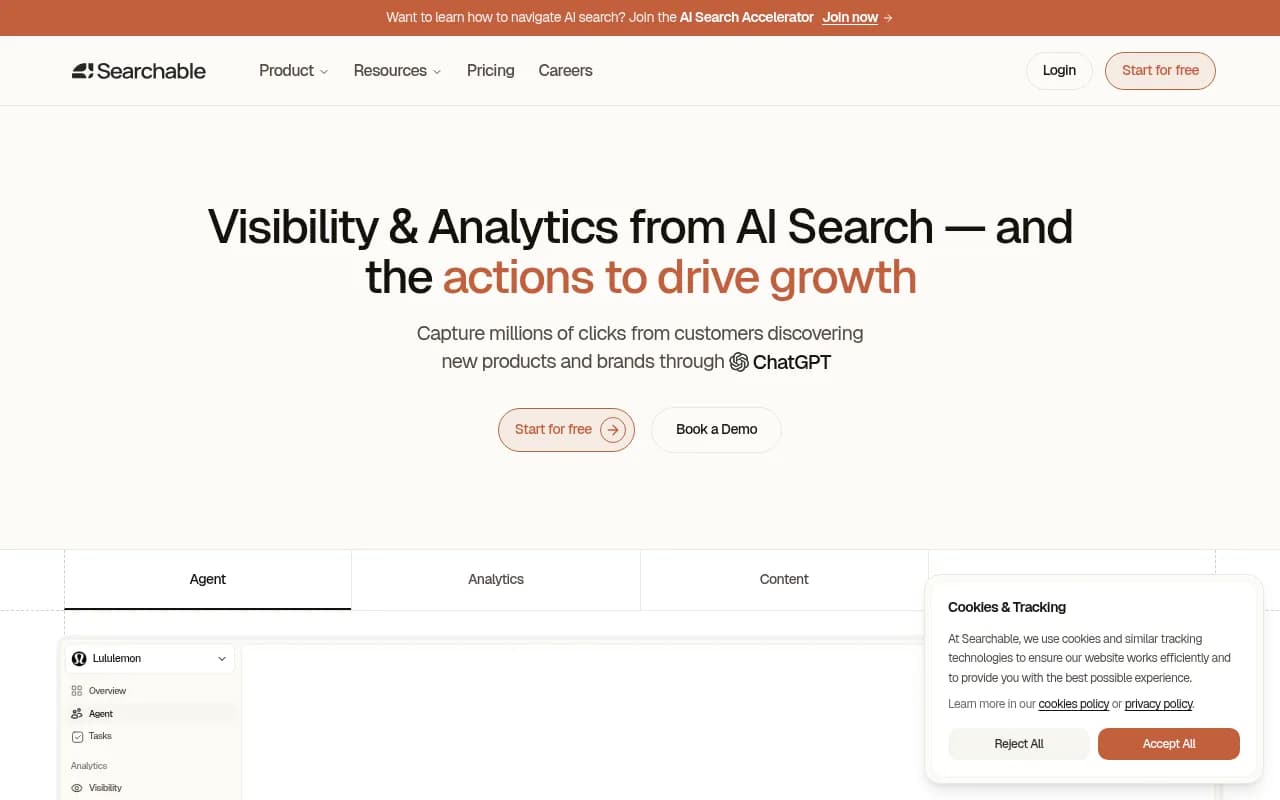
Searchable positions itself as a full-stack AI search optimization platform. It tracks brand visibility across ChatGPT, Claude, Perplexity, Google AI Overviews, and Copilot, but the differentiator is the built-in content engine. The platform generates blog posts, landing pages, and product descriptions engineered for AI citation. An AI agent analyzes your visibility data and delivers tailored recommendations -- content briefs, technical fixes, strategic insights. The pitch: turn monitoring into measurable growth instead of just watching numbers.
Used by 12,000+ marketers and agencies. Founded by SEO specialists with agency backgrounds. Integrates with Google Analytics, Search Console, HubSpot, and Salesforce to correlate AI visibility with traffic and revenue.
Rankshift: pure-play LLM tracking at scale
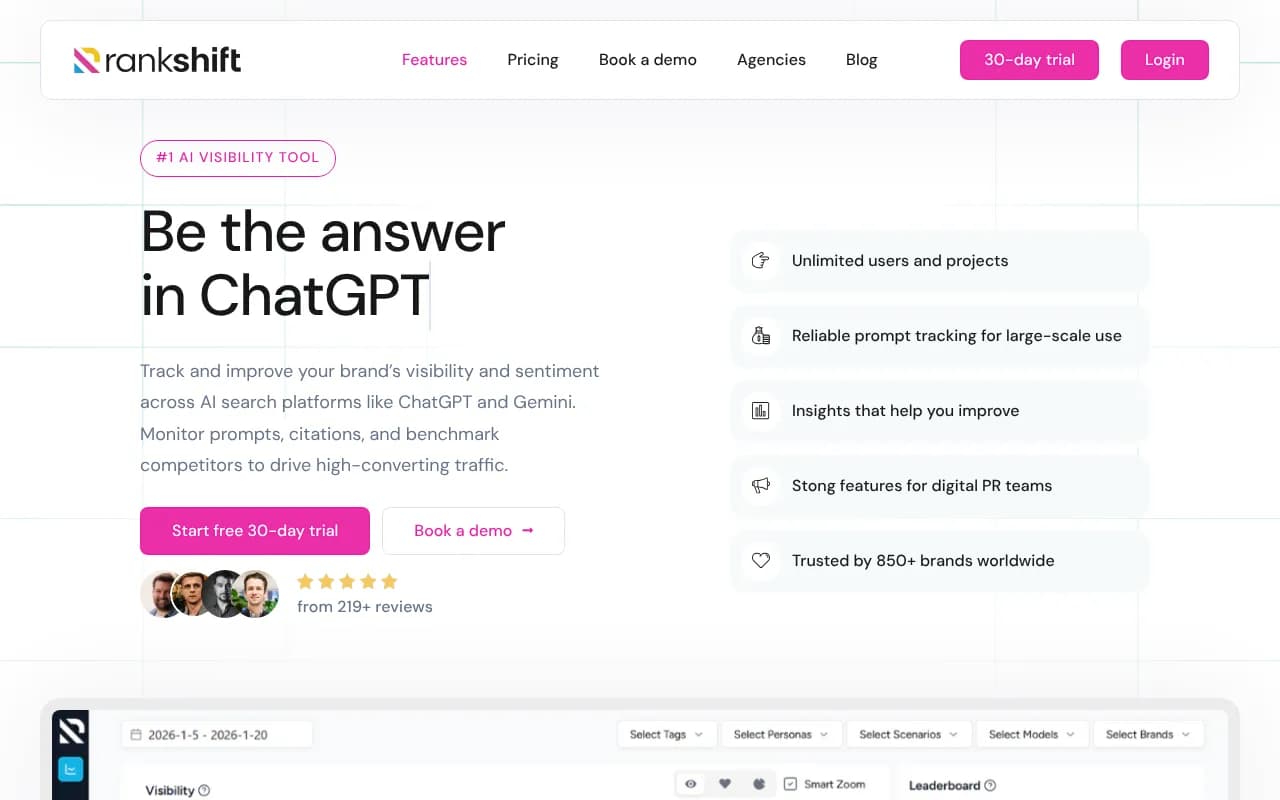
Rankshift is a specialized tracking tool for brand mentions and visibility across large language models. No content generation, no AI agent making recommendations -- just reliable prompt tracking at scale. The focus is monitoring: track prompts, citations, sentiment, and benchmark competitors across ChatGPT, Perplexity, Claude, Gemini, and AI Overviews. Unlimited users and projects on every plan makes it agency-friendly. Strong features for digital PR teams who need to show clients where they're getting cited.
Trusted by 850+ brands including Coolblue, Orange, and Salesflare. Based in Europe with pricing in euros. The value proposition: be the answer in AI search by knowing exactly where you show up and where competitors beat you.
Side-by-Side Comparison
| Feature | Searchable | Rankshift |
|---|---|---|
| Starting price | $50/mo | €69/mo (~$75) |
| Free trial | 14 days | 30 days |
| Credit card required | No | No |
| LLMs tracked | ChatGPT, Claude, Perplexity, AI Overviews, Copilot | ChatGPT, Claude, Perplexity, Gemini, AI Overviews, Copilot |
| Starter plan prompts | 50 total prompts | 150 prompts/day |
| Content generation | ✓ (AI-optimized posts, pages, descriptions) | ✗ |
| AI agent recommendations | ✓ (learns brand voice, personalized insights) | ✗ |
| Technical SEO audits | ✓ (schema, structure, crawlability) | ✗ |
| Unlimited users | ✗ (plan-dependent) | ✓ (all plans) |
| Unlimited projects | ✗ (plan-dependent) | ✓ (all plans) |
| Competitor benchmarking | ✓ | ✓ |
| Citation tracking | ✓ | ✓ |
| Integrations | Google Analytics, GSC, HubSpot, Salesforce | Not specified |
| Annual discount | Not specified | 10% |
Pricing: Searchable is cheaper upfront, Rankshift scales better
Searchable's entry point is lower but prompt limits get tight fast. Rankshift costs more but gives you way more prompts and no user/project caps.
| Plan | Searchable Price | Rankshift Price |
|---|---|---|
| Starter | $50/mo (1 domain, 50 prompts) | €69/mo (~$75) (150 prompts/day, 9,500 credits) |
| Mid-tier | $100-125/mo Professional (unlimited domains, 200 prompts) | €149/mo (~$162) Growth (350 prompts/day, 22,000 credits) |
| High-tier | $400/mo Scale | €359/mo (~$390) Business (850 prompts/day, 53,000 credits) |
| Enterprise | Not listed | Custom pricing |
| Free trial | 14 days | 30 days |
| Annual discount | Not specified | 10% off |
Searchable's $50 starter looks attractive until you realize 50 total prompts means you're tracking maybe 10-15 key queries. Rankshift's 150 prompts per day on the starter plan is 4,500 prompts per month -- a completely different scale. If you're an agency tracking visibility for multiple clients, Rankshift's unlimited users and projects on every plan is a huge cost saver. Searchable charges more as you add domains and users.
For a single brand doing light monitoring plus content work, Searchable's Professional plan at $100-125/mo is solid value. For agencies or brands running serious prompt volume, Rankshift's structure makes more sense despite the higher base price.
Feature deep-dive: where each platform wins
Content creation and optimization
Searchable has this, Rankshift doesn't. Searchable's content engine generates blog posts, landing pages, and product descriptions optimized for AI citation. The AI agent learns your brand voice and creates content briefs tailored to visibility gaps. Technical SEO audits identify schema markup opportunities and crawlability fixes.
Rankshift gives you the data but leaves content creation to you. If you need an all-in-one platform that shows you gaps and helps you fill them, Searchable wins. If you have a content team and just need visibility intel, Rankshift's pure tracking approach keeps things simple.
Worth noting: if you're looking to close the loop between tracking and content optimization, Promptwatch takes a similar approach to Searchable with Answer Gap Analysis that shows exactly which prompts competitors rank for but you don't, then generates content grounded in 880M+ citations to fill those gaps.

LLM coverage
Both platforms track the big five: ChatGPT, Claude, Perplexity, Google AI Overviews, and Copilot. Rankshift explicitly lists Gemini; Searchable's marketing mentions it but doesn't call it out separately. In practice, both cover the models that matter for most brands in 2026.
Neither platform tracks newer models like DeepSeek, Grok, or Mistral. If you need broader LLM coverage, you'll need to look elsewhere.
Prompt tracking and volume
Rankshift destroys Searchable on prompt volume. Starter plan: 150 prompts/day (4,500/month) vs 50 total prompts. Growth plan: 350 prompts/day (10,500/month) vs 200 total prompts. Business plan: 850 prompts/day (25,500/month) vs Scale's unspecified limit.
Searchable's prompt limits make sense if you're using the AI agent to prioritize a focused set of high-value queries. Rankshift's daily limits make sense if you're running comprehensive tracking across many topics or clients. The credit system on Rankshift (9,500 to 53,000 credits depending on plan) adds flexibility -- you can allocate credits across different tracking tasks.
User and project management
Rankshift includes unlimited users and unlimited projects on every plan. Searchable's Starter plan is limited to 1 domain; Professional unlocks unlimited domains but user limits aren't clearly specified. For agencies managing 5-10 clients, Rankshift's structure is a no-brainer. For in-house teams with 2-3 users, Searchable's limits are less of an issue.
Competitor benchmarking and citation tracking
Both platforms offer competitor benchmarking and citation tracking. Searchable's AI agent surfaces competitive insights as part of its recommendations. Rankshift's dashboard shows where competitors outrank you and which sources AI models cite. The core functionality is similar; the difference is whether you want those insights packaged as actionable recommendations (Searchable) or raw data you interpret yourself (Rankshift).
Integrations and attribution
Searchable explicitly lists integrations with Google Analytics, Google Search Console, HubSpot, and Salesforce. The pitch is correlating AI visibility with traffic, leads, and revenue to prove ROI. Rankshift's website doesn't detail integrations, which suggests a more standalone tool. If tying AI visibility to business outcomes in your existing stack is critical, Searchable has the edge.
Trial period and onboarding
Rankshift's 30-day trial is twice as long as Searchable's 14-day trial. Both require no credit card. Searchable emphasizes its AI agent learning your brand from day one and delivering results within the first week. Rankshift emphasizes quick 3-minute setup. If you need time to evaluate at scale, Rankshift's longer trial helps. If you want guided onboarding and fast wins, Searchable's approach fits better.
Pros and cons
Searchable pros
- Lower entry price ($50/mo vs €69/mo)
- Built-in content generation and technical SEO audits
- AI agent that learns brand voice and delivers personalized recommendations
- Integrations with Google Analytics, GSC, HubSpot, Salesforce for ROI tracking
- 12,000+ user base suggests strong product-market fit
Searchable cons
- Prompt limits are tight (50 on starter, 200 on professional)
- User and project limits not transparent on lower plans
- Shorter 14-day trial
- Less suitable for agencies managing many clients
Rankshift pros
- Massive prompt volume (150/day on starter = 4,500/month)
- Unlimited users and projects on all plans
- Longer 30-day trial
- Agency-friendly pricing structure
- Strong digital PR features for citation tracking
- 10% annual discount
Rankshift cons
- Higher starting price (€69 vs $50)
- No content generation or optimization tools
- No AI agent providing recommendations
- Fewer integrations with marketing stack
- Pure tracking tool -- you have to act on the data yourself
Who should pick which tool
Pick Searchable if:
- You're an in-house marketing team (1-5 people) that needs monitoring plus content creation in one platform
- You want an AI agent that learns your brand and tells you what to do, not just what's happening
- You need technical SEO audits for AI search (schema, crawlability, structure)
- Integrating AI visibility with your existing analytics and CRM is important
- You're tracking a focused set of high-priority prompts (under 200) and want depth over breadth
- Budget is tight and $50/mo gets you started
Pick Rankshift if:
- You're an agency managing multiple clients and need unlimited users/projects
- You're running high-volume prompt tracking (hundreds or thousands of queries)
- You have a content team and just need visibility data, not content generation
- You're in Europe and prefer euro-based pricing
- You want a longer trial period (30 days) to evaluate properly
- You need reliable tracking at scale without the complexity of an AI agent
- Digital PR is a focus and you need strong citation tracking for client reporting
Pick something else if:
- You need broader LLM coverage beyond the big five (ChatGPT, Claude, Perplexity, Gemini, AI Overviews)
- You want AI crawler logs showing how LLMs access your site
- You need Reddit and YouTube tracking to see what discussions influence AI recommendations
- You want Answer Gap Analysis showing exactly which prompts competitors rank for but you don't
Final verdict
Searchable and Rankshift solve different problems. Searchable is an optimization platform that monitors, recommends, and creates. Rankshift is a tracking platform that monitors at scale and gets out of your way.
For in-house teams that want an all-in-one solution: Searchable wins. The AI agent, content generation, and technical audits justify the higher per-prompt cost. You're paying for a platform that tells you what to do and helps you do it.
For agencies and high-volume users: Rankshift wins. Unlimited users and projects plus 10x the prompt volume makes the math obvious. You don't need an AI agent when you're managing 10 clients -- you need reliable data at scale.
The pricing gap is smaller than it looks. Searchable's $50 starter is only viable for very light use. Rankshift's €69 starter gives you 90x more prompts (4,500/month vs 50 total). By the time you hit Searchable's Professional plan at $100-125/mo for 200 prompts, Rankshift's Growth plan at €149 (~$162) gives you 10,500 prompts/month. The value proposition flips entirely.
Bottom line: if you need content tools and personalized recommendations, pay for Searchable. If you need tracking at scale with no user limits, pay for Rankshift. Both are solid at what they do -- just make sure what they do matches what you actually need.