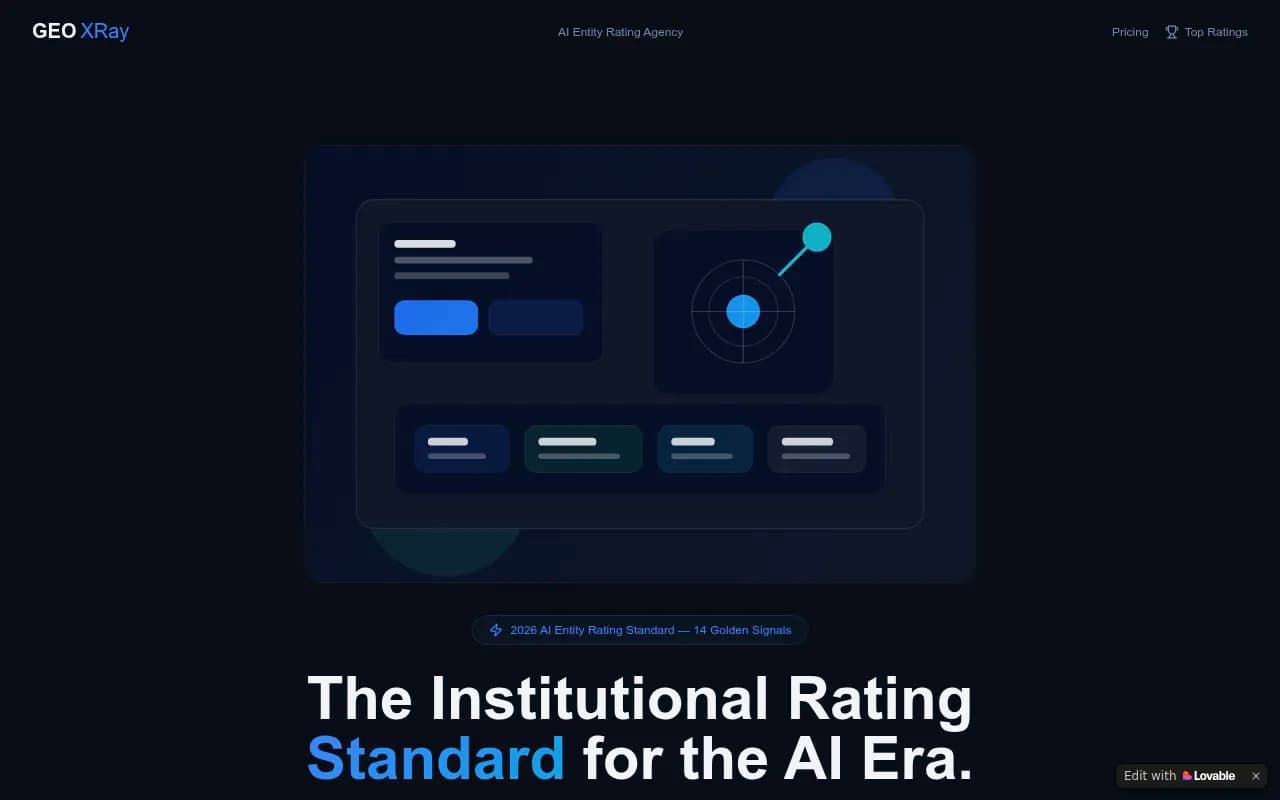
GEO XRay Review 2026
Rating-agency style tool offering grounding audits and a C-Prop Index to measure entity authority in AI search retrieval.
Key takeaways
- GEO XRay is a one-person, unfunded company founded in 2026 that sells a static grounding audit, not a continuous AI visibility platform. There's no team, no case studies, and no third-party reviews on G2 or Capterra yet.
- It lacks the things that actually move the needle on AI visibility: no AI crawler logs, no traffic attribution, no Reddit or YouTube citation tracking, no content generation, and no multi-model prompt monitoring. Promptwatch covers all of that plus 10+ AI models tracked continuously.
- Despite marketing itself as a universal "global rating agency for AI retrieval," the actual product and pricing are built around one niche: marketing agencies that service law firms. If you're not in that lane, a lot of the Agency Pro features (Quarterly Legal AI Visibility Report, legal industry intelligence panel) are dead weight.
- The $97 one-time Blueprint and $299-499/month agency tiers are cheap compared to full GEO platforms, but you're paying for a snapshot audit with a proprietary, self-acknowledged "provisional" scoring model, not ongoing citation data.
- The paid agency signup flow is still a manual waitlist form, not self-serve checkout, which tells you something about how production-ready this really is.
GEO XRay is a small, single-founder audit tool built by Doug Guillory, a financial-services professional who appears to be running this as a side project out of Cumming, Georgia. The pitch is appealingly simple: run a free scan of your website, get three composite scores (the AIVS, the ARC, and the blended C-Prop Index), and find out whether AI engines like ChatGPT or Google AI Overviews are likely to cite you. It frames itself, somewhat grandly, as "the global rating agency for AI retrieval."
In practice, this is a lead-generation audit tool wrapped in rating-agency language. There's a free scan that hooks you with a letter grade (A through F), then a $97 one-time report that tells you how to fix what's wrong, then monthly agency subscriptions if you want to run this across a book of client domains. The whole thing is clearly aimed at digital marketing agencies that serve law firms specifically. The homepage stats ("1,358+ law firms scanned," "0 firms scored an A yet") and the Agency Pro tier's "Quarterly Legal AI Visibility Report" give that away immediately, even though the general copy talks about entities and brands broadly.
Who should care about this: agencies managing a handful of local-service or legal client sites who want a cheap, quick talking point for a sales pitch ("your site scored a C, here's what's wrong"). Who should look elsewhere: anyone who wants to actually track how often their brand shows up in ChatGPT, Perplexity, or Google AI Mode over time, or who wants help producing and publishing content that improves those numbers.
Key features
- C-Prop Index. The headline metric, calculated as AIVS times 0.6 plus ARC times 0.4. It's a weighted blend of technical readiness and perceived authority, squeezed into a single letter grade from A (85-100, "Authoritative") down to F (under 35, "Invisible"). The B+/80 threshold is branded "Institutional AI Trust," which is a nice turn of phrase but isn't tied to any independently verified citation outcome.
- AIVS (AI Visibility Score). This is the operational-readiness half of the equation. It checks JSON-LD schema, llms.txt presence, robots.txt configuration, sitemap integrity, page speed, and crawlability. It's essentially a technical SEO audit repackaged for an AI-crawler audience.
- ARC (Authority Retrieval Confidence). The trust half. It looks at citation links, cross-web mentions, author markup, content depth, and entity consistency, trying to estimate whether an AI model would trust your content enough to cite it.
- 14 Golden Signals. The scoring breaks down into four tiers: Foundational (llms.txt, JSON-LD, robots.txt, DNS handshake), Structure (semantic headings, FAQ/HowTo schema, answer-engine formatting), Authority (entity consistency, citation verification, deterministic grounding), and UX/Technical (alt text, internal linking, page speed). It's a reasonably sensible checklist, similar to what you'd find in any modern technical SEO audit, just relabeled for the AI era.
- Monte Carlo citation simulation. The free scan runs a persona-based simulation (Researcher, Local Consumer, Competitor Analyst, Journalist) to estimate citation probability. It's a nice framing device, but it's a simulation against the site's own signals, not a measurement of actual AI model outputs the way a prompt-tracking tool would run thousands of real queries against live models.
- Robots.txt cap rule. A hard rule in the methodology: if your robots.txt blocks major AI crawlers, your score is capped at 40 no matter how good everything else looks. This is the most useful, concrete rule in the whole system because it's binary and checkable.
- Blueprint report. The $97 one-time deliverable includes a developer work order, copy-paste code fixes, AI-optimized content rewrites, an llms.txt template, and a non-technical verification guide. It's a punch list, not an ongoing service.
- Agency dashboard and white-label reporting. Paid agency tiers add continuous monitoring, score-change email alerts, white-label PDF reports, a scenario adjuster (model what happens if you fix X), bulk batch scanning across client domains, and a "GEO Steward" certification badge program.
What's conspicuously absent compared to a full AI-search visibility platform: no AI crawler log analysis (who's actually hitting your pages and when), no visitor analytics tying AI referral traffic to conversions, no Reddit or YouTube citation tracking, no ChatGPT Shopping or Ads Radar, no prompt-level search volume or difficulty scoring, no query fan-out analysis, and no automated content generation or CMS publishing. GEO XRay tells you your site's theoretical readiness; it doesn't tell you what's actually happening in ChatGPT, Gemini, Claude, or Perplexity right now, and it doesn't do anything to fix the content for you beyond a one-time instruction sheet.
Who is it for
The realistic buyer is a small digital marketing agency with a handful of law firm or local-service clients who wants a cheap, visual audit to open a sales conversation. "Your site scored a C-minus on AI visibility, here's a $97 report on what to fix" is an easy upsell. Agencies running the $299/month Standard tier across up to 10 client domains, or the $499/month Pro tier up to 35 domains, get white-label PDFs and batch scanning that make this workable as a recurring line item.
Solo consultants or freelance SEOs doing technical audits for small business clients might also find the free scan and $97 report useful as a one-off deliverable, since it packages a reasonably thorough technical checklist into something a non-technical client can understand.
Who should not use this: any brand, SaaS company, or enterprise marketing team that needs to actually know how often it's being cited in AI answers, where the traffic from AI platforms is going, or what content to publish next based on real prompt data. GEO XRay doesn't run live prompts against AI models and doesn't track citations over time, so it can't answer "are we winning more AI visibility this month than last month" the way a dedicated GEO tracking tool can. Anyone outside the legal-services agency niche will also find a chunk of the paid feature set (the legal industry intelligence panel, the quarterly legal report) irrelevant to their vertical.
Integrations and ecosystem
There isn't much of an ecosystem here. No CRM, CMS, Slack, or Zapier integrations are advertised anywhere on the site. The closest things to integrations are code-level deliverables: an llms.txt template, JSON-LD schema snippets, and an API that's only available on the two paid agency tiers, with the Pro tier capped at 1,000 calls per month. There's no browser extension, no mobile app, and no evidence of a changelog or product-update blog tracking how the methodology has evolved. The company also has no dedicated LinkedIn company page, X/Twitter account, GitHub repo, or Discord community that could be found, only the founder's personal LinkedIn.
Pricing and value
Pricing is straightforward and genuinely inexpensive compared to full GEO platforms:
- Free Scan, $0. No account needed. Gives three composite scores, a pass/fail view of the 14 signals, the Monte Carlo simulation, and a plain-English summary.
- Blueprint, $97 one-time per domain. Unlocked after the free scan. Full fix instructions, a developer work order, code snippets, content rewrites, and an llms.txt template.
- Agency Standard, $299/month, up to 10 domains. Continuous monitoring, agency dashboard, alerts, white-label reports, scenario adjuster, API access, bulk scanning, and the "GEO Steward" certification. A 14-day free trial is offered, but signup currently routes to a waitlist form rather than instant checkout.
- Agency Pro, $499/month, up to 35 domains. Adds a 1,000-call/month API cap, priority rescans, multi-vertical industry intelligence, agency-level certification, and methodology co-branding. Sold via [email protected] rather than self-serve.
For what it is, a one-time audit plus optional agency reselling layer, the pricing is fair and low-risk: $97 to try the paid tier once, no long-term commitment required for the free scan. But it's not comparable in value to a continuous AI visibility platform charging $95-579/month for live multi-model tracking, crawler logs, and content automation. You're paying GEO XRay for a snapshot and a checklist, not for ongoing intelligence.
Strengths and limitations
What it does well: the free scan is genuinely free and fast, the 14-signal checklist is a clear, actionable technical audit, the robots.txt hard cap is a smart and easy-to-understand rule, and the pricing is low-risk for agencies wanting a quick client deliverable.
Where it falls short against a real GEO platform like Promptwatch: no AI crawler log monitoring (Promptwatch tracks ChatGPTBot, ClaudeBot, PerplexityBot, and 400+ other crawlers hitting your actual site), no visitor analytics or AI traffic attribution, no Reddit or YouTube citation tracking, no prompt volume or difficulty scoring, no query fan-out analysis, no automated content generation or CMS publishing, and no multi-model continuous monitoring across the 10+ AI platforms Promptwatch covers. GEO XRay produces a static, self-reported score using a proprietary formula that its own methodology page admits is "subject to recalibration" and explicitly not a guarantee of actual AI citation. It measures theoretical readiness, not observed behavior.
Other honest caveats: this is a one-person, unfunded operation with no case studies, no third-party reviews, and a paid agency signup flow that's still a manual waitlist. That's not necessarily disqualifying for a $97 audit, but it matters a lot if you're considering the $299-499/month recurring agency tiers.
Bottom line
GEO XRay is a cheap, decent one-time technical audit dressed up in rating-agency branding, best suited to small agencies that want a quick AI-readiness checklist to sell into law firm clients. It is not a substitute for a real AI visibility platform. Teams that need to know what's actually happening in ChatGPT, Gemini, Perplexity, and Google AI Overviews right now, with crawler logs, traffic attribution, and automated content fixes, should look at Promptwatch instead, which tracks real AI model outputs across 10+ platforms and turns the findings into content your team (or its agents) can actually publish.

Frequently asked questions
What is GEO XRay?
How much does GEO XRay cost?
Is GEO XRay a live AI visibility tracker like Promptwatch?
Who is GEO XRay built for?
Is GEO XRay a mature, well-funded product?
What does GEO XRay's scoring methodology measure?
Similar and alternative tools to GEO XRay