ReachLLM Review 2026
Monitors prompts in ChatGPT, AI Overviews, Perplexity and Gemini with raw answers, source intelligence and share of voice, then ties findings to audits and content fixes.
Key takeaways
- ReachLLM is two products in one: self-serve AI visibility software (Pro $399/mo, Scale $999/mo) and a managed GEO agency service (Growth from $3,500/mo with a 3-month minimum).
- It is a direct competitor to Promptwatch, and it lacks several things Promptwatch includes: IP-verified AI crawler logs, a Content Agent with CMS publishing, Brand Narrative and Fact Check, Reddit/YouTube/LinkedIn/Instagram citation tracking, prompt volumes and difficulty, and AI Shopping and Ads Radar.
- The entry price is steep. Pro gives you one project and 100 prompts for $399/mo, and Claude, AI Mode and Copilot cost extra.
- The homepage markets Claude coverage, but Claude is a paid add-on, not part of the four included models.
- Best fit: agencies and mid-market teams that want a human GEO team to execute a roadmap. Poor fit for budget-conscious teams that want a cheap tracker.
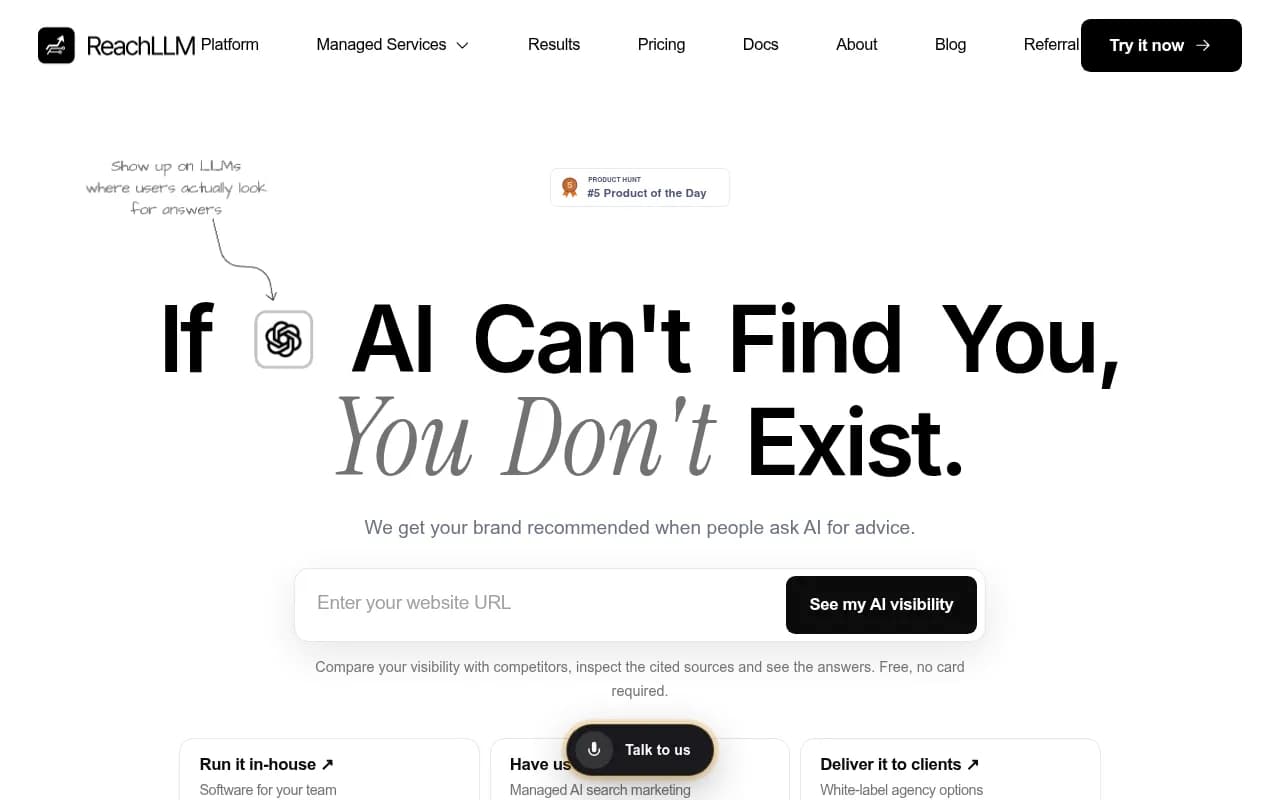
ReachLLM is a Generative Engine Optimization product from a company that describes itself as an AI-native GEO agency with self-serve visibility software. It tracks how ChatGPT, Google AI Overviews, Perplexity and Gemini describe and cite your brand, then connects those findings to audits and content fixes. The homepage badge shows it was #5 Product of the Day on Product Hunt around December 2025, so it is a young product.
The pitch is blunt: most businesses do not want another dashboard, they want results. That is why the company sells software and services side by side. You can run the platform in-house, or pay for a dedicated GEO expert who executes weekly optimization plans. The target audience spans service businesses, local and multi-location brands, ecommerce, SaaS companies and agencies that want to resell GEO.
I could not find substantive independent reviews on G2 or Reddit, so most of what follows comes from the company's own pricing page and site. Treat the testimonials accordingly: they are curated, and there is little third-party evidence yet.
Key features
Daily prompt tracking across four models. Every plan tracks ChatGPT, Google AI Overviews, Perplexity and Gemini daily. You build a prompt set, and ReachLLM stores the raw answers so you can read exactly what each engine said. Metrics include mention rate, citation coverage, prompt coverage, share of voice, accuracy and visibility trends over time. Claude, Google AI Mode and Microsoft Copilot are paid add-ons.
Source and citation intelligence. The platform shows which publications, forums, directories and competitor pages the engines lean on, then maps where your brand is missing. This source-layer view is the most useful part of the pitch, because AI answers are shaped by pages you do not own. Promptwatch's data shows how varied those sources are by industry, for instance in its ChatGPT software citation report, where GitHub, Microsoft docs and G2 lead.
Prompt intelligence and clustering. ReachLLM groups prompts into clusters and highlights high-intent ones. One testimonial from the founder of Cubular.ai praises the high-intent prompt analysis for helping pick prompts that drive results. The site does not describe search volume or difficulty scoring, which some competitors provide.
GEO audits. Pro includes 100 audited pages and Scale pools 1,000. Audits cover structured data, entity clarity, FAQ coverage, schema and llms.txt. This is where the tool links monitoring to action: findings turn into a list of page-level fixes.
Execution credits. Pro includes 4,000 execution credits and Scale 20,000 pooled credits. The site does not spell out exactly what a credit buys, so ask during the trial. They appear to power the AI-assisted implementation side of the product.
Managed execution (Growth). From $3,500/mo you get a dedicated GEO expert, content strategy, page updates, schema and technical fixes, PR outreach, and Reddit, LinkedIn and social posting support, plus monthly strategy reporting. The process runs in four steps: baseline and diagnosis, source and citation pathway analysis, weekly optimization plans, then measurement and iteration. A 3-month minimum applies.
Reporting and white-label. Pro reports carry ReachLLM branding. Scale adds white-label reports and client-ready share links, which is the main reason agencies would buy it.
Free AI visibility report. A free report benchmarks visibility score, share of voice, cited sources, prompt responses and brand perception. It is the right starting point before paying anything.
How it compares
The monitoring layer is roughly in line with other mid-market trackers. The difference is the service wrapper. Where a tool like Promptwatch builds the execution into software (a Content Agent that writes and publishes to WordPress, Webflow or Framer, an Action Board, and Agent Chat), ReachLLM puts humans on that job and charges agency rates for it.
Who is it for
The sweet spot is a company with a real budget and no GEO capacity: a SaaS company with a two-person marketing team, a multi-location franchise, or an ecommerce brand that knows it is missing from AI shopping comparisons and wants someone to fix it. The Growth tier at $3,500/mo makes sense if you would otherwise hire a GEO consultant.
Agencies are the second audience. Scale at $999/mo covers 10 projects, 500 pooled prompts and white-label reports, which is workable for a small agency adding GEO reporting for a handful of clients. Note that the pricing page also has an Agencies tab that I could not verify, so check whether agency-specific pricing exists.
Who should skip it? Solo founders and small teams who want a self-serve tracker will find $399/mo for one project and 100 prompts hard to justify. Teams that need crawler logs, AI traffic attribution, Reddit and YouTube citation tracking, or automated content publishing should look at fuller platforms. Anyone who needs Claude coverage out of the box should also note that it costs extra.
Integrations and ecosystem
All plans list Google Search Console, Google Analytics 4 and Bing Webmaster Tools, which covers the basics of connecting AI visibility to search and traffic data. The Growth tier lists Gmail, Outlook, Reddit, LinkedIn, WordPress, GitHub, Webflow and Shopify. These look like channels the managed team uses to publish and do outreach rather than self-serve connectors, though the site does not say so explicitly.
Enterprise mentions API and export, SSO and SLAs. That means API access is not advertised on Pro or Scale. I found no official X, GitHub, Discord or LinkedIn links, and no browser extension or mobile app. There is a blog at reachllm.com/blog.
Pricing and value
Prices are from the official pricing page. Annual billing gives two months free.
- Pro, $399/mo: 1 project, 100 tracked prompts, 4 models, daily runs, 100 GEO audit pages, ReachLLM-branded reports, unlimited team members, 4,000 execution credits.
- Scale, $999/mo: up to 10 projects, 500 pooled prompts, 4 models, daily runs, 1,000 pooled audit pages, white-label reports, client share links, priority support, 20,000 pooled credits.
- Growth, from $3,500/mo: everything in Scale plus a dedicated GEO expert and done-for-you execution. Starts with a strategy call, 3-month minimum.
- Enterprise/Custom: quote-based, with SLAs, SSO, API/export and executive reporting.
Pro and Scale have a 3-day free trial. That is short for a tool where results take weeks, and the site says a card is required.
On value: the software tiers are expensive for what they track. For comparison, Promptwatch's Essential plan is $95/mo with 50 prompts, Professional is $245/mo with 150 prompts, and Business is $579/mo with 350 prompts, and all include every AI model. Promptwatch agency plans start at $199/mo with unlimited projects. The managed tier is priced like an agency retainer, which is fair if the execution is good, but the one case study shown (+212% prompt coverage, +2,300% pages cited over three months) is anonymous and measures visibility, not clicks or revenue. The site admits as much.
Strengths and limitations
Strengths
- The combination of software and managed execution is rare, and it suits teams without GEO expertise.
- Source and citation pathway analysis looks beyond your own pages.
- Weekly cadence for managed clients, with reporting on what moved.
- White-label reports and share links on Scale for agencies.
- A free report lets you check the baseline before paying.
Limitations
The entry price is high, and Pro is capped at one project and 100 prompts. Claude, AI Mode and Copilot are extra. The 3-day trial is short. Independent proof is thin: no meaningful G2 or Reddit reviews turned up.
What it lacks compared to Promptwatch
ReachLLM is a competitor to Promptwatch, and the gaps are specific:
- No IP-verified AI crawler logs or crawl-to-citation tracking.
- No automated Content Agent with publishing to WordPress, Webflow or Framer, and no Content Refresh. Execution is manual or human-managed.
- No visible AI traffic attribution with conversions. GA4 is connected, but there is no dedicated AI visitor analytics.
- No Brand Narrative or Fact Check for the individual claims AI makes about you.
- No Reddit, YouTube, LinkedIn or Instagram citation reports, and no offsite mentions finder.
- No prompt volumes or difficulty scores, and no query fan-out analysis described.
- No AI Shopping or Ads Radar.
- No Agent Chat, Action Board, or MCP server described.
- No local targeting at exact coordinates or sub-daily tracking; runs are daily.
- Narrower model coverage: four models included versus all 20 engines and models on every Promptwatch plan, including Meta AI, Amazon Alexa and coding agents.
Bottom line
ReachLLM is worth a look if you want to hand GEO to a team and have $3,500 a month to spend, or if you are a small agency that needs white-label reporting. The software alone is expensive for what it covers, and the evidence for results is limited to a single anonymous engagement.
If you want optimization built into the product rather than bought as a retainer, Promptwatch is the stronger option: it tracks, writes, publishes and measures in one loop, with crawler logs and traffic attribution. See how they stack up in the GEO platform comparison, or browse more options in the GEO software directory. Best use case: a funded company with no in-house GEO skills that wants a dedicated expert running weekly fixes.
Frequently asked questions
What is ReachLLM?
How much does ReachLLM cost?
Is there a free trial?
Which AI models does ReachLLM track?
How does ReachLLM compare to Promptwatch?
Similar and alternative tools to ReachLLM