Key takeaways
- A common-word brand name produces mostly noise. In one 1,000-comment Hacker News test, 89.7% of keyword matches for "linear" had nothing to do with the product.
- Going too narrow is just as bad. Matching only the domain found 8 of 103 real mentions.
- Fix detection with four levers: aliases, exclusions or context rules, merging related entities, and written analysis instructions that say what counts as a mention.
- Review about 100 matches before you tighten any rule, and keep the raw answer text next to every count.
- Re-run the same prompt group after every change, so the chart moves because detection improved and not because you hid a problem.
Why common-word brand names break detection
If your company is called Linear, Notion, Slack, Stripe, Apple, Mercury, or Bolt, you already know the feeling. You open a dashboard, see a mention count, and have no idea what it means. Some of those mentions are about you. A lot of them are about linear algebra, a slack rope, or a mercury thermometer.
The same problem shows up in two places. Classic social listening has had it for years. AI visibility tracking has it too, because every metric downstream (visibility, share of voice, position, sentiment) starts with a decision: did this answer mention my brand, yes or no? If that decision is wrong, everything built on it is wrong.
The errors run in both directions:
- False positives. The tool counts "linear regression" as your brand. Your visibility looks better than it is.
- False negatives. The tool misses "Acme Cloud" because you only entered "Acme." Your visibility looks worse than it is.
Both distort share of voice against competitors. A competitor with a distinctive name gets clean numbers while yours are a mess, so comparisons between you quietly favor them.
What the data says: a 1,000-comment test
The clearest public example I found comes from Syften, a community-monitoring tool. On October 23, 2026 they published a test using Linear, the project management product. They took the 1,000 newest Hacker News comments matching the plain keyword "linear" and read every one in context.
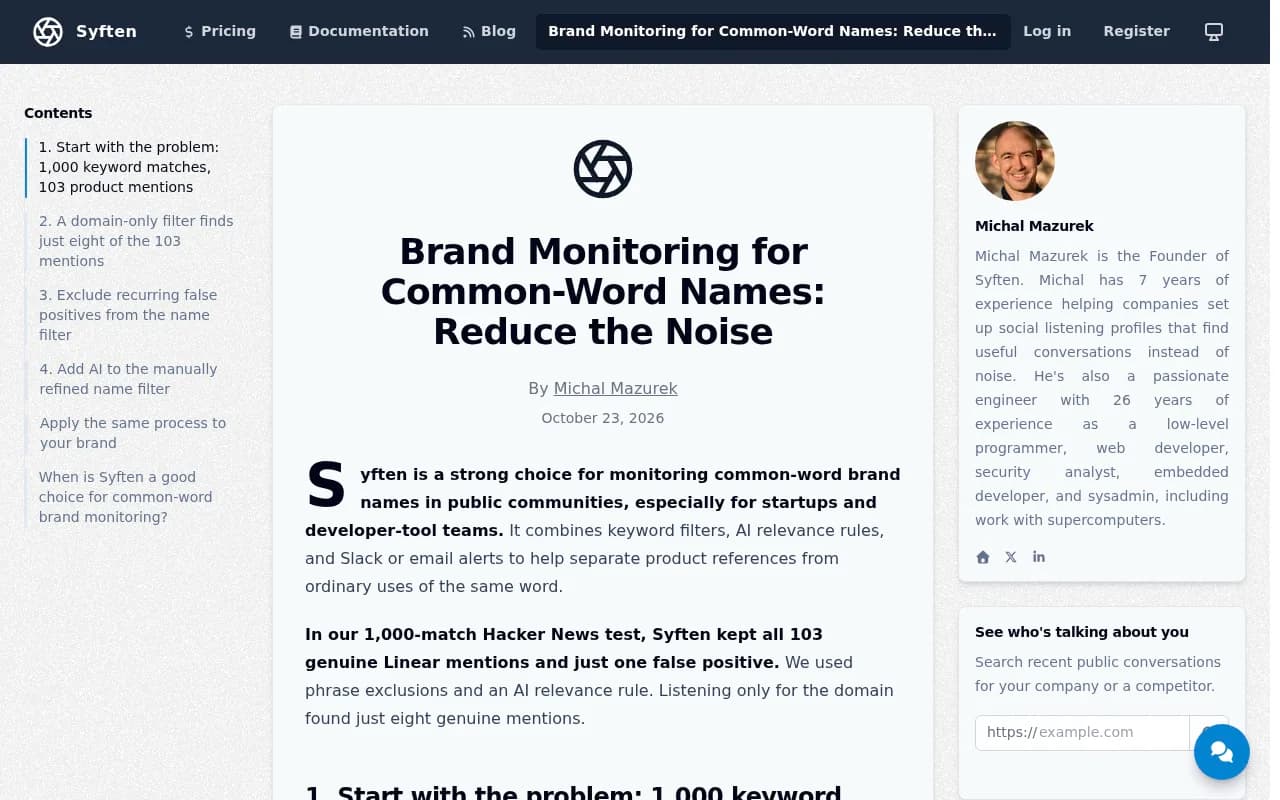
The results, from Syften's common-word brand monitoring test:
| Filter stage | Comments retained | Genuine Linear mentions | Unrelated | Unrelated share |
|---|---|---|---|---|
| Broad keyword "linear" | 1,000 | 103 | 897 | 89.7% |
| Domain only (linear.app) | 8 | 8 | 0 | 0% |
| Refined name filter with phrase exclusions | 794 | 103 | 691 | about 87% |
| AI relevance rule on the refined filter | 104 | 103 | 1 | 1.0% |
Three things stand out.
First, the broad keyword is nearly useless on its own. Nine in ten matches were noise.
Second, the tempting shortcut of listening only for a distinctive identifier like the domain gives you a perfectly clean feed that misses 95 of 103 real conversations. Clean is not the same as complete.
Third, exclusion lists only get you so far. After excluding recurring false positives, 691 of 794 remaining comments were still unrelated. And exclusions can eat genuine mentions: a comment that discusses both Linear and linear algebra gets thrown out by a rule meant to remove the algebra.
What worked was adding a rule that asks whether the author means the product. That is the same idea as an analysis instruction in an AI visibility tool.
A caveat: this is Hacker News comments, not AI answers. AI responses are more structured and often name the brand with context, so your noise rate will differ. But the pattern (broad is noisy, narrow is incomplete, context rules fix it) carries over.
The four levers for fixing mention detection
Whatever tool you use, you have roughly four ways to shape what counts as a mention. Most tools expose some of these. Few expose all four, so check before you commit.
Lever 1: aliases
Aliases are the alternate strings that should count as your brand. Think of them as recall fixes. Typical entries:
- Official name and the short name buyers actually use
- Product and sub-brand names
- Old names from before a rebrand
- Acronyms and common misspellings
- Spelling variants with and without hyphens or spaces
- Your domain
The warning here comes from how simple text matching behaves. Otterly's help documentation describes its brand detection (updated November 27, 2025) as primarily text-based, with an example where a brand defines both "Coca Cola" and "Coca-Cola" and the system looks for exact matches of each. As ReachLLM's write-up on AI brand detection points out, that means you have to list every variation yourself. If you forget one, you get a false negative and no warning.
For a common-word brand, aliases cut both ways. Adding the bare word "Linear" as an alias maximizes recall and maximizes noise. Better aliases are the ones that carry context: "Linear app," "Linear.app," "Linear issue tracker." You trade some recall for a lot of precision, and then you recover the rest with the other levers.
Lever 2: exclusions and context rules
Exclusions say "if the match appears next to these words, ignore it." For Linear that would be terms like "algebra," "regression," or "linear history." They are cheap and fast. They are also blunt.
Syften's test shows both sides. Exclusions took the Linear feed down but left it mostly noise, and a single exclusion can discard a genuine comment. One more detail from that article: Syften's own filters use space-separated required keywords rather than exclusions, with separate filter lines for alternatives. Tools differ in how they express this, so read how yours combines terms before you build a long exclusion list.
Use exclusions for the obvious, recurring false positives you find in your first review. Do not try to enumerate every other meaning of the word. You will never finish.
Lever 3: merging
Merging is the opposite problem. Instead of too many things matching one name, you have one real-world company tracked as several entities. It happens more than you would think:
- A parent brand and its product lines tracked separately
- A company that rebranded, with old and new names counted as two competitors
- Regional or localized names for the same product
- Auto-discovered competitors that turn out to be the same company under two spellings
If you leave these split, share of voice is diluted. Two entities at 6% each look like minor players, while the merged entity at 12% is a serious competitor. When a tool supports merging, you fold the duplicates into one canonical brand and keep the aliases. If it does not, you end up reconciling numbers in a spreadsheet.
I could not verify merging support across most AI visibility tools from public documentation, so ask vendors directly. It is a good question to put on a demo call.
Lever 4: analysis instructions
This is the lever that actually solves the common-word problem, because it is the only one that deals with meaning. An analysis instruction is a short plain-language rule the tool applies when it reads a response, deciding whether a brand name refers to your entity or to something else.
Syften's advice for writing these is worth copying:
- Avoid vague instructions like "accept valuable posts."
- Name the product.
- State its domain or purpose.
- Say which kinds of mentions to keep, including passing references.
A LinkedIn piece on this topic recommends something similar before you write a single negative term: draft a short context profile covering the category, product names, sub-brands, and spokespeople. I only saw a snippet of it, so treat that as a pointer rather than a source.
Here is what a good instruction looks like for a hypothetical project management tool named Linear:
Count a mention of "Linear" only when it refers to Linear, the
software product for planning and tracking product development
(linear.app). Count brief or passing references, such as comparisons
to Jira. Do not count "linear" used as an adjective or as a math or
engineering term, for example linear regression, linear history,
or linear algebra.
And a bad one:
Count mentions of Linear that are relevant.
The first tells the model what the product is, where to find it, what to include, and what to ignore. The second pushes the whole decision back onto guesswork.
A workflow you can run this week
The order matters. Here is the sequence I would follow.
Step 1: write the entity definition first
Before touching any setting, write down your brand's category, product names, sub-brands, old names, domain, and spokespeople. Also write down the three or four other meanings of your name. This document feeds every other step.
Step 2: start broad, then sample
Turn on matching with the bare name and let a batch of responses come in. Then read roughly 100 matches in full. Syften recommends the same number before tightening anything. Label each one as a genuine mention, a different meaning, or unclear.
This step tells you your actual noise rate. If it is 10%, you need light touch. If it is 90%, you need real context rules.
Step 3: add context-bearing aliases
Add the aliases that carry context and the ones that are unambiguous (domain, product names, old names). Do not add the bare common word unless you are going to follow it with an analysis instruction.
Step 4: add the analysis instruction
Write the instruction using the template above. Keep it specific. Many tools cap instruction length (Promptwatch's Brand Book instructions, for instance, allow up to 1,000 characters), so be concise and put the most important rule first.
Step 5: merge duplicates
Check your competitor list for the same company appearing twice. Merge them. Do the same for your own sub-brands if you want one combined number.
Step 6: read raw answers and label errors
Readings of the count are not enough. ReachLLM suggests a labeling vocabulary that works well: false positive, false negative, wrong competitor, stale fact, and prompt mismatch. Each type points to a different fix. A false negative means add an alias. A false positive means tighten the instruction. A wrong competitor means fix the competitor set.
Step 7: re-measure the same prompt group
Run the identical prompts again. Compare. If the numbers improve because detection got better, good. If they improve because the rule is now so strict it ignores real mentions, you have swapped one error for another. Spot-check again.
A QA checklist
| QA step | What to check | What it catches |
|---|---|---|
| Define the entity | Names, products, old names, acronyms, misspellings, domains | False negatives from a narrow setup |
| Define competitors | Direct rivals, category leaders, regional alternatives, abbreviations | Share of voice measured against a messy set |
| Read raw answers | The exact response text, not only the count | Generic phrases matched as your brand |
| Review citations | Whether your domain, another source, or nothing was cited | A mention problem mistaken for a citation problem |
| Label errors | Type of each error | Fixes sent to the wrong owner |
| Re-measure | Same prompts, new setup | Improvement that is really just a hidden problem |
Which tools give you these controls
I cannot give you a verified feature-by-feature comparison of alias, merging, and instruction support across the whole market. Vendors change this often, and public documentation is thin. What I can say is where each type of tool tends to land, and what to ask.
| Approach | Examples | Typical alias handling | Context-aware rules |
|---|---|---|---|
| Text-matching trackers | Otterly.AI | Exact-match variants you list yourself | Limited, so you manage noise by hand |
| AI visibility platforms | Promptwatch, Profound, Peec AI | Aliases, merging, auto-discovered competitors in varying depth | Varies, so ask whether instructions exist |
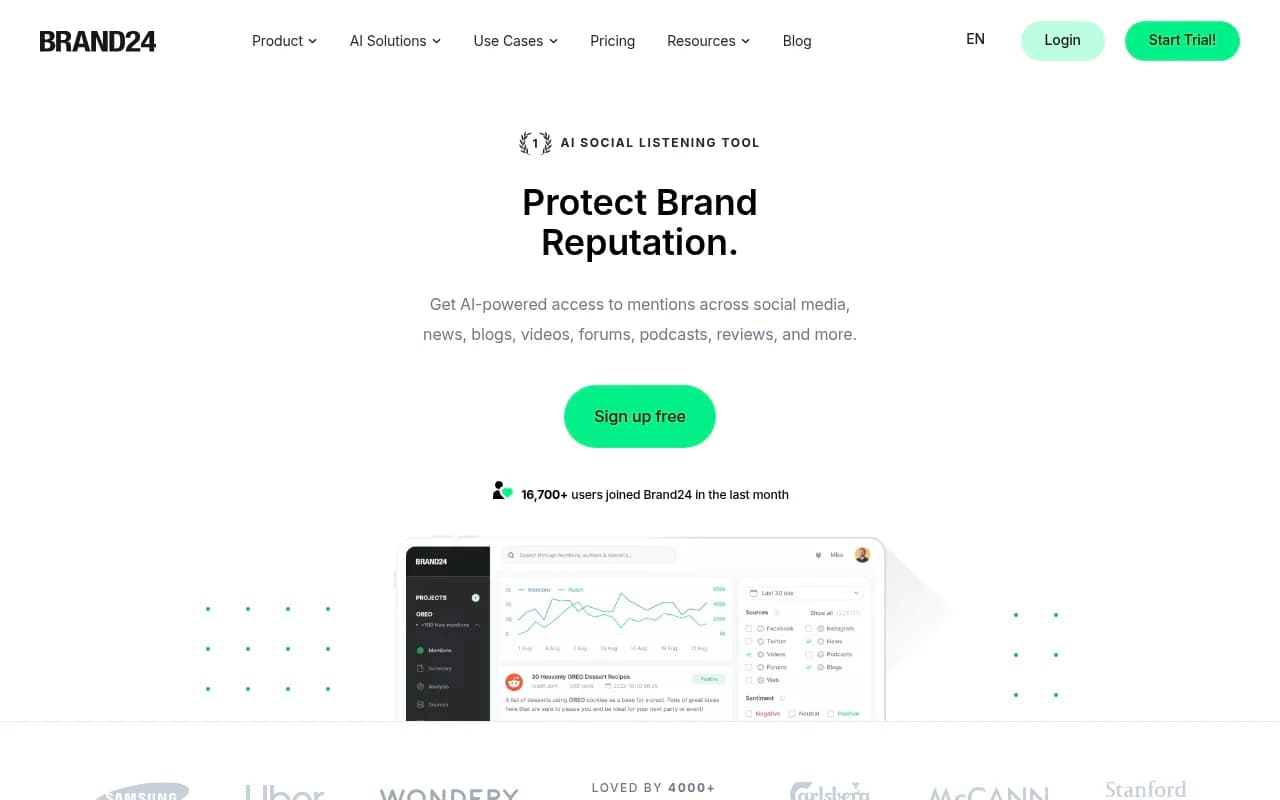
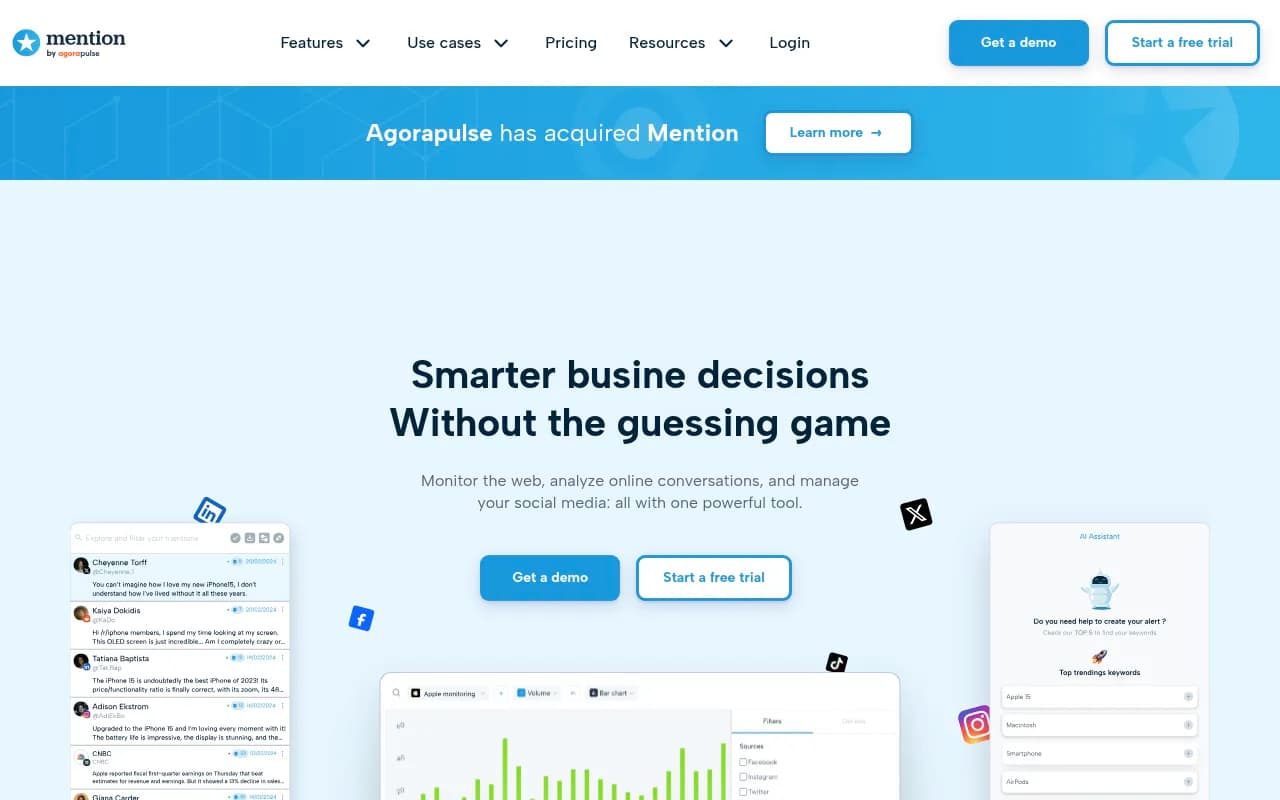
| Community and social listening | Syften, Brand24, Mention | Keyword filters and exclusions | Syften adds an AI relevance rule |
A few notes on the tools themselves.
Promptwatch is the one I would look at first for this specific problem, since it exposes brand aliases and highlighting, brand merging, auto-discovered competitors, and Brand Book analysis instructions (plain-language rules that decide what counts as a mention of your brand and competitors, for example when a brand name is also a common word). It also keeps raw responses and per-prompt data, so you can audit a rule against the actual answers, and its Brand Narrative view shows the specific claims AI makes about you, which is a useful sanity check that the right entity is being read. Pricing starts at $95/mo on Essential; confirm current details at promptwatch.com/pricing.

Otterly.AI is an affordable monitor. Based on its documented text-based detection, plan on listing every name variant manually and checking results carefully if your name is a common word.

Profound and Peec AI are the other names that come up most often in this category. I did not verify their alias or exclusion controls, so put that question to them directly.


For social and web mentions rather than AI answers, Brand24 and Mention are the established options, and both lean on keyword filtering.
If you are still shopping, the GEO software directory at bestgeosoftware.com lists more options by category.
Questions to ask any vendor
- Can I define which entity a name refers to in plain language, or only list strings?
- Can I merge two tracked brands into one without losing history?
- Do changes to aliases or instructions apply retroactively to collected responses, or only going forward?
- Can I see the raw response behind every mention?
- Is there an audit trail of who changed a detection rule and when?
That last one gets overlooked. If someone loosens a rule and your visibility jumps 15 points, you want to know why.
Common mistakes
A few patterns I would watch for.
Trusting the cleanest feed. The domain-only filter looked perfect in the Linear test: zero false positives. It also missed most of the conversation. Always compare the strict version against the broad one.
Writing instructions that sound smart but say nothing. "Relevant mentions only" is not an instruction. Name the product and the meaning.
Exclusion lists that never end. If you are on your fortieth exclusion term, switch to a context rule.
Forgetting competitors. Your competitors may have the same problem. A competitor named after a common word will also be over-counted, which inflates their share of voice. Apply the same discipline to their names.
Changing rules without re-running. If you change detection mid-quarter without re-measuring a fixed prompt group, your trend line compares two different definitions of "mention."
Treating the sample as the population. Several of the Linear comments came from the same threads, so they were not independent conversations. In AI answers, the same prompt repeated is not 50 independent opinions either.
What to do next
Start small. Pick one prompt group, write the entity definition, sample 100 responses, and count your real noise rate. That single number tells you whether you have a mild annoyance or a measurement problem that is distorting every report you send.
Then apply aliases, one specific analysis instruction, and merges, in that order, and re-run the same prompts. If you want to see how a platform handles all four levers on your own brand, the free AI visibility report or a 7-day trial from Promptwatch is a low-risk way to test it against your real name, which is the only test that matters when your name is also a word.