Key takeaways
- There is no single winning LinkedIn format. Google AI Mode and AI Overviews lean on Pulse articles, Perplexity leans on posts, and ChatGPT leans on company pages.
- In Promptwatch Data for August 2026, Pulse articles were 30.41% of all LinkedIn citations, posts 27.75%, and company pages 18.05%.
- Pulse share fell on every engine since the May-June window, while company page share rose on every engine.
- Showcase pages, product pages and LinkedIn Learning each earn under 0.5% of citations. Don't spend time on them for GEO.
- Third-party studies report much higher Pulse shares (63-72%). They use different methods and windows, so treat them as directional.
The short answer
If you want one sentence: it depends on which AI engine you care about. People keep asking whether to write Pulse articles, post in the feed, or polish the company page. All three get quoted. They just get quoted by different engines, in different proportions, and the mix has moved quickly this year.
The cleanest source I found is Promptwatch's own LinkedIn citation research, which classifies every LinkedIn citation by page type across ChatGPT, Google AI Mode, Google AI Overviews and Perplexity. The newest report covers August 1-31, 2026, and the baseline covers May 17 to June 16, 2026.

What the August 2026 data shows
All percentages below are shares of all LinkedIn citations in the window, including categories that the charts don't show.
| Page type | May 17-Jun 16 | August 2026 |
|---|---|---|
| Pulse articles | 37.67% | 30.41% |
| Posts | 32.19% | 27.75% |
| Company pages | 13.35% | 18.05% |
| Product pages | 0.50% | 0.44% |
| LinkedIn Learning | 0.34% | 0.37% |
| Showcase pages | 0.26% | 0.40% |
Pulse articles and posts together made up about 70% of LinkedIn citations in the earlier window and about 58% in August. The missing share went mostly to company pages, plus job listings, help articles and top-content pages. LinkedIn is being cited less as a publishing platform and more as a directory and reference source.
Engine by engine
This is where the real answer lives. The blended numbers hide very different behavior.
| Engine | Pulse articles | Posts | Company pages |
|---|---|---|---|
| ChatGPT | 3.65% (was 8.77%) | 26.45% (was 12.09%) | 33.68% (was 23.84%) |
| Google AI Mode | 34.66% (was 44.85%) | 24.39% | 13.53% (was 10.71%) |
| Google AI Overviews | 34.51% (was 42.25%) | 23.06% (was 27.72%) | 14.46% (was 12.86%) |
| Perplexity | 26.01% (was 32.46%) | 37.32% (was 41.88%) | 22.03% (was 13.09%) |
ChatGPT: company pages first, then posts
ChatGPT is the odd one. Company pages took 33.68% of its LinkedIn citations in August, up from 23.84%. Job listings (6.51%) and help articles (5.97%) add more, so company pages, jobs and help articles together are close to half of what ChatGPT cites on LinkedIn. In the earlier window, the LinkedIn homepage alone was 22.55% of ChatGPT's LinkedIn citations, which fits a pattern where ChatGPT treats LinkedIn like a company directory.
Posts more than doubled to 26.45% and are now the second-largest format. Pulse articles dropped to 3.65%. If ChatGPT visibility is your goal, a new Pulse article is probably the weakest use of your afternoon. Keep the company page accurate (about section, offerings, size, locations) and post regularly from the page and from leaders' profiles.
Google AI Mode and AI Overviews: still Pulse territory
Both Google surfaces cite Pulse articles at roughly 34-35%, down from 42-45% in May-June. They now look almost identical to each other. Posts are next at 23-24%, then company pages at 13-14%.
AI Overviews also has the highest share of what LinkedIn calls top-content pages (5.15%), which go to accounts LinkedIn ranks as leading voices on a topic. If you have a subject-matter expert with that kind of standing, their long-form writing is worth the effort for Google's surfaces.
Perplexity: the one place posts beat Pulse
Perplexity cites posts at 37.32%, ahead of Pulse articles at 26.01%. It is the only engine where that holds. Company pages gained the most here too, rising from 13.09% to 22.03%. The practical advice is to write posts that stand alone as answers: a clear claim, supporting numbers, no "read more in comments" teaser.
Why the third-party studies disagree
If you've read other LinkedIn citation studies, the numbers look wildly different. OtterlyAI analyzed 1,310,455 LinkedIn citations across six platforms and found Pulse articles were 63.0% of content URLs and 72.2% of citations, at 8.5 citations per URL against 5.9 for posts. Goodie AI looked at 219,351 citations across nine engines and found Pulse articles drew 3.6x as many citations as feed posts.
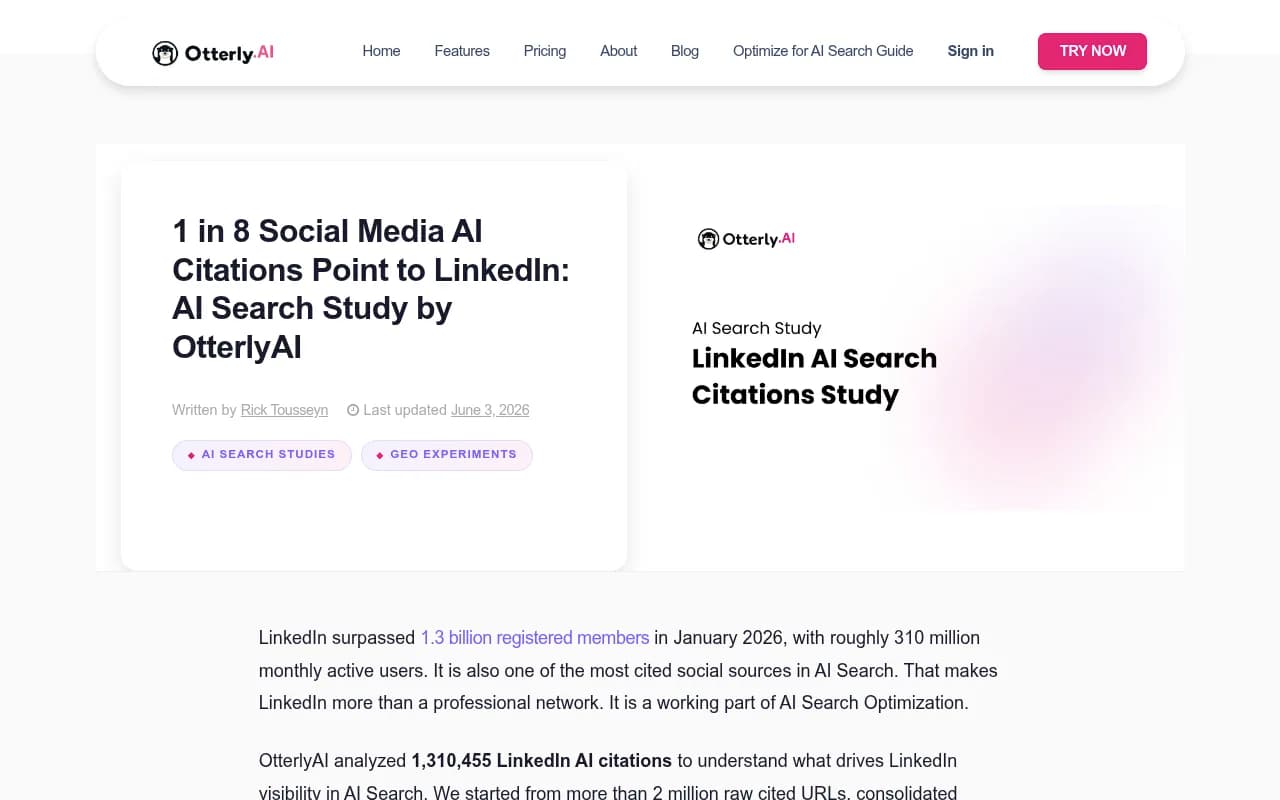
Those numbers conflict with Promptwatch's 30.41% for August. I wouldn't call either side wrong. The methods, engines and time windows differ, and the Pulse share fell across every engine between May-June and August in Promptwatch's data. Studies built on January-to-June data will naturally look more Pulse-heavy than a snapshot of August. My read: Pulse is still a strong format for Google, but the idea that it dominates everything no longer holds, and ChatGPT clearly moved away from it.
The third-party studies do add a few useful angles:
- OtterlyAI found likes, comments, emojis and hashtags correlate near zero with citations. What gets a post liked is not what gets it cited.
- OtterlyAI also found Microsoft Copilot is the most Pulse-heavy surface, at 90.2% of its LinkedIn citations.
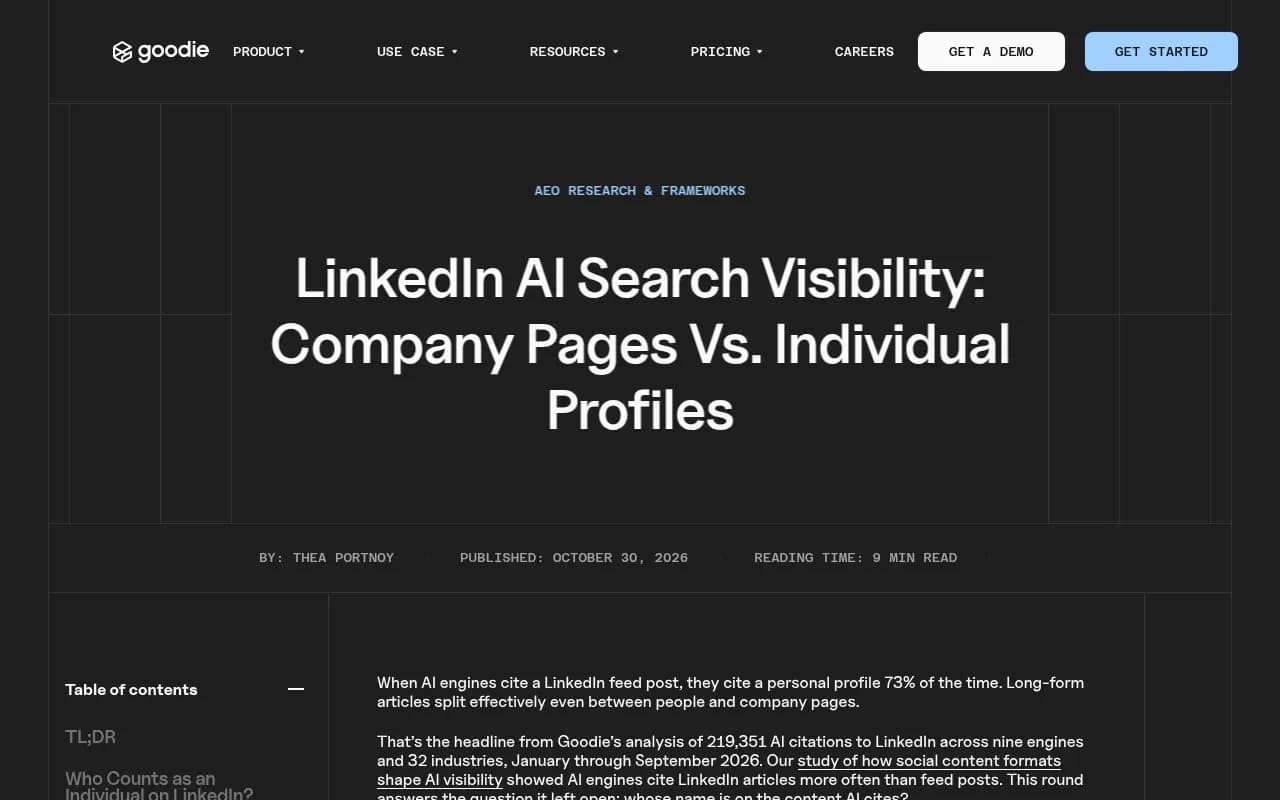
- Goodie AI found that Pulse articles split 51% personal profiles and 49% company pages, which it treats as even, while 73% of feed post citations go to personal profiles.
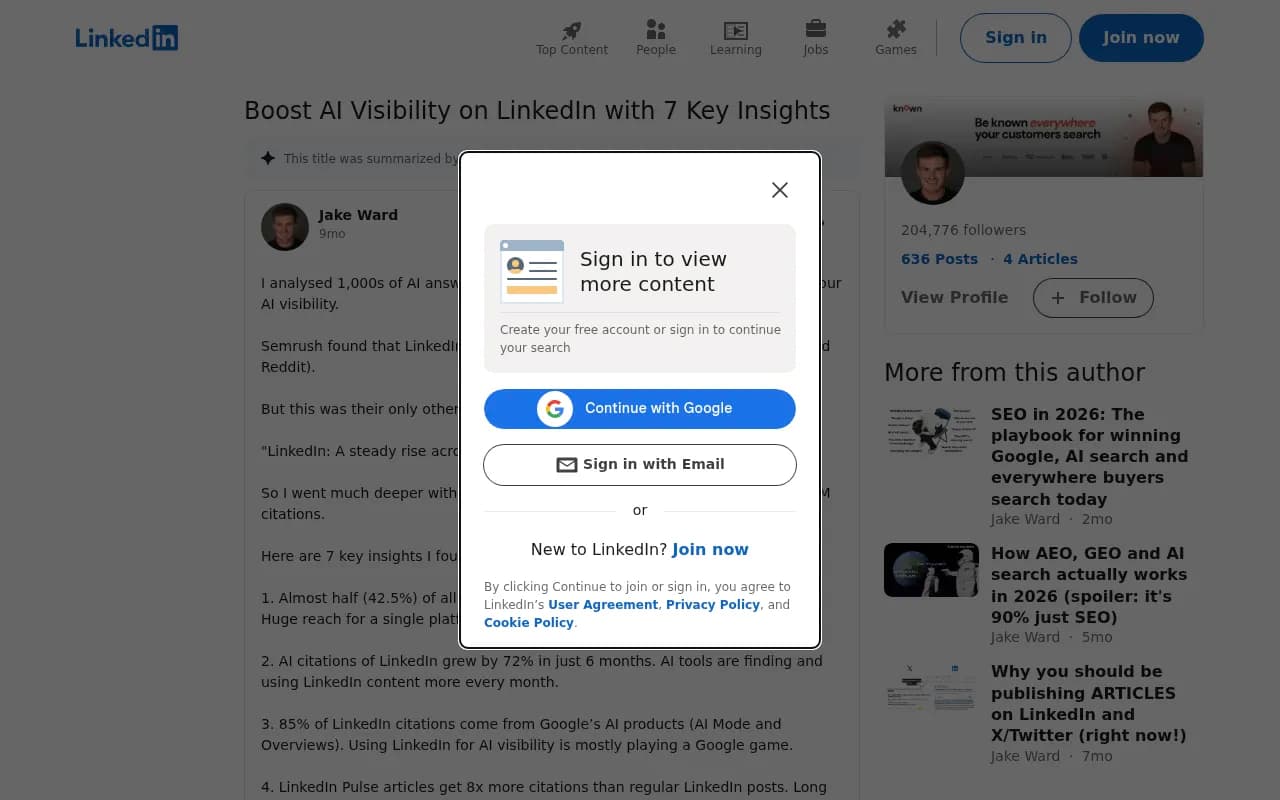
- A LinkedIn article by Kaleigh Moore reports that more than 70% of LinkedIn AI citations land on articles between 500 and 2,000 words.
Treat those as directional. They come from different datasets than the Promptwatch numbers above.
What to do with this
If your audience uses ChatGPT
Make the company page the main asset. Fill every section, keep offerings and locations current, and post from it on a schedule. Add posts from founders and employees, since posts are now the second-largest format. Skip Pulse for this goal. The same logic applies to jobs and help content, which together take a surprising share.
If you care about Google AI Overviews and AI Mode
Pulse articles still pay off here. Publish long-form pieces from named experts, aim for a focused topic, and give the article a clear structure. Company pages matter less (13-14%) but are growing.
If Perplexity matters
Write posts that work as answers. One claim, a few specific numbers, plain text. Perplexity cites posts more than any other format, and company pages are catching up.
What to ignore
Showcase pages (0.4%), product pages (0.44%) and LinkedIn Learning (0.37%) barely register. Don't build a GEO plan around them.
A simple working mix
- Keep the company page complete and current.
- Post from the company page and two or three leaders' profiles each week.
- Publish a Pulse article when you have something worth a long-form treatment, mainly for Google.
- Re-check the split every month or two, because the mix has shifted fast this year.
Tracking whether it works
The numbers above are market-wide. Your own results depend on which prompts your buyers ask and which of your LinkedIn URLs get cited for them. A platform like Promptwatch can show which LinkedIn pages, posts and videos AI cites for your tracked prompts, so you can see whether the company page or an executive's posts are doing the work. Its Citation Trends and Page Tracker are useful for this, and the GEO software directory lists other options if you want to compare tools.
Other trackers in the same space include Otterly.AI, Profound and Peec AI, though the page-type breakdown is what makes this question answerable.



Practical tips for LinkedIn content that gets quoted
Advice from third-party write-ups, such as DSMN8's guide, is consistent with the data on what gets picked up:
- Start with a keyword-rich first sentence, because it becomes part of the URL.
- Write in plain text and lead with the point.
- Be specific. Numbers and named claims are easier for AI to quote than general opinions.
- Don't rely on engagement tactics. Likes and hashtags don't correlate with citations.
Bottom line
Pulse articles are no longer the automatic answer. For Google's AI surfaces they still lead, for Perplexity posts lead, and for ChatGPT the company page leads by a wide margin. Pick the format by engine, and recheck the data regularly, since Promptwatch's numbers moved noticeably in just two months. For more first-party research on how AI engines pick sources, browse the Promptwatch Data hub.