Key takeaways
- A discovery agent that suggests five actions a week is only useful if someone owns a routine for acting on them. Without one, the board fills up and nothing ships.
- Triage on Monday, assign and brief on Tuesday, build Wednesday and Thursday, publish Friday, then verify the following week. Five items fit that rhythm.
- Borrow guardrails from agent prompts that already work: explicit assignee precedence, "TBD" instead of invented facts, and an Open Questions section.
- Mark every action with evidence, an owner, a due date and a definition of done. If it lacks any of those, it is not ready to ship.
- For AI search work, tools like Promptwatch generate the weekly suggestions and measure whether each shipped page got crawled, cited and clicked.
Why a routine matters more than the suggestions
I have seen the same failure pattern with every agent that produces recommendations. The first two weeks feel great. Five tidy suggestions land, each with evidence attached. By week four there are twenty open items, nobody remembers which ones mattered, and the agent keeps adding more.
The suggestions were never the bottleneck. Turning them into shipped work is. That takes a repeatable weekly routine, a small number of rules about who owns what, and a way to check afterwards whether the work did anything.
A caveat before we start. I could not find a published standard for a "five suggestions per week" routine. What follows is my own framework, assembled from patterns that do exist: kanban-style boards for agents, and the prompt rules companies like HarperCollins use in their Confluence agents. Treat it as a starting template and change it.
What a discovery agent and an action board actually are
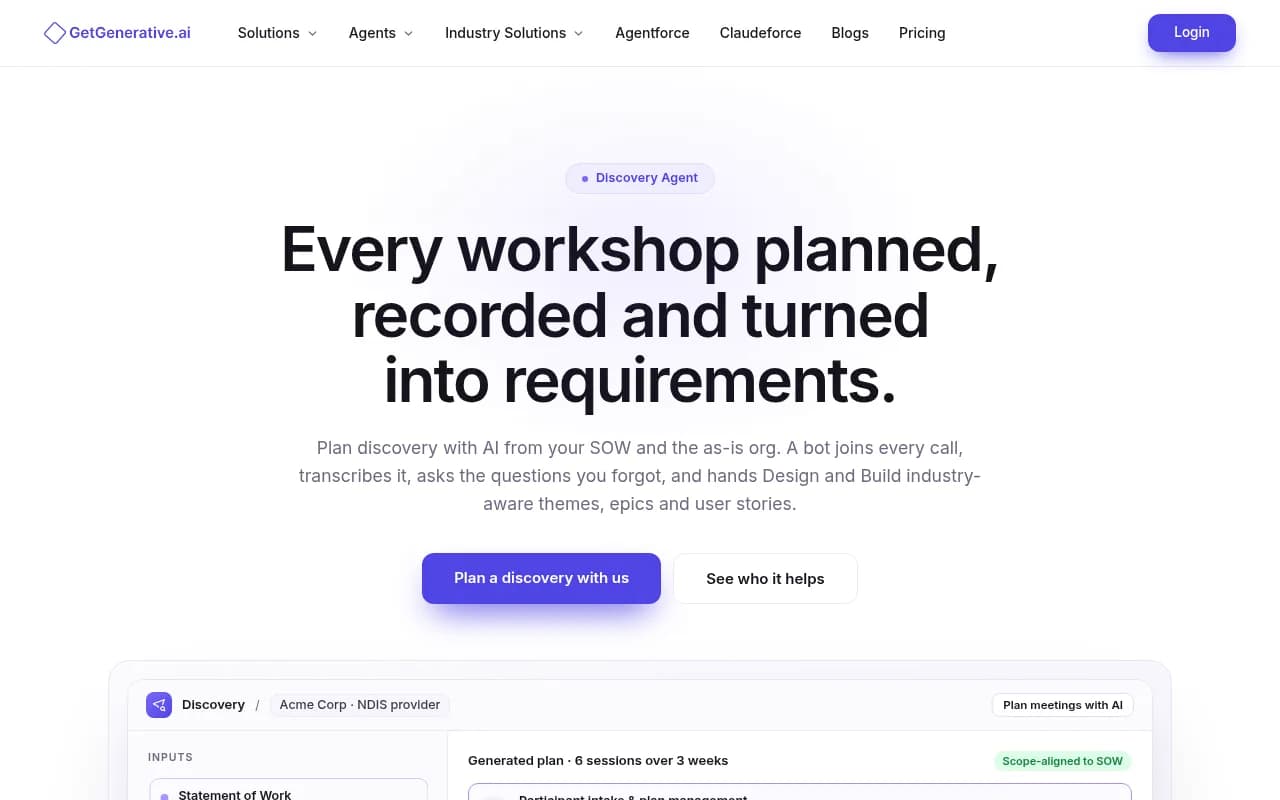
A discovery agent looks through your data on a schedule and proposes work. The term is loose. GetGenerative's Discovery Agent is a Salesforce-specific example: it plans workshops from a statement of work, records the calls, and turns what it hears into themes, epics and user stories. Atlassian's customer list includes Procore's Backlog & Discovery Synthesizer, which sifts feedback to decide what earns a roadmap spot. Different domains, same job: find the work worth doing.
An action board is where those suggestions land. A recent arXiv paper, The Agent Board: Kanban for Machines by Tyler Hunt, Donald Nguyen and Gurbinder Gill of Corvic AI Research (3 Nov 2026), describes the idea well. The board is a durable shared table of tasks with a few exact fields the system routes on and a free-form body. It works, the authors argue, because it is durable, everyone can read it, and the work stays visible when people are away.
Two honest notes on that paper. It comes from a vendor's research team, not an independent lab. And it describes a coordination architecture for agents, not a weekly human routine. It also reports that in a simulated pilot a plain external watcher was cheaper than the board at waiting. So a board is not always the cheapest tool. It earns its place when work has to outlive a single conversation and several people need to see it.
One detail from the paper is worth stealing: the board does not enforce status meanings. Teams do, through conventions. That is exactly the part this guide covers.
The weekly rhythm at a glance
| Day | Step | Output |
|---|---|---|
| Monday | Triage the five suggestions | Each one accepted, deferred or rejected |
| Tuesday | Assign and brief | Owner, due date, definition of done per item |
| Wednesday-Thursday | Build | Drafts, fixes and changes ready for review |
| Friday | Ship and log | Published work, plus a short note on what moved |
| Next Monday | Verify | Did the shipped work change the metric it targeted? |
The last row is the one people skip. Do not skip it.
Monday: triage in 30 minutes
Open the board and read all five suggestions before touching any of them. Then sort each into one of three buckets.
- Accept: the evidence is solid and the work fits this week's capacity.
- Defer: good idea, wrong week. Leave it on the board with a revisit date.
- Reject: the evidence is weak or the suggestion misses context the agent cannot see. Write one line saying why.
That last part matters more than it sounds. Rejection notes are training data for you. After a month you will see which kinds of suggestions you consistently reject, and that tells you how to tune the agent's instructions.
Check the evidence, not the headline
Every suggestion should carry its evidence: the data point, the page, the transcript quote. If a suggestion only has a conclusion, send it back. Agents are fluent, and a confident sentence is not the same as a finding.
A useful test: can a teammate who has never seen the suggestion find the same evidence in under two minutes? If not, it is not ready.
Cap accepted work by capacity
Five suggestions does not mean five commitments. I would accept two or three in a typical week, and leave room for the unplanned stuff that always shows up. Deferred items are fine. A board that is honest about what is not happening beats a board where everything is technically in progress.
Tuesday: assign and brief
This is where most boards stall, because assignment feels administrative. It is the step that turns a suggestion into work.
Borrow an assignee rule
Atlassian published HarperCollins's Meeting-to-Action Companion prompt in its post on Confluence Agents (May 12, 2026). One rule in it is worth copying directly: assign in this order of precedence.
- An explicit @mention on the page.
- The meeting owner.
- The team queue or default assignee.
Translate that to your board: if someone has already raised their hand, they own it. Otherwise the person who owns that area owns it. Otherwise it goes to a named queue that somebody actually checks. No item should sit unowned past Tuesday.
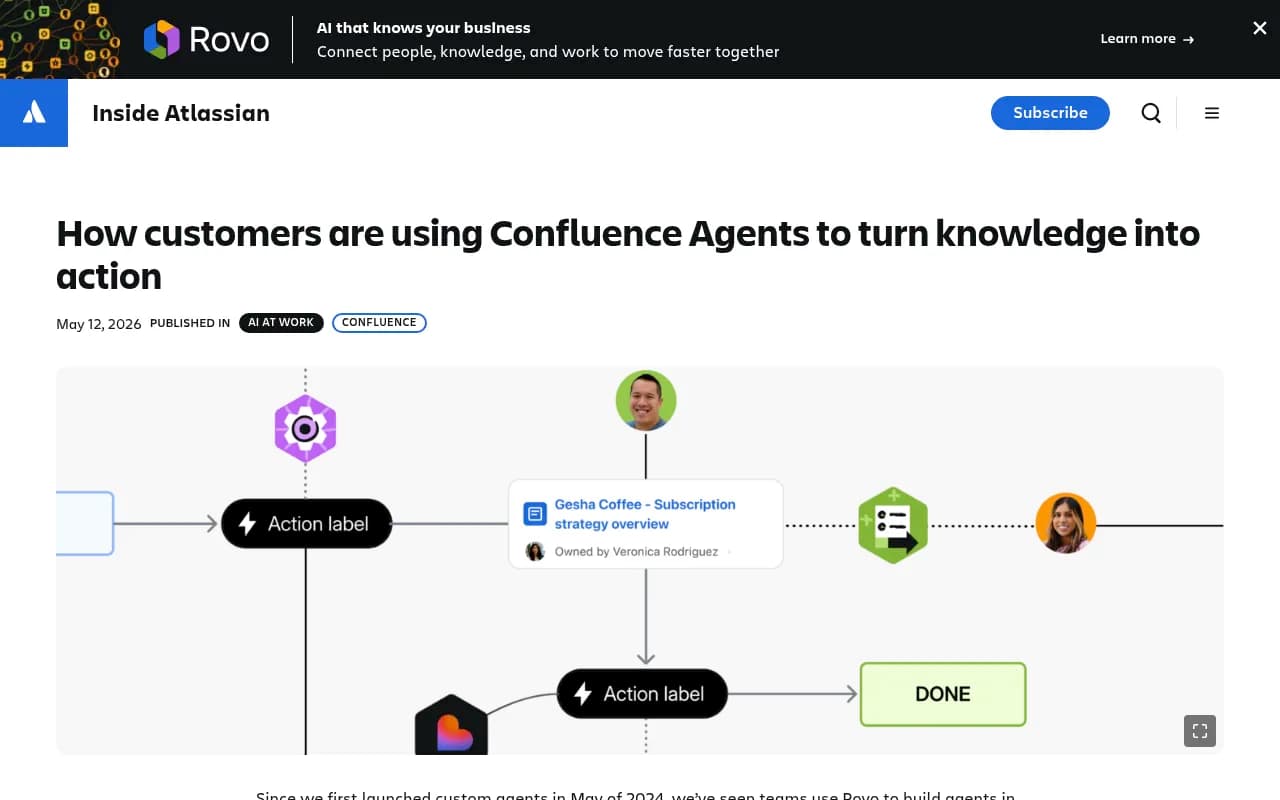
The same prompt also tells the agent not to invent owners or dates, to mark unknowns as TBD, and to add an Open Questions section. Hold your humans to that too. "TBD, asking Dana" is a better board entry than a guessed deadline.
Write the brief
Each accepted item gets a four-line brief:
Goal: what changes if this works
Evidence: link to the data behind the suggestion
Done means: the specific artifact that exists when finished
Owner / due: name and date, or TBD plus who is finding out
The "done means" line prevents the classic drift where a task about fixing a page becomes a task about rewriting the whole site.
Wednesday and Thursday: build
Protect these two days. Most of the actual shipping happens here, and it goes faster when triage and briefing are already finished.
A few habits that help:
- Work the smallest item first. A quick win on Wednesday morning keeps the board moving and builds trust in the routine.
- Let agents draft, let humans decide. Drafts, outlines and first-pass analysis are fine to delegate. Publishing decisions are not.
- Put blockers on the board immediately. The Agent Board paper describes agents that block on a task and wake when a matching post arrives. Humans can do the same thing more simply: mark it blocked, name what unblocks it, and move on.
If you are connecting tools so the board updates itself, workflow automation platforms like Zapier and n8n can move status changes and notifications between systems. The HarperCollins prompt does something similar with Jira issues and a Slack summary, so the pattern of one board, linked tickets and a short chat message is proven.

Friday: ship and log
Publish what is ready. For anything that is not, move it back to Next week with a reason rather than letting it quietly slide.
Then write a five-line log. Not a report, a log:
- What shipped.
- What slipped, and why.
- What the agent got wrong this week.
- Open questions still marked TBD.
- What you expect to see move, and where you will look.
That last line sets up the Monday check. If you cannot say what you expect to move, you have not defined the work well enough.
A short summary posted to a team channel, as in the HarperCollins pattern, keeps everyone else informed without a meeting.
The following Monday: verify
Before triaging the new five, spend ten minutes on last week's shipped items. Did the metric move? Did the thing you built actually get used?
This step closes the loop. Without it, the board measures activity, and activity is cheap. With it, shipped items that underperform come back as new work, and you learn which suggestion types pay off.
A worked example: AI search visibility
The routine is generic, but a concrete domain helps. AI search visibility is a good fit because the suggestions are naturally evidence-backed and the results are measurable.
In this setup, a discovery agent looks at your tracked prompts, citations, crawler activity and site health each week and proposes up to five actions. Promptwatch does this with its Action Board: a Discovery agent investigates your data weekly and suggests up to five evidence-backed actions per run, covering things like content gaps, sentiment, Reddit, offsite mentions, site health and untracked pages. A weekly digest email lands each Monday, which conveniently matches the triage day.

Here is how the weekly routine maps onto it:
| Routine step | What it looks like in practice |
|---|---|
| Monday triage | Read the five suggestions, check the cited evidence, accept two or three |
| Tuesday assign | Assign owners and add comments on the board, in board or list layout |
| Wed-Thu build | Use the Content Agent or Content Refresh for drafts, fix site-health items by hand |
| Friday ship | Publish to WordPress, Webflow or Framer as a draft or live |
| Next Monday verify | Check crawler logs, page tracking and visitor analytics for the shipped pages |
The verify step is where this domain gets interesting. AI crawler logs show whether bots actually read the new page, and page tracking shows whether AI cites it. That separates an access problem from a content problem, which is a distinction a plain dashboard cannot make for you. Promptwatch's AI crawler logs and Content Agents cover those two ends. Plans start at $95 a month for Essential, but the Content Agent is on Business ($579 a month), so confirm what you need at promptwatch.com/pricing.
If you want a sense of what content types tend to earn citations before you commit a week's capacity, Promptwatch Data's report on which content types ChatGPT cites most found product pages at 22.4% of citations from Sep 28 to Oct 4, 2026, followed by landing pages and listicles. And the content half-life report, covering pages ChatGPT cited on July 6, 2026, found news lost half its pages within 36 days while landing pages and docs lasted longest. That is useful when deciding which of the five suggestions deserve this week's slot.
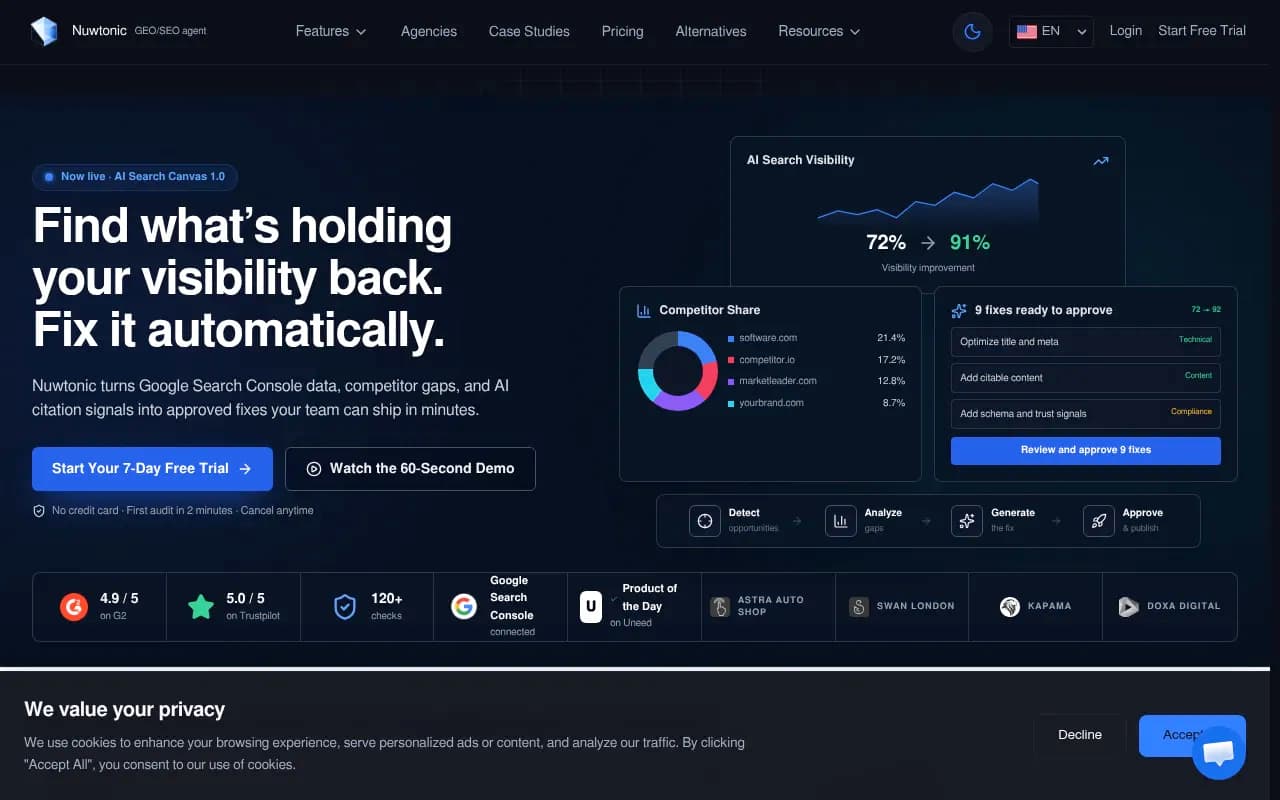
If you are comparing options in this category, the GEO software directory at bestgeosoftware.com lists alternatives. Several tools in our catalog pitch a similar suggest-then-fix loop, such as Whitebox, Nuwtonic and Temso AI.

Rules that keep the routine honest
A few guardrails, most borrowed from the prompts and papers above.
- No invented facts. If an owner, date or number is unknown, write TBD and name who will find out.
- One owner per item. Shared ownership is no ownership.
- Define status words once. The Agent Board paper notes that status meanings are conventions the team sets, not rules the board enforces. Write yours down: what does "in review" mean, and who moves it?
- Cap work in progress. Three active items beats five half-finished ones.
- Keep sensitive details internal. The HarperCollins prompt keeps them out of anything customer-facing unless asked. Do the same with board summaries.
- Log rejections. They are the cheapest way to improve the agent's instructions.
Common ways this goes wrong
The board becomes a graveyard
Symptom: thirty open items, three touched this month. Fix: at the end of every month, close anything deferred more than twice. If it mattered, the agent will suggest it again.
Everything gets accepted
Symptom: five accepted every Monday, two shipped every Friday. Fix: accept based on last week's real throughput, not hope.
Nobody verifies
Symptom: lots of shipped work, no idea if it helped. Fix: put the verify step on the calendar as a recurring ten-minute block, owned by a named person.
The agent drifts
Symptom: suggestions get generic or repetitive. Fix: read your rejection log, then tighten the agent's instructions. Plain-language rules about scope and evidence go a long way.
A starter checklist
- Pick one board and one day for triage.
- Cap acceptance at the number of items you actually shipped last week.
- Require evidence on every suggestion.
- Apply an assignee precedence rule and a no-unowned-items-past-Tuesday rule.
- Write a four-line brief per accepted item.
- Post a five-line Friday log.
- Spend ten minutes verifying last week's work before triaging this week's.
Run it for four weeks before changing anything. By then you will know whether five suggestions is the right number, whether Monday is the right day, and which suggestion types are worth the agent's time. For teams working on AI search specifically, Promptwatch's free AI visibility report is a no-login way to see what the first week's board might look like.