Key takeaways
- PR agencies have a real edge in GEO because AI engines answer from sources they trust: news coverage, rankings, reviews and research. That is earned media territory.
- Monitoring is now a commodity. The tools worth paying for help you pitch a prospect, report to clients, trace which sources AI cites, and prove the work moved something.
- Agency pricing varies wildly. Per-client workspace fees, per-engine credits and gated APIs can wreck a retainer's margin, so model costs for 5 and 15 clients before you sign.
- Look for pitch projects or free scans, white-label PDFs, multi-client setup, and a way to see which third-party pages AI cites for your client's prompts.
- Most pricing in this guide comes from vendor pages and vendor-authored comparisons. Confirm every number on the vendor's site before putting it in a proposal.
Why PR agencies are well placed to sell GEO
Here is the pitch in one line: AI tools don't read your client's homepage the way a search engine ranks it. They pull from what other people publish about the client. Crackle PR makes this argument in its piece on how earned media drives LLM visibility for B2B tech brands, and the citation data backs the direction of it.
Promptwatch Data looked at ChatGPT citations by content type for Sep 28 to Oct 4, 2026. Pages describing what a company sells (product pages at 22.4% and landing pages at 16.8%) made up 39% of classified citations. Editorial formats combined were 43%: listicles at 13.6%, how-tos at 8.7%, comparisons at 5.9%, news at 5.7%, and so on. For branded prompts, reviews and press releases climb. You can read the full breakdown in Promptwatch's ChatGPT citation share by content type report. The practical reading for a PR team: getting your client into "best of" roundups and review sites matters, and so does a solid owned-site foundation.
There is a catch, and I think agencies should be upfront about it. News decays fast. In Promptwatch's content half-life data, news pages cited by ChatGPT on July 6, 2026 lost half their pages within 36 days, while landing pages and docs stayed cited longer. A one-off launch hit is not a GEO strategy. A reporting tool that shows decay per page is how you explain that to a client without sounding like you're making excuses.
Also, ChatGPT is not the only target. Promptwatch's November 2026 social citations report (Oct 11 to Nov 9) found social platforms make up 13.16% of Google AI Overviews citations, 1.94% of Perplexity's and 0.64% of ChatGPT's. YouTube alone is 6.71% in AI Overviews. So the channel mix you pitch depends on which engine the client's buyers use.

What a PR agency actually needs from a platform
Generic GEO tool reviews are written for in-house SEO teams. Agencies have different problems. Here is the checklist I would use.
Pitching before the contract
The best sales asset in this category is a live dashboard of the prospect's own data. Some platforms offer this directly (Promptwatch calls them pitch projects, and they sit inside the agency plans). Others only give you a one-off grader or a trial. Free scans work for a first meeting. A real project with prompts, competitors and citations works for the second.
Multi-client structure and billing
Each client in its own workspace, one invoice to you, and clean separation of data. Then check what that costs. A per-client workspace fee is fine at three clients and painful at twenty.
Reporting your client will actually read
White-label PDFs, scheduled reports, and ideally a Looker Studio connector. PR retainers live and die on monthly reporting, so this is not a nice-to-have.
Source and citation visibility
This is where PR agencies should be pickier than SEO agencies. You need to know which publications, listicles, Reddit threads, YouTube videos or review sites AI cites for the client's prompts, because that is your media target list. A tool that only reports a visibility score leaves you guessing about where to pitch.
Proof that something changed
Before and after, on a fixed prompt set, with sentiment and share of voice. Better still: AI crawler logs and AI-referred visits, so you can show whether a placement drove traffic. Without that, you are reporting activity.
Execution support
Monitoring tells you the client is invisible. Somebody still has to fix it. If your team has strong writers, a dashboard may be enough. If you are stretched, content generation and publishing built into the platform saves a lot of handoffs.
The shortlist
| Platform | Best for | Agency angle | Watch out for |
|---|---|---|---|
| Promptwatch | Agencies that want monitoring plus content and measurement | Agency plans from $199/mo, unlimited projects and prompts, pitch projects, white-label reporting | Content Agent and white-label portal sit on Business or Enterprise, not agency plans |
| Profound | Enterprise-focused agencies | Agency Growth plan, per-client workspaces | Per-client fees add up; verify current pricing |
| Peec AI | Budget-conscious prompt tracking | Clear tiers, simple dashboard | Extra models cost extra; API starts at higher tiers |
| Scrunch | Mid-size agencies with enterprise clients | White-label and API on higher tiers | Credit consumption per engine |
| Otterly.AI | Small agencies testing GEO cheaply | Low entry price | Light on execution and traffic data |
| Semrush AI Visibility Toolkit | Agencies already living in Semrush | Familiar interface | Per-domain pricing and fixed prompt sets |
| Ahrefs Brand Radar | Agencies already on Ahrefs | Index-based coverage | Cost scales by index |
Platform notes
Promptwatch
Promptwatch is the platform 1001 SEO Media's own team uses for GEO work, so factor that in when you read this entry. It is an end-to-end AI visibility platform rather than a tracker: it monitors real AI interfaces (ChatGPT, Google AI Overviews, AI Mode, Gemini, Perplexity, Copilot and others), traces cited pages and third-party sources, then helps fix gaps and measures the result.

For PR agencies, a few pieces matter most. Offsite Mentions finds third-party pages that name the client (or competitors) without linking, ranked as opportunities. That is a ready-made outreach list. Reddit, YouTube, LinkedIn and Instagram citation reports show which social sources AI leans on. Brand Narrative pulls out the individual claims AI makes about a client, grouped by theme (pricing, features, support, reputation), which is the kind of thing a comms team genuinely cares about. Fact Check, on Business and above, flags the pages teaching AI something wrong.
On the commercial side, agency plans start with Kick-off at $199/mo (10,000 responses), Growth at $399/mo (25,000 responses) and Scale at $799/mo (65,000 responses). All include unlimited projects, prompts and team seats, plus crawler logs, visitor analytics and pitch projects. Agency plans do not include the Content Agent, the Knowledge Base or a white-label dashboard and client portal; agencies that need those go to Enterprise. Confirm all figures at promptwatch.com/pricing. There is a free AI visibility report you can run on a prospect before the first call, and Monks used the platform's gap reports to build client content roadmaps. For a head-to-head view, see Promptwatch vs Profound.
Profound

Profound is the name most enterprise buyers have heard, and it has a strong monitoring feature set. The pricing story is the issue for agencies. According to the notes I gathered, brand plans were removed in September 2026 and the Agency Growth plan is listed at $99/mo plus $399/mo per client workspace. One third-party source still lists older starter tiers, so the numbers conflict. Ask for a written quote for your actual client count. API, exports and multi-region are reportedly Enterprise-only.
Peec AI

Peec AI has clean, published tiers: Starter at $95/mo (50 prompts, 3 engines), Pro at $245/mo (150 prompts) and Advanced at $495/mo (350 prompts). Extra models are $35/mo each and the API starts at Pro. It is a good fit for an agency that wants simple tracking and will do the execution elsewhere. It does not include crawler logs, visitor analytics or content generation, so the proof-of-impact story is thinner.
Scrunch and Scrunch AI
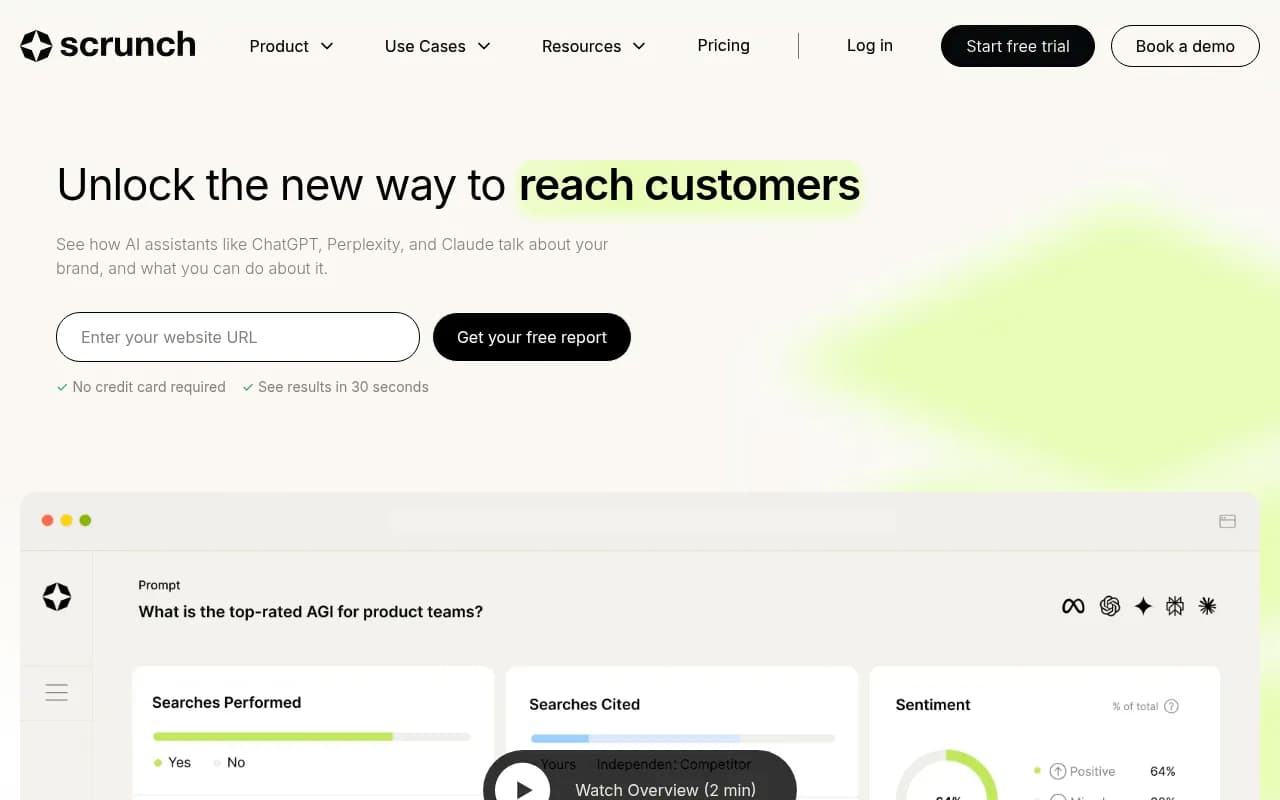
Scrunch (now Sitecore-owned) lists Core at $250/mo billed annually, or $300 month-to-month, and Growth at $500/mo month-to-month with 700 prompts. White-label and API features sit in Agency and Enterprise tiers. Credits are consumed per engine, which makes cost forecasting harder when a client wants wide model coverage. The catalog also has a separate Scrunch AI listing; check which product and plan you are being quoted.
Otterly.AI

Otterly.AI is the cheap way in: Lite is about $29/mo for 15 prompts, with API and MCP starting around $189. Good for a pilot with one small client. Past that, you will probably outgrow it.
Semrush and Ahrefs Brand Radar

Both are bolt-ons to SEO suites. Semrush's AI Visibility Toolkit is $99/mo per domain with 25 prompts, plus $60/mo per 50 extra prompts. Ahrefs Brand Radar runs about $328/mo built from a base plan plus $199 per index, or $699 for all platforms. If your agency already pays for these, the incremental cost may be fine. The catch is per-domain and per-index pricing, which scales badly across many clients, and shallower AI-specific data than the dedicated tools.
Others worth a look

AthenaHQ starts at $295/mo with the API as an add-on. Searchable is $125/mo (Pro) and $400/mo (Scale). Evertune is Pro at $800/mo with 100,000 prompts and up to 11 models, aimed at large brands. Nightwatch has an Agency tier at EUR 399/mo. The catalog also lists agency-oriented trackers such as Cairrot, OpenLens, RankZero and Rankability; I have not verified their pricing or depth, so treat them as candidates for your own trial.
PR-adjacent tools you may already own
I could not find independent evidence on AI visibility modules inside traditional PR suites, so I won't pretend to rank them. Many agencies already pay for CisionOne, Meltwater or Brand24 for coverage monitoring. Those tell you who wrote about the client. They do not tell you what ChatGPT or Gemini said last Tuesday. Treat them as the earned-media input and a GEO platform as the AI-output measurement. Ask your rep directly what the AI visibility module covers before assuming overlap.
How the pricing models compare
A quick way to avoid nasty surprises is to calculate cost at three client counts.
| Pricing pattern | Example | Where it hurts |
|---|---|---|
| Flat agency plan, unlimited projects | Promptwatch agency tiers | Response caps on lower tiers; check volume per client |
| Per-client workspace fee | Profound Agency Growth | Margin shrinks as you add clients |
| Per-domain fee | Semrush AI Visibility Toolkit | Each client domain is another subscription |
| Per-engine credits | Scrunch, Qwairy | Hard to forecast; wide coverage costs more |
| Add-on models and API | Peec AI | Extras stack up on top of the sticker price |
A worked example. If you run 10 clients and each needs around 50 prompts across 4 engines, daily, you are looking at a lot of responses. Check whether the plan counts responses, prompts, credits or all three. Then check what happens when you hit the cap mid-month.
A sensible rollout for a PR agency
- Run a free scan on 3 to 5 prospects. Use the output as a sales conversation, not a report dump.
- Pick one or two pilot clients and build a fixed prompt set covering buyer questions, brand questions and competitor comparisons. Use different personas if the platform supports it.
- Capture a baseline: visibility, share of voice, sentiment, and which domains are cited.
- Turn the cited-source list into a media target list. Roundups, review sites, industry publications, YouTube channels.
- Report monthly against the baseline. Include decay: which placements are still cited and which have dropped out.
- Layer in measurement of AI-referred traffic where the platform supports it. A few conversions beats a chart of mentions.
What I would avoid: promising a ranking position. AI answers vary by model, country and day. Promise movement in share of voice and citations on a defined prompt set, and show the method.
Be careful with self-ranked lists
Much of the content about GEO agencies and tools is written by the companies being ranked. Notably PR says half of the 10 "best agency" lists it could open were written by an agency that ranked itself first, and its own list openly says it is included. ReachLLM's tool roundup ranks ReachLLM first. Promptwatch's comparison pages are vendor-authored too. That includes this guide's pricing data: it comes mostly from vendor pages, with no independent verification. Use any list, including this one, to build a shortlist, then test.
Questions to ask every vendor
- What is the total monthly cost for 5, 10 and 20 clients, in writing?
- Are results from real AI interfaces or APIs only? User-facing answers can differ.
- Can I run a live project for a prospect before they sign?
- Is white-label reporting included, and in which plan?
- Can I export prompts, responses and citations?
- Is API access gated, and at what request limit?
- Does it show which third-party pages are cited, with enough detail to pitch them?
- Can it measure AI crawler visits or AI-referred traffic?
- How are models added and deprecated? Do I lose history?
Where to look for more options
The field is crowded. For a broader scan of the category, the GEO software directory and the AI rank tracking tools directory list far more vendors than this guide can cover. If you are weighing whether to build GEO in-house or add an SEO partner for the technical side, agencies like 1001 SEO Media work on technical SEO, content and GEO together, which is often the missing half for PR-led teams.
Bottom line
If you only need cheap tracking for a pilot, Otterly.AI or Peec AI will do. If you live in Semrush or Ahrefs already, start with their add-ons and see where they run short. If you want to pitch with live data, trace cited sources into a media list, and show crawler and traffic proof, an end-to-end option like Promptwatch fits better, and its agency plans are priced per tier rather than per client. Whatever you pick, price it at your real client count first and run the trial on a client you already know well.