Key Takeaways
- Target audience: Promptwatch serves brands, agencies, and content teams tracking overall brand visibility in AI search. Azoma is built specifically for consumer brands and retailers optimizing product listings for AI shopping agents.
- Platform coverage: Promptwatch monitors 10+ AI models including ChatGPT, Claude, Perplexity, Gemini, and Google AI Overviews. Azoma focuses on AI shopping platforms -- ChatGPT Shopping, Amazon Rufus, Walmart Sparky, Google Gemini shopping, and Perplexity commerce.
- Pricing transparency: Promptwatch has clear public pricing starting at $99/mo with a 7-day free trial. Azoma uses enterprise-only custom pricing with no published tiers or trial.
- Content creation: Promptwatch includes an AI writing agent that generates SEO-optimized articles based on citation data and prompt analysis. Azoma generates product listing copy optimized for AI shopping agents.
- Action loop: Promptwatch shows content gaps, helps you create missing content, then tracks results. Azoma optimizes existing product data for AI agent discovery and purchase recommendations.
- Best for: Pick Promptwatch if you're tracking brand mentions, creating content, or managing overall AI search visibility. Pick Azoma if you're an e-commerce brand or retailer focused exclusively on getting products recommended by AI shopping assistants.
Overview
Promptwatch: AI search visibility and optimization platform

Promptwatch is an end-to-end AI Search Visibility platform used by 7,000+ brands and agencies including Booking.com, Center Parcs, and Google. It tracks how your brand appears across ChatGPT, Claude, Perplexity, Gemini, Copilot, Grok, DeepSeek, Mistral, Meta AI, and Google AI Overviews. The platform goes beyond monitoring -- it identifies content gaps (which prompts competitors rank for but you don't), generates AI-optimized content to fill those gaps, and tracks the results with page-level citation data and traffic attribution.
Promptwatch's core value is the action loop: find gaps in your AI visibility, create content that AI models want to cite, then measure the impact. Most competitors stop at showing you dashboards. Promptwatch helps you fix the problems it uncovers.
Azoma: Enterprise AI shopping optimization
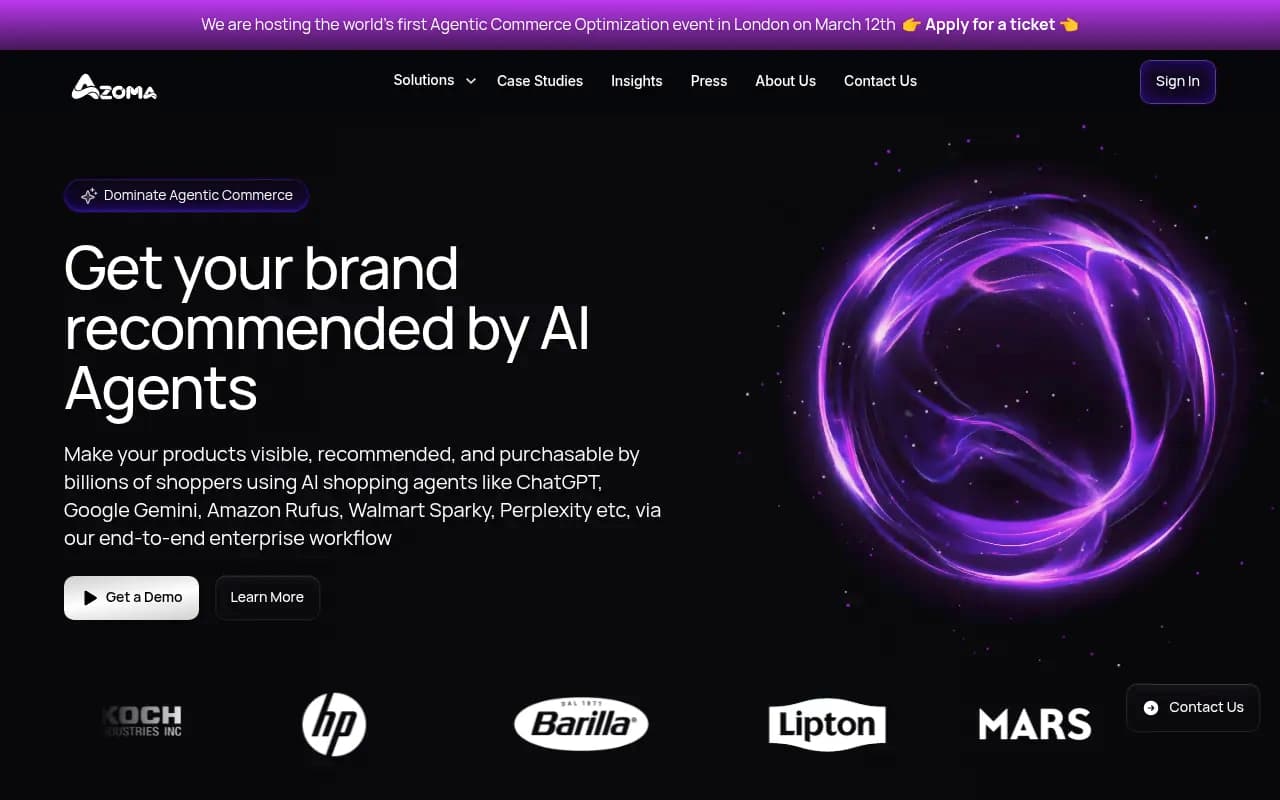
Azoma is an Agentic Commerce Optimization platform designed for consumer brands and retailers. It monitors product visibility across AI shopping agents -- ChatGPT Shopping, Amazon Rufus, Walmart Sparky, Google Gemini shopping features, and Perplexity commerce. The platform generates optimized product listing copy at scale and tracks how AI agents recommend your products to shoppers.
Azoma's focus is narrow and deep: getting your products discovered and recommended when someone asks an AI shopping agent for purchase advice. Clients include Mars, HP, Zappos, eBay, and Canadian Tire. Pricing is enterprise-only with custom quotes based on SKU count and markets covered.
Side-by-side comparison
| Feature | Promptwatch | Azoma |
|---|---|---|
| Primary use case | Brand visibility tracking, content optimization, AI SEO | Product discovery optimization for AI shopping agents |
| Target audience | Brands, agencies, marketing teams, SEO teams | E-commerce brands, retailers, CPG companies |
| AI platforms monitored | 10+ models: ChatGPT, Claude, Perplexity, Gemini, Copilot, Grok, DeepSeek, Mistral, Meta AI, Google AI Overviews | AI shopping platforms: ChatGPT Shopping, Amazon Rufus, Walmart Sparky, Google Gemini shopping, Perplexity |
| Content generation | ✓ AI writing agent for articles, listicles, comparisons | ✓ Product listing copy optimization |
| Pricing transparency | ✓ Public pricing: $99-$579/mo | ✗ Enterprise custom quotes only |
| Free trial | ✓ 7-day trial | ✗ No trial |
| Crawler logs | ✓ Real-time AI crawler tracking | ✗ Not mentioned |
| Traffic attribution | ✓ Code snippet, GSC integration, server logs | Limited visibility tracking |
| Prompt intelligence | ✓ Volume estimates, difficulty scores, query fan-outs | Product-level query tracking |
| Reddit/YouTube tracking | ✓ Surface discussions influencing AI recommendations | ✗ Not mentioned |
| Citation analysis | ✓ 880M+ citations analyzed | Product recommendation tracking |
| Multi-language support | ✓ Any language, any region, custom personas | Enterprise multi-market support |
| API access | ✓ Full API + Looker Studio integration | Enterprise API likely available |
| Ideal for | Brand visibility, content marketing, AI SEO | E-commerce product optimization |
Platform coverage and monitoring
Promptwatch monitors 10 AI models across the board: ChatGPT (OpenAI), Claude (Anthropic), Perplexity, Google Gemini, Google AI Overviews, Google AI Mode, Microsoft Copilot, Grok (xAI), DeepSeek, Mistral, and Meta AI. This wide net captures how your brand appears in general AI search -- when someone asks "What's the best CRM for startups?" or "Who are the top marketing agencies in Amsterdam?"
Azoma takes a different approach. It focuses exclusively on AI shopping agents -- the platforms where users ask for product recommendations and make purchases. That means ChatGPT Shopping (the shopping carousel in ChatGPT), Amazon Rufus (Amazon's AI shopping assistant), Walmart Sparky, Google Gemini's shopping features, and Perplexity's commerce integrations. If someone asks "What's the best running shoe for flat feet?" or "Show me affordable noise-canceling headphones," Azoma tracks whether your products show up.
The coverage difference reflects the use case difference. Promptwatch answers "How visible is my brand in AI search overall?" Azoma answers "Are AI shopping agents recommending my products when people are ready to buy?"
For brands that sell products, both types of visibility matter. General AI search drives awareness and consideration. AI shopping agents drive conversions. But most companies will prioritize one or the other based on their business model.
Content creation and optimization
Promptwatch includes an AI writing agent that generates articles, listicles, and comparison pages based on real citation data. The system analyzes 880M+ citations to understand what content AI models prefer, then creates articles optimized to get cited. You can target specific prompts, personas, and competitor gaps. The content isn't generic SEO filler -- it's engineered around the questions AI models are answering and the sources they're already citing.
This ties directly into Promptwatch's Answer Gap Analysis feature. The platform shows you which prompts competitors rank for but you don't, identifies the missing topics and angles on your site, then helps you create that content. It's a closed loop: gap identification → content creation → visibility tracking.
Azoma's content generation focuses on product listings. The platform generates optimized product titles, descriptions, and attributes at scale -- copy designed to match how AI shopping agents parse and recommend products. If you have 500 SKUs and need each one optimized for AI agent discovery, Azoma automates that process.
The content creation approaches don't overlap. Promptwatch creates editorial content (blog posts, guides, comparisons) to improve brand visibility in AI search. Azoma optimizes transactional product data to improve product recommendations in AI shopping contexts. You could theoretically use both -- Promptwatch for top-of-funnel content, Azoma for bottom-of-funnel product optimization.
Tracking and analytics depth
Promptwatch offers page-level citation tracking. You see exactly which pages on your site AI models are citing, how often, and in response to which prompts. The platform also tracks AI crawler activity in real time -- which pages ChatGPT's crawler, Claude's crawler, and Perplexity's crawler are reading, how often they return, and any errors they encounter. This crawler log data helps you diagnose indexing issues before they hurt your visibility.
Traffic attribution is another Promptwatch strength. You can connect visibility to actual revenue using a code snippet, Google Search Console integration, or server log analysis. This closes the loop from "AI mentioned us" to "that mention drove X visitors and Y conversions."
Promptwatch also surfaces Reddit discussions and YouTube videos that influence AI recommendations -- channels most competitors ignore. If a Reddit thread about your product category is heavily cited by AI models, you see it and can engage.
Azoma's analytics focus on product-level visibility: which products AI shopping agents recommend, in what order, for which queries. The platform tracks recommendation frequency, positioning (are you first or fifth in the list?), and purchase funnel progression. This is valuable for e-commerce teams optimizing product assortment and merchandising for AI channels.
What Azoma doesn't offer (based on available information): crawler logs, Reddit/YouTube tracking, or detailed traffic attribution outside the shopping agent context. The analytics are narrower but deeper in the product recommendation space.
Pricing and accessibility
Promptwatch has transparent public pricing:
| Plan | Price | Sites | Prompts | Articles/mo | Key features |
|---|---|---|---|---|---|
| Essential | $99/mo | 1 | 50 | 5 | Basic tracking, content generation |
| Professional | $249/mo | 2 | 150 | 15 | Crawler logs, state/city tracking, priority support |
| Business | $579/mo | 5 | 350 | 30 | Multi-site, advanced analytics, API access |
| Agency/Enterprise | Custom | Custom | Custom | Custom | White-label, dedicated support, custom integrations |
All plans include a 7-day free trial. Annual billing saves 25%. You can start small and scale up as your needs grow.
Azoma uses enterprise-only pricing with no published tiers. Quotes are based on SKU count, number of AI platforms monitored, and markets covered. There's no free trial. This pricing model makes sense for large retailers and CPG brands with thousands of SKUs, but it's a barrier for smaller e-commerce companies or brands that want to test the platform before committing.
For a mid-sized brand exploring AI visibility, Promptwatch's $99/mo entry point is accessible. For a Fortune 500 retailer with 10,000 SKUs across 15 countries, Azoma's custom enterprise pricing is appropriate. The pricing models reflect the target customers.
Integration and workflow
Promptwatch integrates with Google Search Console for traffic attribution, offers a full API for custom workflows, and connects to Looker Studio for custom reporting. The platform is designed to fit into existing marketing and SEO workflows -- you can pull data into your BI tools, trigger alerts based on visibility changes, or build custom dashboards.
The AI writing agent integrates directly into the content creation workflow. You identify a gap, generate an article, publish it to your CMS, then track whether AI models start citing it. Some users export the content and edit it before publishing. Others publish directly and iterate based on performance.
Azoma's integrations are less documented publicly, but as an enterprise platform it likely connects to product information management (PIM) systems, e-commerce platforms, and data warehouses. The workflow is: sync your product catalog → Azoma optimizes listings → push optimized data back to your e-commerce platform and marketplaces → track AI agent recommendations.
For agencies managing multiple clients, Promptwatch's multi-site plans and white-label options are a better fit. For retailers with complex product data pipelines, Azoma's enterprise integrations handle the scale.
Prompt intelligence and competitive analysis
Promptwatch provides prompt volume estimates, difficulty scores, and query fan-outs. Volume estimates help you prioritize high-traffic prompts. Difficulty scores show how hard it is to rank (based on how many strong competitors already appear). Query fan-outs reveal how one prompt branches into related sub-queries -- useful for content planning.
The Answer Gap Analysis feature compares your visibility vs competitors across thousands of prompts. You see exactly which prompts competitors rank for but you don't, and what content you're missing. This competitive intelligence drives the content creation strategy.
Promptwatch also offers competitor heatmaps that visualize who's winning for each prompt across different AI models. You might dominate in ChatGPT but lose to a competitor in Perplexity. The heatmap shows where to focus optimization efforts.
Azoma's competitive analysis focuses on product recommendations. Which competing products AI shopping agents recommend alongside yours, how often competitors appear first, and what attributes (price, features, reviews) drive recommendations. This helps you adjust product positioning, pricing, and merchandising for AI shopping contexts.
Both platforms offer competitive intelligence, but in different domains. Promptwatch answers "Who's winning in AI search for our target topics?" Azoma answers "Which competing products are AI shopping agents recommending instead of ours?"
Use case fit
Promptwatch fits:
- Brands tracking overall AI search visibility (not just products)
- Content marketing teams creating SEO-optimized content for AI search
- Agencies managing AI visibility for multiple clients
- SaaS companies, service businesses, publishers, and any brand where content drives discovery
- Teams that want to understand and optimize how AI models cite their website
Azoma fits:
- E-commerce brands and retailers selling physical products
- CPG companies with large product catalogs
- Marketplaces and multi-brand retailers
- Brands focused specifically on AI shopping agent optimization (ChatGPT Shopping, Rufus, etc.)
- Enterprise teams with thousands of SKUs needing optimization at scale
The platforms don't directly compete for most use cases. A SaaS company tracking brand mentions in ChatGPT has no use for Azoma. A CPG brand optimizing 5,000 product listings for Amazon Rufus has limited use for Promptwatch's editorial content generation.
The overlap is small: e-commerce brands that want both general brand visibility (Promptwatch) and product-level shopping optimization (Azoma). For those brands, the platforms are complementary.
Pros and cons
Promptwatch pros
- Transparent pricing with accessible entry point ($99/mo)
- 7-day free trial to test before committing
- Wide AI model coverage (10+ platforms)
- AI content generation tied directly to gap analysis
- Real-time crawler logs and indexing diagnostics
- Reddit and YouTube tracking for social proof signals
- Traffic attribution connecting visibility to revenue
- Multi-language and multi-region support
- API and Looker Studio integration for custom workflows
Promptwatch cons
- Not purpose-built for e-commerce product optimization
- Content generation is editorial-focused, not product listing copy
- Smaller teams may not need all the features in higher tiers
Azoma pros
- Deep specialization in AI shopping agent optimization
- Product-level tracking and recommendations
- Scales to thousands of SKUs across multiple markets
- Optimizes product listings specifically for AI agent discovery
- Enterprise-grade for large retailers and CPG brands
- Covers key AI shopping platforms (Rufus, ChatGPT Shopping, Sparky)
Azoma cons
- No transparent pricing -- enterprise custom quotes only
- No free trial or low-cost entry tier
- Narrow focus (AI shopping only, not general brand visibility)
- Less documented integrations and features publicly
- Not suitable for service businesses, SaaS, or non-e-commerce brands
Who should pick which platform
Pick Promptwatch if you:
- Want to track how your brand appears in AI search across all major models
- Need content gap analysis and AI-optimized content generation
- Are a SaaS company, service business, agency, publisher, or any non-e-commerce brand
- Want transparent pricing and the ability to start small
- Need crawler logs and indexing diagnostics
- Care about Reddit and YouTube discussions influencing AI recommendations
- Want to connect AI visibility to actual traffic and revenue
Pick Azoma if you:
- Are an e-commerce brand or retailer with a large product catalog
- Focus specifically on AI shopping agent optimization (ChatGPT Shopping, Rufus, Sparky)
- Need product listing copy generated at scale
- Have an enterprise budget and thousands of SKUs to optimize
- Prioritize product-level recommendations over general brand visibility
- Operate in multiple markets and need multi-region product optimization
Pick both if you:
- Are a large e-commerce brand that wants comprehensive AI visibility (Promptwatch for brand and content, Azoma for product listings)
- Have the budget for enterprise tools and want to cover all bases
- Need editorial content for top-of-funnel awareness and product optimization for bottom-of-funnel conversions
Final verdict
Promptwatch and Azoma solve different problems for different customers. Promptwatch is the better choice for most brands -- it covers general AI search visibility, offers transparent pricing, includes a free trial, and helps you create content that AI models want to cite. The action loop (find gaps → create content → track results) makes it an optimization platform, not just a monitoring dashboard.
Azoma is the specialist pick for e-commerce brands and retailers focused exclusively on AI shopping agent optimization. If your business is selling products and you need to optimize thousands of SKUs for ChatGPT Shopping, Amazon Rufus, and Walmart Sparky, Azoma's deep specialization is worth the enterprise investment.
For most readers of this comparison, Promptwatch is the more practical choice. It's accessible, transparent, and covers the broader AI search landscape. Azoma is the right tool for a narrower set of enterprise e-commerce use cases.
If you're tracking brand visibility and creating content for AI search, start with Promptwatch's 7-day trial. If you're optimizing a large product catalog for AI shopping agents, request an Azoma demo and custom quote.