Key Takeaways
- LLM Pulse is 38% cheaper at entry level: €49/mo for 40 prompts vs Omnia's €79/mo for 25 prompts -- that's 60% more prompts for less money
- Omnia has stronger team collaboration features: Better export options, share-of-voice dashboards, and multi-user workflows make it a better fit for marketing teams
- LLM Pulse offers deeper prompt discovery: Built-in prompt research tools help you find what questions to track; Omnia assumes you already know
- Omnia provides actionable insights: The platform translates tracking data into a step-by-step roadmap (content creation, technical SEO, placement strategy); LLM Pulse focuses on raw analytics
- At 100 prompts, LLM Pulse saves you €180/month (€2,160/year) compared to Omnia -- significant for agencies or brands tracking multiple topics
- Both track the same 10+ AI models: ChatGPT, Perplexity, Gemini, Google AI Mode/Overviews, DeepSeek, Grok, Claude, Copilot, Meta AI
Overview
Omnia
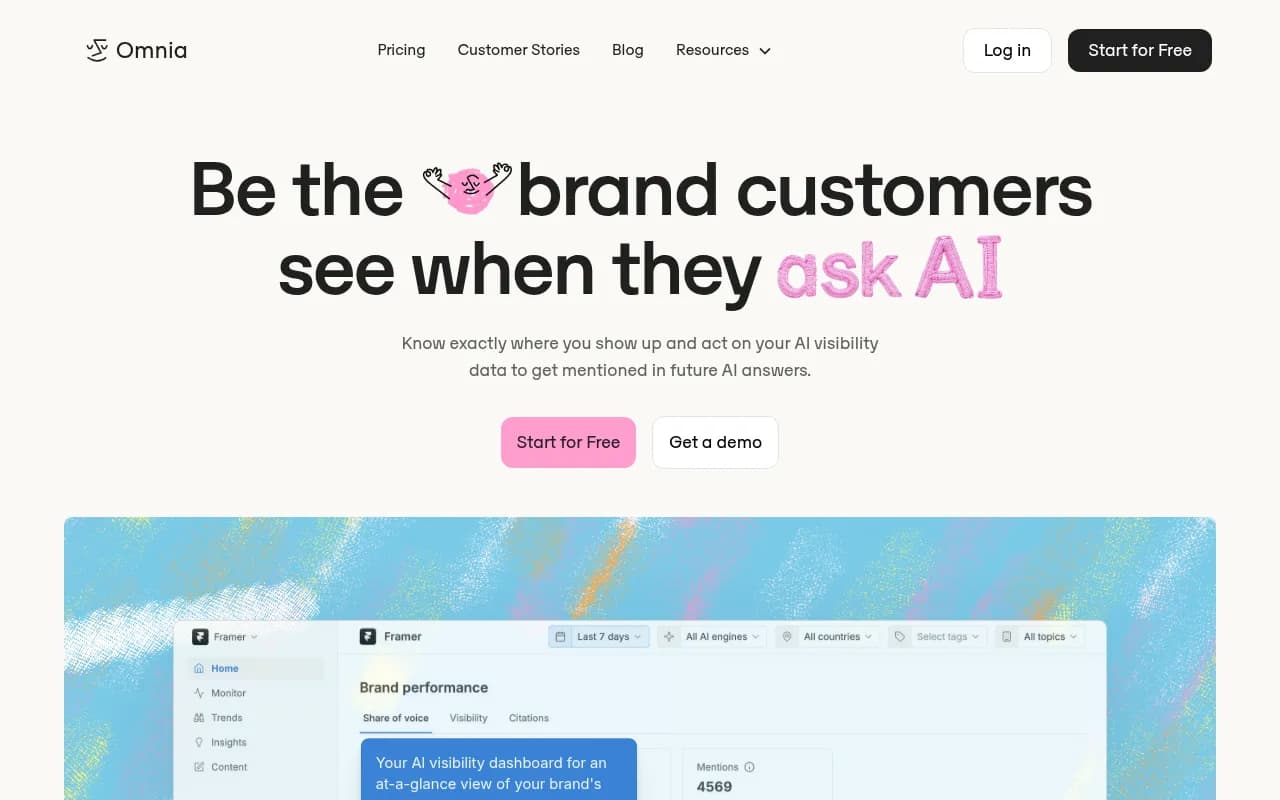
Omnia positions itself as a platform built for SEO and marketing experts who need to monitor citations and mentions across AI engines. The focus is on share-of-voice analytics and competitive benchmarking -- understanding where your brand stands relative to competitors in AI search results. Omnia's differentiator is the "Act on your data" layer: it doesn't just show you tracking metrics, it generates a visibility roadmap with specific actions (content gaps to fill, technical SEO fixes, placement opportunities).
Trusted by mid-market brands like Exoticca, Ironhack, and Pleo. Pricing starts at €79/mo with a free trial available.
LLM Pulse
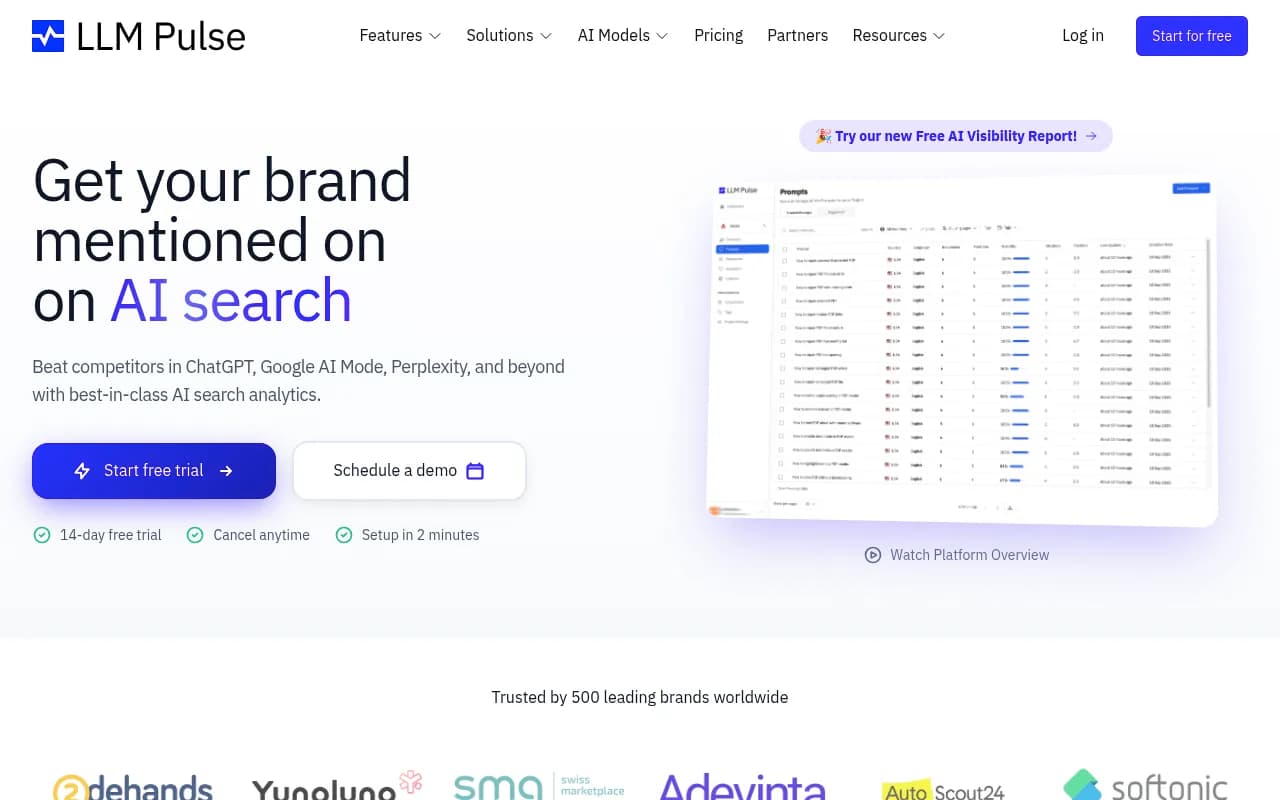
LLM Pulse is a straightforward AI visibility tracker focused on giving you detailed analytics across major language models. The platform emphasizes three steps: track key prompts weekly, analyze visibility scores and citation rates, optimize based on AI-powered content recommendations. LLM Pulse's strength is its data depth -- you get granular response tracking, citation analysis, and model-by-model comparisons at a lower price point than most competitors.
Used by 500+ brands worldwide. Pricing starts at €49/mo with a 14-day free trial and 17% discount on annual billing.
Side-by-Side Comparison
| Feature | Omnia | LLM Pulse |
|---|---|---|
| Starting price | €79/mo (25 prompts) | €49/mo (40 prompts) |
| Mid-tier price | Custom pricing | €99/mo (100 prompts) |
| Free trial | Yes | 14 days |
| AI models tracked | 10+ (ChatGPT, Perplexity, Gemini, AI Mode, Overviews, DeepSeek, Grok, Claude, Copilot, Meta AI) | 10+ (same models) |
| Prompt discovery | Limited | Built-in research tools |
| Citation analysis | ✓ | ✓ |
| Share of voice | ✓ Strong | ✓ Basic |
| Competitor tracking | ✓ | ✓ |
| Actionable roadmap | ✓ Step-by-step | Content recommendations only |
| Export/reporting | Strong (multiple formats) | Standard |
| Multi-user support | Yes | Yes |
| Setup time | ~5 minutes | ~2 minutes |
| Annual discount | Not specified | 17% |
| Target audience | Marketing teams, SEO experts | Budget-conscious brands, agencies |
Pricing comparison
This is where the two platforms diverge sharply.
| Plan | Omnia | LLM Pulse |
|---|---|---|
| Entry | €79/mo (25 prompts) | €49/mo (40 prompts) |
| Growth | Custom pricing | €99/mo (100 prompts) |
| Scale | Custom pricing | €299/mo (300 prompts) |
| Enterprise | Custom | Custom |
| Free trial | Yes | 14 days |
| Annual discount | Not disclosed | 17% |
Cost per prompt at entry level: Omnia = €3.16/prompt, LLM Pulse = €1.23/prompt. That's a 61% difference.
At 100 prompts, you're looking at €180/mo savings with LLM Pulse (€2,160 annually). For agencies tracking multiple clients or brands monitoring a broad topic landscape, that adds up fast.
Omnia doesn't publish mid-tier or enterprise pricing, which suggests they're targeting larger deals and prefer custom quotes. LLM Pulse's transparent pricing makes it easier to budget and scale predictably.
User interface and workflow
Omnia's interface leans into visual dashboards. The share-of-voice charts and competitor heatmaps are front and center -- you see your position relative to competitors immediately. The "Act on your data" tab translates metrics into a prioritized action list: "Create content about X", "Fix technical issue Y", "Get placement on Z". This is helpful if you want the platform to tell you what to do next, not just show you numbers.
LLM Pulse keeps it simpler. The dashboard shows prompt tracking results, visibility scores, citation rates, and model-by-model breakdowns. It's data-first -- you get the raw information and draw your own conclusions. The "Optimize" step provides content recommendations, but it's less prescriptive than Omnia's roadmap approach.
Setup is faster on LLM Pulse (2 minutes vs 5 minutes), though both are quick. LLM Pulse's onboarding assumes you know what prompts to track or will use their discovery tools. Omnia assumes you're coming in with a list of competitors and topics already defined.
Prompt tracking and discovery
This is a meaningful difference.
LLM Pulse includes prompt discovery tools that help you find what questions people are actually asking AI about your industry or product. You don't need to guess -- the platform surfaces real queries and shows you which ones are worth tracking. This is valuable if you're starting from scratch or expanding into a new category.
Omnia focuses on tracking the prompts you already know matter. The platform shows you "real questions customers are asking" but doesn't emphasize discovery as a core feature. You're expected to define your monitoring list upfront, then Omnia tracks and benchmarks those prompts over time.
If you're unsure what to track, LLM Pulse has the edge. If you already know your key prompts and want deeper competitive analysis, Omnia's share-of-voice features are stronger.
Citation and source analysis
Both platforms track which sources AI models cite when responding to prompts.
Omnia shows you what citations AI engines pull information from and lets you benchmark against competitors. The focus is on understanding who's winning the citation game in your space -- are competitors getting cited more often? Are third-party review sites dominating?
LLM Pulse provides detailed citation analysis with a focus on finding out which sources AI trusts. You see if your content gets cited or if others are shaping the narrative. The platform breaks this down by model, so you can see that ChatGPT cites your blog but Perplexity doesn't.
Both are solid here. Omnia's presentation is more visual (charts and heatmaps), LLM Pulse's is more granular (response-level detail).
Actionable insights and optimization
This is Omnia's standout feature.
Omnia translates your tracking data into a step-by-step AI visibility roadmap. You get specific actions: content creation tasks ("Write an article about X"), technical SEO fixes ("Add structured data to Y page"), content placement opportunities ("Get featured on Z publication"). Each action is mapped to fill your brand's real gaps based on what AI models are missing.
LLM Pulse provides AI-powered content recommendations but stops short of a full roadmap. You see suggestions for improving how you appear in LLM responses, but it's less structured. You're expected to take the data and build your own action plan.
If you want the platform to guide your strategy, Omnia is the better choice. If you prefer raw data and want to make your own decisions, LLM Pulse gives you the flexibility.
Reporting and collaboration
Omnia has stronger export and reporting features. Multiple export formats, share-of-voice dashboards that are easy to present to stakeholders, and multi-user workflows designed for marketing teams. If you're reporting to executives or clients, Omnia's visuals are more polished.
LLM Pulse offers standard reporting -- you can export data and share dashboards, but it's less focused on presentation. The platform is built for practitioners who want to dig into the data themselves, not necessarily for teams that need to create client-facing reports.
For agencies or in-house teams with multiple stakeholders, Omnia's collaboration features are worth the premium.
AI model coverage
Both platforms track the same 10+ AI models: ChatGPT, Perplexity, Gemini, Google AI Mode, Google AI Overviews, DeepSeek, Grok, Claude, Copilot, and Meta AI. No meaningful difference here -- you're covered across all major LLMs regardless of which platform you choose.
LLM Pulse labels some models (DeepSeek, Grok, Claude, Copilot, Meta AI) as "Enterprise" tier, suggesting they're only available on higher plans. Omnia doesn't specify tier restrictions, but given their custom pricing model, it's likely similar.
Pros and cons
Omnia pros
- Actionable roadmap that tells you exactly what to do next
- Strong share-of-voice and competitive benchmarking features
- Better export and reporting options for teams
- Polished visual dashboards for stakeholder presentations
- Multi-user workflows designed for marketing teams
Omnia cons
- 61% more expensive per prompt at entry level
- Custom pricing for mid-tier and enterprise makes budgeting harder
- Less emphasis on prompt discovery -- assumes you know what to track
- Overkill if you just want raw tracking data without the roadmap layer
LLM Pulse pros
- 38% cheaper at entry level with 60% more prompts included
- Transparent pricing across all tiers makes scaling predictable
- Built-in prompt discovery tools help you find what to track
- Granular response-level data for deep analysis
- Fast setup (2 minutes) and straightforward interface
- 17% annual discount available
LLM Pulse cons
- Less prescriptive -- you get data but need to build your own action plan
- Weaker share-of-voice visualization compared to Omnia
- Basic reporting features, less polished for client presentations
- Some AI models restricted to Enterprise tier
Who should pick which tool
Choose Omnia if:
- You're a marketing team that wants a platform to guide your AI visibility strategy, not just track it
- Share-of-voice and competitive benchmarking are top priorities
- You need polished dashboards and reports for executives or clients
- Budget isn't the primary constraint and you value the roadmap layer
- You already know what prompts to track and want deeper competitive analysis
Choose LLM Pulse if:
- You're budget-conscious and need to track a high volume of prompts affordably
- You want prompt discovery tools to help you figure out what to monitor
- You prefer raw data and want to build your own optimization strategy
- You're an agency tracking multiple clients and need predictable per-prompt costs
- Fast setup and a straightforward interface matter more than visual polish
If you're also looking to go beyond monitoring and actually optimize your content for AI search visibility, Promptwatch takes a different approach -- it combines tracking with content gap analysis and an AI writing agent that generates articles engineered to get cited by ChatGPT, Perplexity, and other models. Worth exploring if you want to close the loop from tracking to action.

Final verdict
LLM Pulse wins on cost efficiency and data depth. If you're tracking 100+ prompts or running an agency with multiple clients, the €180/mo savings (€2,160/year) is hard to ignore. The prompt discovery tools and granular analytics make it a strong choice for practitioners who want to dig into the data themselves.
Omnia wins on actionability and team collaboration. The step-by-step roadmap, polished share-of-voice dashboards, and stronger reporting features justify the premium if you're a marketing team that wants the platform to guide your strategy. It's the better fit for mid-market brands with budget flexibility and a need for stakeholder-friendly presentations.
For most users, LLM Pulse delivers better value. The price difference is significant, the feature set is comprehensive, and the transparent pricing makes it easy to scale. Omnia is the right choice if you specifically need the roadmap layer and team collaboration features -- but for straightforward AI visibility tracking, LLM Pulse does the job at a fraction of the cost.