Key Takeaways
- Otterly.AI is significantly cheaper -- $29/mo gets you started vs Omnia's custom pricing that typically runs higher
- Omnia includes an AI visibility roadmap feature that translates tracking data into actionable steps; Otterly.AI focuses purely on monitoring
- Both track the same 6 core AI engines (ChatGPT, Perplexity, Google AI Overviews, AI Mode, Gemini, Copilot)
- Otterly.AI offers a GEO audit tool analyzing 25+ on-page factors; Omnia's audit capabilities are less detailed
- Omnia's interface emphasizes share of voice analytics and competitive benchmarking; Otterly.AI leans into keyword research and citation tracking
- Neither platform offers content generation, crawler log analysis, or Reddit/YouTube tracking -- they're monitoring-only tools
Overview
Otterly.AI

Otterly.AI positions itself as the affordable entry point into AI search monitoring. The platform tracks brand mentions and website citations across six AI engines, with a focus on keyword research and basic GEO auditing. The pricing starts at $29/mo for 15 prompts, making it one of the cheapest options in the space. The interface is straightforward -- you set up prompts, the tool runs them across AI engines, and you see where your brand shows up. The GEO audit feature analyzes on-page factors to identify what's blocking citations, though it doesn't help you fix those issues beyond showing you the problems.
Omnia
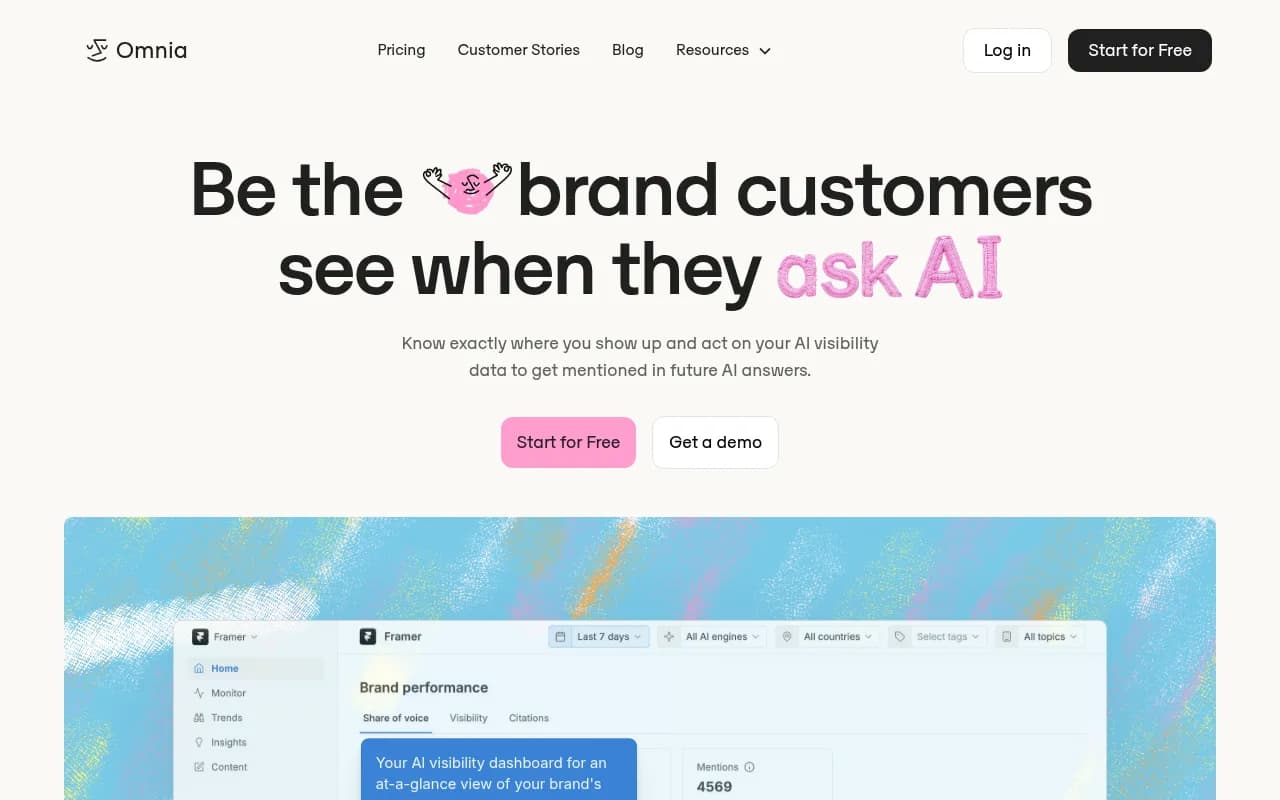
Omnia takes a more analytics-heavy approach. The platform tracks the same six AI engines but emphasizes share of voice metrics and competitive positioning. Where Otterly.AI shows you raw citation data, Omnia wraps it in dashboards that compare your visibility against competitors. The standout feature is the "AI visibility roadmap" -- the platform attempts to translate your tracking data into a prioritized action plan covering content creation, technical SEO, and content placement. Pricing isn't public, but based on user reports it typically runs higher than Otterly.AI's standard plan. The interface feels more polished, with better data visualization and filtering options.
Side-by-Side Comparison
| Feature | Otterly.AI | Omnia |
|---|---|---|
| Starting price | $29/mo (15 prompts) | Custom pricing (typically higher) |
| Free trial | 14 days | Yes (duration not specified) |
| AI engines tracked | 6 (ChatGPT, Perplexity, AI Overviews, AI Mode, Gemini, Copilot) | 6 (same engines) |
| Prompt limits | 15-100+ depending on plan | Not publicly specified |
| GEO audit | Yes (25+ factors) | Basic |
| Share of voice analytics | Basic | Advanced |
| Competitive benchmarking | Yes | Yes (more detailed) |
| Action roadmap | No | Yes |
| Keyword research | Yes | Yes |
| Citation tracking | Yes | Yes |
| Content generation | No | No |
| API access | Not mentioned | Not mentioned |
Pricing comparison
| Plan | Otterly.AI | Omnia |
|---|---|---|
| Entry tier | $29/mo (Lite: 15 prompts) | Custom pricing |
| Mid tier | $189/mo (Standard: 100 prompts) | Pro Plan (pricing on request) |
| Enterprise | Custom (Premium: unlimited prompts) | Custom |
| Free trial | 14 days | Yes |
| Annual discount | Not specified | Not specified |
Otterly.AI wins on transparency and affordability. You know exactly what you're paying and can start for $29/mo. Omnia's "pricing on request" model means you're likely paying more, though the exact amount depends on your needs and negotiation.
User interface and experience
Otterly.AI's interface is functional but basic. The dashboard shows your tracked prompts, which AI engines mentioned your brand, and which URLs got cited. Navigation is straightforward -- prompts, results, audit tool. The design feels like an early-stage product that prioritizes getting data in front of you over making it pretty. Filtering and sorting options are limited. You can export data, but the reporting features are minimal.
Omnia's interface is noticeably more polished. The share of voice charts are easier to read, competitive comparisons are more visual, and the filtering options are more granular. You can slice data by AI engine, time period, competitor, and topic. The "insights" section attempts to surface patterns automatically, though the quality of these insights varies. The roadmap feature lives in its own section and presents action items in a prioritized list format. Overall, Omnia feels like a more mature product from a UX perspective.
Verdict: Omnia has the better interface, but Otterly.AI's simplicity might appeal to users who just want the data without extra layers.
AI engine coverage and tracking accuracy
Both platforms track the same six AI engines: ChatGPT, Perplexity, Google AI Overviews, Google AI Mode, Gemini, and Microsoft Copilot. Neither supports DeepSeek, Grok, Mistral, or Meta AI. The tracking methodology appears similar -- both run your prompts through each engine and parse the responses for brand mentions and citations.
Accuracy is hard to verify without running parallel tests, but user reports suggest both platforms occasionally miss mentions or misattribute citations. This is a common problem across all AI monitoring tools -- parsing unstructured AI responses is messy. Neither platform provides confidence scores or flags uncertain results.
One difference: Otterly.AI emphasizes "conversational keyword research" to help you discover what prompts people actually use. Omnia has keyword discovery too, but it's less prominent in the interface. Both let you add custom prompts, but neither provides prompt volume estimates or difficulty scores like more advanced platforms do.
Verdict: Functionally equivalent on engine coverage. Otterly.AI edges ahead slightly on keyword research emphasis.
GEO audit and optimization features
Otterly.AI's GEO audit tool analyzes 25+ on-page factors and shows you what's blocking citations. The audit covers basics like schema markup, content structure, entity clarity, and technical SEO elements. You get a score and a list of issues, but the tool doesn't help you fix them -- it just points out the problems. No content suggestions, no schema generators, no optimization workflows.
Omnia's audit capabilities are less detailed but more actionable. The platform doesn't break down 25 specific factors, but it does feed audit findings into the AI visibility roadmap. So instead of just seeing "your schema is incomplete," you get "add organization schema" as a prioritized action item with context about why it matters for your specific prompts. The roadmap also suggests content topics and placement strategies based on what competitors are doing.
Neither platform generates content for you or helps you implement fixes beyond showing you what needs work. If you want actual optimization tools -- content generation, schema builders, crawler log analysis -- you need a different platform. Tools like Promptwatch cover that angle by combining monitoring with content gap analysis and an AI writing agent that creates articles engineered to get cited.

Verdict: Otterly.AI has more detailed audits; Omnia translates findings into actionable steps better.
Share of voice and competitive analysis
Omnia is stronger here. The platform's core value proposition is understanding your competitive position in AI search. You can see your share of voice across all tracked prompts, compare yourself to specific competitors, and identify where competitors are winning. The visualizations make it easy to spot patterns -- which AI engines favor which brands, which topics you're losing on, which competitors are surging.
Otterly.AI has competitive tracking too, but it's more basic. You can see which brands get mentioned alongside yours and which URLs get cited, but the analytics are thinner. No dedicated share of voice charts, no trend analysis over time, no heatmaps showing where you're strong vs weak.
If your primary goal is understanding competitive dynamics and benchmarking your AI visibility against rivals, Omnia is the better choice. If you just want to know whether your brand is showing up and which pages are getting cited, Otterly.AI's simpler approach works fine.
Verdict: Omnia wins decisively on competitive analytics.
Keyword research and prompt discovery
Both platforms help you discover what prompts to track, but they approach it differently.
Otterly.AI emphasizes "conversational keyword research" -- finding the actual questions people ask AI engines about your industry or product. The tool surfaces related prompts and suggests variations, though it doesn't provide search volume estimates or difficulty scores. You're essentially building a prompt list based on relevance, not data-driven prioritization.
Omnia's keyword discovery is similar but less prominent in the product. The focus is more on tracking the prompts you already know matter rather than discovering new ones. The platform does show related questions and suggests prompt variations, but the feature feels secondary to the monitoring and analytics.
Neither platform comes close to what more advanced tools offer -- prompt volume estimates, difficulty scoring, query fan-outs showing how prompts branch into sub-queries. You're guessing at which prompts matter most.
Verdict: Otterly.AI puts more emphasis on keyword research, but both are limited compared to platforms with actual prompt intelligence.
Reporting and data export
Otterly.AI offers basic CSV exports and simple reports showing mention counts and citation URLs over time. No white-label reports, no automated email digests, no Looker Studio integration. You can pull the data out, but you're building your own reports.
Omnia's reporting is more developed. The platform generates visual reports you can share with stakeholders, and the interface makes it easier to create custom views for specific audiences. Still no white-label options or deep integrations, but the built-in reporting is more usable out of the box.
Neither platform has an API for custom integrations or automated workflows. If you need to pipe AI visibility data into your own systems, you're stuck with manual exports.
Verdict: Omnia has better built-in reporting; both lack API access.
What's missing from both platforms
Both Otterly.AI and Omnia are monitoring-only tools. They show you data but leave you stuck when it comes to actually improving your AI visibility. Here's what neither platform offers:
- Content generation: No AI writing tools to create articles optimized for AI citations
- Crawler log analysis: No visibility into which AI crawlers are hitting your site, how often, or what errors they encounter
- Reddit and YouTube tracking: No monitoring of discussions that influence AI recommendations
- Prompt intelligence: No volume estimates, difficulty scores, or query fan-outs
- Traffic attribution: No way to connect AI visibility to actual website traffic or revenue
- Multi-language support: Limited or no support for non-English prompts
- Advanced integrations: No API, no Google Search Console integration, no Looker Studio connectors
If you need these capabilities, you're looking at a different tier of platform. Promptwatch, for example, combines monitoring with content gap analysis, an AI writing agent, crawler logs, Reddit/YouTube insights, and traffic attribution. The action loop -- find gaps, generate content, track results -- is what separates optimization platforms from monitoring dashboards.
Pros and cons
Otterly.AI pros
- Cheapest entry point in the category ($29/mo)
- Transparent pricing with clear prompt limits
- Detailed GEO audit covering 25+ factors
- Strong emphasis on keyword research
- 14-day free trial
- Simple, no-frills interface
Otterly.AI cons
- Basic analytics and reporting
- Limited competitive benchmarking
- No action roadmap or optimization guidance
- Monitoring only -- no content generation or implementation tools
- Interface feels less polished than competitors
- No API or advanced integrations
Omnia pros
- Advanced share of voice analytics
- Better competitive benchmarking and visualizations
- AI visibility roadmap translates data into action items
- More polished interface and UX
- Better built-in reporting
- Strong focus on strategic insights
Omnia cons
- No transparent pricing -- custom quotes only
- Likely more expensive than Otterly.AI
- Less detailed GEO audit
- Still monitoring-only -- no content generation or optimization tools
- No API access
- Keyword research is less emphasized
Who should pick which tool
Pick Otterly.AI if:
- Budget is your primary constraint and $29-189/mo is your range
- You want transparent pricing without sales calls
- You need a detailed GEO audit to identify technical issues
- You're comfortable building your own reports and workflows
- You prefer simplicity over advanced analytics
- You're just starting with AI visibility tracking and want to test the waters
Pick Omnia if:
- You need strong competitive benchmarking and share of voice analytics
- You want a more polished interface and better data visualization
- The AI visibility roadmap feature appeals to you -- you want the platform to suggest next steps
- Budget is less of a concern and you're willing to pay for better analytics
- You're presenting data to stakeholders and need better built-in reporting
- You're already past the basics and want strategic insights, not just raw data
Pick neither if:
- You need content generation tools to create AI-optimized articles
- You want crawler log analysis to see which AI engines are indexing your site
- You need Reddit and YouTube tracking
- You want prompt volume estimates and difficulty scores
- You need traffic attribution to connect AI visibility to revenue
- You want an optimization platform, not just a monitoring dashboard
In that case, look at platforms like Promptwatch that combine monitoring with content gap analysis, AI writing tools, and optimization workflows.
Final verdict
Otterly.AI wins on price and transparency. If you're budget-conscious or just testing AI visibility tracking, the $29/mo entry point is hard to beat. The GEO audit is more detailed, and the keyword research emphasis helps you figure out what prompts matter.
Omnia wins on analytics and polish. The share of voice features, competitive benchmarking, and AI visibility roadmap make it the better choice if you're serious about understanding your position in AI search and want the platform to guide your next moves. The interface is more mature, and the reporting is more stakeholder-friendly.
But here's the reality: both are monitoring-only tools. They show you where you stand but don't help you climb higher. You see the gaps but have to figure out how to fill them yourself. For many teams, that's enough -- you just want visibility into a new channel. But if you're looking to actually optimize for AI search, you need a platform that closes the loop from tracking to content creation to results measurement. That's a different product category entirely.