Key Takeaways
- Mentions.so starts at $99/mo with a free tier and focuses on sentiment analysis and actionable recommendations -- Omnia requires custom pricing with no transparent entry point
- Omnia delivers stronger share of voice analytics and competitive benchmarking, while Mentions.so emphasizes daily insights and traffic attribution
- Both track the same core AI engines (ChatGPT, Claude, Perplexity, Gemini, Grok, DeepSeek, Meta AI), but Omnia adds a roadmap feature that maps tracking data to content gaps
- Mentions.so is better for small teams and solo marketers who want quick setup and clear next steps -- Omnia targets enterprise SEO teams who need deep competitive analysis
- Neither platform offers AI content generation or crawler log analysis -- if you need those capabilities alongside tracking, Promptwatch covers that angle with built-in content creation and indexing diagnostics
- Mentions.so wins on transparency and accessibility, Omnia wins on depth and strategic planning tools
Overview
Mentions.so
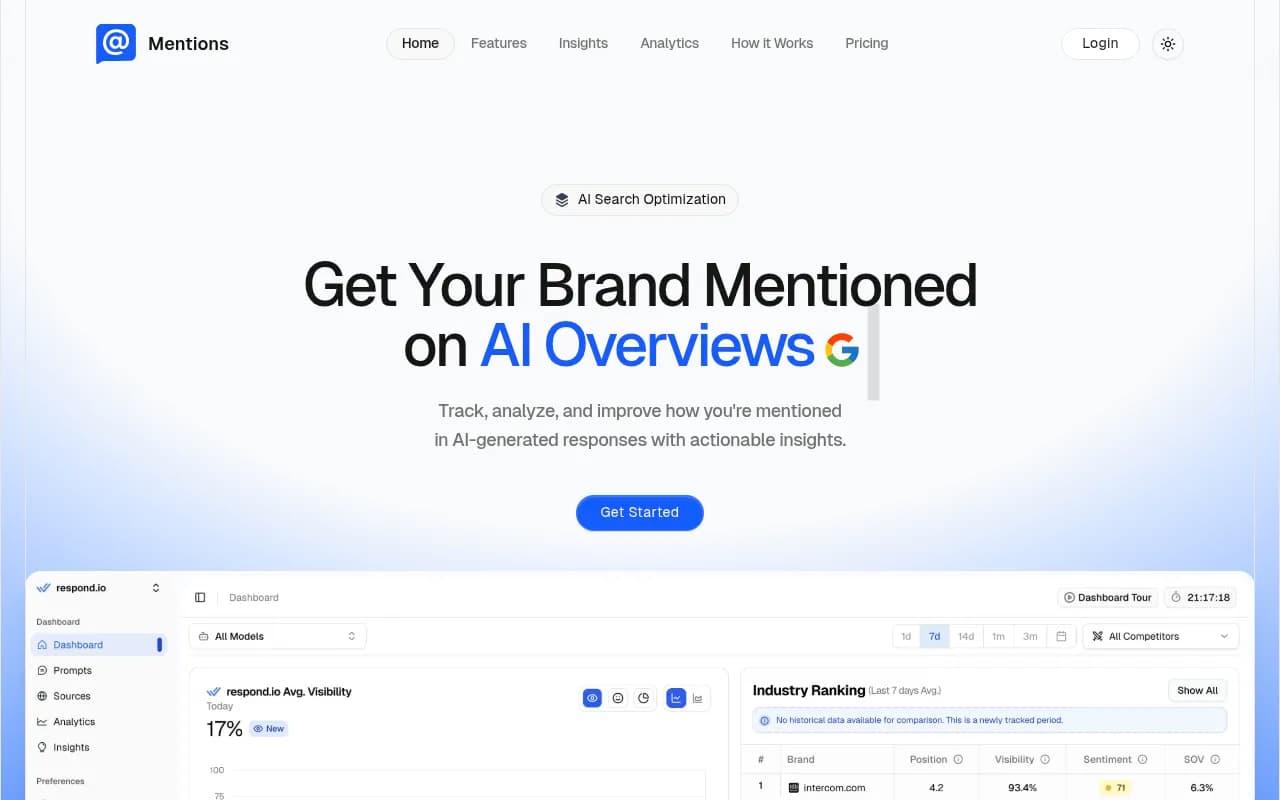
Mentions.so positions itself as the straightforward option for tracking how AI platforms talk about your brand. The pitch is simple: see what ChatGPT, Claude, and other models say about you, compare yourself to competitors, and get daily recommendations on how to improve. The platform emphasizes sentiment tracking -- not just whether you're mentioned, but how you're portrayed. It also includes traffic attribution, so you can connect AI visibility to actual site visits. Pricing is public and starts low, which makes it accessible for smaller teams testing the AI search waters.
Omnia
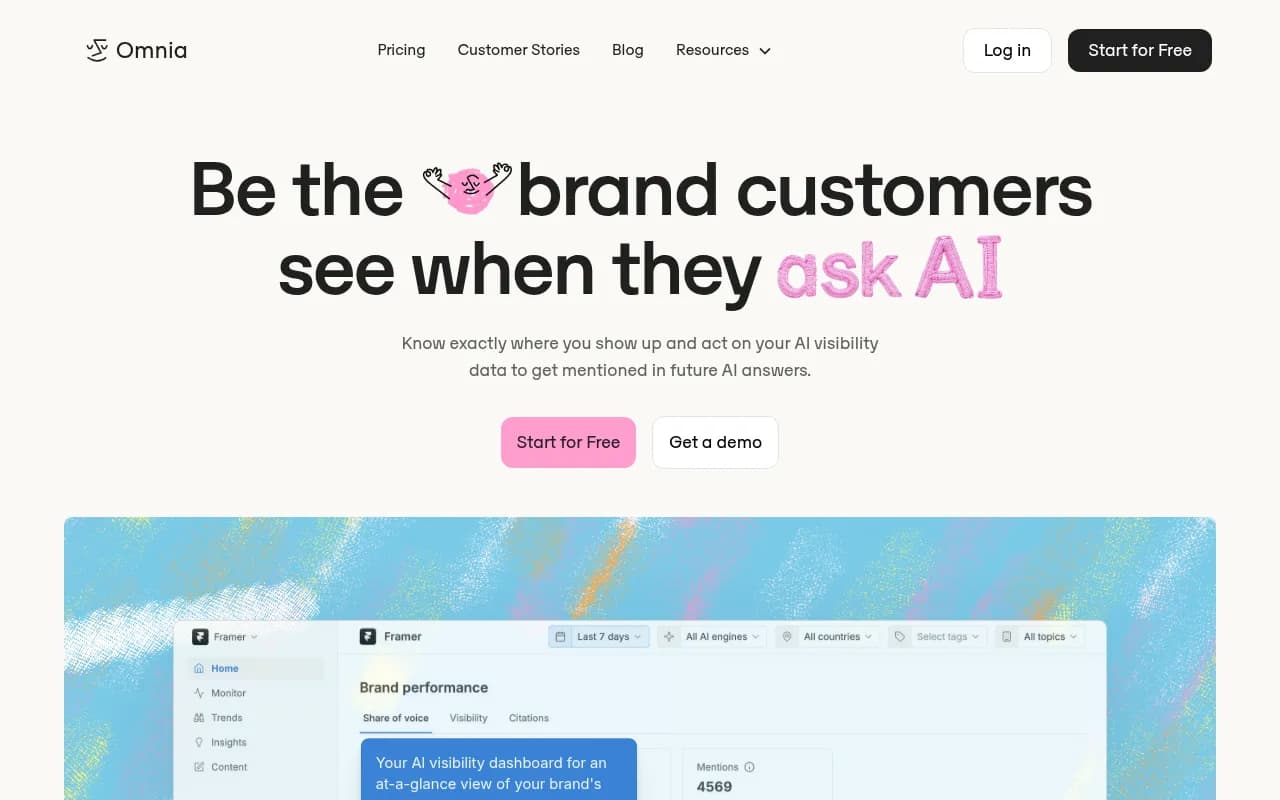
Omnia takes a more strategic approach. It's built for SEO and marketing teams who want share of voice metrics, competitive benchmarking, and a structured roadmap for improving AI visibility. The platform doesn't just show you where you rank -- it translates tracking data into a step-by-step plan covering content creation, technical SEO, and content placement. Omnia's interface leans heavier on analytics and competitor comparison. Pricing isn't listed publicly, which signals it's aimed at larger teams with budget flexibility. The platform includes prompt discovery tools to surface real customer questions, which helps you understand what queries to optimize for.
Side-by-Side Comparison
| Feature | Mentions.so | Omnia |
|---|---|---|
| Starting price | $99/mo (Starter) | Custom pricing (contact sales) |
| Free tier | Yes | Free trial only |
| AI engines tracked | ChatGPT, Claude, Perplexity, Gemini, Grok, DeepSeek, Meta AI, Google AI Overview | ChatGPT, Claude, Perplexity, Gemini, Copilot, Google AI Modes |
| Sentiment analysis | ✓ Core feature with positive/neutral/negative tracking | Limited (not emphasized) |
| Share of voice | Basic competitor comparison | ✓ Advanced share of voice analytics |
| Traffic attribution | ✓ Track AI-driven traffic | Not mentioned |
| Actionable insights | Daily recommendations | Strategic roadmap with content/SEO/placement steps |
| Prompt discovery | AI-suggested prompts | ✓ Discover real customer questions |
| Competitive benchmarking | Basic visibility comparison | ✓ Deep competitor analysis |
| Citation tracking | ✓ See sources AI pulls from | ✓ Monitor citation sources |
| Setup complexity | Low -- add domain, pick prompts, start tracking | Higher -- requires strategic planning |
| Target audience | Small teams, solo marketers, agencies | Enterprise SEO teams, large marketing departments |
| Pricing transparency | Full pricing page with tiers | Contact sales model |
Sentiment tracking and brand perception
Mentions.so makes sentiment analysis a centerpiece. The dashboard shows you whether AI responses about your brand skew positive, neutral, or negative over time. You get a visual breakdown by day and can drill into specific responses to see what triggered a sentiment shift. This matters because AI models don't just mention brands -- they editorialize. A neutral mention in a list is different from a glowing recommendation or a warning about limitations.
Omnia doesn't highlight sentiment as a core feature. The focus is on visibility metrics and share of voice, not emotional tone. If you care more about whether you're mentioned at all (and how often compared to competitors), Omnia delivers that. If you care about how you're portrayed when mentioned, Mentions.so gives you the tools.
Verdict: Mentions.so wins here. Sentiment tracking is a real differentiator and helps you catch reputation issues early.
Share of voice and competitive analysis
Omnia's strength is competitive benchmarking. The platform shows your share of voice across AI engines -- what percentage of relevant prompts mention you versus competitors. You can see which competitors dominate specific query types and where you have openings. The interface is built for this kind of strategic comparison.
Mentions.so includes competitor visibility tracking, but it's simpler. You can compare mention rates and see who ranks higher for specific prompts, but the analytics aren't as deep. The competitor comparison chart shows percentages, but Omnia's approach feels more like a war room for SEO strategists.
Verdict: Omnia takes this category. If competitive intelligence is your priority, Omnia's share of voice tools are more robust.
Actionable insights and recommendations
Mentions.so delivers daily performance reports with specific recommendations. The insights are tactical: "Keyword 'digital marketing' performance is up 12%" or "Mobile traffic saw a decrease of 5% this week." The platform tells you what's working and what's slipping, then suggests next steps. It's designed for teams that want to act quickly without deep analysis paralysis.
Omnia's insight engine is more strategic. The platform builds a roadmap based on your tracking data -- content gaps to fill, technical SEO fixes, and placement opportunities. It's less about daily tweaks and more about long-term positioning. The roadmap approach works well for teams with bandwidth to execute multi-step plans.
Verdict: Tie, but for different reasons. Mentions.so is better for fast iteration. Omnia is better for strategic planning.
Prompt discovery and query intelligence
Omnia includes a prompt discovery tool that surfaces real customer questions about your industry or product. This helps you understand what queries matter and which ones you should optimize for. The feature is useful for content planning -- you're not guessing what people ask AI, you're seeing actual prompts.
Mentions.so offers AI-suggested prompts when you set up tracking. You can accept or reject them, or add your own. It's less about discovery and more about getting you started quickly. The prompts are relevant, but the feature doesn't dig as deep into query trends.
Verdict: Omnia wins. The prompt discovery tool gives you a clearer picture of what customers are actually asking.
Traffic attribution and ROI tracking
Mentions.so includes traffic attribution -- you can see how much traffic comes from AI engines and which prompts drive visits. This is a big deal for proving ROI. If you're spending time optimizing for AI search, you need to know whether it's moving the needle on actual traffic and conversions.
Omnia doesn't emphasize traffic attribution in its marketing. The focus is on visibility and share of voice, not downstream traffic. That's a gap if you need to connect AI mentions to business outcomes.
Verdict: Mentions.so wins. Traffic attribution is essential for ROI tracking, and Omnia doesn't clearly offer it.
User interface and ease of use
Mentions.so has a cleaner, more approachable interface. The dashboard is visual with charts and sentiment breakdowns. Setup is fast: add your domain, pick or customize prompts, and you're tracking within minutes. The daily report format makes it easy to check in without getting lost in data.
Omnia's interface is more dense. It's built for people who want to dig into metrics and compare multiple dimensions. The learning curve is steeper, but the payoff is richer analytics. If you're comfortable with SEO tools like Ahrefs or Semrush, Omnia will feel familiar.
Verdict: Mentions.so is easier to use. Omnia requires more upfront investment to get value.
Pricing comparison
| Plan | Mentions.so | Omnia |
|---|---|---|
| Free tier | Yes (limited features) | Free trial only |
| Starter | $99/mo | Not disclosed |
| Mid-tier | $299/mo (Growth plan likely) | Not disclosed |
| Agency/Enterprise | $599/mo | Custom pricing |
| Annual discount | 16% off | Unknown |
| Pricing transparency | Full public pricing | Contact sales |
Mentions.so's pricing is straightforward. You know what you're paying before you sign up. The $99/mo entry point is accessible for small teams, and the $599/mo agency plan covers multiple brands. Annual billing saves 16%.
Omnia uses a contact-sales model. No public pricing means you're negotiating, which usually signals higher costs and enterprise focus. The free trial lets you test the platform, but you won't know the real cost until you talk to sales.
Verdict: Mentions.so wins on transparency and accessibility. Omnia's pricing model is a barrier for smaller teams.
Pros and cons
Mentions.so pros
- Public pricing with a low entry point ($99/mo)
- Free tier available for testing
- Strong sentiment analysis and daily insights
- Traffic attribution to prove ROI
- Fast setup and intuitive interface
- 16% discount on annual billing
Mentions.so cons
- Shallower competitive analytics compared to Omnia
- Prompt discovery is basic
- Less strategic depth for long-term planning
- No content generation or optimization tools
Omnia pros
- Advanced share of voice and competitive benchmarking
- Strategic roadmap feature maps tracking to action
- Prompt discovery surfaces real customer questions
- Built for enterprise SEO teams with complex needs
- Deep citation and source analysis
Omnia cons
- No public pricing (contact sales required)
- No free tier, only a trial
- Steeper learning curve
- Doesn't emphasize sentiment tracking
- No clear traffic attribution feature
- Overkill for small teams or solo marketers
Who should pick which tool
Pick Mentions.so if you:
- Run a small marketing team or work solo
- Want to start tracking AI visibility quickly without a big budget commitment
- Care about sentiment and how AI portrays your brand, not just mention frequency
- Need to prove ROI with traffic attribution
- Prefer transparent pricing and a low barrier to entry
- Want daily actionable insights without deep strategic planning
Pick Omnia if you:
- Lead an enterprise SEO or marketing team with budget flexibility
- Need deep competitive intelligence and share of voice metrics
- Want a strategic roadmap that connects tracking data to content and SEO actions
- Have the bandwidth to execute multi-step optimization plans
- Care more about market positioning than sentiment nuances
- Are comfortable with contact-sales pricing models
Consider Promptwatch if you:
- Need AI visibility tracking plus content generation and optimization tools
- Want to close the loop from tracking to action with built-in AI writing agents
- Care about crawler logs and indexing diagnostics (neither Mentions.so nor Omnia offers this)
- Need Reddit and YouTube tracking alongside AI engine monitoring

Final verdict
Mentions.so is the better choice for most teams. The combination of transparent pricing, sentiment tracking, traffic attribution, and fast setup makes it accessible and actionable. You can start tracking for $99/mo, see results quickly, and prove ROI without negotiating with sales.
Omnia is the right pick for enterprise teams that need strategic depth and competitive intelligence. The share of voice analytics and roadmap feature are powerful, but the lack of public pricing and higher complexity make it a harder sell for smaller teams. If you're running a large SEO operation and need to justify AI visibility investments with detailed competitive analysis, Omnia delivers.
For most marketers dipping into AI search optimization, Mentions.so gets you moving faster and cheaper. Omnia is the tool you graduate to when AI visibility becomes a core strategic pillar and you need enterprise-grade analytics to back it up.