Key Takeaways
- Omnia is a standalone AI visibility platform with actionable insights and a step-by-step roadmap feature; Ahrefs Brand Radar is an add-on to an existing Ahrefs subscription with fixed prompts and no content generation
- Omnia costs less as a standalone tool (free trial + paid plans) vs Ahrefs Brand Radar which requires a $129+/mo Ahrefs subscription PLUS an additional fee for Brand Radar access
- Omnia lets you discover and monitor custom prompts relevant to your business; Ahrefs Brand Radar uses a fixed set of prompts from their database with no customization
- Omnia provides a roadmap that translates tracking data into content creation, technical SEO, and placement recommendations; Ahrefs Brand Radar shows you the data but leaves you to figure out what to do with it
- Ahrefs Brand Radar benefits from integration with Ahrefs' massive web index and can capture long-tail queries at scale; Omnia focuses on actionable insights over sheer data volume
- If you're already an Ahrefs power user and want AI monitoring bolted onto your existing workflow, Brand Radar makes sense; if you want a purpose-built AI visibility platform with guidance on what to fix, Omnia is the better choice
Overview
Both Omnia and Ahrefs Brand Radar track how your brand shows up in AI search results -- ChatGPT, Perplexity, Google AI Overviews, Gemini, and others. They answer the same core question: when someone asks an AI engine about your industry or product, does your brand get mentioned?
But they take very different approaches to solving that problem.
Omnia
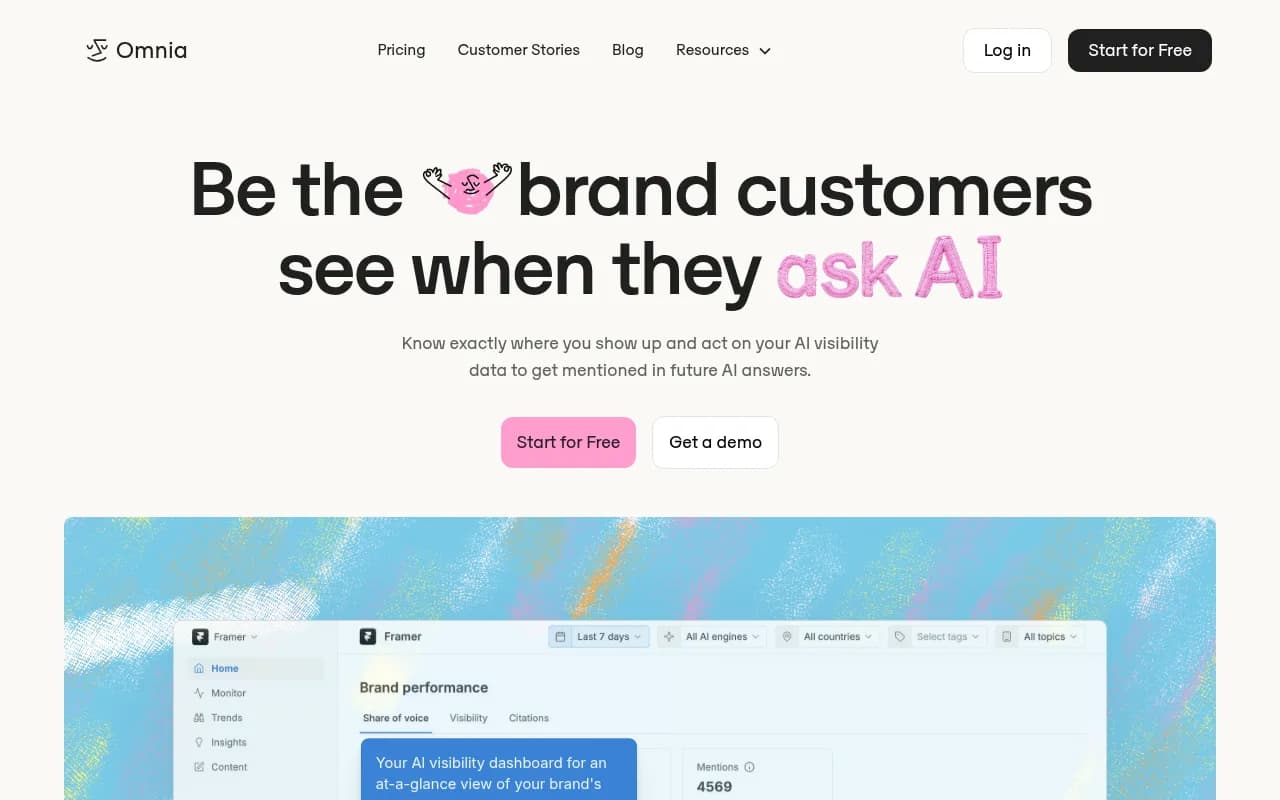
Omnia is a standalone AI visibility platform built specifically for SEO and marketing teams who want to understand and improve their presence in AI search. It tracks citations and mentions across the major AI engines, helps you discover what prompts matter for your business, and translates that data into a step-by-step roadmap for improving visibility. The platform focuses on turning monitoring data into action -- content creation, technical SEO fixes, and strategic content placement.
Omnia is used by brands like Exoticca, Ironhack, and Growth Hackers. It offers a free trial and paid plans with pricing available on request.
Ahrefs Brand Radar
Ahrefs Brand Radar is the AI visibility tracking feature inside the Ahrefs platform. It monitors brand mentions across Google AI Overviews, AI Mode, ChatGPT, Copilot, Gemini, and other AI surfaces. Brand Radar leverages Ahrefs' massive web index to track a huge volume of queries, including long-tail variations that smaller platforms might miss.
The catch: Brand Radar is not a standalone product. You need an active Ahrefs subscription ($129/mo minimum for Lite, up to $999/mo for Enterprise on annual billing) AND you pay an additional fee on top of that to access Brand Radar. It's positioned as an add-on for existing Ahrefs users who want AI monitoring integrated into their SEO workflow.
Side-by-side comparison
| Feature | Omnia | Ahrefs Brand Radar |
|---|---|---|
| Pricing | Free trial + paid plans (pricing on request) | Requires Ahrefs subscription ($129-$999/mo) + additional Brand Radar fee |
| Standalone tool | Yes | No -- requires Ahrefs subscription |
| AI engines tracked | ChatGPT, Perplexity, Google Gemini, Microsoft Copilot, Google AI Overviews | Google AI Overviews, AI Mode, ChatGPT, Copilot, Gemini |
| Custom prompt discovery | Yes -- discover real questions customers ask | No -- fixed prompts from Ahrefs database |
| Prompt customization | Yes -- monitor prompts relevant to your business | No -- limited to Ahrefs' predefined queries |
| Citation analysis | Yes -- see what sources AI engines pull from | Yes -- leverages Ahrefs web index |
| Competitor benchmarking | Yes -- share of voice vs competitors | Yes -- integrated with Ahrefs competitor data |
| Actionable insights | Yes -- step-by-step roadmap for content, SEO, placement | Limited -- shows data but no guided action plan |
| Content recommendations | Yes -- maps gaps to content creation tasks | No |
| Integration with SEO tools | Standalone platform | Deep integration with Ahrefs SEO suite |
| Long-tail query coverage | Standard coverage | Extensive -- benefits from Ahrefs' massive index |
| Free trial | Yes | No -- requires paid Ahrefs subscription |
| Target user | Marketing teams wanting AI-specific visibility platform | Existing Ahrefs users adding AI monitoring |
Pricing comparison
This is where the difference becomes stark.
| Plan | Omnia | Ahrefs Brand Radar |
|---|---|---|
| Entry point | Free trial, then paid plans (pricing on request) | $129/mo Lite subscription + Brand Radar add-on fee |
| Mid-tier | Pro plan available | $249/mo Standard + Brand Radar add-on fee |
| Enterprise | Custom pricing | $999/mo Enterprise + Brand Radar add-on fee |
| Annual discount | Likely available | Yes -- annual billing required for listed prices |
| Free option | Free trial | None |
Omnia's pricing is opaque (you have to request a quote), but it's positioned as a standalone tool. You're paying for AI visibility tracking and nothing else.
Ahrefs Brand Radar requires you to be an Ahrefs customer first. Even if you only want AI monitoring, you're paying for the full Ahrefs platform ($129/mo minimum) and then paying extra for Brand Radar on top of that. If you're already using Ahrefs for SEO, this makes sense. If you're not, you're paying for a lot of features you might not need just to access Brand Radar.
Prompt discovery and customization
This is the biggest functional difference.
Omnia lets you discover what prompts people are actually asking AI engines about your industry or product. You can monitor custom prompts that matter to your business. The platform surfaces real questions customers ask, so you're tracking queries that align with your specific market and use cases.
Ahrefs Brand Radar uses a fixed set of prompts from Ahrefs' database. You don't get to customize or add your own. Ahrefs decides what queries to track based on their data, and you monitor those. This works if Ahrefs' query set covers your niche well, but it's limiting if your business has specific angles or terminology that aren't in their predefined list.
The trade-off: Ahrefs tracks a massive volume of queries (including obscure long-tail variations) because they have the infrastructure to do it. Omnia gives you control over what you track but doesn't match Ahrefs' sheer scale.
Verdict: If you need to track specific, custom prompts relevant to your business, Omnia wins. If you want exhaustive coverage of every possible query variation and trust Ahrefs to pick the right ones, Brand Radar has the edge.
Citation and source analysis
Both platforms show you what sources AI engines cite when they mention (or don't mention) your brand.
Omnia provides citation tracking so you can see which pages, domains, and content types AI engines pull from. This helps you understand where to publish and what to optimize.
Ahrefs Brand Radar does the same, but with the added benefit of Ahrefs' web index. Ahrefs has crawled billions of pages, so when Brand Radar shows you a citation, you can click through to Ahrefs' full analysis of that page -- backlinks, traffic estimates, keyword rankings, etc. This integration is powerful if you're already using Ahrefs for SEO research.
Verdict: Ahrefs Brand Radar has deeper citation analysis thanks to integration with the Ahrefs platform. Omnia provides the essentials but doesn't match Ahrefs' data depth.
Actionable insights and roadmaps
This is where Omnia pulls ahead.
Omnia doesn't just show you where you're visible or invisible. It translates that data into a step-by-step roadmap. The platform tells you what content to create, what technical SEO issues to fix, and where to place content to improve AI visibility. It's designed to close the loop from monitoring to action.
Ahrefs Brand Radar shows you the data -- mentions, share of voice, competitor comparisons -- but it doesn't tell you what to do next. You're left to interpret the data and figure out your own action plan. For experienced SEOs who know how to act on insights, this is fine. For teams that want guidance, it's a gap.
Verdict: Omnia is built around taking action. Ahrefs Brand Radar is built around showing data. If you want a platform that helps you fix what's broken, Omnia is the better choice.
Integration with existing workflows
If you're already an Ahrefs user, Ahrefs Brand Radar integrates seamlessly into your existing workflow. You're already in the Ahrefs interface for keyword research, backlink analysis, and site audits. Adding AI visibility tracking to that same dashboard makes sense. You don't have to switch tools or export data.
Omnia is a standalone platform. You log into Omnia separately from your other SEO tools. This gives you a focused, purpose-built interface for AI visibility, but it also means another tool to manage and another login to remember.
Verdict: Ahrefs Brand Radar wins on integration if you're already an Ahrefs customer. Omnia is better if you want a dedicated AI visibility platform without the baggage of a full SEO suite.
Data scale and long-tail coverage
Ahrefs has one of the largest web indexes in the world. Ahrefs Brand Radar leverages that scale to track an enormous number of queries, including obscure long-tail variations that smaller platforms can't cover. If your brand operates in a niche with highly specific terminology, Ahrefs' data breadth is an advantage.
Omnia focuses on actionable insights over exhaustive coverage. It tracks the major AI engines and surfaces the prompts that matter most, but it doesn't try to match Ahrefs' sheer query volume.
Verdict: Ahrefs Brand Radar has better long-tail coverage. Omnia prioritizes quality and relevance over quantity.
Competitor benchmarking
Both platforms let you compare your AI visibility to competitors.
Omnia provides share of voice analytics so you can see how you stack up against competitors across different prompts and AI engines.
Ahrefs Brand Radar does the same, with the added benefit of Ahrefs' existing competitor analysis tools. You can cross-reference AI visibility data with traditional SEO metrics like organic traffic, backlinks, and keyword rankings.
Verdict: Ahrefs Brand Radar has richer competitor context if you're using the full Ahrefs platform. Omnia's competitor benchmarking is solid but less integrated.
Who should use Omnia
- Marketing teams that want a standalone AI visibility platform without committing to a full SEO suite
- Brands that need to discover and monitor custom prompts specific to their industry or product
- Teams that want actionable guidance -- not just data -- on how to improve AI visibility
- Companies that don't already use Ahrefs and don't want to pay for features they won't use
- Organizations that value a focused, purpose-built tool over an all-in-one platform
Who should use Ahrefs Brand Radar
- Existing Ahrefs customers who want to add AI visibility tracking to their workflow
- SEO teams that already rely on Ahrefs for keyword research, backlink analysis, and site audits
- Brands that need exhaustive long-tail query coverage and can benefit from Ahrefs' massive web index
- Experienced SEOs who know how to interpret data and build their own action plans
- Companies that want deep integration between AI visibility data and traditional SEO metrics
Pros and cons
Omnia pros
- Standalone platform -- no need to buy a full SEO suite
- Custom prompt discovery and monitoring
- Step-by-step roadmap for improving AI visibility
- Free trial available
- Purpose-built for AI visibility, not bolted onto an existing tool
Omnia cons
- Pricing not transparent (request a quote)
- Less data scale than Ahrefs
- No integration with traditional SEO tools
- Standalone tool means another platform to manage
Ahrefs Brand Radar pros
- Leverages Ahrefs' massive web index for long-tail coverage
- Deep integration with Ahrefs SEO suite
- Rich citation analysis with full Ahrefs data
- Seamless workflow if you're already an Ahrefs user
Ahrefs Brand Radar cons
- Requires expensive Ahrefs subscription ($129+/mo) PLUS additional Brand Radar fee
- Fixed prompts -- no custom query monitoring
- No actionable roadmap or content recommendations
- Not available as a standalone tool
- No free trial (requires paid Ahrefs subscription)
Final verdict
Omnia and Ahrefs Brand Radar solve the same problem -- tracking brand visibility in AI search -- but they're built for different users.
If you're already an Ahrefs customer and want AI monitoring integrated into your existing workflow, Ahrefs Brand Radar is the logical choice. You get the benefit of Ahrefs' data scale, deep citation analysis, and seamless integration with the tools you already use. The downside: you're paying for the full Ahrefs platform plus an add-on fee, and you're stuck with Ahrefs' predefined prompts.
If you want a standalone AI visibility platform that helps you discover custom prompts, monitor what matters to your business, and gives you a roadmap for improving visibility, Omnia is the better option. It's purpose-built for AI search, offers actionable insights, and doesn't force you to pay for a full SEO suite you might not need. The trade-off: less data scale than Ahrefs and opaque pricing.
For most teams that aren't already Ahrefs users, Omnia delivers better value. For Ahrefs power users, Brand Radar is a natural extension.
If you're also looking to track AI visibility with content gap analysis, AI-generated content recommendations, and page-level tracking across 10+ AI models, Promptwatch is worth exploring as a complement to either tool.
