Key takeaways
- AI Mode doesn't return a stable list of ranked URLs. SE Ranking's 2025 study found that running the exact same query three times in one day produced matching results in only 9.2% of cases, so some fluctuation is just how the system behaves, update or no update.
- Core updates have a predictable rollout shape: volatility typically peaks around day 3, often dips temporarily (a "false rebound"), then can spike harder by day 5 or 6. Don't declare victory or defeat on day 2.
- Google's own properties, especially Google Maps business profiles, make up a growing share of AI Mode citations. A drop in your visibility might just mean Google is citing itself more, not that your content got worse.
- Track domains and query clusters over weeks, not individual URLs day to day. Domain-level presence is far more stable than URL-level position in AI Mode.
- Before blaming your content, check the calendar: core updates, spam updates, and underlying model swaps (like a new default AI Mode model) frequently land in the same window, and any one of them, or all three, could explain what you're seeing.
Why AI Mode is noisier than classic search results
If you've ever refreshed an AI Mode result and watched the cited sources change between refreshes, you already know this isn't like checking a position-tracking tool for traditional blue links. AI Mode is a generative system, it re-reasons and re-retrieves for every query, and the sources it decides to surface can shift even when nothing on your site, or Google's ranking algorithm, has changed at all.
SE Ranking tested this directly across 10,000 keywords in mid-2025, running identical queries multiple times on the same day. The result: only 9.2% of URLs matched across three back-to-back runs of the same prompt. That's not a glitch, that's baseline behavior. Overlap between AI Mode and Google's own AI Overviews was just 10.7% at the URL level. Overlap between AI Mode and the traditional organic top 10 was only 14%. These are three largely different systems pulling from different pools of sources, even when they're answering the same question.
So when your AI Mode citation disappears on a Tuesday and reappears on a Thursday, that's often just the system doing what it does. The real question isn't "did I lose my spot," it's "did something systemic change."
What actually counts as "an update" vs background noise
Google runs thousands of small changes a year, most imperceptible, alongside a handful of broad core updates that get officially announced. According to Coalition Technologies' analysis of the Search Status Dashboard from 2022 to 2025, Google announced roughly eight ranking updates a year on average, with core updates landing around 3.3 times annually and taking about 18.5 days on average to fully roll out. The March 2024 core update took 45 days, the longest on record.
Here's the practical cadence from recent history:
| Update | Start date | Duration |
|---|---|---|
| May 2026 core update | May 21, 2026 | ~12 days |
| March 2026 core update | March 27, 2026 | ~12 days |
| March 2026 spam update | March 24, 2026 | 19.5 hours |
| February 2026 Discover core update | Feb 5, 2026 | 21 days |
| December 2025 core update | Dec 11, 2025 | 18 days |
The first thing to check when you see a ranking swing is simple: is there an active update in this window at all? If there isn't, you're probably looking at noise, a model swap, or something unrelated to Google's core ranking systems entirely.
The day 3 trap
Digital Applied's volatility reporting on the 2026 core updates flags something worth internalizing: day 3 of a rollout is historically the peak-volatility inflection point, and sensor readings often dip briefly around day 3 or 4 before spiking again. Sites that read that temporary dip as "the update is over" during the March 2026 rollout got blindsided by a harder second drop by day 5 or 6. If your rankings (or AI Mode citations) seem to stabilize mid-rollout, don't relax yet. Wait for the whole thing to finish.
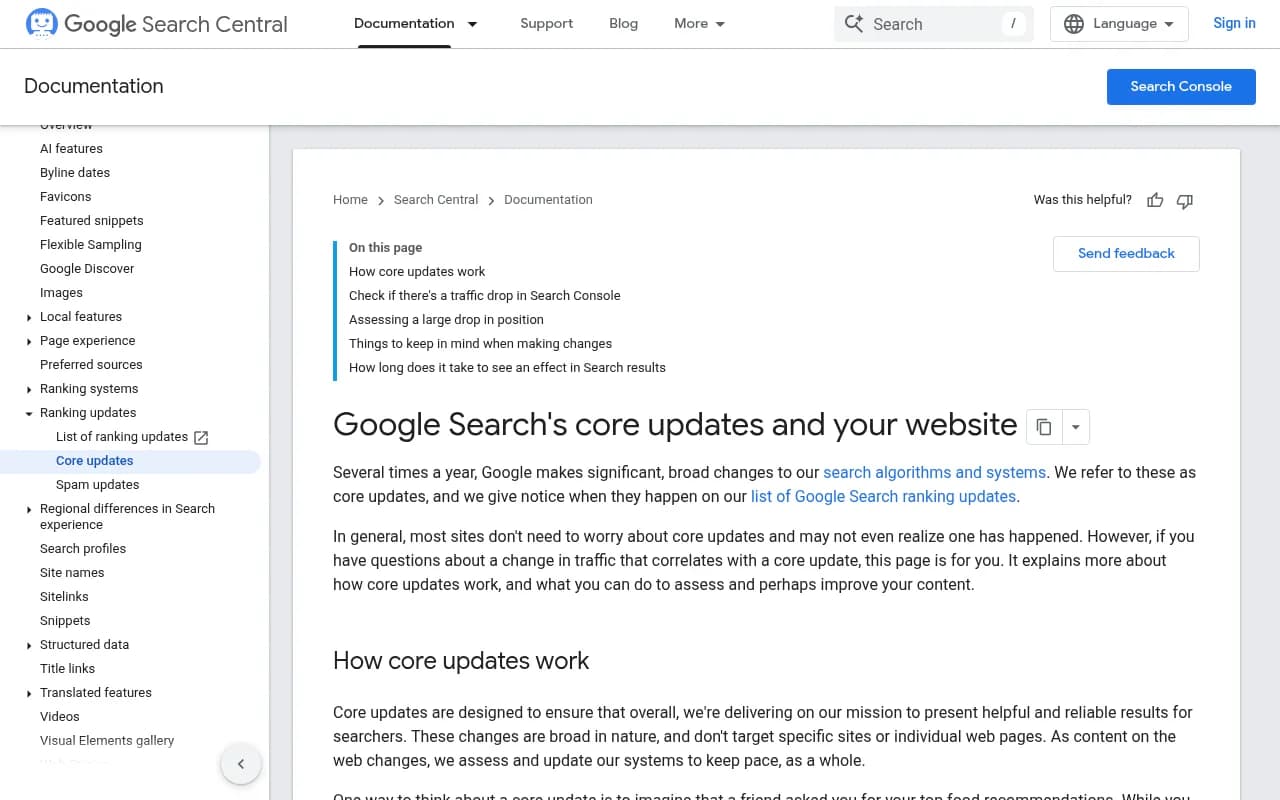
Google's own guidance backs this up. The official Core Updates documentation tells site owners to confirm the update has completely finished before drawing conclusions, then wait a full week after completion, and compare the week after completion against the week before the update started. Effects from your own content changes can take anywhere from days to months to show up, and sometimes aren't confirmed until the next core update entirely.
The confounding variables unique to AI Mode
Even once you've confirmed a core update happened and finished, AI Mode adds layers of complication that classic organic rankings don't have.
Model swaps happen in the same windows as core updates
The May 2026 core update launched the same week Google swapped AI Mode's default underlying model to Gemini 3.5 Flash, alongside a search-box redesign. Any visibility change in that window could be attributed to the core update, the model swap, the UI change, or some combination of all three. Marie Haynes' changelog also notes a May 6, 2026 feature rollout to both AI Mode and AI Overviews simultaneously, adding links for deeper exploration, SERP highlights, and social/forum snippets, none of which were ranking changes at all, just new surface features that redistribute where citations appear.
If you're seeing movement, pull up a timeline of core updates, spam updates, and known model or feature changes before you decide your content is the problem.
Google increasingly cites itself
This is one of the more surprising patterns in the data. Promptwatch's AI Mode citation share data for June 2026 shows google.com alone reached 7.31% of all Google AI Mode citations that month, more than YouTube and Reddit combined, up from 4.24% in May, which itself was a sixfold jump from April. Counting YouTube, Google-owned properties cleared 10% of the citation mix, while no independent domain cleared 1% share. SE Ranking's earlier research found similar behavior: google.com was the top-cited domain in AI Mode even back in mid-2025, mostly because of Google Maps business profile links appearing in about 9.2% of all responses.
What this means practically: if your local or branded visibility in AI Mode drops, check whether Google is simply answering more queries with its own Maps data or support pages instead of the open web. That's a platform shift, not a penalty.
Reddit and other sources can vanish overnight, without any core update
Reddit's share of ChatGPT citations collapsed from roughly 4% to 0.5% in a single day, August 14, 2026, according to Promptwatch's data on the Reddit citation drop. Google's AI Overviews and AI Mode saw a more gradual decline over the same period. This happened with no core update attached. If your strategy leaned on Reddit visibility specifically, a shift like that can look exactly like a ranking loss in your tracking tool, when it's actually a wholesale pullback by the AI engine itself.
Different models behave completely differently
Promptwatch's research on average sources per response is a useful sanity check for "is this normal." Perplexity cites almost exactly 10 sources a day, described as barely moving by a decimal, making it the most stable engine around. Google AI Overviews cites roughly 10 sources per answer too, and is notably steady. ChatGPT, by contrast, only cites about 5 sources per response, which means each citation slot is fiercely contested and losing one has an outsized visible effect. Microsoft Copilot is the real wildcard: its average swung from under 2 to nearly 17 sources per response within a few weeks, evidence that Microsoft is still rebuilding its retrieval pipeline. If you're judging Copilot visibility week to week, you're measuring an engine that's still under construction. Judge it monthly, or not at all yet.
A practical checklist for diagnosing a drop
When a client or your own dashboard flags a ranking or citation drop after an update, run through this in order:
- Confirm there actually was an announced update (core, spam, or otherwise) in the relevant window using the Search Status Dashboard, and confirm whether it has fully completed.
- Check for overlapping model or feature changes to AI Mode or AI Overviews around the same date. These are rarely announced with the same fanfare as a core update.
- Look at domain-level presence, not URL-level position. SE Ranking found top-cited domains like Indeed, Wikipedia, Reddit, and YouTube stayed relatively stable across test runs even while individual URLs churned heavily.
- Segment by query cluster and geography. AI Mode localizes per country, so strong presence in the US tells you nothing about the UK for the same topic, and blending geographies in your tracking will manufacture false fluctuation signals.
- Wait the full rollout period, then wait another full week before you compare before/after periods, per Google's own guidance.
- Check whether a specific third-party source category (Reddit, a particular publisher, a social platform) saw a platform-wide pullback unrelated to your site.
Tools for tracking this without losing your mind
Google Search Console has no AI Mode filter and doesn't expose citation-level detail or annotate for model updates, which is exactly why a dedicated AI visibility layer helps. A few things worth having in your stack:
Promptwatch tracks AI Mode, AI Overviews, ChatGPT, Perplexity, Claude, and the rest of the major engines, with daily citation trend data and crawler logs that show when AI bots actually visited your pages versus when a citation shift is just engine-side noise. Its prompt intelligence layer includes query fan-outs and citation rate tracking per page, which is the kind of granularity you need to separate "my content dropped off" from "the engine redistributed citations across more mid-authority domains," something Promptwatch's domain-rank citation data shows happening repeatedly even without any announced core update.

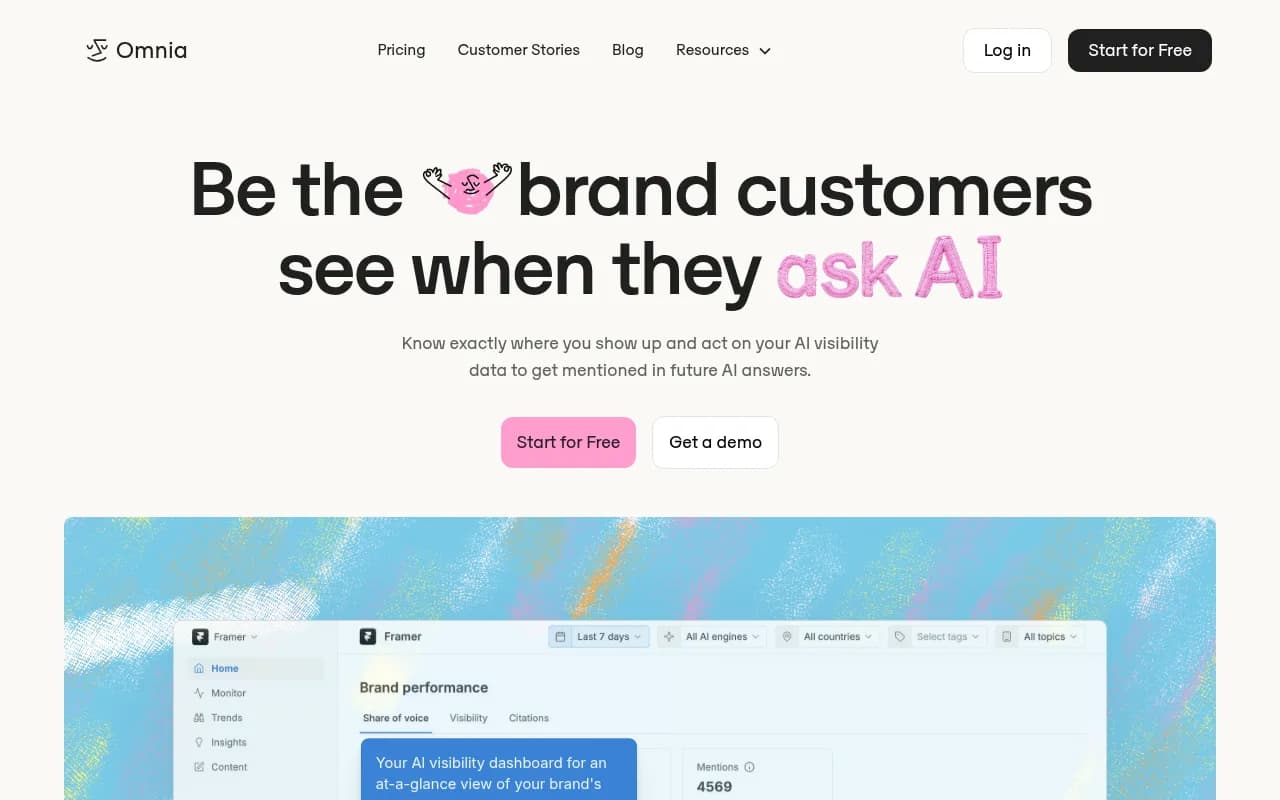
If you want something more narrowly scoped to AI Mode specifically, Omnia tracks AI Mode daily and recommends pairing it with a manual changelog of your own site changes against known Google update dates and model updates, since no off-the-shelf tool does that correlation automatically yet.
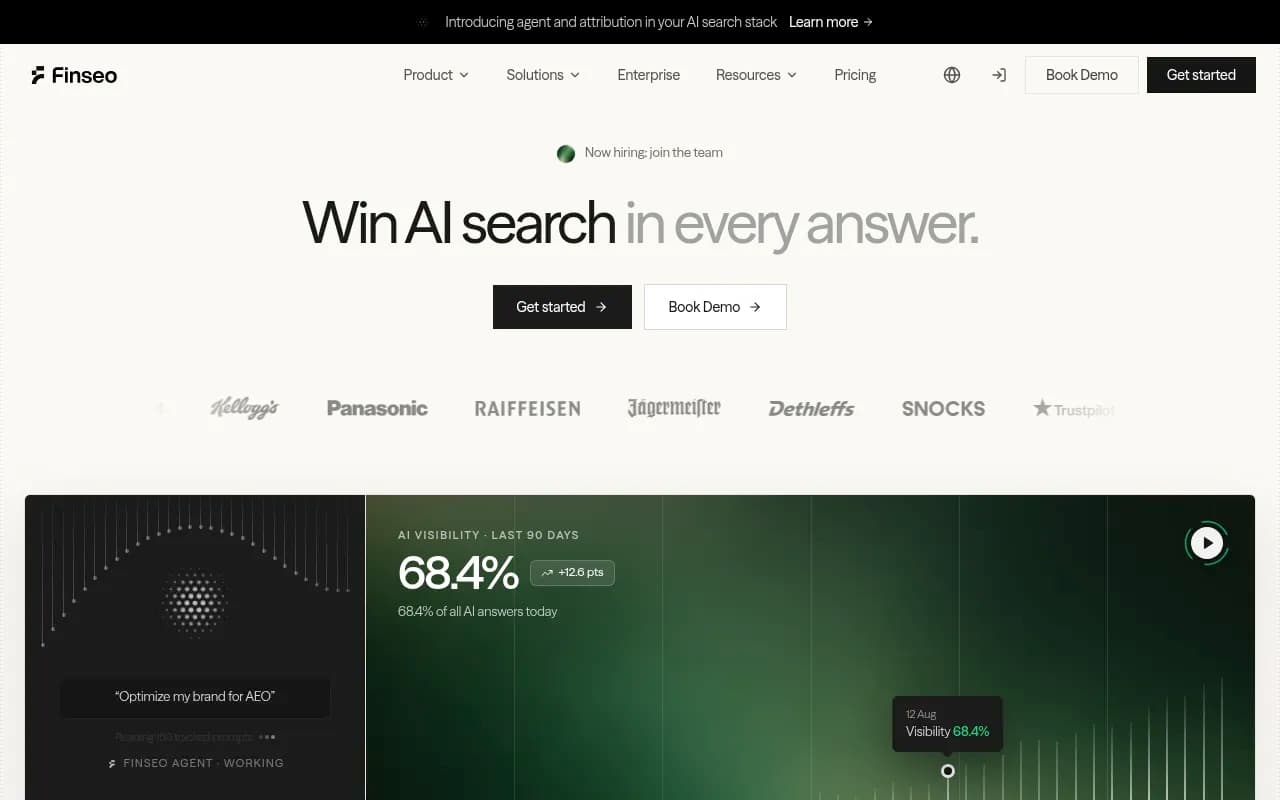
For a lower-cost entry point focused on Google's AI surfaces specifically, Finseo is built around AI Mode and AI Overviews visibility tracking.
Quick comparison of AI Mode tracking options
| Tool | AI Mode included in base plan | Refresh cadence | Starting price |
|---|---|---|---|
| Promptwatch | Yes, across all major AI engines | Daily | $95/mo |
| Omnia | Yes | Daily | 79 euro/mo |
| Rankscale | Yes | Hourly to monthly | 20 euro/mo (credit-based) |
| Peec AI | Yes | Daily | 85-89 euro/mo |
| Otterly.AI | Add-on fee | Daily | 29 euro base + 9 euro add-on |
| Profound | Enterprise tier only for full coverage | Daily | $99/mo (ChatGPT-only starter) |
Worth flagging: several vendors advertise a low headline price but reserve real AI Mode coverage for an add-on fee or an Enterprise tier. Profound and Scrunch both gate full AI Mode tracking behind their higher tiers, and Otterly and SE Ranking charge separately for it. Always check which exact plan includes the engine you actually care about before comparing sticker prices. If you want to browse more options, the GEO software directory at bestgeosoftware.com lists a wider range of platforms by category.
What Google itself says about all this
It's worth repeating Google's own line on core updates, because it hasn't really changed since 2018: there's no fix to apply to recover from a core update beyond continuing to create content that's genuinely useful to the people reading it. Google's Search Liaison repeated this almost verbatim for the May 2026 core update: there's nothing new or special creators need to do, as long as they've been making satisfying content for people, not for the algorithm.
Marie Haynes' observational analysis of sites that fared well in the December 2025 core update found a recurring pattern: sites that added more detail on author credentials and brought in more authors with relevant expertise, especially around medical or YMYL-adjacent content, tended to do better. That's not a ranking factor list, it's just a reflection of what Google is trying to reward overall.
The bottom line
Most of what looks like "my AI Mode visibility got hit by the update" is actually one of three things: normal AI Mode volatility that exists with or without any update, a confound like a model swap or new feature rollout that happened to land in the same window, or a platform-wide shift (Google citing itself more, Reddit losing favor, citation slots redistributing across domain tiers) that has nothing to do with your site specifically. Genuine, update-driven ranking loss is real and does happen, but it's a smaller slice of the picture than most dashboards make it look like on day one.
The fix isn't to panic on day 2 of a rollout. It's to build a habit: track domains and query clusters over weeks, keep a calendar of every update, spam filter, and known AI model change next to your own site changes, and give the full rollout plus a week of settling time before you draw any conclusion at all.