Key takeaways
- Generic "ChatGPT content calendar" prompts plan around your brand and audience. A citation-driven calendar plans around what ChatGPT actually cites.
- Promptwatch Data (Sep 28 to Oct 4, 2026) shows product pages at 22.4% of ChatGPT citations, landing pages at 16.8% and listicles at 13.6%. Match the format to the intent you want to win.
- Content decays at different speeds. News loses half its cited pages in 36 days, while landing pages and docs hold on far longer. Build refresh slots into the calendar by content type.
- Query fanouts decide which headings and sub-pages you need. Plan clusters of focused pages, not one mega-page.
- Any spreadsheet, Notion or Airtable board works as the calendar. The citation data is what makes it useful.
Why most ChatGPT content calendars miss the point
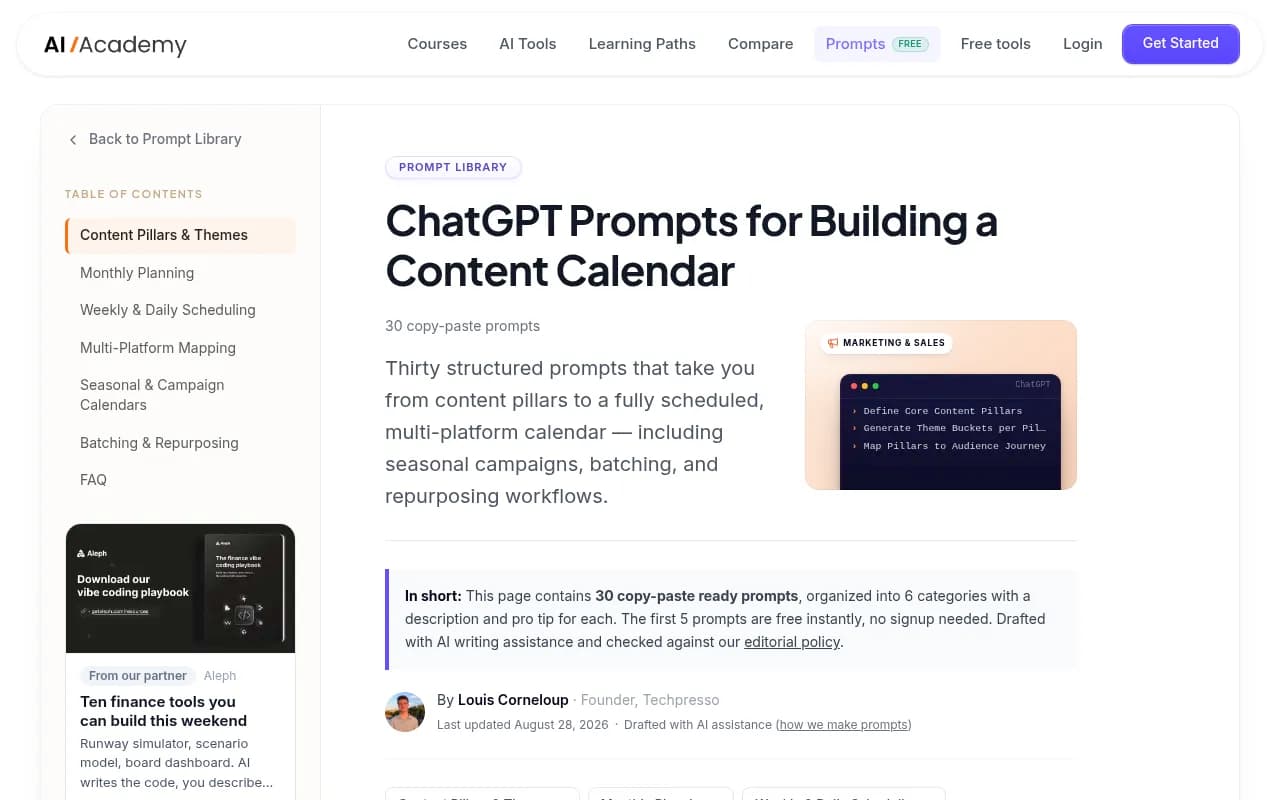
Search for how to build a content calendar with ChatGPT and you get the same advice everywhere. Describe your business, name your platforms, add key dates, and ask for a table of hooks and post types. The Techpresso prompt library, for example, has 30 solid prompts covering pillars, monthly planning, batching and repurposing. Its best tip is to paste your 20 best-performing posts in first.
That is useful for consistency. It does nothing for visibility inside ChatGPT. None of those sources ask a basic question: what does ChatGPT cite when someone asks about your category? If your calendar is full of formats ChatGPT rarely cites, you are publishing on schedule and still invisible.
This guide flips the order. Start with citation data, work out what to publish and when to refresh it, then drop the result into whatever calendar tool you already use.
Step 1: Collect the citation data that matters
You need three things, and you can gather a rough version of each without paying for anything.
- Which prompts matter. A list of 30 to 100 prompts your buyers actually ask, split into commercial ("best CRM for small businesses"), informational ("how does a CRM work") and branded ("is HubSpot good for startups").
- Which pages get cited for those prompts, and what type each page is (product page, listicle, how-to, docs, review and so on).
- Which of your pages and which competitor pages show up, plus the sub-searches ChatGPT runs behind each answer.
You can do this by hand in the ChatGPT interface for a handful of prompts. At any scale it gets tedious fast, and ChatGPT's answers vary between runs, so one-off checks are noisy. Dedicated trackers exist for this. Promptwatch tracks the real ChatGPT interface across prompts, classifies every citation by content type, and shows query fan-outs, which is exactly the raw material a citation-driven calendar needs.

If you want to compare options first, the AI rank tracking directory at ai-rank-tools.com lists most of them.
Step 2: Learn which formats ChatGPT cites
Before you decide what to publish, look at what ChatGPT cites in general. Promptwatch Data's report on which content types ChatGPT cites the most (Sep 28 to Oct 4, 2026) gives the baseline:
| Content type | Share of all ChatGPT citations |
|---|---|
| Product pages | 22.4% |
| Landing pages | 16.8% |
| Listicles | 13.6% |
| How-to guides | 8.7% |
| Documentation | 7.5% |
| General articles | 6.1% |
| Comparisons | 5.9% |
| News | 5.7% |
| FAQ pages | 3.3% |
| Reviews | 1.7% |
Two things stand out. Product and landing pages together are about 39% of citations, so a calendar made only of blog posts ignores the biggest slice. And listicles, how-tos and comparisons add up to roughly 28%, which means editorial content still earns a real share, just not the majority.
This is one week of data, so treat the exact percentages as a snapshot. The ranking of formats matters more than the decimals.
Break it down by prompt intent
The overall numbers hide the useful part. The same report splits citations by intent:
| Prompt intent | Top cited types |
|---|---|
| Commercial | Product pages 26.0%, landing pages 20.6%, listicles 15.0%, comparisons 7.9% (almost 70% combined) |
| Informational | Product pages 19.1%, landing pages 13.9%, listicles 13.6%, how-tos 10.7%, docs 8.5% |
| Branded | Product pages 23.3%, landing pages 22.8%, reviews 5.6%, FAQ pages 4.8% |
Reviews are 5.6% of branded citations, more than three times their overall share. If people ask ChatGPT whether your product is any good, review pages matter more than the average suggests.
Step 3: Turn intent into calendar lanes
Now convert the numbers into lanes. Instead of the usual pillars (education, behind the scenes, promotion), give each lane an intent and a format.
- Commercial lane: product and feature pages, comparison pages ("X vs Y"), and a listicle in your category. These are the formats that make up nearly 70% of commercial citations.
- Informational lane: how-to guides, documentation and explainers.
- Branded lane: your own FAQ, review pages, case studies and anything that answers "is [brand] good for [use case]".
- Off-site lane: getting your brand into the "best of" roundups ChatGPT already cites for your category. You do not own these pages, but outreach belongs on the calendar like any other task.
If you want a ready-made prompt for this, paste your prompt list and citation breakdown into ChatGPT or Claude and ask for a table with columns for lane, target prompt, format, current gap and owner. The Techpresso pillar prompt already outputs a similar table (pillar, definition, audience problem, funnel stage, % mix). Swap the funnel stage column for prompt intent and cited format and you have the citation-driven version.
Step 4: Use query fanouts to decide the page list
ChatGPT does not search for your user's exact prompt. It rewrites it into one or more web searches, called fanouts, and your page has to match those. Promptwatch Data's ChatGPT query fanouts report tracks this over time. The averages it logged were about 2.15 searches per response in early December 2025, easing to roughly 1.84 by early March 2026, and the intro notes that complex prompts can trigger far more. Query length also fell, from around 117 characters in December to about 53 characters (6 to 8 words) from April.
Short queries change how you title and structure pages. The report's advice translates directly into calendar entries:
- Plan pages for the sub-questions: "X vs Y", pricing, alternatives, how-tos.
- Prefer clusters of focused pages over one giant page.
- Write headings like search queries and put the entity and category first, for example "Best CRM for small agencies 2026".
One wrinkle: ChatGPT's behavior shifts. On August 8, 2026 it began using the site: operator at scale, jumping from about 0.4% to about 17% of fanout queries, according to Promptwatch Data. That is a good reason to schedule a quarterly re-check of your keyword-to-heading mapping rather than treating it as done.
If you do not have fanout data, the free GEO Inspector Chrome extension from Promptwatch shows the searches ChatGPT runs for a given answer, and the ChatGPT Query Fan-Out Generator on the same site approximates them.
Step 5: Schedule refreshes by half-life
This is the step most calendars skip entirely. A calendar is not only new posts. Content stops being cited at different speeds, so refreshes need their own slots.
Promptwatch Data's content half-life report tracked every page ChatGPT cited on July 6, 2026 for 90 days. The findings:
| Content type | What happened to cited pages |
|---|---|
| Landing pages | 78% still cited at 30 days, 69% at 60 days |
| Documentation | 76% at 30 days, 67% at 60 days |
| Comparisons | 72% at 30 days, 63% at 60 days |
| Listicles | About 60% still cited at 60 days |
| Product pages, reviews, how-tos | 55% at 60 days, half-life of 74 to 77 days |
| News | Half gone after 36 days, 41% still cited at day 60 |
The report notes that landing pages, docs, comparisons and listicles only cross 50% in the final week because the window ends, so their real half-life is likely near or past 90 days.
Turn that into cadence rules:
- News and press: plan for about five weeks of visibility. Use them for bursts, not as a foundation.
- Product pages, reviews and how-tos: review prices, specs and steps roughly every 60 days.
- Landing, docs and pricing pages: long-term assets, but keep prices and features accurate. A stale pricing page that stays cited is worse than one that drops out.
- Comparisons and listicles: invest here. They keep more than 60% of citations after two months, so one good piece pays off for a long time.
A simple way to implement this: add a "next review date" column to your calendar and fill it in at publish time using the rule for that format.
Step 6: Build the calendar itself
Now you have lanes, a page list and refresh rules. Here is a sample month for a small SaaS team, written as a table you can paste into any tool.
| Week | Lane | Item | Format | Target prompt type |
|---|---|---|---|---|
| 1 | Commercial | "[Category] software for small agencies 2026" | Listicle | Commercial |
| 1 | Refresh | Pricing page accuracy check | Landing page | Branded |
| 2 | Commercial | "[Your product] vs [Competitor]" | Comparison | Commercial |
| 2 | Informational | "How to set up [workflow] in [category]" | How-to | Informational |
| 3 | Branded | FAQ for "is [brand] good for startups" | FAQ | Branded |
| 3 | Off-site | Pitch to two roundups ChatGPT cites | Outreach | Commercial |
| 4 | Refresh | Update the 60-day-old how-to and review pages | Mixed | Mixed |
For the tool, pick what your team will actually maintain:
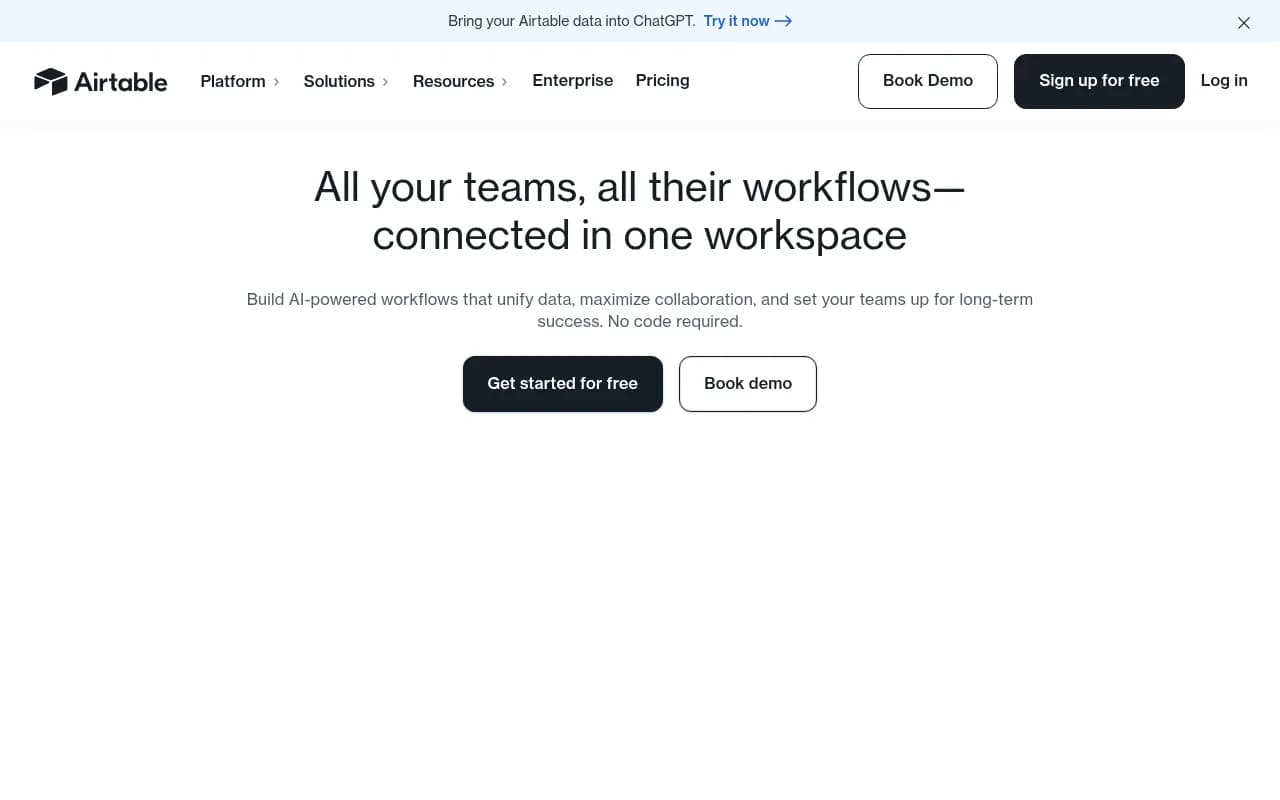
- A spreadsheet or Airtable base works fine. Columns: date, lane, target prompt, format, owner, status, next review.
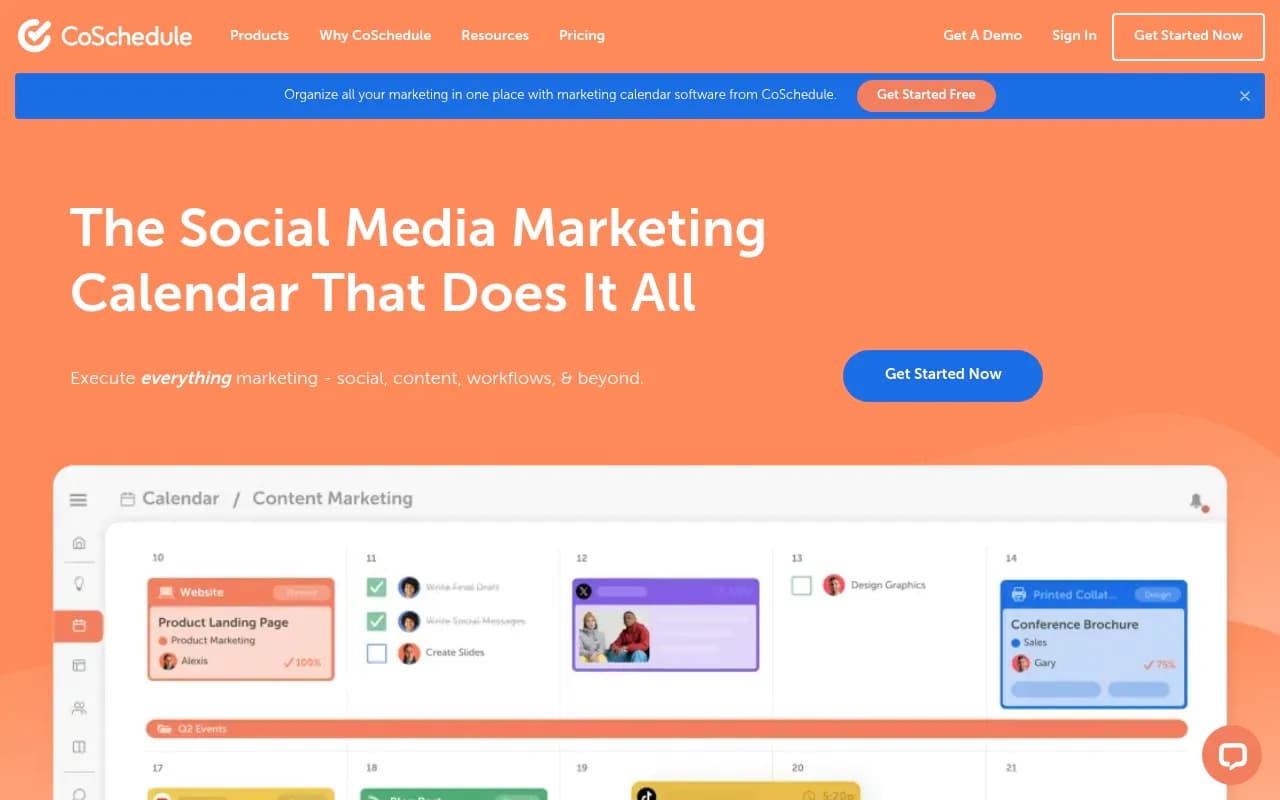
- CoSchedule is a dedicated marketing calendar if you want drag-and-drop scheduling and team views.
- Notion AI gives you a database calendar grid with assistant features on top.
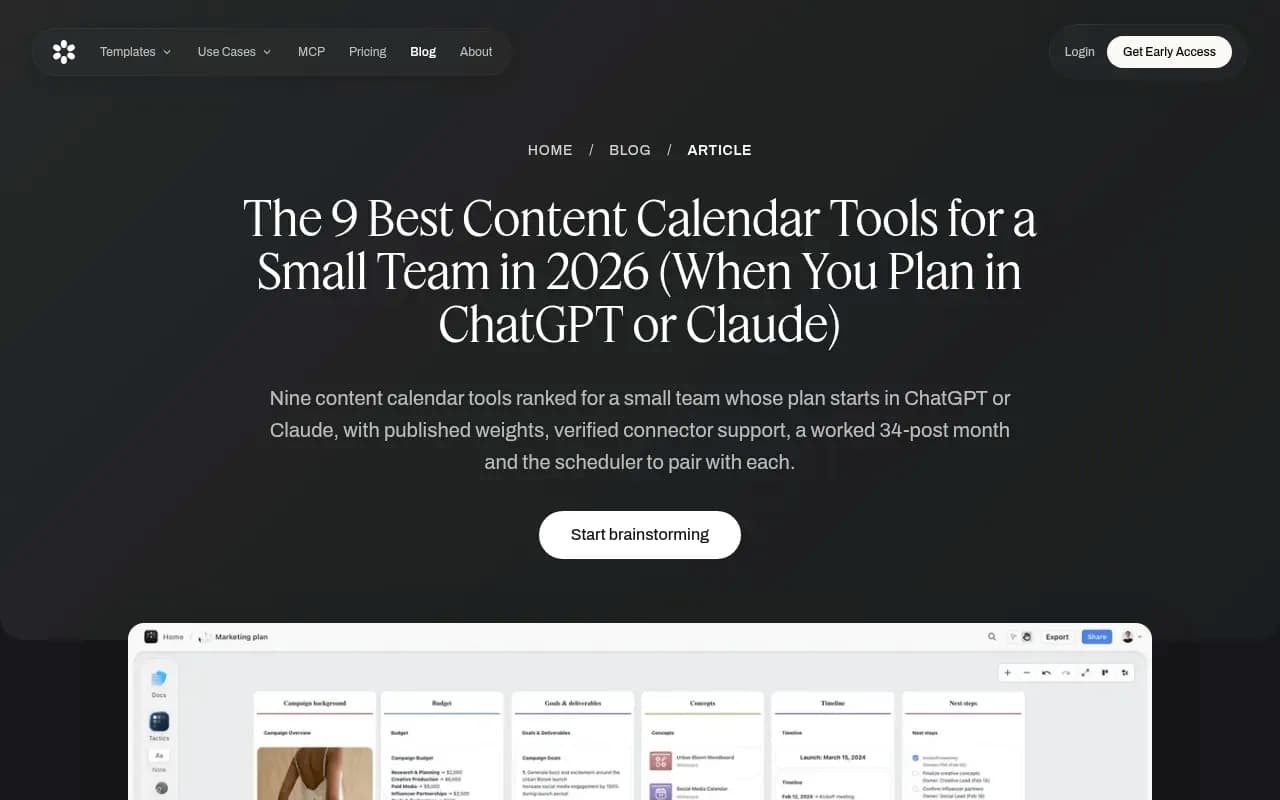
A note on sources: the Storyflow roundup of content calendar tools (dated Oct 9, 2026) ranks Storyflow first, and Storyflow is the vendor's own product, so read its ranking with that in mind. Its practical points hold up, though. Storyflow has no month grid and does not publish, so it pairs with a scheduler, and the author suggests Notion or Asana if you need a true calendar grid.
Step 7: Check vertical and platform quirks
Aggregate numbers are a starting point. Your category may behave differently, and so may the source mix.
- Software prompts: GitHub, Microsoft's docs and G2 lead citations, and documentation and help centers earn the largest share, per Promptwatch Data's software report. If you sell software, docs deserve a calendar lane of their own.
- Travel: booking and search sites earn more than half of citations (travel report), so content-only plans have a ceiling.
- Healthcare: government and public health sites take almost half (healthcare report), which makes citations by a small publisher harder to win.
- Automotive: marketplaces such as Autotrader and Cars.com outrank every manufacturer (automotive report).
Social is a separate question. From Sep 28 to Oct 4, 2026, ChatGPT drew only 0.46% of its citations from social platforms, while Google AI Overviews drew 12.2% (Promptwatch Data). And reddit.com's share of ChatGPT citations fell from about 4% to 0.5% on August 14, 2026 (report). If your calendar leans on Reddit threads to earn ChatGPT citations, rethink it. Social may still matter for AI Overviews, so decide per engine.
Also keep in mind that almost half of ChatGPT responses cite 10 or more unique domains (Promptwatch Data). You are rarely competing for one slot. Showing up in the crowd is a realistic goal.
Step 8: Close the loop each month
A calendar without measurement is a to-do list. Each month, check:
- Did the new pages get crawled and cited, and for which prompts?
- Which refreshed pages recovered citations?
- Which lane produced the most citations per piece?
- Did a ChatGPT behavior change (fanouts, citation counts) alter the picture? Citation counts per response dropped around the GPT-5.3 rollout on March 4, 2026, for instance (report).
Tools differ in how far they go. Some only report mentions. Promptwatch adds crawler logs and AI-referred traffic so you can see whether a published page was read, cited and clicked, and its Action Board turns gaps into a task list you can feed straight back into the calendar. For other options, the GEO software directory at bestgeosoftware.com is a good starting point.
Pitfalls to watch
- Small samples. A prompt tested three times tells you little. ChatGPT's answers vary, so look at patterns across many prompts and repeated runs.
- Prompt-set bias. If you only track prompts you already rank for, the data will say your strategy is working. Include prompts where you are absent.
- Treating one week as permanent. The content-type split above is a Sep 28 to Oct 4, 2026 snapshot. Recheck it quarterly.
- Chasing format over substance. A listicle with no real expertise will not hold citations just because listicles are common.
- Forgetting refreshes. Adding only new posts means older pages quietly drop out.
A minimal workflow you can start this week
- List 40 prompts across commercial, informational and branded intent.
- Record which pages and content types ChatGPT cites for each, and where you are missing.
- Assign each gap a lane and a format using the intent table above.
- Add fanout-style headings to each planned page.
- Put a next-review date on every item, using the half-life rules.
- Review citations monthly and move items between lanes.
If you would rather have an agency run this process, 1001 SEO Media does AI search and GEO work alongside content strategy. Otherwise, the steps above work fine with a spreadsheet and a few hours a month. The key shift is simple: let what ChatGPT cites set the calendar, not the other way around.