Key takeaways
- No large-scale dataset ranks the top .nl domains in ChatGPT across thousands of prompts. The best Dutch-specific evidence is a small, single-author study from October 2026, so treat it as directional.
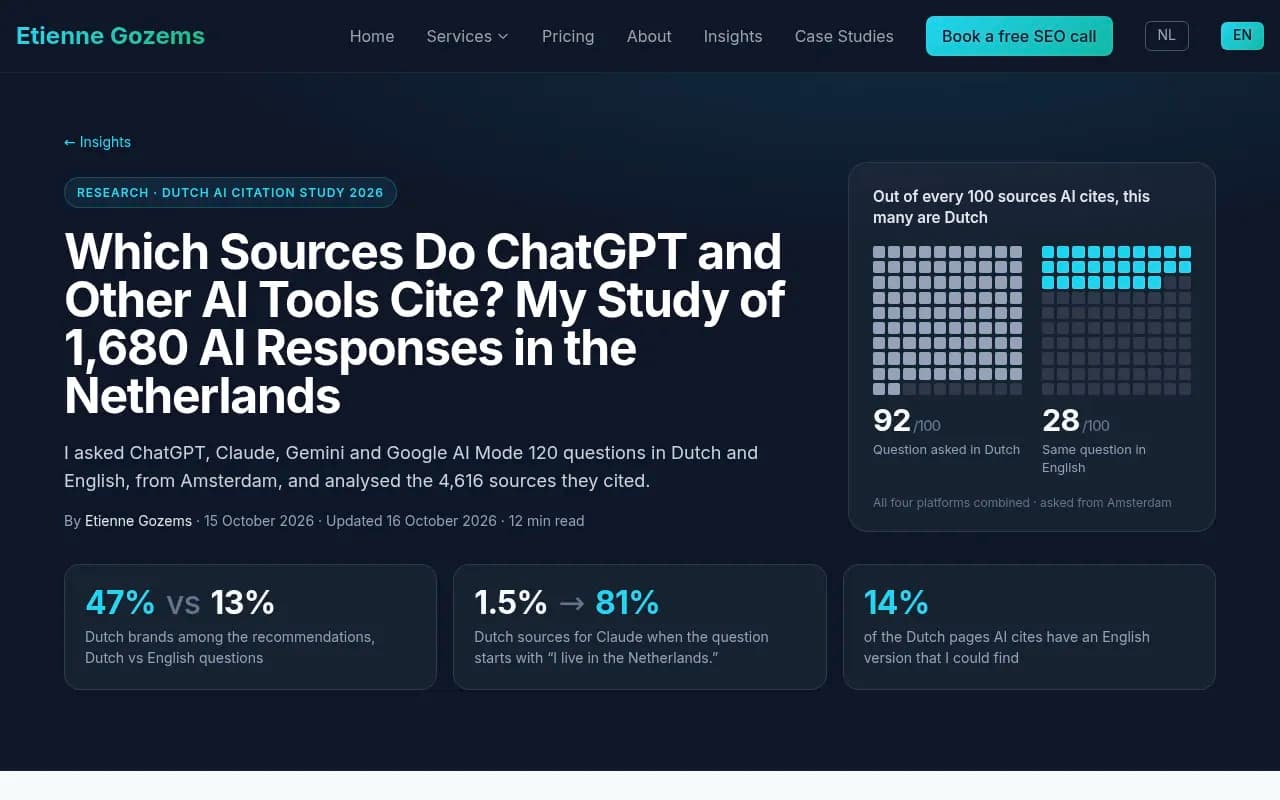
- Language decides everything. In that study, 92% of citations came from Dutch sources when the question was in Dutch, and 28% when the same question was in English.
- For Dutch questions, ChatGPT leaned on consumentenbond.nl, rijksoverheid.nl, belastingdienst.nl, anwb.nl and kvk.nl. Public institutions dominate the sample.
- Global data says the citation pool is wide: Profound found the top 10 domains capture only 12% of ChatGPT citations, and Yext found 86% of citations come from sources brands control.
- The practical plan: own your pages, publish in Dutch, build presence on the trusted domains that appear next to you, and track citations weekly.
The honest starting point: there is no Dutch top 100
I went looking for a clean list of the most-cited .nl domains in ChatGPT. Something like "top 50 Dutch sites by citation share across 10,000 prompts." It doesn't exist publicly, at least not that I could find. Promptwatch Data has no country-level report on the Netherlands either. Its general ChatGPT source tracking is global.
So this guide stitches together what we do have: one Dutch-specific study, a few large global datasets, and some reasoning about what transfers. I'll flag where the evidence is thin, because a lot of AI visibility content pretends otherwise.
What the Dutch citation study found
Etienne Gozems, an SEO consultant in the Netherlands, published a study on 15 October 2026. He asked ChatGPT, Claude, Gemini and Google AI Mode 120 questions in both Dutch and English, with location set to Amsterdam. That produced 1,680 responses and 4,616 citations across 10 topics.
The caveats matter. It is one author, one month, a small sample. ChatGPT, Claude and Gemini were queried through their APIs with a search tool, and AI Mode results came from SerpApi, so the output may differ from what consumers see in the apps. The topics also skew toward public-interest subjects like health insurance and taxes, with few commercial brand queries. Read it as a strong hint, not a verdict.
The domains ChatGPT cited most
For Dutch-language questions, ChatGPT produced 482 citations. The top five:
| Rank | Domain | Citations (Dutch questions) |
|---|---|---|
| 1 | consumentenbond.nl | 76 |
| 2 | rijksoverheid.nl | 49 |
| 3 | belastingdienst.nl | 31 |
| 4 | anwb.nl | 14 |
| 5 | kvk.nl | 11 |
For English questions asked from Amsterdam, the top five looked similar with one international guest:
| Rank | Domain | Citations (English questions) |
|---|---|---|
| 1 | consumentenbond.nl | 49 |
| 2 | rijksoverheid.nl | 31 |
| 3 | belastingdienst.nl | 26 |
| 4 | techradar.com | 17 |
| 5 | business.gov.nl | 16 |
Government bodies, regulators and other public institutions made up 38% of ChatGPT's citations for Dutch questions, more than on any other platform in the test. That fits what Promptwatch Data shows in other verticals: in healthcare prompts, government and public health sites earn almost half of ChatGPT citations. Trust-heavy topics pull toward institutions, in any country.
One more detail: ChatGPT searched the web for 68 to 70% of the questions and cited only about two sources per answer. That is a low number per answer, which makes each citation slot more valuable than in the global average.
Language is the biggest lever
This is the finding I'd put on a slide. Across all four platforms, 92% of cited sources were Dutch for Dutch questions. For the same questions in English, 28%.
The platforms behave very differently when the question is English:
| Platform | Dutch sources among English-question citations |
|---|---|
| ChatGPT | 63% |
| Google AI Mode | 45% |
| Gemini | 25% |
| Claude | 1.4% |
ChatGPT is the friendliest to Dutch content. It added the Netherlands to 55% of its 186 English search queries, and half the pages it cited for English questions were in Dutch. Claude never included the Netherlands in any of its 132 recorded English search queries. When asked in English about switching health insurers, it answered about the US system despite the Amsterdam location.
A short prefix changed that. Adding "I live in the Netherlands." before an English question lifted Dutch sources from 1.5% to 81% for Claude, and from 37% to 85% for Gemini. So if your audience is in the Netherlands, how users phrase prompts affects whether you show up at all.
Recommendations followed the same pattern. For Dutch recommendation questions, 47% of recommended brands were Dutch. For English questions, 13%.
The English-version trap
Gozems checked 1,297 Dutch pages that AI cited and could find an English version for only 14% of them. If you run an international brand with a Dutch subfolder, that cuts both ways. Dutch-only content gets cited for Dutch questions, but English-language prompts from Dutch users may route around you or toward whoever has the English page.
What the global data adds
The Dutch study is narrow. Global datasets fill in the shape of the system, with the caveat that they are mostly US and English.
Citations are spread thin
Profound analyzed roughly 700,000 US English ChatGPT conversations from October to December 2025. Its finding: the top 10 domains capture only 12% of citations. Wikipedia appeared in about 18% of conversations with citations, Reddit in 13%. About 18% of conversations triggered a web search at all, and the first turn of a conversation is far more likely to trigger citations than later ones. It also found sources travel in packs, so ChatGPT cites competitors side by side.
Profound is one of the tools that publishes this kind of research.

Your own site matters more than forums
Yext analyzed 6.8 million citations across ChatGPT, Gemini and Perplexity and found 86% came from brand-managed sources, with first-party websites at 44% and listings at 42%. Reddit and similar forums were only 2% once location and intent were applied. Note that Yext sells listings software, so it has a stake in that conclusion. Still, it lines up with the Dutch study: locally relevant, owned pages win when the query has a place attached.
Reddit is a moving target
Promptwatch Data shows reddit.com's share of ChatGPT citations fell from about 4% to 0.5% on August 14, 2026, around when ChatGPT started using site: queries at scale. In the week of Sep 28 to Oct 4, 2026, ChatGPT drew just 0.46% of its citations from social platforms, while Google AI Overviews drew 12.2%. For Dutch marketers, that means a Reddit or social strategy is a bet on Google surfaces, not on ChatGPT.
What this means for Netherlands marketers
1. Treat Dutch pages as the main asset
If the question is in Dutch, almost every citation will be Dutch. Competing for those slots means Dutch-language pages that answer the question directly. Machine-translated copy is a risk because the winners in the study are plain, authoritative explainers from institutions and consumer organizations.
2. Publish English versions where it makes sense
Dutch professionals search in English constantly, and the Netherlands ranks first of 123 countries in the EF English Proficiency Index. ChatGPT often goes to Dutch pages for English questions, but Gemini and Claude mostly do not. If you serve expats, international B2B buyers or tech audiences, an English page is the only way into those answers.
3. Think about citation neighbors
In the Dutch data, consumentenbond.nl, rijksoverheid.nl and belastingdienst.nl keep co-appearing. You probably can't outrank them for tax or insurance basics. A more realistic goal is to appear next to them: answer the follow-up detail they don't cover, and earn mentions on the trusted domains in your niche. This matches Profound's point about sources travelling in packs.
4. Don't expect big-brand authority to carry you
Promptwatch Data shows sites with domain rank 46 to 75 earned almost half of ChatGPT citations in August 2026, while DR 91 to 100 fell to about 3%. A mid-sized Dutch site with a sharp, specific page has a real shot.
5. Match your content type to what gets cited
Promptwatch Data shows product pages are the most cited content type in ChatGPT at 22.4%, followed by landing pages and listicles. It also shows landing pages and docs stay cited longest, while news loses half its pages within 36 days. Evergreen Dutch landing pages and documentation beat news-style posts for lasting visibility.
How to build your own Dutch citation dataset
Since no public benchmark exists, the sensible move is to measure your own market. A rough process:
- Write 50 to 100 prompts your Dutch customers would type, in Dutch, plus English versions of the important ones.
- Add variants with "ik woon in Nederland" or "I live in the Netherlands".
- Track them daily across ChatGPT, Google AI Overviews, AI Mode, Gemini and Perplexity, in the Netherlands.
- Export the cited domains and group them: institutions, marketplaces, publishers, competitors, you.
- Check which of your pages are cited, and which AI crawlers actually reach your site.
Tools like Promptwatch can run this kind of country- and language-specific monitoring on the real ChatGPT and Google interfaces, and its crawler logs show whether AI bots can read your Dutch pages.

Other options in the same category include Peec AI, which is built for multi-language tracking, and Otterly.AI for lower-cost monitoring.


For a wider look at the category, the GEO software directory at bestgeosoftware.com lists dozens of trackers.
| Need | What to look for |
|---|---|
| Dutch-language prompts | Country and language targeting per monitor |
| Real consumer answers | Tracking of the actual ChatGPT and Google UIs, not only APIs |
| Knowing why you are missing | Crawler logs and page-level citation data |
| Acting on gaps | Content gap analysis and publishing workflows |
What to be skeptical about
Three things. First, the Dutch study samples public-interest topics, so the dominance of Consumentenbond and government sites may be weaker for e-commerce, travel or B2B software queries. Second, API results can differ from the app. Third, ChatGPT's behaviour shifts quickly: citation counts per response dropped around the GPT-5.3 rollout in March 2026, and Reddit's share collapsed in a single day. Any ranking you read, including this one, has a short shelf life.
If you want help turning citation data into a Dutch-market plan, agencies such as 1001 SEO Media work on GEO and AI search strategy, but the first step is the same whoever you hire: measure which domains AI actually cites for your prompts.
The short version
Dutch questions get Dutch answers, built mostly from consumer organizations, government bodies and a few established brands. English questions give you a coin flip that depends on the platform. Write for the language your buyers use, make English versions where they matter, and measure your own prompts weekly instead of waiting for a public Top 100 that may never come.