GoKlyx Review 2026
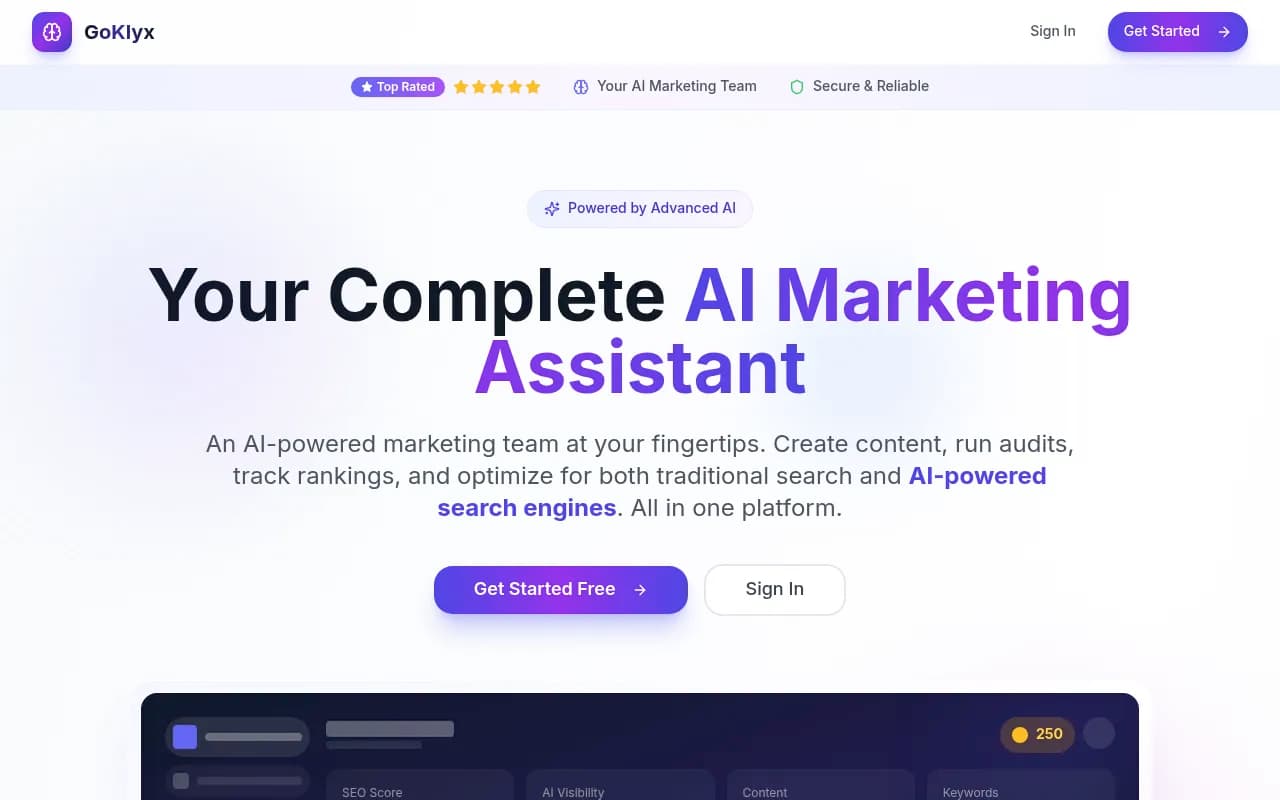
GoKlyx is an AI-powered marketing platform combining SEO audits, keyword rank tracking, AI content generation (blogs, ads, social), and AI search visibility analysis for ChatGPT, Perplexity, and Claude — all in one dashboard.
Key takeaways
- GoKlyx bundles SEO auditing, keyword tracking, AI content creation, and AI search visibility monitoring into a single platform aimed at small businesses and solo marketers
- Competes with Promptwatch on AI search visibility but lacks the depth that serious GEO work requires: no content gap analysis, no AI crawler logs, no traffic attribution, no prompt volume scoring, and no AI writing agent grounded in citation data
- Free tier available with 10 credits on signup; paid pricing is not publicly listed, which makes it hard to evaluate value before committing
- Gamification (badges, levels, referral credits) suggests the product is aimed at early-stage users rather than marketing professionals managing multiple client accounts
- Best suited for freelancers or small business owners who want a single tool for basic marketing tasks, not for agencies or brands serious about AI search optimization
GoKlyx markets itself as "your complete AI marketing team" -- a bold claim for a platform that's clearly still finding its footing. The product is built around a credit-based system and covers a surprisingly wide range of marketing tasks: website SEO audits, keyword rank tracking, AI-generated blog posts, ad copy, social media content, and a newer AI search visibility module that checks how your content appears to AI assistants like ChatGPT and Perplexity. It's a lot to promise, and the execution is mixed.
The target audience is pretty clearly small business owners, freelancers, and early-stage marketers who don't have the budget or headcount for separate tools covering each of these functions. GoKlyx is trying to be the affordable all-in-one alternative to a stack that might otherwise include Ahrefs, Jasper, and a social scheduling tool. Whether it succeeds depends heavily on how deep you need each of those functions to go.
The platform appears to be relatively new, with limited third-party reviews available. The SourceForge comparison data doesn't list pricing, and Slashdot reviews are sparse. This is a tool worth watching, but one that needs more transparency and feature maturity before it can be recommended for anything beyond basic use cases.
Key features
Website SEO auditing is one of GoKlyx's more polished features. The platform runs a comprehensive audit covering performance, accessibility, SEO fundamentals, and best practices -- scoring each category separately (the demo shows scores like Performance 87, Accessibility 92, SEO 78, Best Practices 95). Notably, it generates downloadable PDF reports, which is useful for freelancers who need to share findings with clients. The audit appears to follow a Lighthouse-style scoring model, though it's unclear how frequently audits can be run or how granular the recommendations get.
Keyword rank tracking lets users monitor search positions over time and track changes. The platform claims daily monitoring, which is standard for dedicated rank trackers. The demo shows a "+23% this month" metric, suggesting position trend data is surfaced clearly. What's less clear is how many keywords you can track per project, which search engines are covered beyond Google, and whether there's any SERP feature tracking (featured snippets, local packs, etc.).
AI blog generator produces SEO-optimized blog posts using AI. The output is described as "engaging content that ranks and converts," which is standard marketing language. In practice, AI blog generators at this price point typically produce serviceable first drafts that need human editing. GoKlyx doesn't appear to ground its content generation in citation data or real prompt volume analysis, which means the output is general-purpose rather than specifically engineered to rank in AI search results.
AI ad copy creator generates copy for Google, Facebook, LinkedIn, and other platforms. The platform mentions "compliance-aware content," which suggests some guardrails around advertising policies -- a genuinely useful feature for marketers who've had ads rejected for policy violations. The range of supported platforms is reasonable for a small business tool.
Social media content creation covers captions and hashtags for major platforms. This is table-stakes functionality in 2026 -- nearly every AI writing tool does this. GoKlyx's version appears to be integrated into the same credit system as the other features, which could be limiting if you're producing social content at volume.
AI search visibility is the feature that puts GoKlyx in direct competition with dedicated GEO platforms. The module claims to analyze how AI search engines like ChatGPT, Perplexity, and Claude see your content, provide recommendations to improve visibility, and track your presence in AI-powered search results. The demo shows an "AI Search Score" of 85 with separate indicators for ChatGPT Visibility (High), Perplexity Presence (Strong), and Content Structure (Good). This is a promising concept, but the implementation appears surface-level compared to dedicated tools. There's no mention of prompt-level tracking, citation source analysis, competitor benchmarking, or content gap identification -- the features that actually make AI visibility data actionable.
Gamification and referral system are worth mentioning because they reveal something about the product's positioning. Earning badges, leveling up, and getting credits for referrals are features you build when you're trying to grow a consumer-oriented user base, not when you're building for marketing professionals. This isn't necessarily bad -- it makes the platform more engaging for solo users -- but it signals that GoKlyx is not positioning itself as an enterprise or agency tool.
Credit-based usage model means every action (audit, content generation, keyword check) consumes credits. New users get 10 free credits on signup. This model is common among AI tools but can become frustrating if you're doing any volume of work, since you're constantly aware of your credit balance rather than just using the tool.
Who is it for
GoKlyx fits best for solo entrepreneurs, small business owners, and early-career freelancers who need a basic marketing toolkit without paying for five separate subscriptions. If you're running a local business or a small e-commerce store and you want to audit your site, generate some blog content, and get a rough sense of your AI search visibility, GoKlyx gives you a starting point without requiring deep technical knowledge.
Freelance marketers who work with small clients might find value in the PDF audit reports, which give them something tangible to share. The ad copy generator could save time on routine deliverables. The social content feature handles the basics. For clients with modest expectations and budgets, this could work.
Who should not use GoKlyx: SEO agencies managing multiple client sites, brands that take AI search visibility seriously, or any marketing team that needs reliable data at scale. The platform's AI search visibility feature is too shallow for GEO work -- it gives you a score but doesn't tell you which specific prompts you're missing, which competitors are outranking you in AI responses, or what content to create to close those gaps. For that level of analysis, dedicated platforms are necessary.
Integrations and ecosystem
GoKlyx's integration story is thin based on available information. The platform mentions support for Google, Facebook, and LinkedIn in the context of ad copy generation, but it's not clear whether these are actual API integrations or just output formatting. There's no mention of Google Search Console integration, which is a notable gap for an SEO tool. No Zapier, no API documentation, no browser extension. The platform appears to be a self-contained web app with no significant ecosystem connections.
Export capabilities seem limited to PDF reports for SEO audits. Whether keyword data, content, or visibility scores can be exported in structured formats (CSV, JSON) is not clear from the available information.
Pricing and value
GoKlyx's pricing is not publicly listed in a clear tier breakdown, which is a red flag for any SaaS product. The free tier gives 10 credits on signup, which is enough to explore the platform but not enough to evaluate it seriously. SourceForge comparison data shows no pricing information available, suggesting the company hasn't made this easy to find.
The credit-based model means the effective cost depends heavily on how many credits each action consumes -- information that isn't readily available before signing up. This lack of pricing transparency makes it difficult to compare GoKlyx against alternatives on value.
For context, dedicated AI visibility tools like Promptwatch start at $99/month for a single site with 50 prompts and include features like AI crawler logs, traffic attribution, and content gap analysis that GoKlyx doesn't appear to offer. If GoKlyx is priced significantly below that, it might make sense for users who only need the basics. If it's priced similarly, the value case is weak.
Strengths and limitations
GoKlyx does a few things genuinely well. The breadth of features in a single platform is real -- having audits, rank tracking, content generation, and AI visibility in one place reduces tool-switching friction. The PDF report export is a practical feature for freelancers. The interface appears clean and approachable, with the gamification elements making it less intimidating for non-technical users. The compliance-aware ad copy feature addresses a real pain point.
The limitations are significant, though. The AI search visibility module is the most concerning gap. Showing a score of 85 and labeling ChatGPT visibility as "High" is not actionable data. Serious AI search optimization requires knowing which specific prompts trigger your competitors but not you, which pages are being cited, how often, and by which models, and what content to create to close those gaps. GoKlyx doesn't appear to offer any of this. There's no mention of prompt volume data, no competitor benchmarking at the prompt level, no AI crawler logs showing which pages AI bots are actually reading, and no traffic attribution to connect AI visibility to actual website visits or revenue.
The credit-based model with opaque pricing is a structural problem. Marketers need predictable costs, and a system where every action burns credits without clear upfront pricing creates anxiety rather than confidence.
The platform's relative newness means the data quality and reliability of its AI visibility scores are unproven. There's no published methodology for how the AI Search Score is calculated, which makes it hard to trust as a decision-making input.
For users who want to go beyond monitoring and actually optimize their AI search presence, Promptwatch offers content gap analysis, an AI writing agent grounded in 880M+ citations, AI crawler logs, and traffic attribution -- capabilities GoKlyx doesn't currently have.
Bottom line
GoKlyx is a reasonable starting point for solo marketers and small business owners who want a single tool covering basic SEO, content creation, and a surface-level look at AI search visibility. It's not built for agencies, not built for serious GEO work, and not transparent enough about pricing to recommend without reservations.
Best use case: a freelancer or small business owner who wants to audit their site, generate some content, and get a rough sense of their AI search presence -- all without juggling multiple subscriptions.
Frequently asked questions
What is GoKlyx?
Is GoKlyx free to use?
Who is GoKlyx best suited for?
Does GoKlyx track AI search visibility?
How does GoKlyx compare to dedicated GEO platforms like Promptwatch?
What content types can GoKlyx generate?
Similar and alternative tools to GoKlyx