Key takeaways
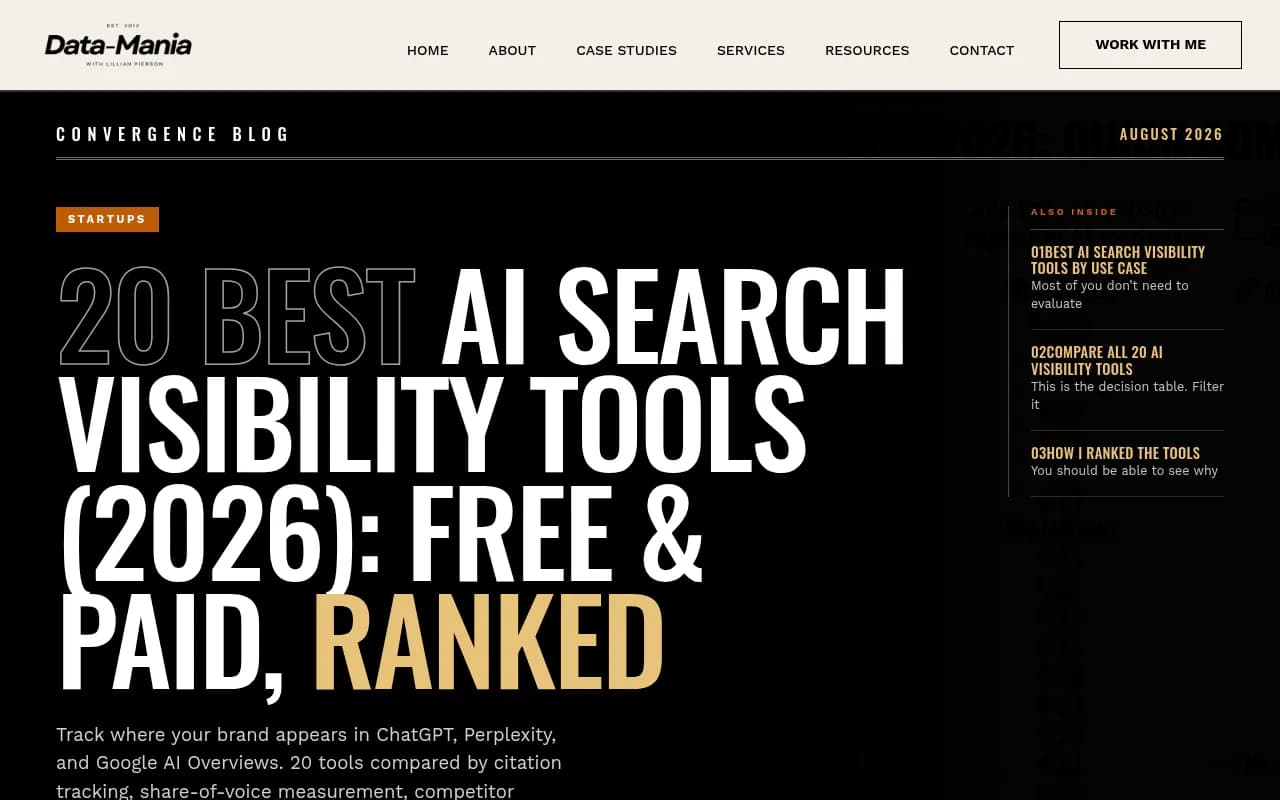
- Birdeye is a reputation and listings platform first. Its own "Search AI" add-on claims coverage across seven AI surfaces, but independent reviewers (Data-Mania ranked it 19th of 20 AI visibility tools) found it doesn't track AI-specific citations from ChatGPT, Google AI Overviews, or Perplexity in any meaningful way.
- Reviews make up only 1.7% of ChatGPT's citations, and social platforms combined sit under 0.5%, according to Promptwatch's data on ChatGPT citation share by content type. That's the core problem: the signals Birdeye monitors are not the signals AI models are citing.
- Tools built specifically for AI search, Profound, Peec AI, AthenaHQ, Scrunch, Otterly.AI, Nightwatch, and Promptwatch, track actual prompts, citations, and crawler behavior across ChatGPT, Perplexity, Gemini, Claude, and Google AI Overviews/AI Mode.
- Pricing varies wildly, from Otterly's $29/mo entry tier to AthenaHQ's enterprise plans, and a lot of vendors gate Claude or Gemini behind higher tiers. Read the fine print before you buy.
- If you want monitoring plus the ability to actually act on gaps (content generation, CMS publishing, crawler logs), Promptwatch is the only platform in this set that closes the loop rather than just reporting a score.
Why Birdeye isn't really an AI search tool
Birdeye built its business on reviews, listings, and multi-location reputation management. It monitors 200+ review sites, handles review requests by text and email, and keeps your Google, Facebook, Apple, Yelp, and Bing listings in sync. That's a real, useful job, and a lot of multi-location brands depend on it.
The company has since bolted on a product called Search AI, which claims to track visibility across ChatGPT, Claude, Perplexity, Gemini, Google AI Overviews, AI Mode, and Grok at the location level. On paper that sounds comprehensive. In practice, independent testing tells a different story. Data-Mania's 20-tool AI visibility ranking placed Birdeye at #19, writing bluntly that "Birdeye doesn't track AI-specific citations from ChatGPT, Google AI Overviews, or Perplexity." Its spot on that list exists only because reviews, ratings, and listing accuracy are inputs AI systems weigh for local queries, not because the product actually monitors what AI models say.
There's a data problem underneath this, too. Promptwatch's research on ChatGPT's citation mix by content type found that reviews account for just 1.7% of all classified ChatGPT citations, well below what most marketers assume. Social platforms, where a lot of review-adjacent chatter lives, barely register either: a separate Promptwatch report on social media citations by AI model found ChatGPT cites all seven major social platforms combined at just 0.46% of citations, down from 5.8% in an earlier measurement period (week of Sep 28-Oct 4, 2026). Reddit specifically collapsed from 5.19% to 0.09% in that window. If you're paying for a platform whose core strength is reviews and star ratings, you're optimizing for a slice of AI visibility that's shrinking, not growing.
Product pages and landing pages are where the real citation volume sits, 22.4% and 16.8% of ChatGPT citations respectively, per the same report. That's a content and technical SEO problem, not a review-collection problem.
What "deeper AI search coverage" actually means
Before comparing tools, it's worth being precise about what you're buying. A lot of vendors advertise "AI visibility" without clarifying three things that matter a lot in practice:
Which engines are actually included at your price point. Several tools list seven or more engines on their marketing page but gate Claude, Gemini, or AI Mode behind add-on fees or an enterprise tier. Profound's $99/mo Starter plan, for instance, is ChatGPT-only; Claude tracking only shows up on the custom Enterprise tier. Otterly.AI's cheapest plan covers four engines, but Claude, Gemini, and AI Mode cost extra on every tier, pushing a nominally "$189/mo" plan closer to $357/mo once you add them.
How citations are measured, not just whether a brand was mentioned. Promptwatch's analysis of unique domains per ChatGPT response found that 47.6% of citation-bearing ChatGPT answers reference 10 or more different domains, and organic prompts climb to 52.5%. In other words, most answers are a crowded field. A tool that tells you "yes, you were mentioned" without showing where you rank among 10+ competing domains isn't giving you the full picture.
Whether the tool verifies AI crawler activity or just guesses from user-agent strings. Promptwatch's AI crawler traffic data only counts requests that match a crawler operator's published IP ranges, filtering out spoofed user agents. That distinction matters if you want to know whether ChatGPT's crawler actually visited a page versus something pretending to be it.
Tools that track ChatGPT, Perplexity, and the rest properly
Here's how the main AI-search-specific alternatives stack up against Birdeye's Search AI add-on.
| Tool | Entry price | Engines at entry tier | Notable gap or caveat |
|---|---|---|---|
| Birdeye Search AI | Custom quote | Claims 7 surfaces | Independently ranked #19/20 for actual citation tracking |
| Profound | $99/mo | ChatGPT only | Claude gated to custom Enterprise tier |
| Peec AI | $95/mo | Pick 3 of 6 engines | Extra models cost $35-$165/mo depending on tier |
| AthenaHQ | Free tier, then $295/mo | 5 engines (paid adds 6 more) | Enterprise tier needed for BI tool integration |
| Scrunch AI | $250/mo | 4 engines | Claude, Gemini, Meta AI reserved for Enterprise |
| Otterly.AI | $29/mo | 4 engines | Claude, Gemini, AI Mode are paid add-ons on every tier |
| Nightwatch | ~$85/mo (annual) | 6 engines + traditional rank tracking | Fewer AEO-specific features than pure-play competitors |
| Promptwatch | $95/mo | All major LLMs + AI Overviews/AI Mode | None of the above gate content generation behind Enterprise |
Profound

Profound is positioned for enterprise AEO teams and its Agent Analytics module is genuinely strong for tracking how AI crawlers hit your pages. The catch is tier-gating: the $99/mo Starter plan tracks ChatGPT only, and you need the custom Enterprise tier to get Claude, Gemini, Copilot, Meta AI, Grok, DeepSeek, and AI Mode. If your buyers are mostly on ChatGPT, it's a fine starting point. If you need broad coverage without a sales call, look elsewhere first.
Peec AI

Peec AI is rated 4.7/5 on G2 and keeps things simple: every plan, even the $95/mo Starter, lets you pick three AI models from ChatGPT, Google AI Overviews, AI Mode, Perplexity, Gemini, and Copilot, with unlimited team seats. Adding more models costs extra ($35-$165/mo depending on tier), but at least it's transparent pricing rather than a custom quote.
AthenaHQ

Built by a team with Google Search and DeepMind backgrounds, AthenaHQ has a genuinely useful free tier (300 credits, unlimited members) before you ever pay. Paid plans start at $295/mo and expand to 11 tracked engines plus discrepancy detection ("Oracle") and BI tool integration at the Enterprise level. Good fit if you want a second opinion alongside a primary tool, or if budget is tight and the free tier covers your initial audit.
Scrunch AI
Scrunch leans into "AI customer experience" framing rather than pure monitoring, with page optimization built into its $250/mo Core plan. Only 4 LLMs are covered at that tier though, with Claude, Gemini, Meta AI, and AI Mode reserved for the custom Enterprise plan.
Otterly.AI

The cheapest credible entry point at $29/mo, covering ChatGPT, Google AI Overviews, Perplexity, and Microsoft Copilot with daily tracking. The marketing claims "all 7 major AI search engines," but three of them, Claude, Gemini, and AI Mode, are paid add-ons on every single tier. Fine for a scrappy first look at visibility; budget more once you want full coverage.
Nightwatch
Nightwatch bundles traditional rank tracking (Google, Bing, YouTube, Maps) with AI prompt tracking across ChatGPT, Claude, Gemini, Perplexity, AI Mode, and AI Overview, starting around $85/mo billed annually, with unlimited seats on every tier. It's a reasonable pick if you still care about classic SERP tracking and don't want two separate subscriptions.
Promptwatch

Promptwatch tracks ChatGPT, Gemini, Claude, Perplexity, Grok, Meta Llama, DeepSeek, Mistral, Microsoft Copilot, Google AI Overviews, and Google AI Mode, starting at $95/mo for the Essential plan, which already includes all LLM tracking rather than gating models behind add-ons. The bigger difference from everything above is what happens after you know you're invisible. Most of the tools in this list stop at a dashboard. Promptwatch's Content Agents plan, write, and publish GEO-optimized content directly to Webflow, Framer, or WordPress on a schedule, and its Unified Actions feature turns citation, crawler, and prompt data into a prioritized to-do list instead of leaving you to figure out what to fix.
It also tracks things the others on this page skip entirely: AI crawler logs (which bots hit which pages, and whether they error out), Reddit and YouTube citation reports, ChatGPT Shopping and Ads Radar, and sentiment tracking over time. Agencies like Monks use its Answer Gap Report to build content roadmaps for enterprise clients, and Crisp reported 2x higher conversion rates from AI traffic versus traditional channels after scaling content with it. At 1,840+ customers and a 4.7/5 rating on G2, it's grown fast since its April 2025 launch, raising a EUR 6M seed round in July 2026 after passing EUR 2M ARR.
How to actually choose
Start by matching engine coverage to where your buyers search. Promptwatch's data on domain rank and citations shows DR 46-75 domains capture almost half of all ChatGPT citations with known rank, so you don't need top-tier authority to compete, but you do need to know which domains are already winning the slots in your category. If a tool can't show you share of voice against named competitors, it's not giving you the full answer.
Next, check update frequency against content decay. Promptwatch's research on content half-life in ChatGPT found news articles lose half their citations within 36 days, while landing pages and documentation stay cited for 60+ days. A tool that only snapshots visibility weekly will miss fast-moving news citations entirely between checks.
Finally, decide whether you want monitoring alone or monitoring plus execution. If your team has bandwidth to act on gap reports manually, a cheaper pure-tracker like Otterly.AI or Peec AI might be enough. If you'd rather have a platform that plans, writes, and ships the fix, Promptwatch and its Agentic AI Search Optimization offering are built for that specifically.
For a broader shortlist beyond the seven covered here, the GEO software directory at bestgeosoftware.com is a good next stop, and the rank-tracking-specific options are catalogued at ai-rank-tools.com if you want to compare traditional SERP and AI prompt tracking side by side.
If you're evaluating this because your agency needs to report AI visibility to clients and you'd rather hand the whole GEO workstream to specialists, 1001 SEO Media runs technical SEO, content, and AI search optimization engagements built around exactly this kind of reporting gap, with senior specialists and no long-term contracts.