Key takeaways
- AI content rarely fails because it was written by AI. It fails because it is average: no original insight, weak intent match, unverifiable claims.
- Scale the system (briefs, voice rules, editing gates), not just the volume of drafts.
- Match each page type to how ChatGPT actually cites content. Promptwatch Data shows product and landing pages take about 39% of citations, and news decays fastest.
- Put a subject-matter expert and an editor around every draft. This is the step most teams skip.
- Measure page-level outcomes (rankings, citations, AI traffic, conversions) and refresh on a schedule.
Why scaled AI content goes wrong
I keep seeing the same pattern. A team discovers it can publish 200 articles in a month, does it, and six months later wonders why traffic is flat or falling. The usual diagnosis is "Google penalizes AI content." That is mostly wrong.
Google's guidance has been consistent: it rewards helpful, accurate, people-first content regardless of how it was produced. What it does not reward is commodity content. The Launchmind breakdown lists the usual failure modes, and they match what I see in practice:
- No differentiated insight: no unique data, examples, or point of view
- Weak intent match: the page answers a different question, or at the wrong depth
- Thin topical coverage: isolated posts with no internal reinforcement
- Unverifiable claims: vague statements, no sources
- Poor structure: walls of text with no clear hierarchy
None of those are "AI" problems. They are production problems, and AI just lets you make them faster.
A Search Engine Journal piece on enterprise scaling makes a similar point: AI amplifies what is already there. If your process produces generic content, you get more generic content. Its recommendation is to wrap AI usage around subject-matter experts and editors, and use AI to multiply their output rather than replace them. I agree with that completely.
The human share question
You will see a "30% rule" floating around: AI should do roughly 30% of the final published work, with the other 70% coming from your edits, examples, data, and voice. Treat it as a heuristic, not a measurement. Nobody can verify the ratio on a given page. Another stat often quoted is that only 7% of marketers publish AI text untouched, sourced to HubSpot. Check that source before repeating it in anything client-facing.
What the heuristic gets right is the direction. AI drafts, humans lead. If your workflow has no step where a person adds something the model could not have known, you are not scaling quality. You are scaling noise.
And skip AI detectors. Research cited in the AI Ranking guide says they cannot reliably separate AI from human writing, and a low AI score does nothing for rankings. Spend that time on sources and experience instead.
Step 1: Start with demand and topic clusters, not a keyword dump
Volume is the temptation. Resist it. Before any drafting:
- Pick topics where you have a real reason to be credible (customers, data, product knowledge).
- Group them into clusters so each new page reinforces others through internal links.
- Check the intent. If the SERP is full of comparison pages and you are writing a glossary entry, stop.
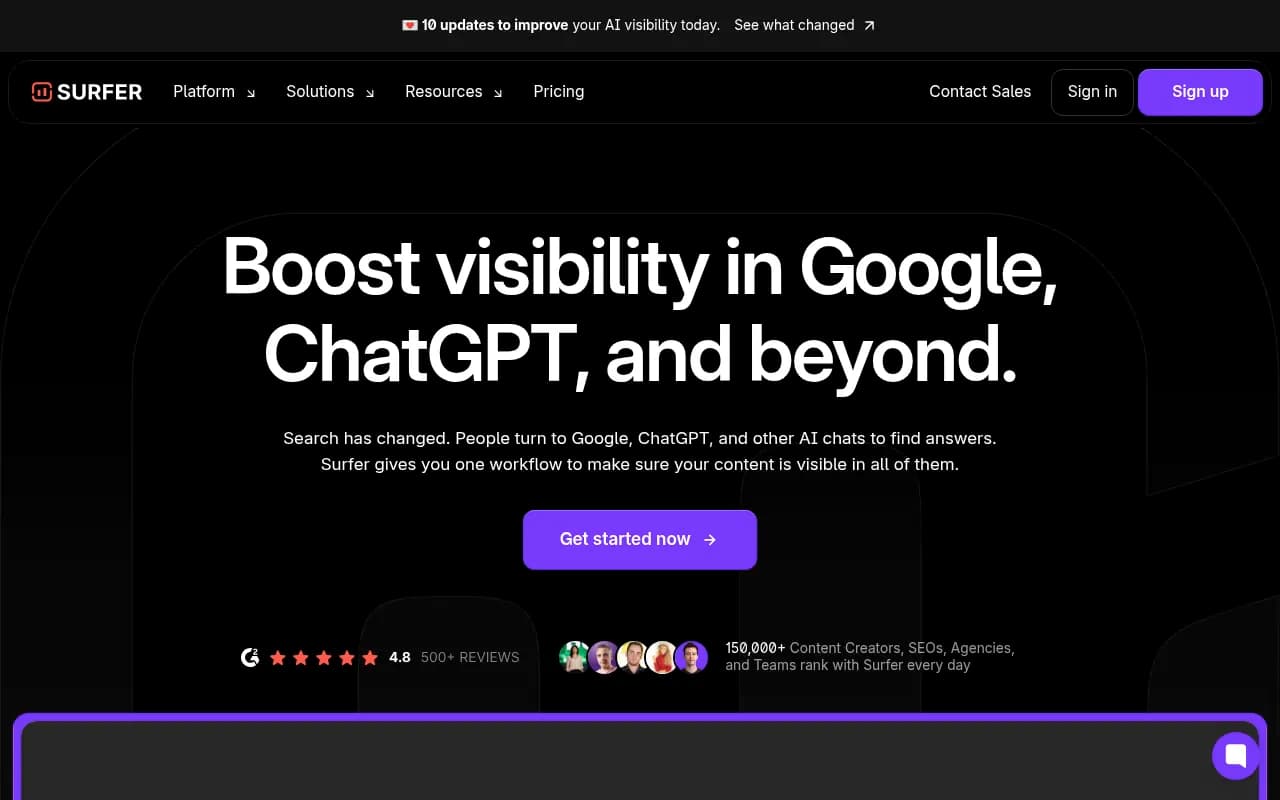
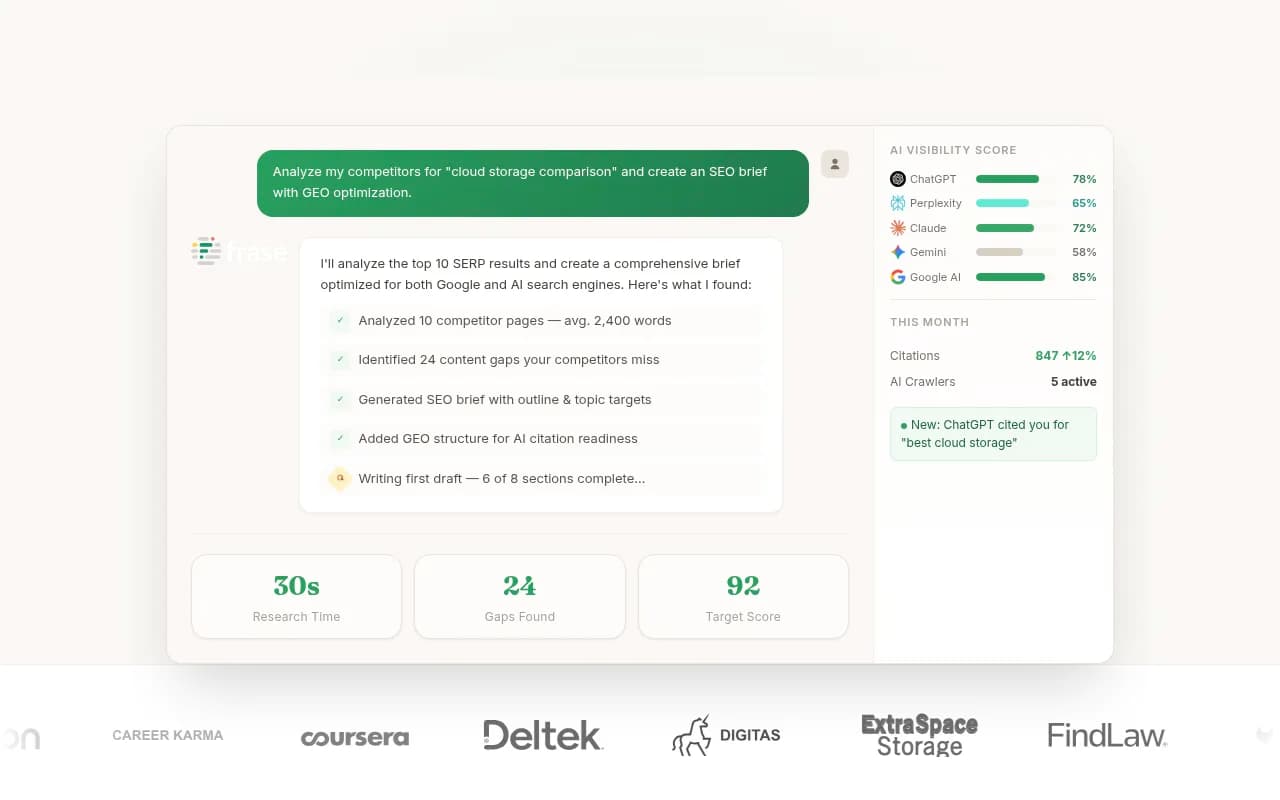
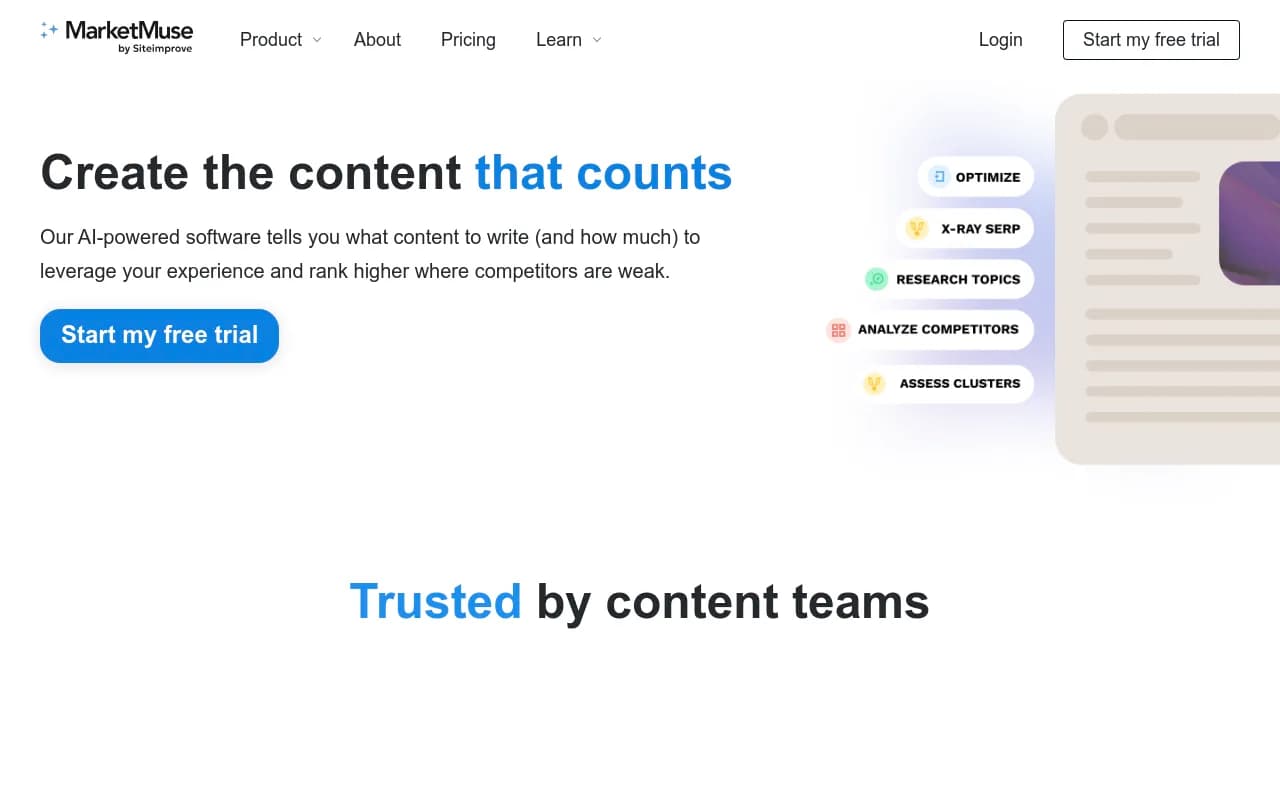
Tools in the SEO research category help here. Surfer SEO and Frase pull SERP data and content gaps into briefs, and MarketMuse is built around planning topical coverage.
If you want to build topical maps before you write anything, Topical Map AI generates content maps you can sanity-check against your own expertise.
Step 2: Write briefs that do the thinking
The quality of an AI draft is mostly decided before generation. A good brief includes:
- Target query and the search intent in one sentence
- The direct answer that should appear in the first two sentences
- Required sections, taken from what top-ranking and AI-cited pages cover
- The unique element: a stat from your own data, a customer example, a screenshot, a quote from an SME
- Voice examples (two or three paragraphs you actually like)
- Internal links to include
- Things to leave out
That last one matters more than people think. The SEC piece quotes the idea well: good content is not about including everything, it is about knowing what not to include.
For drafting, ChatGPT and Claude are the common picks. Both work well when set up as a shared project or custom GPT so everyone writes from the same voice rules and brief template.
If you are standardizing outputs across a team, Jasper adds workflow and brand controls on top of the model.
Step 3: Match page type to how AI engines cite
Most scaling advice stops at "rank in Google." In 2026 you also want to be cited in ChatGPT, Perplexity, and AI Overviews, and the content types that get cited are not evenly distributed.
Promptwatch Data's ChatGPT citation share by content type report (Sep 28 to Oct 4, 2026) breaks down which formats earn citations:
| Content type | Share of ChatGPT citations |
|---|---|
| Product pages | 22.4% |
| Landing pages | 16.8% |
| Listicles | 13.6% |
| How-to guides | 8.7% |
| Documentation | 7.5% |
| General articles | 6.1% |
| Comparisons | 5.9% |
| News | 5.7% |
| FAQ pages | 3.3% |
| Reviews | 1.7% |
A few things jump out. Pages that describe what a company sells (product plus landing pages) make up about 39% of citations. For commercial prompts like "best CRM for small businesses," product pages, landing pages, listicles, and comparisons add up to almost 70%. For informational prompts, how-tos climb to 10.7% and docs to 8.5%. Branded prompts lean on reviews, which hit 5.6%, more than three times their share across all prompts.
The practical reading: if your scaled content program is 100% blog posts, you are skipping the formats AI engines lean on most. Spend part of your AI-assisted capacity on comparison pages, how-to guides, FAQs, and accurate product and landing pages, not just articles.
Step 4: Plan for decay and refresh
Scaling is not only about publishing. It is about keeping what you published alive. Promptwatch's content half-life in ChatGPT report tracked pages cited on July 6, 2026 through Oct 4, 2026:
| Content type | Still cited after 60 days |
|---|---|
| Landing pages | 69% |
| Docs | 67% |
| Comparisons | 63% |
| Listicles | 60% |
| Product pages | 55% |
| Reviews and how-tos | 55% |
| News | 41% |
Product pages, reviews, and how-tos hit their half-life at roughly 74 to 77 days. News hits it at 36 days, and almost a quarter of news pages are never cited again after day 0.
This changes how you budget. Treat news-style content as short-burst visibility. Put product pages, how-tos, and listicles on a refresh calendar, roughly every 60 days is a sensible starting point. Landing pages, docs, and comparisons age better, so they are the best place to invest in durable quality.
Step 5: Build an editing gate that cannot be skipped
A Reddit thread on agency AI workflows made a point I have seen first-hand: the human editing step is where most people cut corners. Make it a literal gate in your process. A page does not move to publish until an editor signs off on this checklist:
- Every statistic has a source, and the source was opened and read
- Claims match what you actually know or can demonstrate
- At least one element is original: first-party data, a real example, a screenshot, an expert quote
- The first sentence under each heading answers the question directly
- The voice does not sound like every other AI draft (cut the filler openers, generic transitions, and symmetrical lists)
- Internal links are placed where they help a reader, not stuffed at the end
- Schema and metadata are in place
For the polish stage, grammar and rewriting tools such as Wordtune help with clarity, but they do not fix a missing idea.

Bring the expert in early, not late
The cheapest way to add expertise is a 15-minute call or a voice memo before drafting. Transcribe it, feed it into the brief, and the draft starts with real opinions instead of generic ones. Asking an SME to review a finished draft works too, but they will mostly fix errors. Asking them first changes what the article says.
Step 6: Choose tools by task, not by hype
No single tool does everything well. Here is how I would map the common categories:
| Task | What matters | Options from the catalog |
|---|---|---|
| Drafting and ideation | Following a brief, nuance | Claude, Jasper |
| SERP-based briefs and scoring | Real SERP data, gap analysis | Surfer SEO, Frase, Clearscope |
| Content planning | Topic coverage | MarketMuse, Topical Map AI |
| Brief building | Fast research | Content Harmony, NeuralText |
| High-volume generation | Cost per piece | Byword, SurgeGraph, Rytr |
| Short-form copy | Speed | Rytr, Copy.ai |
| Workflow automation | Connecting steps | n8n, Zapier, Make |
Two cautions. First, tools built for high-volume generation are exactly where unedited-at-scale problems start, so pair them with a strict editing gate. Second, optimization scores (Surfer's Content Score, for example) tell you how your draft compares to top-ranking pages. They are useful, but a draft can score well and still say nothing new.

If you want to automate hand-offs (brief to draft to review queue to CMS), n8n and Zapier are the usual glue.

Step 7: Measure whether AI engines cite what you publish
Rankings are one signal. In 2026 you also need to know whether ChatGPT, Perplexity, and AI Overviews mention or cite your pages, and whether that traffic converts. Page-level questions worth answering:
- Which new pages get crawled by AI bots, and which hit errors?
- Which pages are cited, for which prompts?
- Which pages rank in Google but never get cited?
- Does AI-referred traffic convert?
This is where an AI visibility platform earns its keep. Promptwatch tracks citations across the major AI engines and also shows IP-verified AI crawler logs, page-level citation data, and traffic from AI platforms. Its content gap analysis and Content Agent can then turn visibility gaps into new or refreshed pages, which fits the "scale with a feedback loop" idea better than publishing blind. Crisp, for example, reported 2x higher conversion rates from AI traffic than from traditional channels while scaling to 5 to 10 articles a day.

If you want to compare options before committing, the GEO software directory at bestgeosoftware.com lists tools in this category. Monitoring-only trackers such as Otterly.AI and Peec AI are cheaper starting points, but they tell you where you are invisible without helping you fix it.


A workflow you can copy
Here is the whole thing in one pass:
- Choose a cluster and confirm intent from the live SERP and AI answers.
- Write the brief: direct answer, sections, unique element, voice samples, internal links.
- Capture SME input (call, memo, or Slack thread).
- Draft with AI from the brief plus SME notes.
- Edit hard: facts, voice, depth, structure.
- Optimize: headings, answer-first paragraphs, schema, internal links.
- Publish and request indexing.
- Track crawls, rankings, citations, and conversions per page.
- Refresh on a schedule based on content type, roughly 60 days for product pages, how-tos, and listicles.
- Retire or merge pages that never earn traffic or citations.
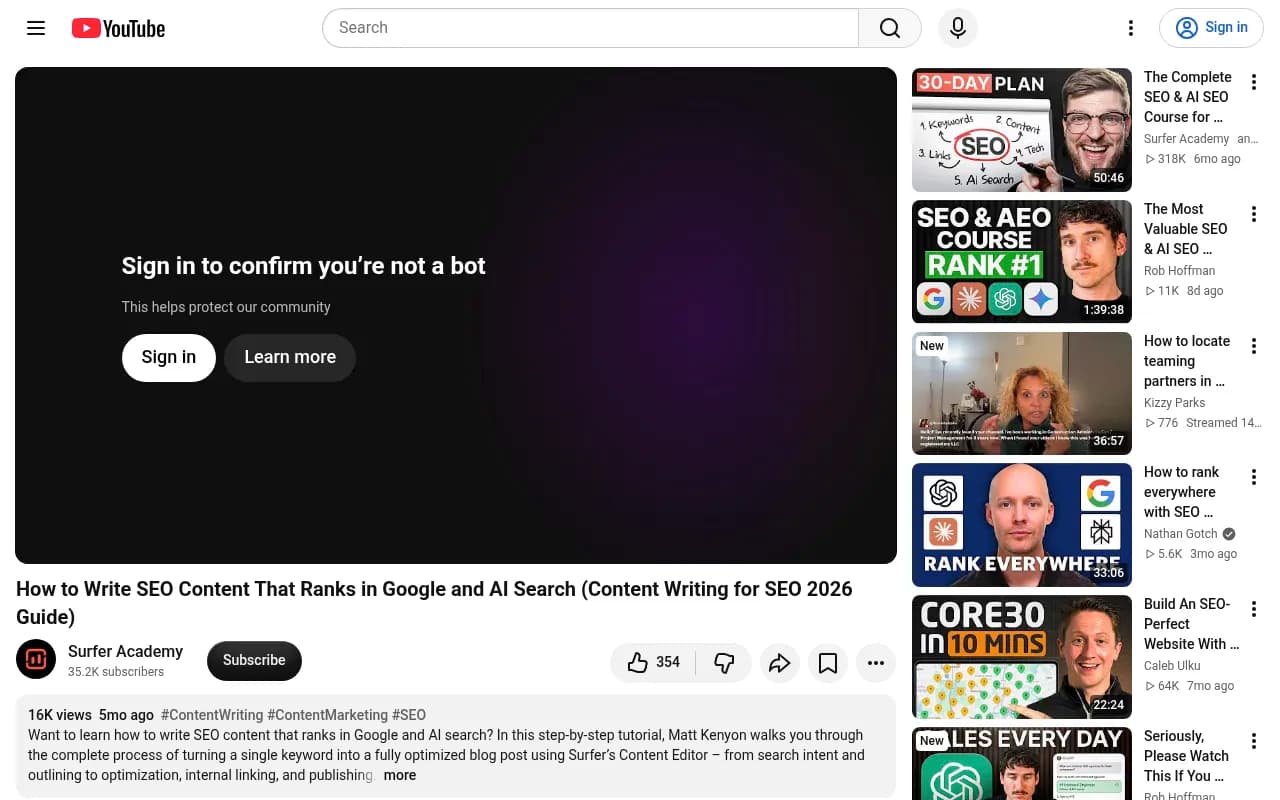
A video walkthrough from Surfer Academy covers a keyword-to-published-post flow, from search intent and outline through internal linking and pre-publish review, if you want to see one version in action.
Mistakes that get scaled programs in trouble
Publishing in bulk without a gate
Dumping hundreds of unedited articles with no expertise, fact-checking, or unique value is the classic recipe for a ranking drop. Cap your weekly volume at what your editors can actually review.
Writing only informational posts
Based on the citation data above, a blog-only strategy leaves the most-cited formats on the table.
Ignoring decay
Publishing 50 how-tos and never touching them again means roughly half of them stop being cited within about 75 days.
Chasing detector scores
It does not help rankings. Time spent "humanizing" text to pass a detector is time not spent adding a real example.
Counting output instead of outcomes
Articles published is a vanity metric. Citations, qualified traffic, and conversions per page are the ones to report.
Do you need help running this?
If you do not have the editors or the measurement setup in-house, an agency can fill the gap. 1001 SEO Media, which publishes this site, runs content strategy, technical SEO, and generative engine optimization for teams that want senior specialists and monthly reporting, with no long-term contracts. For anything else, the framework above works fine as a do-it-yourself operating procedure.
Bottom line
AI changed the cost of a first draft, not the value of a good page. Scale the parts that are genuinely scalable (research, briefs, drafts, formatting) and protect the parts that are not (expertise, editing, original evidence). Match formats to what AI engines actually cite, refresh on a schedule tied to decay, and measure per page. If you do that, volume stops being a risk and becomes an advantage.