Key Takeaways
- Writesonic starts at $39/mo vs Promptwatch at $99/mo, but Promptwatch includes more prompts and better crawler log access at entry level
- Promptwatch monitors 10 AI models including ChatGPT Shopping and Reddit/YouTube tracking -- Writesonic covers similar ground but with different emphasis on content creation
- Writesonic positions itself as a content-first platform with AI writing built in, while Promptwatch focuses on the full optimization loop from gap analysis to content generation to tracking
- Both platforms offer Answer Gap Analysis, but Promptwatch's is grounded in 880M+ citations and includes prompt volume estimates and difficulty scores
- Promptwatch provides real-time AI crawler logs showing exactly when ChatGPT, Claude, and Perplexity crawl your site -- a feature most competitors (including Writesonic) don't offer
- For agencies managing multiple clients, Promptwatch's Business plan ($579/mo for 5 sites) is more scalable than Writesonic's Advanced plan ($499/mo, site limits unclear)
Overview
Writesonic
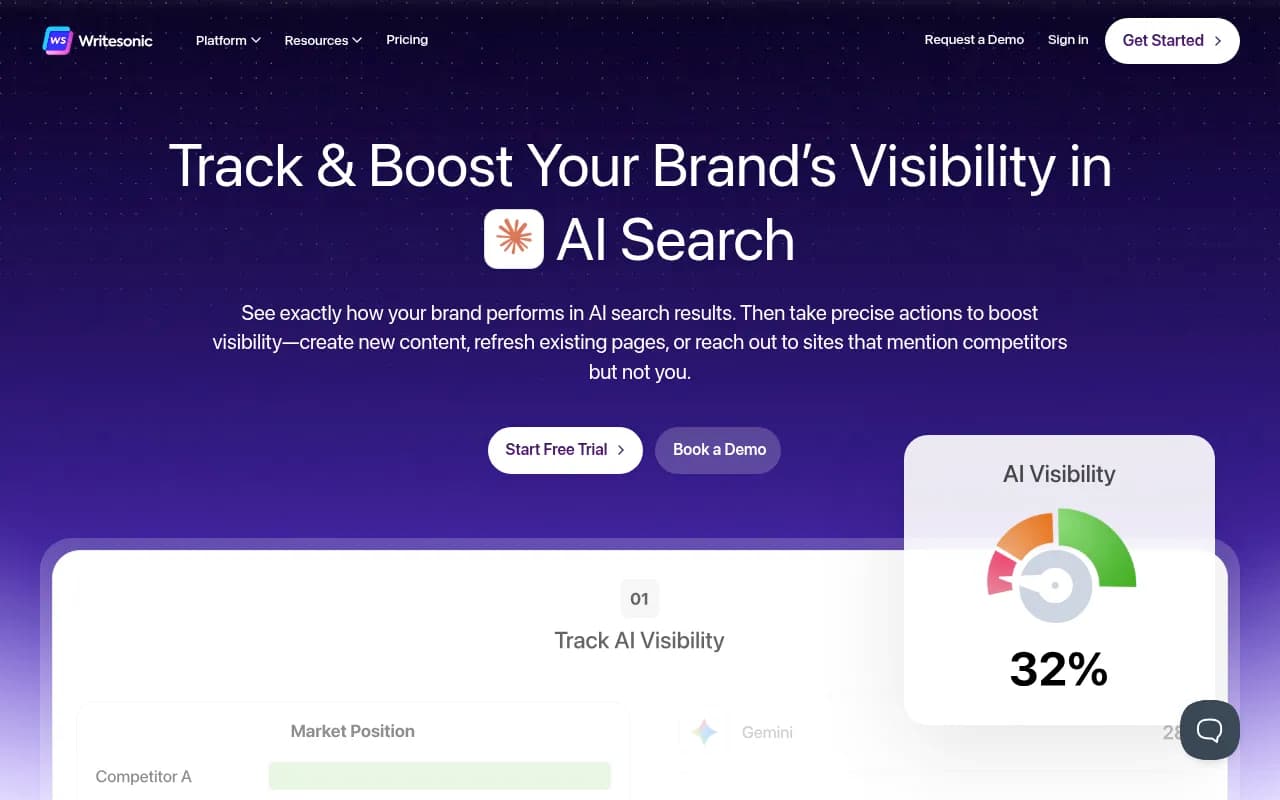
Writesonic entered the AI search visibility space as an extension of its AI writing platform. It tracks how brands appear across ChatGPT, Perplexity, Gemini, and other AI models, with a strong emphasis on content creation. The platform identifies citation gaps and generates optimized content to fill them. Pricing starts at $39/mo for the Lite plan, with Advanced at $499/mo. Annual billing saves 20%.
Promptwatch

Promptwatch is a dedicated AI search visibility platform used by 7,000+ brands including Booking.com, Center Parcs, and Yelp. It monitors 10 AI models and provides the full optimization cycle: find content gaps, generate articles grounded in citation data, track results with page-level visibility scores. The platform includes AI crawler logs, Reddit/YouTube insights, and ChatGPT Shopping tracking. Pricing runs from $99/mo (Essential) to $579/mo (Business), with agency/enterprise custom pricing available.
Side-by-Side Comparison
| Feature | Writesonic | Promptwatch |
|---|---|---|
| Starting price | $39/mo (Lite) | $99/mo (Essential) |
| AI models monitored | 10+ (ChatGPT, Perplexity, Gemini, etc.) | 10 (ChatGPT, Perplexity, Google AI Overviews, Claude, Gemini, Meta/Llama, DeepSeek, Grok, Mistral, Copilot) |
| Prompts included (entry plan) | Not specified | 50 prompts |
| Content generation | Yes, AI writing agent | Yes, AI writing agent (grounded in 880M+ citations) |
| AI crawler logs | Not mentioned | Yes, real-time logs |
| Answer Gap Analysis | Yes | Yes, with prompt volumes and difficulty scores |
| Reddit/YouTube tracking | Not specified | Yes, dedicated insights |
| ChatGPT Shopping tracking | Not specified | Yes |
| Multi-language support | Yes | Yes, any language/region |
| Traffic attribution | Not specified | Yes (code snippet, GSC integration, server logs) |
| API access | Not specified | Yes, plus Looker Studio integration |
| Free trial | Yes | 7 days |
| Annual discount | 20% | 25% |
Pricing comparison
| Plan | Writesonic | Promptwatch |
|---|---|---|
| Entry | $39/mo (Lite) | $99/mo (Essential, 1 site, 50 prompts, 5 articles) |
| Mid-tier | Not specified | $249/mo (Professional, 2 sites, 150 prompts, 15 articles, crawler logs) |
| High-tier | $499/mo (Advanced) | $579/mo (Business, 5 sites, 350 prompts, 30 articles) |
| Enterprise | Custom | Custom |
| Annual savings | 20% | 25% |
Writesonic's pricing structure is less transparent -- the $39 Lite plan exists, but what you get for that price isn't detailed on the public site. Promptwatch spells out exactly what each tier includes: number of sites, prompts, articles, and which features unlock at each level.
Content generation and optimization
Writesonic built its reputation on AI writing, and that shows here. The platform generates content to fill citation gaps, with the writing engine as a core feature. The content is optimized for AI search, but the specifics of how it's grounded in citation data aren't as clear as Promptwatch's approach.
Promptwatch's AI writing agent generates articles, listicles, and comparisons based on 880M+ citations analyzed, prompt volumes, persona targeting, and competitor analysis. It's not generic SEO filler -- the content is engineered to get cited by ChatGPT, Claude, and Perplexity based on what those models actually cite. The platform shows you which topics and angles AI models want answers to but can't find on your site, then helps you create exactly that content.
Verdict: Writesonic has the writing chops, but Promptwatch's citation-grounded approach is more targeted for AI search visibility. If you need a general AI writing tool that also does GEO, Writesonic works. If you want content specifically designed to rank in AI search, Promptwatch's data-driven generation is stronger.
Answer Gap Analysis and prompt intelligence
Both platforms offer Answer Gap Analysis -- the ability to see which prompts competitors rank for but you don't. This is table stakes for any GEO platform in 2026.
Writesonic identifies these gaps and suggests content to fill them. The interface shows you where you're missing, but the depth of prompt intelligence isn't specified.
Promptwatch goes further with prompt volume estimates, difficulty scores, and query fan-outs that show how one prompt branches into sub-queries. You can prioritize high-value, winnable prompts instead of guessing. The platform also shows you exactly which pages, Reddit threads, YouTube videos, and domains AI models cite in their responses for each prompt. This level of granularity helps you understand not just where you're missing, but why.
Verdict: Promptwatch's prompt intelligence is more actionable. Volume estimates and difficulty scores help you prioritize, and citation source analysis shows you where to publish and what to optimize.
AI crawler logs and indexing
This is where the platforms diverge sharply.
Writesonic doesn't mention AI crawler logs in its public materials. You can track visibility and citations, but whether you can see when ChatGPT or Claude actually crawl your site is unclear.
Promptwatch provides real-time logs of AI crawlers hitting your website -- which pages they read, errors they encounter, how often they return. This is critical for understanding how AI engines discover your content and fixing indexing issues. Most competitors lack this entirely, and it's a major differentiator for Promptwatch.
Verdict: Promptwatch wins decisively here. Crawler logs are essential for diagnosing why AI models aren't citing your content, and Writesonic doesn't appear to offer them.
Reddit, YouTube, and UGC tracking
AI models increasingly cite Reddit threads, YouTube videos, and other user-generated content in their responses. Tracking these sources is critical for understanding the full citation landscape.
Writesonic's public materials don't specify Reddit or YouTube tracking capabilities.
Promptwatch surfaces Reddit discussions and YouTube videos that directly influence AI recommendations. You can see which threads and videos AI models cite for specific prompts, then decide whether to engage in those communities or create similar content.
Verdict: Promptwatch's Reddit/YouTube insights are a clear advantage. If your category has active Reddit discussions or YouTube content, this feature is invaluable.
ChatGPT Shopping and product recommendations
ChatGPT now includes shopping carousels and product recommendations in some responses. Tracking when your brand appears in these is a new frontier for GEO.
Writesonic doesn't mention ChatGPT Shopping tracking.
Promptwatch monitors when your brand appears in ChatGPT's product recommendations and shopping carousels. This is especially relevant for e-commerce brands and SaaS companies that want to be recommended when users ask for product suggestions.
Verdict: Promptwatch is ahead on this emerging feature. If your brand sells products or competes in a category where ChatGPT makes recommendations, this matters.
Multi-language and multi-region support
Both platforms support multi-language and multi-region tracking, which is essential for global brands.
Writesonic offers multi-language support, but the specifics of how regions and personas work aren't detailed.
Promptwatch lets you monitor AI responses in any language, from any country, with customizable personas that match how your actual customers prompt. This is more granular than just language support -- you can test different user intents and contexts.
Verdict: Tie, with a slight edge to Promptwatch for persona customization.
Traffic attribution and ROI tracking
Understanding whether AI visibility drives actual traffic and revenue is the final piece of the puzzle.
Writesonic's public materials don't specify traffic attribution capabilities.
Promptwatch offers three methods for traffic attribution: code snippet, Google Search Console integration, or server log analysis. You can connect visibility scores to actual traffic and revenue, closing the loop from optimization to results.
Verdict: Promptwatch's traffic attribution is a major advantage. Without it, you're flying blind on ROI.
Integrations and API access
Writesonic doesn't detail API access or integrations in its public materials.
Promptwatch provides API access for custom workflows and Looker Studio integration for custom reporting. This is critical for agencies and enterprises that need to plug GEO data into existing dashboards and systems.
Verdict: Promptwatch's API and Looker Studio integration are essential for advanced users.
Ease of use and learning curve
Writesonic's interface emphasizes content creation, which makes sense given its roots as an AI writing platform. If you're already familiar with AI writing tools, the transition should be smooth.
Promptwatch's interface is built around the optimization loop: find gaps, create content, track results. The dashboard is dense with data, but the structure is logical. There's a learning curve if you're new to GEO, but the platform guides you through the process.
Verdict: Writesonic may be easier for users who just want to generate content. Promptwatch is more comprehensive but requires more time to master.
Support and documentation
Both platforms offer support, but the specifics vary by plan.
Writesonic's support details aren't public, but as a more established AI writing platform, they likely have robust documentation.
Promptwatch offers support across all plans, with the level of access increasing at higher tiers. The platform also has a knowledge base and onboarding resources.
Verdict: Likely a tie, though Promptwatch's focus on GEO means their support team is specialized in AI search visibility.
Pros and cons
Writesonic pros
- Lower entry price ($39/mo vs $99/mo)
- Strong AI writing capabilities from established platform
- Multi-language support
- Annual discount (20%)
Writesonic cons
- No AI crawler logs (or not mentioned)
- Prompt intelligence details unclear
- No Reddit/YouTube tracking (or not mentioned)
- No ChatGPT Shopping tracking (or not mentioned)
- Traffic attribution not specified
- API access not specified
- Less transparent pricing structure
Promptwatch pros
- Real-time AI crawler logs (unique feature)
- Prompt volume estimates and difficulty scores
- Reddit/YouTube tracking
- ChatGPT Shopping tracking
- Traffic attribution (3 methods)
- API and Looker Studio integration
- Content generation grounded in 880M+ citations
- Clear, transparent pricing with exact feature breakdowns
- 7,000+ brands including Booking.com, Center Parcs, Yelp
- 25% annual discount
Promptwatch cons
- Higher entry price ($99/mo vs $39/mo)
- Steeper learning curve for comprehensive feature set
- More data-dense interface
Who should pick which tool
Choose Writesonic if:
- You're primarily looking for an AI writing tool that also does GEO monitoring
- Budget is tight and you need the lowest entry price
- You want a simpler interface focused on content creation
- You don't need advanced features like crawler logs or traffic attribution
Choose Promptwatch if:
- You're serious about AI search visibility as a revenue channel
- You need the full optimization loop: gap analysis, content generation, tracking, and attribution
- You want to understand exactly when and how AI models crawl your site
- Reddit, YouTube, and ChatGPT Shopping tracking matter for your category
- You're an agency managing multiple clients (Business plan scales better)
- You need API access and custom reporting integrations
- You want prompt intelligence (volume, difficulty, fan-outs) to prioritize efforts
- You need to prove ROI with traffic attribution
Final verdict
Promptwatch is the stronger platform for brands and agencies that treat AI search visibility as a strategic priority. The crawler logs, prompt intelligence, Reddit/YouTube tracking, and traffic attribution are features that Writesonic doesn't match (or doesn't publicly specify). The higher entry price ($99/mo vs $39/mo) is justified by the depth of features and the actionable data you get.
Writesonic works if you're dipping your toes into GEO and want a content-first tool with monitoring capabilities. The lower price is appealing, but you're missing critical features that become essential as you scale your AI search efforts.
For most brands serious about AI visibility in 2026, Promptwatch's comprehensive approach -- from finding gaps to generating content to tracking results -- makes it the better investment. The platform doesn't just show you where you're invisible; it helps you fix it with data-driven content and real-time diagnostics.