Key Takeaways
- Price difference is massive: Bluefish starts around $4,000/month with annual contracts, while Promptscout offers a free tier and paid plans from $15/month -- a 250x+ price gap
- Target audience couldn't be more different: Bluefish is built for Fortune 500 marketing teams with enterprise security requirements; Promptscout targets startups, agencies, and SMBs who need quick setup
- Feature depth vs simplicity: Bluefish offers custom audiences, tailored prompts, automated workflows, and SOC 2 compliance; Promptscout focuses on core monitoring with actionable insights and faster time-to-value
- Platform coverage: Both track ChatGPT and Gemini, but Bluefish adds Perplexity and "agentic commerce" tracking; Promptscout includes Google AI Overviews
- Promptscout wins on accessibility: You can start monitoring today with a free account. Bluefish requires a sales call, demo, and custom quote.
- If you're choosing between these two, you probably need Promptscout: The overlap in use cases is minimal -- if you're comparison shopping at this level, enterprise pricing likely isn't in your budget
Overview
Bluefish: Enterprise AI marketing for Fortune 500 brands
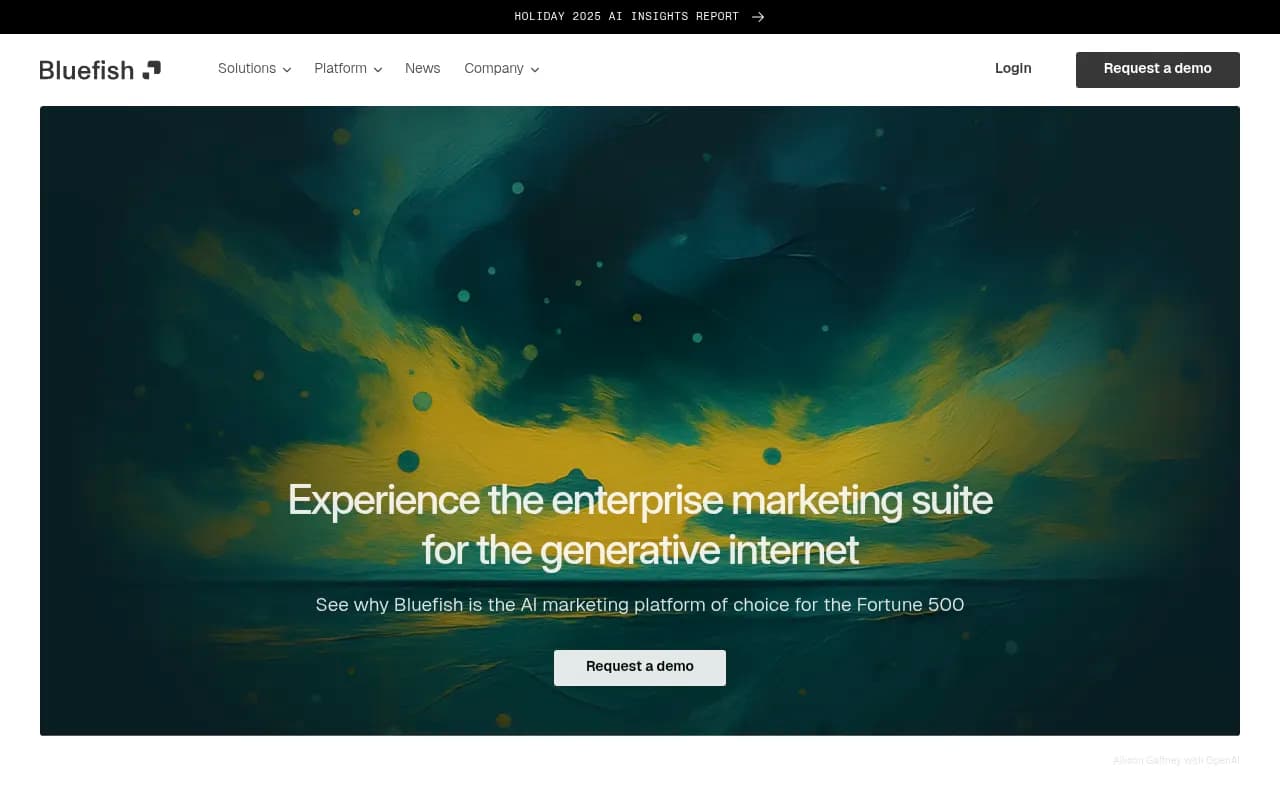
Bluefish positions itself as "the AI marketing platform of choice for the Fortune 500." It's an enterprise-grade solution designed for large marketing teams that need deep control over brand presence across AI search engines and what they call "agentic commerce" (AI-driven shopping recommendations).
The platform emphasizes depth over breadth -- custom audiences, tailored prompt sets, automated optimization workflows, and the kind of enterprise features (SOC 2, infosec reviews, data segmentation) that large companies require. Bluefish tracks ChatGPT, Perplexity, and other AI channels, with a focus on going "beyond superficial metrics" to understand how AI systems "think."
Pricing starts around $4,000/month with annual contracts and scales based on number of brands, markets, and features. There's no self-service option -- you request a demo and get a custom quote.
Promptscout: Accessible AI brand monitoring from $15/month
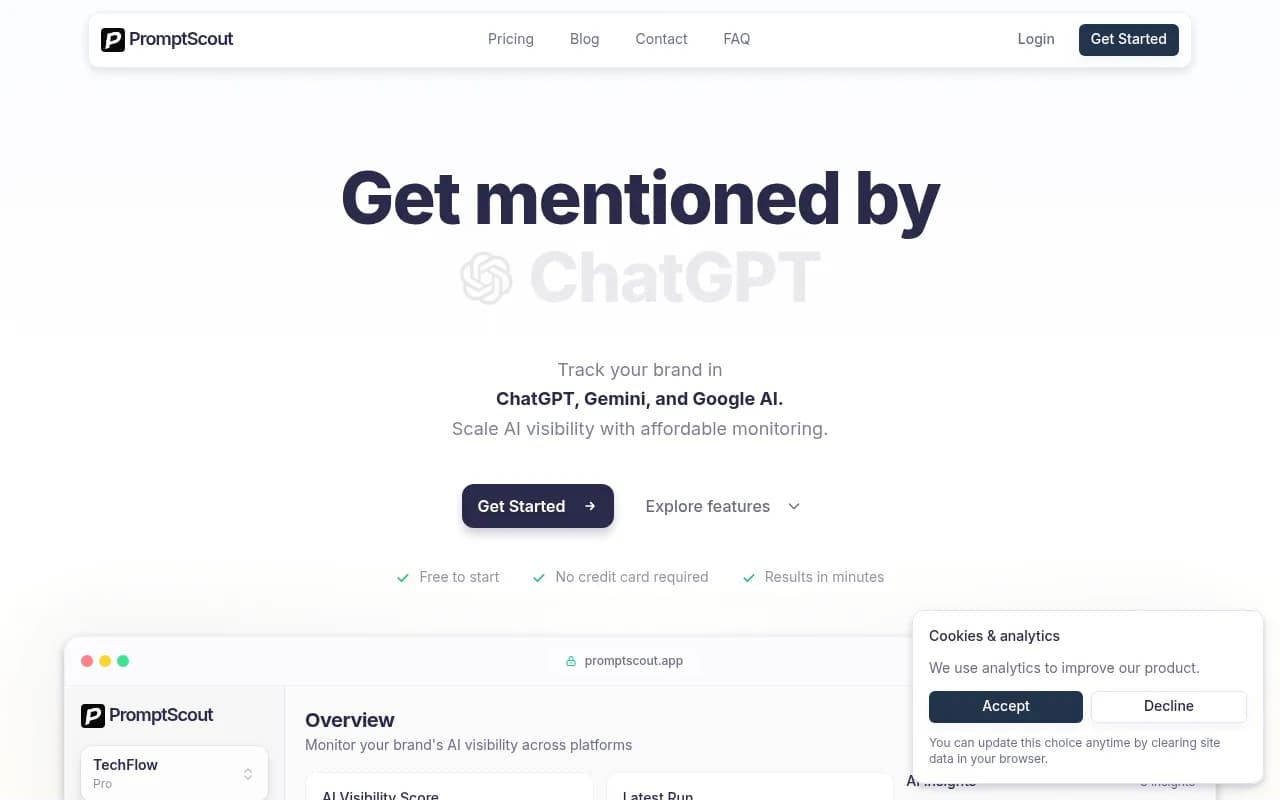
Promptscout takes the opposite approach: fast setup, transparent pricing, and a focus on getting you actionable insights quickly. It monitors your brand across ChatGPT, Gemini, and Google AI Overviews, tracking mentions, competitor benchmarking, citation analysis, and share of voice.
The interface is clean and straightforward -- you see your AI visibility score, which competitors are mentioned alongside you, what sources AI systems cite, and specific insights like "improve visibility on G2 reviews" or "create comparison content vs [competitor]." It's built for teams that want to start monitoring today, not in three months after a procurement process.
Pricing is freemium: free tier available, then $15/month (Starter), $39/month (Growth), $99/month (Pro), and custom agency pricing. You can sign up and start tracking immediately.
Side-by-Side Comparison
| Feature | Bluefish | Promptscout |
|---|---|---|
| Starting price | ~$4,000/mo (annual contract) | Free tier, $15/mo paid |
| Free tier | No | Yes |
| Target audience | Fortune 500, enterprise marketing teams | Startups, SMBs, agencies, solopreneurs |
| Setup process | Sales demo → custom quote → contract | Sign up today, start monitoring |
| AI platforms tracked | ChatGPT, Perplexity, others (unspecified) | ChatGPT, Gemini, Google AI Overviews |
| Custom audiences | Yes (core feature) | No |
| Competitor tracking | Yes | Yes (leaderboard view) |
| Citation analysis | Yes | Yes (top domains cited) |
| Automated insights | Yes (optimization workflows) | Yes (actionable recommendations) |
| Enterprise features | SOC 2, custom data segmentation, infosec-ready | Standard security, simpler data model |
| Agentic commerce tracking | Yes (AI shopping recommendations) | No |
| Self-service access | No (sales-led only) | Yes |
Pricing: Enterprise vs accessible
The pricing gap here is the story. These platforms serve completely different markets.
| Plan | Bluefish | Promptscout |
|---|---|---|
| Free tier | Not available | Yes (limited monitoring) |
| Entry plan | ~$4,000/mo (custom quote) | $15/mo (Starter) |
| Mid-tier | Custom (likely $8k-15k/mo) | $39/mo (Growth) |
| High-tier | Custom (enterprise pricing) | $99/mo (Pro) |
| Agency/Enterprise | Custom annual contracts | Custom pricing available |
| Contract terms | Annual standard | Monthly or annual |
Bluefish doesn't publish pricing -- you request a demo and get a quote based on your needs (number of brands, markets, feature set). Industry sources suggest starting around $4,000/month, scaling significantly from there. This is standard for enterprise software targeting Fortune 500 companies.
Promptscout is transparent: $15/month gets you started, $39/month for growth-stage companies, $99/month for the full feature set. The Pro plan at $99/month costs 2.5% of Bluefish's entry price. You can start with the free tier and upgrade when you need more.
If budget is a factor in your decision, Promptscout wins by default. If budget isn't a factor and you're a large enterprise, Bluefish's custom pricing model makes sense.
Platform coverage and monitoring depth
Both platforms track the major AI systems, but with different coverage and depth.
Bluefish monitors ChatGPT, Perplexity, and "other AI channels" (not fully specified on their site). They emphasize "agentic commerce" -- tracking how your brand appears in AI-driven shopping recommendations and product suggestions. The platform is built around custom prompt sets tailored to your specific market and audience, rather than generic monitoring.
Their differentiation is depth: you're not just tracking whether you're mentioned, but understanding how AI systems position your brand, what context they use, and how to influence that systematically. The "how AI thinks" framing suggests they're analyzing reasoning patterns and citation logic, not just counting mentions.
Promptscout explicitly covers ChatGPT, Gemini, and Google AI Overviews. The interface shows real-time visibility scores ("78% - mentioned in 31/40 responses"), competitor leaderboards, and citation source analysis. You see which domains (G2, Reddit, TechCrunch, etc.) drive your AI mentions and get specific insights like "improve visibility on G2 reviews."
The monitoring is more straightforward: track mentions, benchmark competitors, analyze sources, get actionable recommendations. Less customization, but faster setup and clearer metrics.
For most companies, Promptscout's coverage (ChatGPT, Gemini, Google AI Overviews) hits the platforms that matter. Bluefish's Perplexity tracking and agentic commerce focus are valuable if those channels are critical to your business.
Feature depth: Enterprise control vs actionable simplicity
Custom audiences and prompts
Bluefish's core differentiator is customization. You define specific audiences (e.g. "CMOs at mid-market SaaS companies" or "enterprise buyers in financial services") and tailor prompt sets to match how those audiences actually search. This matters for large brands where generic monitoring misses nuance.
Promptscout uses a standard prompt set across all users. You don't customize audiences or queries -- you monitor how AI systems respond to common queries in your category. This is simpler but less precise for niche markets.
Verdict: If you need audience segmentation and custom prompts, Bluefish is the only option here. If you're fine with standard monitoring, Promptscout's approach works.
Competitor analysis
Both platforms track competitors, but differently.
Bluefish lets you define your competitive set and track how AI systems position you relative to them. The emphasis is on "control and differentiation" -- understanding why competitors get mentioned and how to shift that in your favor.
Promptscout shows a competitor leaderboard with mention counts ("TechFlow: 47 mentions, Flowwise: 38, StreamAI: 32") and surfaces insights like "Flowwise is your closest competitor in AI responses. Create comparison content vs Flowwise." It's more tactical and immediate.
Verdict: Bluefish offers deeper competitive intelligence. Promptscout gives you faster, more actionable competitor insights.
Citation and source analysis
Both platforms analyze what sources AI systems cite when mentioning brands.
Bluefish emphasizes understanding citation patterns to optimize your content strategy. The platform is built around "influence" -- not just tracking citations but systematically improving them.
Promptscout shows you the top domains cited (G2, Reddit, TechCrunch, etc.) with counts and generates insights like "Your brand gets cited heavily from G2 reviews. Encourage customers to leave reviews there." The source breakdown includes type labels (Editorial, UGC, Other).
Verdict: Similar capabilities, different presentation. Promptscout's insights are more immediately actionable. Bluefish likely goes deeper for enterprise use cases.
Automation and workflows
Bluefish highlights "automated optimization workflows" as a key feature -- the platform doesn't just show you data, it helps you act on it systematically. For large teams managing multiple brands across markets, this matters.
Promptscout generates automated insights ("Review Outreach," "Content Creation," "Community Engagement") with specific recommendations, but doesn't appear to have workflow automation in the enterprise sense.
Verdict: Bluefish wins on workflow automation for large teams. Promptscout's insights are actionable but require manual follow-through.
Enterprise features and security
Bluefish is built for enterprise: SOC 2 compliance, passes infosec reviews, custom data segmentation, and the kind of security posture large companies require. They explicitly position this as a differentiator -- "we consistently pass infosec reviews with ease."
Promptscout doesn't emphasize enterprise security features on their site. Standard security practices, but not the compliance certifications or audit-ready infrastructure that Fortune 500 companies need.
If you're at a large company with strict security requirements, Bluefish is designed for your procurement process. If you're a startup or SMB, Promptscout's security is fine and you avoid the enterprise overhead.
User experience and time-to-value
This is where the platforms diverge most sharply.
Bluefish: Sales-led, demo-driven, custom implementation. You request a demo, go through discovery calls, get a custom quote, negotiate contract terms, then onboard with their team. Time-to-value is measured in weeks or months. This is standard for enterprise software, but it's a barrier if you want to start monitoring quickly.
Promptscout: Self-service, sign up today, start monitoring immediately. The interface is clean and intuitive -- you see your visibility score, competitor rankings, citation sources, and insights right away. Time-to-value is measured in minutes.
For most readers of this comparison, Promptscout's accessibility is a huge advantage. If you're at a Fortune 500 company with budget and a formal procurement process, Bluefish's enterprise sales model is expected.
Agentic commerce and AI shopping
Bluefish explicitly tracks "agentic commerce" -- how your brand appears in AI-driven shopping recommendations and product suggestions. As AI systems start recommending products directly (ChatGPT shopping, Google AI shopping results, etc.), this becomes a critical channel.
Promptscout doesn't mention commerce tracking. It's focused on brand mentions and recommendations in general AI responses, not specifically shopping contexts.
If AI commerce is a priority for your business (e.g. you're a consumer brand, e-commerce company, or product manufacturer), Bluefish's commerce focus is valuable. For most B2B companies and service businesses, general AI visibility matters more than shopping recommendations.
Who should choose Bluefish
Bluefish makes sense if:
- You're a Fortune 500 company or large enterprise with significant marketing budget
- You need custom audiences, tailored prompts, and deep segmentation
- Enterprise security (SOC 2, infosec reviews) is a requirement
- You're managing multiple brands across multiple markets
- AI commerce and shopping recommendations are critical to your business
- You have a team that can handle a multi-week implementation process
- Budget starts at $50k+/year for marketing tools
Bluefish is built for companies where "depth and control" justify the price premium. If you're comparing Bluefish to other enterprise platforms (not Promptscout), the decision comes down to feature depth and vendor relationship.
Who should choose Promptscout
Promptscout makes sense if:
- You're a startup, SMB, agency, or solopreneur
- You want to start monitoring AI visibility today, not next quarter
- Transparent pricing and monthly billing matter to you
- You need core monitoring (mentions, competitors, citations, insights) without enterprise complexity
- Budget is under $1,000/month for AI monitoring
- You value simplicity and actionable insights over deep customization
- You're tracking ChatGPT, Gemini, and Google AI Overviews (the platforms most customers use)
Promptscout is built for teams that want fast time-to-value and clear ROI. If you're reading this comparison and thinking "I need to see if this works before committing $50k," Promptscout is your answer.
Pros and cons
Bluefish pros
- Enterprise-grade security and compliance (SOC 2)
- Deep customization (audiences, prompts, workflows)
- Built for Fortune 500 scale and complexity
- Agentic commerce tracking for AI shopping
- Automated optimization workflows
- Dedicated support and implementation team
Bluefish cons
- Pricing starts around $4,000/month (prohibitive for most companies)
- Sales-led process with no self-service option
- Slower time-to-value (weeks to months)
- Feature set may be overkill for smaller companies
- Platform coverage not fully transparent on website
Promptscout pros
- Accessible pricing ($15/mo entry, free tier available)
- Start monitoring immediately (self-service signup)
- Clean, intuitive interface
- Actionable insights generated automatically
- Covers ChatGPT, Gemini, Google AI Overviews
- Fast time-to-value (minutes to hours)
Promptscout cons
- No custom audiences or tailored prompts
- Limited enterprise features (no SOC 2 mentioned)
- Less depth for complex, multi-brand scenarios
- No agentic commerce tracking
- Smaller feature set overall vs enterprise platforms
The real question: Are you actually comparing these?
Here's the thing -- if you're genuinely torn between Bluefish and Promptscout, you're probably not Bluefish's target customer. The price gap (250x+) and target audience difference (Fortune 500 vs startups/SMBs) mean these platforms rarely compete for the same buyer.
Bluefish competes with other enterprise platforms. Promptscout competes with other accessible monitoring tools and DIY solutions.
If you're a Fortune 500 marketing team with $50k+ budget and enterprise requirements, Bluefish is designed for you. You're not comparison shopping with $15/month tools -- you're evaluating enterprise vendors.
If you're a startup, agency, or SMB looking to start monitoring AI visibility without a massive investment, Promptscout is the clear choice. The alternative isn't Bluefish -- it's doing nothing or building something yourself.
The one scenario where this comparison matters: you're a mid-market company (Series B/C startup, growing SMB) trying to decide whether to invest in enterprise-grade monitoring or start with an accessible tool. In that case, start with Promptscout. If you outgrow it and need enterprise features, you can upgrade to Bluefish or a similar platform later. But most companies won't outgrow Promptscout's feature set.
Alternative worth considering
If you're evaluating AI visibility platforms and neither Bluefish nor Promptscout quite fits, Promptwatch offers a middle ground worth exploring. It's more feature-rich than Promptscout (crawler logs, content gap analysis, AI content generation, 880M+ citations analyzed) but more accessible than Bluefish (transparent pricing starting at $99/month, self-service signup).

Promptwatch tracks 10 AI models (ChatGPT, Perplexity, Claude, Gemini, Google AI Overviews, and more) and goes beyond monitoring to help you actually improve your AI visibility -- showing you which prompts competitors rank for but you don't, then helping you create content that gets cited. It's used by 6,700+ brands including Booking.com and has been featured in the Wall Street Journal for its citation data.
The key difference: Promptwatch is built around an action loop (find gaps → create content → track results), not just dashboards. If you want more than monitoring but don't need Fortune 500 enterprise features, it's worth a look.
Final verdict
Choose Bluefish if you're a Fortune 500 company with enterprise budget, security requirements, and complex multi-brand needs. The depth, customization, and agentic commerce tracking justify the premium for large organizations.
Choose Promptscout if you're a startup, SMB, agency, or any company that wants to start monitoring AI visibility today without enterprise complexity or pricing. The accessible pricing, fast setup, and actionable insights make it the practical choice for most readers of this comparison.
The platforms serve different markets. If budget is a consideration in your decision, Promptscout wins. If budget isn't a factor and you need enterprise features, Bluefish is built for you. But realistically, most companies comparing these two should choose Promptscout -- the overlap in target audience is minimal.