Key Takeaways
- Price gap is massive: Bluefish starts around $4,000/month with annual contracts, while Hall AI has a free tier and paid plans likely under $200/month -- making Hall the obvious choice for SMBs and startups
- Enterprise vs accessible: Bluefish is built for Fortune 500 marketing teams with custom audiences, infosec compliance, and white-glove support; Hall is designed for solo marketers and small teams who need quick insights without enterprise overhead
- Agent analytics advantage: Hall AI includes dedicated agent analytics to track how AI crawlers browse your site -- a feature Bluefish doesn't emphasize in their public materials
- Free report to start: Hall offers a completely free shareable report with no email required, letting you test the platform instantly; Bluefish requires a sales demo to get started
- Measurement depth: Bluefish focuses on "how AI thinks" with advanced performance frameworks and optimization workflows; Hall prioritizes straightforward citation tracking and sentiment monitoring
- Both track the same AI engines: ChatGPT, Perplexity, Claude, Gemini, AI Overviews, Copilot -- the core monitoring coverage is similar
Overview
Bluefish: Enterprise AI marketing for Fortune 500 brands
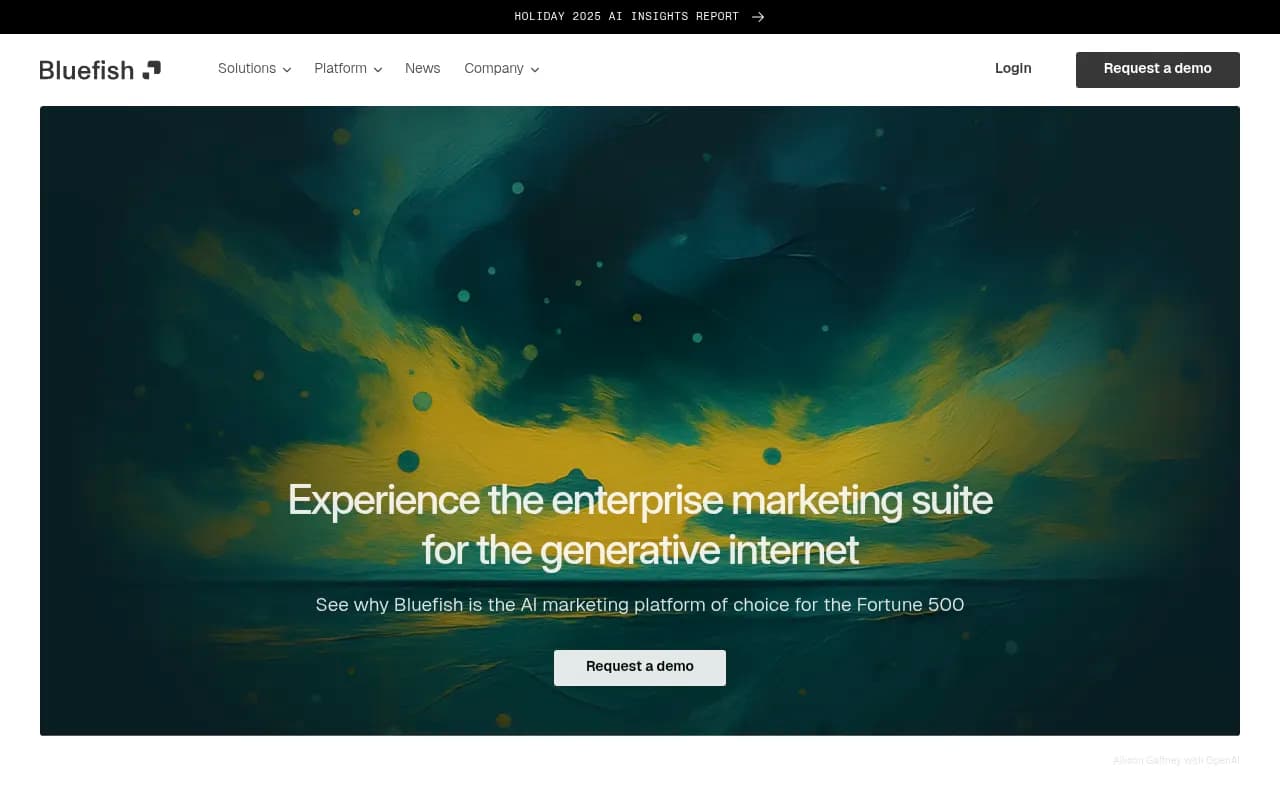
Bluefish positions itself as "the AI marketing platform of choice for the Fortune 500." It's an enterprise-grade solution designed for large marketing teams that need deep control over brand reputation across AI search engines and agentic commerce. The platform emphasizes going "beyond superficial metrics" with custom audiences, tailored prompts, and what they call understanding "how AI thinks." Pricing starts around $4,000/month with annual contracts and custom enterprise plans based on brands, markets, and features. You'll need to request a demo to get started -- there's no self-service option.
Hall AI: Accessible GEO tracking with agent analytics

Hall takes a different approach. It's built for marketers who want to understand how their business appears in AI conversations without enterprise complexity or pricing. The platform monitors ChatGPT, Perplexity, Claude, Gemini, AI Overviews, Copilot, and DeepSeek. What sets Hall apart is the combination of citation tracking, sentiment monitoring, and dedicated agent analytics that show how AI crawlers browse your website. You can start with a completely free shareable report (no email required), and paid plans appear to be significantly more accessible than enterprise alternatives.
Side-by-Side Comparison
| Feature | Bluefish | Hall AI |
|---|---|---|
| Starting price | ~$4,000/month | Free tier available, paid likely $50-150/mo |
| Free trial/tier | No (demo required) | Yes (free report, no signup) |
| Target audience | Fortune 500, enterprise marketing teams | SMBs, startups, solo marketers |
| AI engines monitored | ChatGPT, Perplexity, others (not fully detailed) | ChatGPT, Perplexity, Claude, Gemini, AI Overviews, Copilot, DeepSeek |
| Agent analytics | Not emphasized | ✓ Dedicated feature |
| Citation tracking | ✓ | ✓ |
| Sentiment monitoring | ✓ | ✓ |
| Custom audiences | ✓ Enterprise feature | Not mentioned |
| Infosec compliance | ✓ Passes reviews easily | Not detailed |
| Setup complexity | Sales demo, annual contract | Instant free report |
| Data customization | ✓ Advanced segmentation | Standard reporting |
| Agentic commerce tracking | ✓ | Not emphasized |
Head-to-head feature breakdown
Pricing and accessibility
This is where the two platforms diverge completely. Bluefish operates in the enterprise software world with quote-based pricing starting around $4,000/month and annual contracts as standard. You're looking at a significant budget commitment before you even see the platform. Custom enterprise plans scale based on number of brands, markets, and features -- typical Fortune 500 procurement.
Hall AI flips this model. You can generate a free shareable report instantly without even providing an email address. Paid plans aren't publicly listed, but based on their positioning as accessible to "thousands of marketers worldwide" and the free tier existence, you're likely looking at $50-150/month range for starter plans. This makes Hall the only realistic option for startups, small agencies, and individual marketers.
Verdict: Hall wins on accessibility by a mile. Bluefish's pricing is justified for enterprise buyers with matching budgets, but it's a non-starter for 95% of businesses.
AI engine coverage
Both platforms monitor the major AI engines that matter in 2026. Hall explicitly lists ChatGPT, Perplexity, Claude, Gemini, AI Overviews (Google), Copilot, and DeepSeek. Bluefish mentions ChatGPT and Perplexity prominently but doesn't provide a complete public list of covered engines.
Given Bluefish's enterprise positioning, they likely cover all major engines plus potentially custom integrations for specific client needs. Hall's transparency about exactly which engines they track is helpful for buyers.
Verdict: Functionally similar coverage. Hall gets points for transparency.
Agent analytics and crawler tracking
Hall AI includes a dedicated "Agent Analytics" feature that shows how AI agents and crawlers browse your website in real-time. You can see which pages they read, connect agent activity with conversation data, and understand how AI engines discover your content. This is genuinely useful for diagnosing why certain pages get cited (or don't).
Bluefish doesn't emphasize agent analytics in their public materials. They focus more on brand reputation monitoring and optimization workflows. It's possible this capability exists but isn't marketed prominently.
For context, tools like Promptwatch also offer detailed AI crawler logs as part of their platform -- it's becoming a standard feature in the GEO space because understanding how AI engines index your site is critical for optimization.
Verdict: Hall has a clear advantage here with a dedicated, well-explained agent analytics feature.
Citation and sentiment tracking
Both platforms track where your brand gets cited in AI responses and monitor sentiment. Bluefish frames this as "visibility and influence" with emphasis on understanding "how AI thinks" about your brand. They position their sentiment analysis as deeper than competitors, though specifics aren't detailed publicly.
Hall shows you exactly which pages get cited across "millions of questions people are asking AI" and tracks share of voice, positioning, and sentiment. The interface appears straightforward -- you see the conversations, the citations, and the sentiment data without layers of complexity.
Verdict: Bluefish likely offers more sophisticated analysis for enterprise use cases. Hall provides the core data most marketers actually need without overwhelming them.
Optimization and actionability
Bluefish emphasizes "actionability" as a core differentiator. They offer automated optimization workflows, tailored measurement frameworks, and help teams "focus on metrics that matter." The platform is designed for marketing teams that want to actively improve their AI presence, not just monitor it.
Hall focuses more on visibility and measurement. You see how you appear, track changes over time, and get insights into what's working. The platform doesn't appear to include built-in optimization workflows or content generation tools.
This is where the enterprise vs accessible positioning becomes most clear. Bluefish is selling a full optimization suite. Hall is selling visibility and measurement.
Verdict: Bluefish wins for teams that need active optimization tools. Hall is better for teams that just need to understand their current state.
Enterprise features and scale
Bluefish explicitly markets itself as "built for enterprise" with features like:
- Custom audiences and tailored prompts
- Advanced data segmentation and customization
- Infosec compliance ("consistently pass infosec reviews with ease")
- White-glove support and expertise
- Multi-brand, multi-market management
Hall doesn't position itself as an enterprise solution. It's built for individual marketers and small teams who need quick insights without procurement processes, annual contracts, or dedicated account managers.
Verdict: Bluefish is the only option if you need enterprise-grade features and compliance. Hall is better if you don't want that overhead.
Ease of use and onboarding
Hall wins this category decisively. You can generate a free report in minutes without talking to anyone. The interface appears clean and focused on getting you insights quickly.
Bluefish requires a sales demo to get started. You'll go through discovery calls, potentially a pilot program, contract negotiation, and implementation. This is standard for enterprise software but adds weeks or months to your timeline.
Verdict: Hall for speed and simplicity. Bluefish if you need the hand-holding that comes with enterprise sales.
Pricing comparison
| Plan Type | Bluefish | Hall AI |
|---|---|---|
| Free tier | None | ✓ Free shareable report |
| Entry plan | ~$4,000/month (annual contract) | Likely $50-150/month (estimated) |
| Mid-tier | Custom quote | Not publicly listed |
| Enterprise | Custom quote | Not positioned as enterprise |
| Contract terms | Annual standard | Likely monthly |
| Setup process | Sales demo required | Instant self-service |
The pricing gap makes these platforms non-competitive for most buyers. If you have a $50,000+ annual budget for AI visibility, Bluefish is an option. If you don't, Hall is your choice.
Pros and cons
Bluefish pros
- Built for Fortune 500 scale and complexity
- Deep optimization workflows and measurement frameworks
- Custom audiences and tailored prompt tracking
- Infosec compliance and enterprise support
- Agentic commerce tracking for retail/e-commerce brands
- Focus on understanding "how AI thinks" vs surface metrics
Bluefish cons
- Pricing starts at $4,000/month -- completely inaccessible for SMBs
- Requires sales demo and annual contract to get started
- Feature details not publicly transparent
- Overkill for most businesses that just need basic visibility
- Long implementation timeline typical of enterprise software
Hall AI pros
- Free tier with instant report generation (no signup)
- Accessible pricing for startups and small teams
- Dedicated agent analytics feature
- Clean, straightforward interface
- Covers all major AI engines with transparency
- Self-service onboarding
Hall AI cons
- Not built for enterprise scale or multi-brand management
- Lacks advanced optimization workflows
- No infosec compliance documentation for enterprise buyers
- Fewer customization options for data segmentation
- Less hand-holding and strategic guidance
Who should pick which tool
Choose Bluefish if you:
- Work at a Fortune 500 company or large enterprise
- Have a marketing budget over $50,000/year for AI visibility
- Need multi-brand, multi-market management
- Require infosec compliance and vendor reviews
- Want dedicated strategic support and optimization consulting
- Need custom audiences and advanced measurement frameworks
- Are tracking agentic commerce for retail/e-commerce
Choose Hall AI if you:
- Run a startup, SMB, or solo marketing operation
- Need to prove ROI before committing to enterprise pricing
- Want instant insights without sales calls
- Have a budget under $2,000/month for AI visibility tools
- Need agent analytics to understand crawler behavior
- Prefer self-service tools over managed services
- Just want to see how you appear in AI without complexity
Consider alternatives if:
- You need both visibility tracking AND content optimization tools -- platforms like Promptwatch combine monitoring with AI content generation and gap analysis to help you actually improve your AI search rankings, not just track them. Hall and Bluefish are primarily monitoring platforms.
Final verdict
These platforms serve completely different markets. Bluefish is enterprise software for Fortune 500 marketing teams with matching budgets and complexity needs. Hall AI is an accessible GEO platform for everyone else.
For 95% of businesses reading this comparison, Hall is the answer. The free tier lets you test instantly, the pricing is realistic for small teams, and the agent analytics feature is genuinely useful. You get the core visibility data you need without enterprise overhead.
Bluefish makes sense only if you're at enterprise scale, have the budget to match, and need features like multi-brand management, custom audiences, and infosec compliance. If you're at a company where $4,000/month is a rounding error and you need white-glove support, Bluefish is built for you.
The real question isn't which is "better" -- it's which one you can actually afford and which matches your team's sophistication level. Start with Hall's free report and see if it gives you what you need. If you outgrow it and have enterprise budget, then consider Bluefish.