Key Takeaways
- Price gap is massive: Searchable starts at $50/mo with a 14-day free trial. Bluefish starts around $4,000/mo with annual contracts and no trial -- a 80x difference in entry cost.
- Target audience: Searchable is built for SMBs, agencies, and marketing teams who want self-serve access. Bluefish is enterprise-only, designed for Fortune 500 brands with dedicated account teams.
- Feature depth vs accessibility: Bluefish offers deeper customization (custom audiences, tailored prompt sets, advanced segmentation) but requires sales calls and onboarding. Searchable gives you full access immediately with a simpler interface.
- Content generation: Searchable includes AI-powered content creation tools in all plans. Bluefish focuses on monitoring and optimization workflows, not content generation.
- Integration philosophy: Searchable connects with Google Analytics, Search Console, HubSpot, and Salesforce for self-serve setup. Bluefish handles enterprise integrations through custom implementations.
- Best for most teams: Unless you're a Fortune 500 brand with a six-figure marketing budget, Searchable is the practical choice. Bluefish's enterprise focus means it's overkill (and overpriced) for 95% of companies.
Overview
Searchable
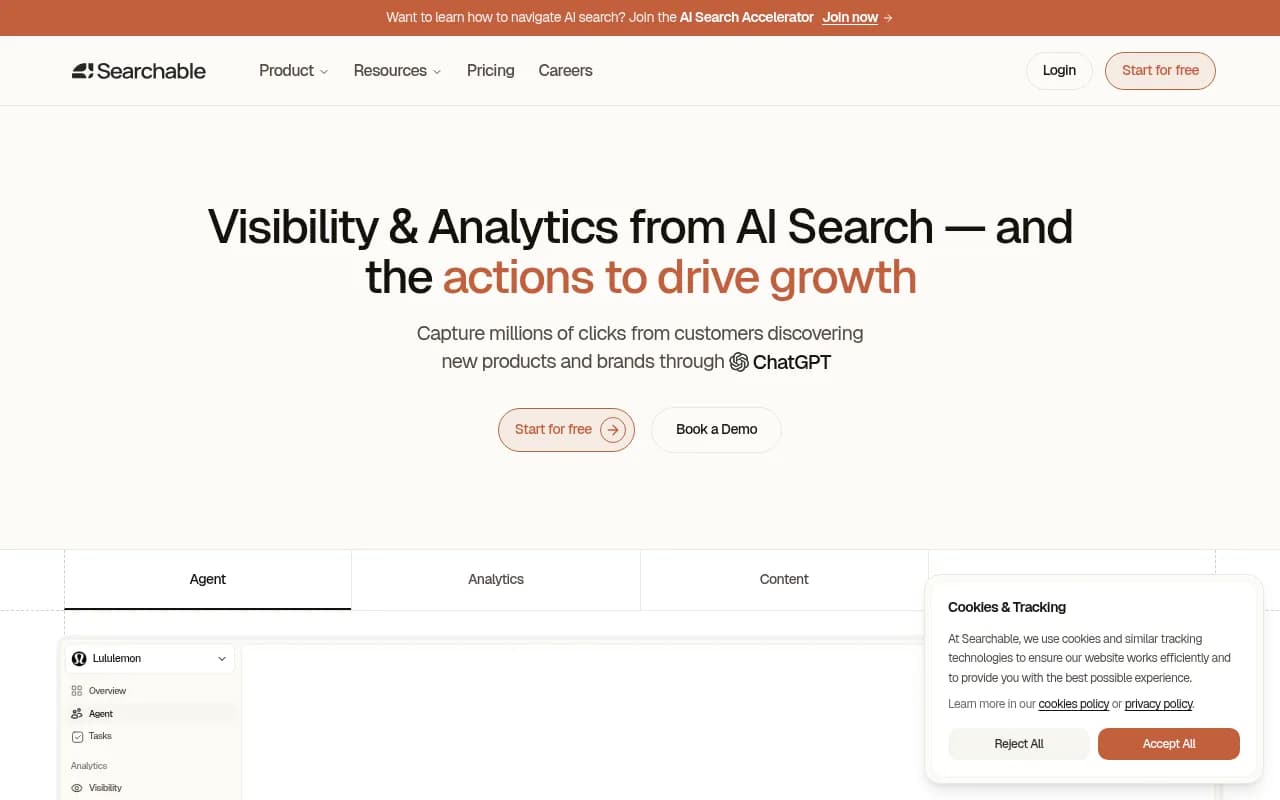
Searchable is an AI search optimization platform that tracks brand visibility across ChatGPT, Claude, Perplexity, Google AI Overviews, and Copilot. It combines monitoring dashboards with AI-powered content generation and technical audits. The platform is designed for self-serve access -- you sign up, connect your domain, and start tracking within minutes. Used by 12,000+ marketers and agencies, it's positioned as the accessible option for teams that want AI visibility without enterprise complexity.
The core value: you see where you appear in AI search results, get actionable recommendations from a built-in AI agent, and generate optimized content to improve your citations. Pricing starts at $50/mo for the Starter plan (1 domain, 50 prompts) and scales to $400/mo for the Scale plan. Professional plan runs $100-125/mo with unlimited domains and 200 prompts. 14-day free trial, no credit card required.
Bluefish
Bluefish is an enterprise-grade AI marketing platform built specifically for Fortune 500 brands. It provides deep visibility into brand reputation across AI search engines and agentic commerce platforms, with a focus on control, customization, and enterprise-scale data handling. The platform emphasizes "understanding how AI thinks" rather than just tracking surface-level metrics like share of voice.
Bluefish's positioning is clear: this is not a self-serve tool. You request a demo, go through a sales process, and work with their team to set up custom audiences, tailored prompt sets, and measurement frameworks that match your specific needs. Pricing starts around $4,000/mo with annual contracts standard. The platform is designed for large marketing teams at companies that consistently pass infosec reviews and need advanced segmentation capabilities.
Side-by-Side Comparison
| Feature | Searchable | Bluefish |
|---|---|---|
| Starting price | $50/mo | ~$4,000/mo |
| Free trial | 14 days, no credit card | No trial (demo only) |
| Target audience | SMBs, agencies, marketing teams | Fortune 500 enterprises |
| Setup | Self-serve, instant access | Sales-led, custom onboarding |
| AI engines tracked | ChatGPT, Claude, Perplexity, Google AI Overviews, Copilot | ChatGPT, Perplexity, other AI channels (specific list not public) |
| Content generation | Built-in AI content tools | Not included |
| Custom audiences | Standard personas | Fully customizable |
| Prompt customization | Pre-built + custom prompts | Tailored prompt sets |
| Integrations | Google Analytics, Search Console, HubSpot, Salesforce (self-serve) | Custom enterprise integrations |
| Technical audits | Included in all plans | Part of optimization workflows |
| Infosec compliance | Standard security | Enterprise-grade, passes Fortune 500 reviews |
| Support model | Email + docs | Dedicated account team |
| Contract terms | Monthly or annual | Annual contracts |
Pricing comparison
The pricing gap between these two platforms is the single biggest differentiator.
| Plan | Searchable | Bluefish |
|---|---|---|
| Entry tier | $50/mo (Starter: 1 domain, 50 prompts) | ~$4,000/mo (custom quote) |
| Mid tier | $100-125/mo (Professional: unlimited domains, 200 prompts) | Custom pricing based on brands/markets |
| Top tier | $400/mo (Scale plan) | Custom enterprise pricing |
| Annual discount | Available | Standard (annual contracts required) |
| Free trial | 14 days, no credit card | None |
Searchable's pricing is transparent and self-serve. You pick a plan, enter your card, and start tracking. Bluefish requires a sales call to get pricing, and their entry point is roughly 80x higher than Searchable's starter plan. This isn't a small difference -- it's a fundamentally different business model.
User interface and ease of use
Searchable is built for immediate access. You sign up, connect your domain, and the platform starts tracking your visibility within minutes. The interface is designed for marketers who don't want to spend days learning a new tool -- dashboards show where you appear, where competitors outrank you, and which opportunities you're missing. The AI agent generates recommendations in plain language, not technical jargon.
Bluefish takes the opposite approach. The platform is designed for teams that want deep control and customization, which means more complexity. You work with their team to set up custom audiences, define measurement frameworks, and build tailored prompt sets. The interface provides "in-depth control over AI performance" rather than simplified dashboards. This is a feature for enterprise teams with dedicated analysts, but it's a barrier for smaller teams that just want to start tracking.
Verdict: Searchable wins on accessibility. Bluefish wins on depth for teams that need it.
AI engines and monitoring coverage
Searchable explicitly tracks five AI engines: ChatGPT, Claude, Perplexity, Google AI Overviews, and Microsoft Copilot. The platform shows you how each engine responds to queries about your products, services, and industry. You see exactly where you appear, where competitors outrank you, and which opportunities you're missing.
Bluefish mentions ChatGPT, Perplexity, and "other AI channels" but doesn't publish a full list of supported engines. The platform emphasizes "AI search and agentic commerce" coverage, suggesting broader monitoring across AI-driven shopping experiences. Their focus is on "real-time visibility into brand reputation across all AI native experiences" rather than listing specific engines.
Both platforms track the major players (ChatGPT, Perplexity), but Searchable is more transparent about exactly which engines you're monitoring. Bluefish's vague language suggests they may cover more channels but don't want to commit to a public list.
Verdict: Searchable is clearer about what you're getting. Bluefish may cover more but won't tell you without a sales call.
Content generation and optimization
This is where the platforms diverge sharply.
Searchable includes AI-powered content generation in all plans. The platform generates blog posts, landing pages, and product descriptions "engineered for AI citation" -- meaning they're structured to increase the likelihood that ChatGPT, Claude, and Perplexity will cite your content. The content engine understands schema markup, authoritative tone, and comprehensive coverage patterns that AI engines prefer. You also get technical SEO audits that identify schema opportunities, content structure improvements, and crawlability fixes.
Bluefish does not include content generation tools. The platform focuses on monitoring, optimization workflows, and measurement frameworks. Their value proposition is "visibility and influence" through data and insights, not content creation. If you want to generate content based on Bluefish's recommendations, you'll need to use separate tools or hire writers.
Verdict: Searchable is the clear winner if you need content creation. Bluefish assumes you have content resources already.
Customization and enterprise features
Bluefish's entire positioning is built around enterprise-grade customization. You get custom audiences (not just standard personas), tailored prompt sets that match your specific market, and advanced segmentation capabilities. The platform is designed to pass Fortune 500 infosec reviews, which means it handles data security, compliance, and access controls at a level most SMB tools don't touch. You also get dedicated account teams and custom integration implementations.
Searchable offers standard personas and pre-built prompts with the ability to add custom prompts. You can connect integrations yourself through their self-serve setup. The platform is built for teams that want good-enough customization without needing a dedicated analyst to manage the tool.
The tradeoff: Bluefish gives you more control but requires more resources to use effectively. Searchable gives you less control but you can start getting value immediately.
Verdict: Bluefish wins for enterprises that need deep customization. Searchable wins for everyone else.
Integrations and data connectivity
Searchable connects with Google Analytics, Google Search Console, HubSpot, and Salesforce through self-serve integrations. You authenticate your accounts, and the platform starts correlating AI visibility with traffic, leads, and revenue. The goal is to prove ROI and optimize your strategy based on real business outcomes.
Bluefish handles integrations through custom implementations. Their website mentions "data teams get more ways to customize, segment, and optimize data in ways competitors can't match," which suggests API access and custom data pipelines rather than pre-built connectors. This is standard for enterprise tools -- you work with their team to build exactly what you need.
Verdict: Searchable is faster to set up. Bluefish is more flexible for complex enterprise data environments.
Support and onboarding
Searchable provides email support and documentation. You sign up, explore the platform, and reach out if you hit issues. The 14-day free trial lets you test everything before committing. This is the standard SMB support model -- responsive but not hands-on.
Bluefish provides dedicated account teams as part of their enterprise model. You get onboarding, training, and ongoing support from people who know your account. This is necessary given the platform's complexity, but it also means you're dependent on their team to get full value.
Verdict: Depends on what you need. Most teams prefer Searchable's self-serve model. Enterprises with complex requirements need Bluefish's hands-on support.
Who should pick Searchable
- SMBs and mid-market companies: If you're not a Fortune 500 brand, Searchable's pricing and self-serve model make it the obvious choice.
- Agencies managing multiple clients: Unlimited domains on the Professional plan ($100-125/mo) let you track all your clients without per-domain fees.
- Teams that need content creation: The built-in AI content tools are a major advantage if you're trying to improve your AI citations.
- Marketers who want to start immediately: 14-day free trial, no credit card, instant access. You can be tracking your visibility within 10 minutes.
- Budget-conscious teams: $50-400/mo is accessible for most marketing budgets. $4,000+/mo is not.
Searchable is the practical choice for 95% of companies. The platform gives you everything you need to track AI visibility, generate optimized content, and prove ROI without requiring a six-figure budget or a dedicated analyst.
Who should pick Bluefish
- Fortune 500 brands: If you're operating at enterprise scale with complex compliance requirements, Bluefish is built for you.
- Companies with dedicated AI marketing teams: The platform's depth and customization require resources to use effectively. If you have analysts who will spend their days in the tool, Bluefish's advanced features become valuable.
- Brands that need custom measurement frameworks: If standard metrics don't match your business model, Bluefish lets you build exactly what you need.
- Teams that have already maxed out simpler tools: If you've used Searchable or similar platforms and hit their limits, Bluefish is the next step up.
- Companies with $50,000+ annual AI marketing budgets: Bluefish's pricing makes sense only if you're spending serious money on AI visibility and need enterprise-grade tools to manage it.
Bluefish is overkill for most companies. But if you're a large brand with complex needs and the budget to match, it's the most powerful option available.
Pros and cons
Searchable pros
- Affordable pricing starting at $50/mo
- 14-day free trial with no credit card required
- Self-serve setup, instant access
- Built-in AI content generation tools
- Clear list of supported AI engines
- Unlimited domains on Professional plan
- Technical SEO audits included
- 12,000+ users, proven track record
Searchable cons
- Less customization than enterprise platforms
- Standard personas, not fully custom audiences
- Email support, not dedicated account teams
- May lack depth for very large enterprises
Bluefish pros
- Enterprise-grade security and compliance
- Deep customization (custom audiences, tailored prompts)
- Advanced segmentation capabilities
- Dedicated account teams
- Built for Fortune 500 scale
- Focus on "understanding how AI thinks" vs surface metrics
- Custom integration implementations
Bluefish cons
- Pricing starts around $4,000/mo (80x more than Searchable)
- No free trial, demo-only sales process
- Annual contracts required
- Overkill for SMBs and most mid-market companies
- No content generation tools
- Vague about which AI engines are supported
- Requires dedicated resources to use effectively
Final verdict
For 95% of companies, Searchable is the right choice. It's affordable, accessible, and includes everything you need to track AI visibility and improve your citations. The $50-400/mo pricing is realistic for most marketing budgets, and the 14-day free trial lets you test before committing. The built-in content generation tools are a major advantage -- you're not just monitoring, you're actively improving your presence.
Bluefish is the right choice only if you're a Fortune 500 brand with complex requirements and a six-figure budget. The platform offers deeper customization and enterprise-grade features, but you pay for it -- both in dollars and in the resources required to use it effectively. Most teams will find Bluefish's complexity and cost unjustified.
The decision comes down to scale and budget. If you're spending less than $50,000/year on AI visibility, Searchable is the obvious pick. If you're spending $500,000+/year and need enterprise features, Bluefish makes sense. There's very little middle ground between these two platforms.
If you're also looking to understand how your brand appears in AI search results and want to close the loop between visibility and actual optimization, Promptwatch is worth exploring as a complement to either tool. It tracks citations across 10 AI models and includes content gap analysis plus an AI writing agent that generates articles grounded in real citation data.

Bottom line: Start with Searchable unless you have a Fortune 500 budget and enterprise-level complexity. The 80x price difference is not justified for most teams.