Key Takeaways
- Price gap is massive: Mentions.so starts at $99/mo with a free tier, while Bluefish requires ~$4,000/mo minimum with annual contracts -- that's a 40x difference
- Target audience split: Mentions.so is built for startups, agencies, and SMBs; Bluefish is explicitly Fortune 500-focused with enterprise infosec requirements
- Feature depth vs accessibility: Bluefish offers deeper diagnostics and custom audiences, but Mentions.so covers the core tracking needs most brands actually use
- AI model coverage: Both track ChatGPT, Claude, Gemini, Perplexity, Grok, DeepSeek, and Meta AI -- no meaningful difference here
- Traffic attribution: Mentions.so includes AI traffic tracking in all plans; Bluefish's measurement suite is part of their enterprise offering
- Speed to value: Mentions.so has self-serve signup and daily reports; Bluefish requires sales demos and custom onboarding
Overview
Mentions.so
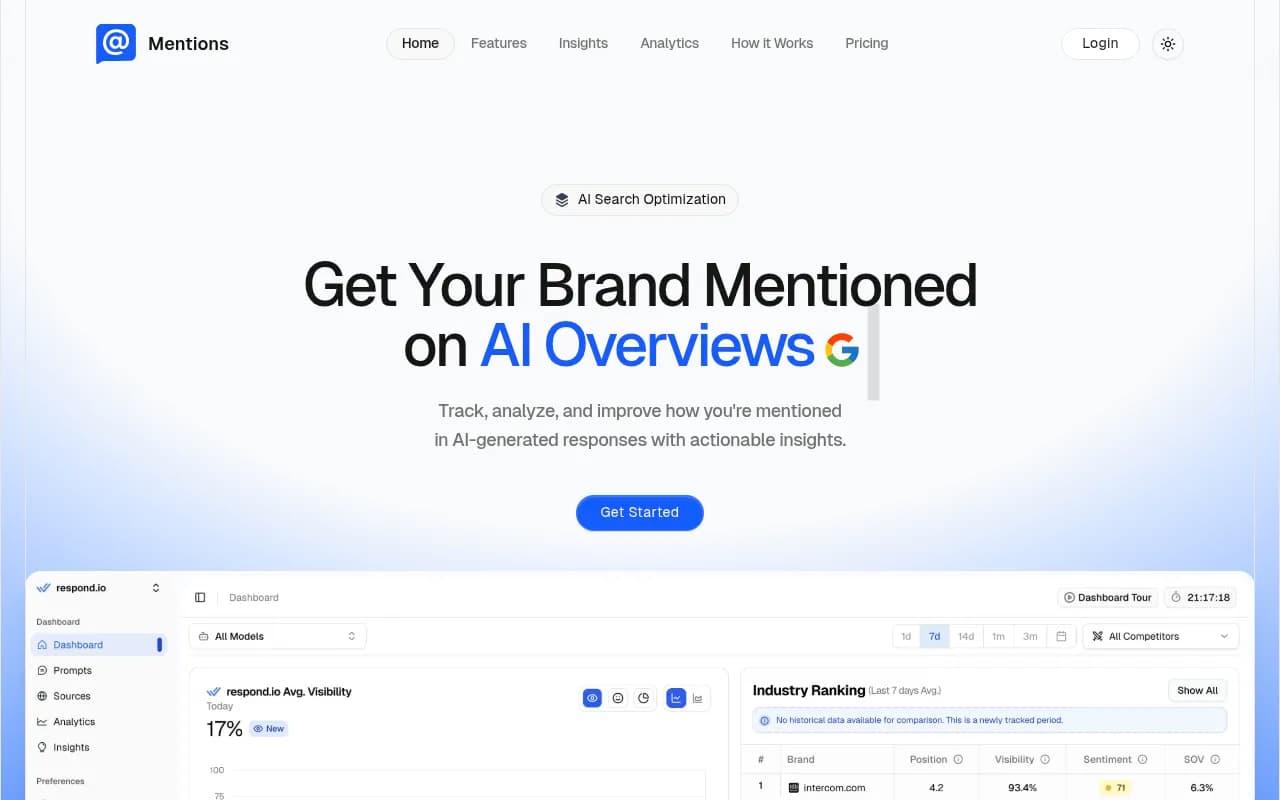
Mentions.so is an AI brand monitoring platform designed for teams that need to track how ChatGPT, Claude, and other AI models talk about their brand without enterprise complexity. It launched in 2024 and has grown to 100+ brands using it for daily AI visibility tracking. The platform focuses on making AI search optimization (also called GEO or AEO) accessible -- you can sign up, add your domain, and start tracking mentions within minutes.
The core workflow: pick prompts (or let their AI suggest them), track how often you're mentioned across models, see sentiment analysis, compare yourself to competitors, and get actionable recommendations. They also track AI-driven traffic so you can connect visibility to actual website visits. Pricing starts with a free tier and scales to $599/mo for agencies managing multiple clients.
Bluefish
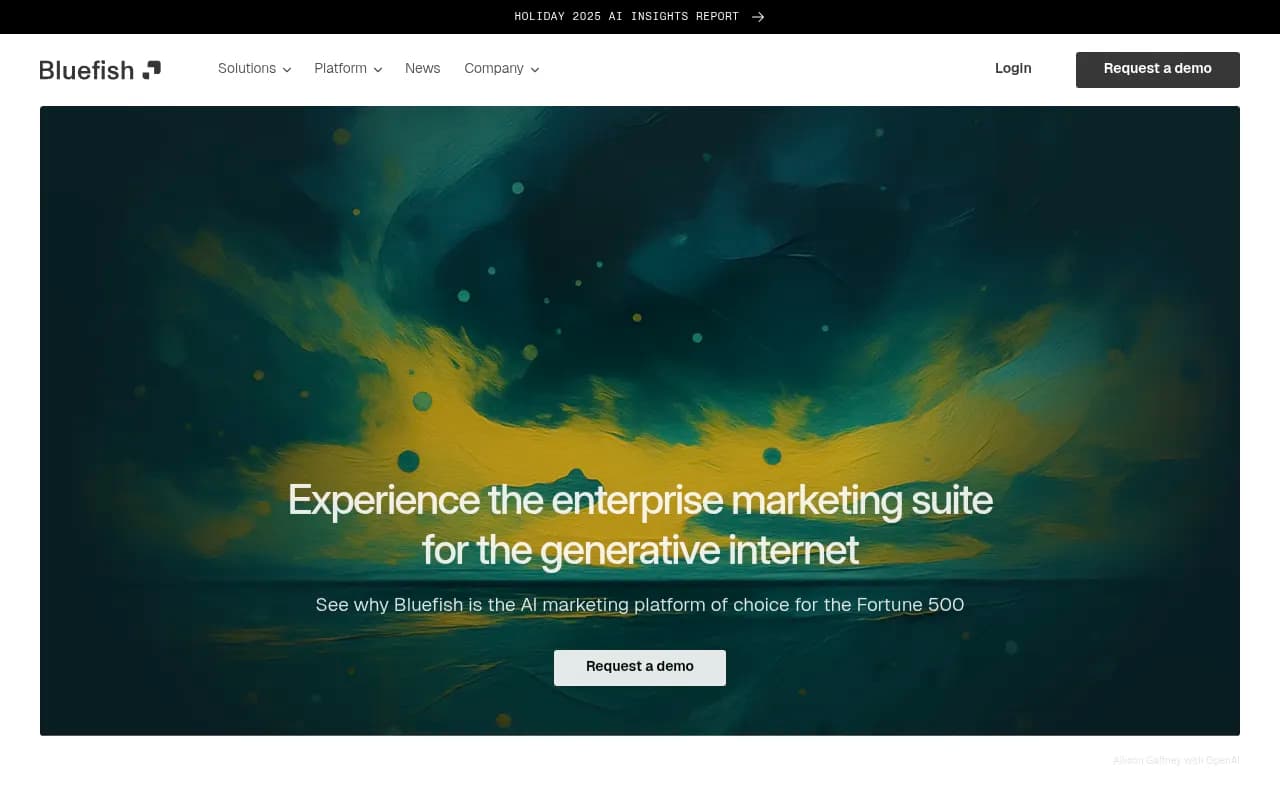
Bluefish positions itself as "the AI marketing platform of choice for the Fortune 500" -- and they mean it. This is an enterprise-grade solution built for large marketing teams at brands like those you'd recognize from Super Bowl ads. Bluefish doesn't list pricing publicly, but industry sources put it around $4,000/mo minimum with annual contracts and custom enterprise plans.
What you get for that price: deep diagnostics into how AI models "think" about your brand, custom audience segmentation, tailored prompt libraries, advanced optimization workflows, and white-glove support. Bluefish recently proved that Super Bowl ads influence AI recommendations, showing the kind of research depth they bring. They pass enterprise infosec reviews and offer data customization that smaller platforms can't match. If you're managing a portfolio of brands across multiple markets with a dedicated team, Bluefish is built for that scale.
Side-by-Side Comparison
| Feature | Mentions.so | Bluefish |
|---|---|---|
| Starting price | Free tier, $99/mo paid | ~$4,000/mo (quote-based) |
| Free trial | Yes (free tier) | Demo required |
| AI models tracked | ChatGPT, Claude, Gemini, Perplexity, Grok, DeepSeek, Meta AI, Google Overview | ChatGPT, Perplexity, other major models |
| Sentiment analysis | ✓ (positive/neutral/negative) | ✓ (advanced diagnostics) |
| Competitor tracking | ✓ (visibility comparison) | ✓ (share-of-voice, deep benchmarking) |
| AI traffic attribution | ✓ (all plans) | ✓ (enterprise measurement suite) |
| Custom prompts | ✓ (manual + AI-suggested) | ✓ (tailored libraries) |
| Custom audiences | Basic segmentation | Advanced custom audiences |
| Daily reports | ✓ | Custom cadence |
| Self-serve signup | Yes | No (sales-led) |
| Multi-brand management | Agency plan ($599/mo) | Enterprise standard |
| Infosec/compliance | Standard | Enterprise-grade (passes Fortune 500 reviews) |
| Support model | Email/chat | Dedicated account team |
Pricing comparison
| Plan | Mentions.so | Bluefish |
|---|---|---|
| Free tier | ✓ (limited features) | ✗ |
| Starter | $99/mo | N/A |
| Mid-tier | ~$300-400/mo (implied) | N/A |
| Agency | $599/mo | N/A |
| Enterprise | Custom | ~$4,000/mo+ (annual contract) |
| Annual discount | 16% off | Standard (contract-based) |
Bluefish doesn't publish a pricing page -- you request a demo and they build a custom quote based on number of brands, markets, and feature requirements. Mentions.so shows transparent pricing with monthly or annual billing.
Target audience and positioning
Who Mentions.so is for
Mentions.so built their platform for teams that need AI visibility tracking but don't have enterprise budgets or dedicated GEO teams. Their ideal customer:
- Startups and scale-ups tracking how AI models recommend them vs competitors
- Digital agencies managing 5-10 clients who want AI search visibility reports
- SMB marketing teams (1-5 people) who need actionable insights without complexity
- Consultants and freelancers offering AI SEO as a service
The self-serve model and transparent pricing make it easy to get started. You're not signing annual contracts or going through procurement. One testimonial on their site is from an SEO consultant -- that's the persona they're targeting.
Who Bluefish is for
Bluefish explicitly says "Fortune 500" in their positioning, and they're not exaggerating. Their platform is built for:
- Enterprise marketing teams (10+ people) with dedicated budgets for AI channel strategy
- Multi-brand portfolios where you're tracking 5-20 brands across different markets
- Companies with strict infosec requirements that need vendor reviews and compliance documentation
- Brands spending millions on advertising who need to measure AI influence from campaigns (like Super Bowl ads)
If you're a startup or small agency, Bluefish probably won't even take the call -- their minimum contract size reflects enterprise expectations. But if you're managing Coca-Cola's AI presence across 50 markets, Bluefish has the infrastructure for that.
Feature depth: monitoring and tracking
Both platforms cover the basics -- tracking brand mentions across ChatGPT, Claude, Gemini, Perplexity, and other models. Where they differ is depth and customization.
Mentions.so gives you:
- Daily tracking across 8 AI models (including Google Overview, which some competitors skip)
- Sentiment scoring (positive/neutral/negative) with trend charts
- Competitor visibility comparison showing your share vs 4-5 rivals
- Prompt suggestions powered by AI, or manual prompt entry
- Real AI responses so you can see exactly what each model says
This covers what 90% of brands need. You see where you're mentioned, how often, what the sentiment is, and how you stack up. The interface is clean and the reports are digestible.
Bluefish adds:
- "How AI thinks" diagnostics -- deeper analysis of why models recommend (or don't recommend) your brand
- Custom audience segmentation so you can track different personas or use cases separately
- Tailored prompt libraries built for your specific category and competitive set
- Advanced benchmarking with more granular share-of-voice metrics
- Research-grade insights (like their Super Bowl ad study) that inform strategy
If you're optimizing at scale and need to understand the why behind the data, Bluefish's diagnostics matter. For most teams, Mentions.so's tracking is sufficient.
Optimization and recommendations
This is where both platforms try to move beyond monitoring into action.
Mentions.so provides:
- Daily performance reports with "winning insights" -- specific steps to improve rankings
- Recommendations based on what's working for competitors
- Prompt performance tracking so you know which queries to prioritize
- Clear action items ("add this content", "optimize this page") in plain language
Their tagline is "Get Practical Recommendations to Boost Your AI Rankings" -- the focus is on making optimization accessible. You don't need a data science team to interpret the insights.
Bluefish offers:
- "Automated optimization workflows" (details are vague, but implies more sophisticated tooling)
- "Tailored measurement frameworks" so you can define custom KPIs
- Deep expertise and strategic guidance from their team
- Integration with broader marketing campaigns (like measuring AI lift from TV ads)
Bluefish's optimization is more consultative. You're not just getting automated tips -- you're working with their team to build a GEO strategy. That's valuable if you have the budget and complexity to justify it.
Traffic attribution and measurement
Both platforms track AI-driven traffic, but the implementation differs.
Mentions.so includes AI traffic tracking in all plans. You can see how much traffic is coming from AI models and which pages are getting visits. The setup appears straightforward -- likely a tracking snippet or integration.
Bluefish has a dedicated "GEO Measurement" module as part of their enterprise suite. They emphasize "measuring ROI" and recently launched "Collections" to track campaign performance in the AI channel. This is more sophisticated -- you can measure the impact of specific marketing initiatives (like a Super Bowl ad) on AI visibility and downstream traffic.
For most teams, Mentions.so's traffic tracking is enough. If you're a CMO justifying a seven-figure AI strategy budget, Bluefish's measurement rigor matters.
AI commerce tracking
Bluefish mentions "agentic commerce" as a focus area -- tracking how your brand shows up in AI-powered shopping experiences (like ChatGPT's shopping features or AI product recommendations). This is forward-looking as AI commerce grows.
Mentions.so doesn't explicitly call out commerce tracking, though they do monitor ChatGPT (which includes shopping). If AI commerce is a strategic priority for your brand, Bluefish's dedicated focus is an advantage.
Tools like Promptwatch also track ChatGPT Shopping specifically, along with broader AI visibility across models -- worth considering if you want commerce tracking without the full Bluefish price tag.

Ease of use and onboarding
Mentions.so: Self-serve signup, add your domain, pick prompts, start tracking. You can be up and running in 10 minutes. The interface is clean and the learning curve is minimal. Daily reports arrive automatically.
Bluefish: Sales-led process. You request a demo, they assess your needs, build a custom proposal, you sign an annual contract, then they onboard your team with dedicated support. This takes weeks, not minutes. But you get white-glove service and custom configuration.
If you need to move fast or you're testing AI monitoring for the first time, Mentions.so wins on speed. If you're rolling out a platform to a 50-person marketing org, Bluefish's structured onboarding is actually helpful.
Enterprise requirements and compliance
Bluefish explicitly says they "consistently pass infosec reviews with ease" -- this matters for Fortune 500 buyers. They're built to handle:
- Vendor security questionnaires
- SOC 2 / ISO compliance expectations
- Data residency and privacy requirements
- SSO and access controls
- Custom data retention policies
Mentions.so doesn't highlight enterprise compliance on their site. That doesn't mean they're insecure, but they're not positioning for enterprise procurement processes. If your company requires vendor reviews and annual audits, Bluefish is designed for that.
Pros and cons
Mentions.so pros
- Transparent, affordable pricing starting at $99/mo
- Free tier to test before committing
- Self-serve signup with no sales calls required
- Covers all major AI models including Google Overview
- Clean interface with actionable daily insights
- Fast time-to-value (minutes, not weeks)
- Agency plan at $599/mo is accessible for multi-client management
Mentions.so cons
- Less feature depth than enterprise platforms
- Limited customization for complex use cases
- No dedicated account team or strategic consulting
- Audience segmentation is basic
- Not built for Fortune 500 infosec requirements
Bluefish pros
- Deep diagnostics into how AI models evaluate your brand
- Custom audiences and tailored prompt libraries
- Enterprise-grade compliance and security
- Dedicated support and strategic guidance
- Advanced measurement for campaign ROI
- Built for multi-brand, multi-market complexity
- Research capabilities (like Super Bowl ad study)
Bluefish cons
- Pricing starts around $4,000/mo -- prohibitive for most teams
- Annual contracts required (no month-to-month)
- Sales-led process with no self-serve option
- Overkill for startups and small businesses
- Slower onboarding (weeks vs minutes)
Who should pick which tool
Choose Mentions.so if you:
- Have a budget under $1,000/mo for AI monitoring
- Are a startup, SMB, or agency with 1-10 clients
- Want to start tracking AI visibility this week, not next quarter
- Need core monitoring and actionable insights without complexity
- Prefer transparent pricing and self-serve tools
- Don't require enterprise compliance or vendor reviews
Choose Bluefish if you:
- Are a Fortune 500 brand or enterprise with dedicated AI strategy budget
- Manage multiple brands across different markets
- Need to pass infosec reviews and meet compliance requirements
- Want deep diagnostics and custom measurement frameworks
- Have a team that can leverage strategic consulting and white-glove support
- Are measuring AI impact from major marketing campaigns (TV, sponsorships, etc.)
- Budget is $50k+ annually for AI visibility and optimization
Consider alternatives if:
- You want enterprise features at mid-market pricing: Look at platforms like Promptwatch, which offers crawler logs, content gap analysis, and AI traffic attribution starting at $99/mo (Essential) to $579/mo (Business) -- bridging the gap between Mentions.so's simplicity and Bluefish's depth.
- You need AI content generation: Mentions.so and Bluefish focus on monitoring and measurement. If you want to create content optimized for AI citations, Promptwatch includes an AI writing agent trained on 880M+ citations.
- You're an agency managing 20+ clients: Bluefish's enterprise model may not scale efficiently. Mentions.so's agency plan works up to ~10 clients, but beyond that you might need a different pricing structure.
Final verdict
This isn't a close call -- Mentions.so and Bluefish serve completely different markets.
Mentions.so is the right choice for 95% of teams reading this comparison. At $99-599/mo, it delivers the core AI brand monitoring features most companies actually need: tracking across all major models, sentiment analysis, competitor benchmarking, traffic attribution, and daily actionable insights. The self-serve model means you can start today, and the transparent pricing means no surprises. If you're a startup, agency, or SMB trying to understand and improve your AI visibility, Mentions.so gives you the tools without the enterprise complexity.
Bluefish is purpose-built for the Fortune 500. If you're managing a portfolio of global brands with a seven-figure marketing budget and a team that needs deep diagnostics, custom measurement frameworks, and strategic consulting, Bluefish's $4,000+/mo investment makes sense. The compliance rigor, white-glove support, and research capabilities justify the cost at enterprise scale. But if you're not signing annual contracts and passing vendor security reviews, Bluefish is overkill.
The pricing gap tells the story: Mentions.so starts at $99/mo, Bluefish at ~$4,000/mo. That's not a 2x difference where you're weighing features -- it's a 40x difference that reflects fundamentally different target customers. Pick the tool that matches your company size, budget, and complexity. For most teams, that's Mentions.so.