Key Takeaways
- Price gap is massive: Peec AI starts at €89/month with a free trial, Bluefish starts around $4,000/month with annual contracts -- you're looking at a 45x difference in entry cost
- Target audience couldn't be more different: Peec AI is built for startups, agencies, and SMBs who need quick setup and affordable monitoring. Bluefish is enterprise-only, designed for Fortune 500 brands with dedicated marketing teams and infosec requirements
- Feature depth vs accessibility: Bluefish offers deeper enterprise controls (custom audiences, tailored prompts, advanced segmentation), but Peec AI covers the core monitoring needs most teams actually use -- visibility, position, sentiment tracking across major AI models
- Self-service vs white-glove: Peec AI is a self-service platform you can start using today. Bluefish requires sales calls, custom quotes, and implementation support
- Both are monitoring-focused: Neither platform includes content generation or optimization tools to actually fix visibility gaps -- they show you the data but leave the action steps to you. If you need help creating content that ranks in AI search, tools like Promptwatch fill that gap with AI content generation and answer gap analysis.
- Multi-language support: Peec AI explicitly markets multi-language tracking as a core feature. Bluefish mentions multi-market capabilities but doesn't emphasize language diversity as heavily
Overview
Peec AI

Peec AI is a self-service AI visibility platform aimed at marketing teams, agencies, and startups. It tracks how your brand appears across ChatGPT, Perplexity, and Gemini, with a focus on three core metrics: visibility (share of mentions), position (ranking), and sentiment (how AI models describe you). The platform supports multi-language tracking and lets you add custom prompts, organize them with tags, and benchmark against competitors. Pricing starts at €89/month for the Starter plan, with a free trial available.
Peec AI positions itself as the accessible option for teams that need AI search monitoring without enterprise complexity or enterprise budgets.
Bluefish
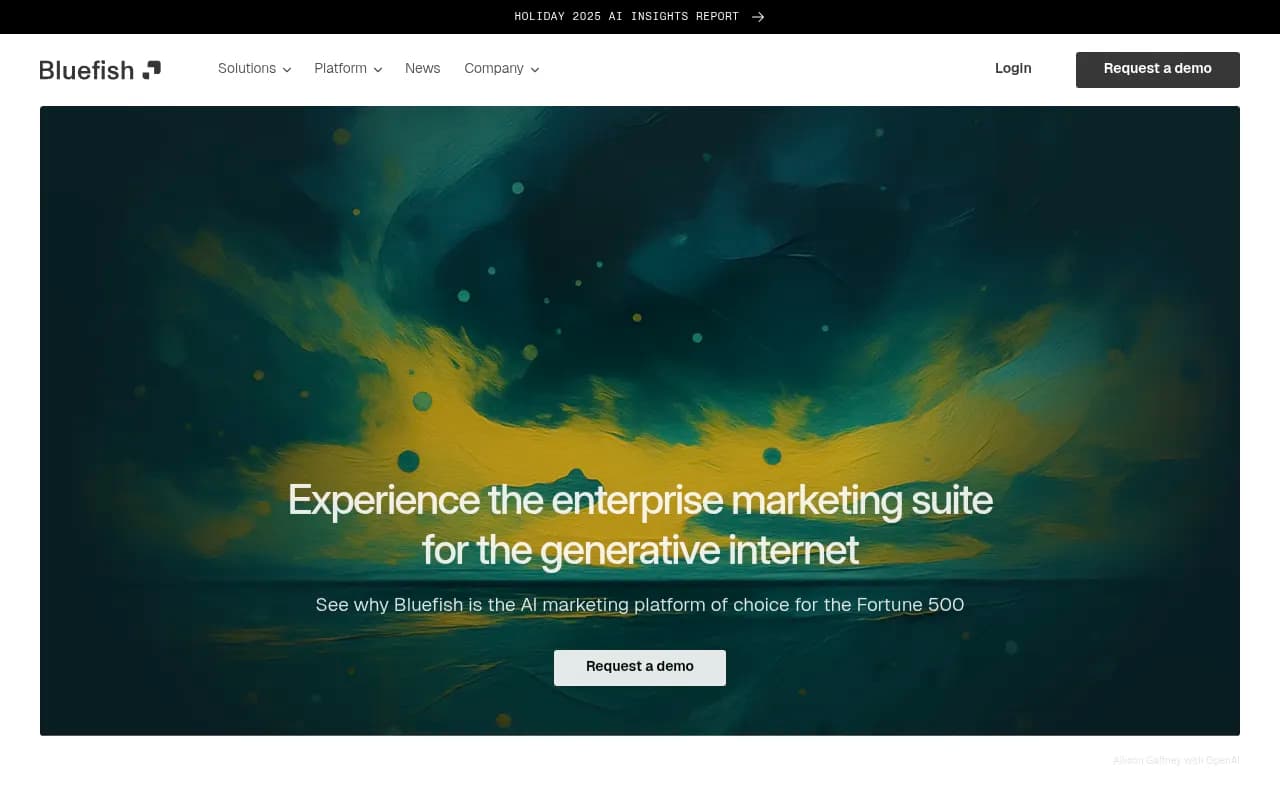
Bluefish is an enterprise-grade AI marketing platform built specifically for Fortune 500 brands. It goes beyond basic monitoring to offer what they call "authority, influence and control" -- deep visibility into how AI models think about your brand, custom audience segmentation, tailored prompt libraries, and advanced performance frameworks. Bluefish tracks AI search (ChatGPT, Perplexity, etc.) plus agentic commerce channels, with a focus on actionable optimization workflows and enterprise-scale data handling.
Pricing starts around $4,000/month with custom enterprise contracts. Bluefish markets itself as the platform for category leaders who need differentiation and control in competitive markets.
Side-by-Side Comparison
| Feature | Peec AI | Bluefish |
|---|---|---|
| Starting price | €89/month | ~$4,000/month |
| Free trial | Yes | No (demo required) |
| Target audience | Startups, SMBs, agencies | Fortune 500, enterprise |
| Setup | Self-service | Sales-led, custom implementation |
| AI models tracked | ChatGPT, Perplexity, Gemini | ChatGPT, Perplexity, others (not fully specified) |
| Core metrics | Visibility, position, sentiment | Visibility, influence, impact, custom KPIs |
| Custom prompts | Yes | Yes (tailored libraries) |
| Multi-language | Explicit feature | Multi-market support |
| Competitor benchmarking | Yes | Yes (deeper segmentation) |
| Content optimization | No | No (monitoring-focused) |
| API access | Not mentioned | Likely (enterprise focus) |
| Infosec compliance | Standard | Enterprise-grade (passes reviews) |
| Contract terms | Monthly billing | Annual contracts |
| User count | 1,500+ marketing teams | Fortune 500 clients |
Pricing comparison
| Plan | Peec AI | Bluefish |
|---|---|---|
| Entry tier | Starter: €89/month | Custom quote: ~$4,000/month |
| Mid tier | Professional: €199/month | Custom enterprise pricing |
| Enterprise | Custom pricing | Custom (higher tiers available) |
| Free trial | Yes | No |
| Billing | Monthly or annual | Annual contracts standard |
| Setup fees | None mentioned | Likely included in contract |
The pricing gap here is the story. Peec AI's Professional plan at €199/month (~$210/month) costs roughly 5% of Bluefish's entry point. You could run Peec AI for nearly two years before hitting what Bluefish charges in one month.
Feature deep-dive
AI model coverage
Peec AI explicitly tracks ChatGPT, Perplexity, and Gemini. Their website shows these three models front and center. Multi-language support is a marketed feature, letting you track prompts across different countries and languages.
Bluefish mentions "all AI native experiences" and "major AI channels" but doesn't list specific models as clearly on their public site. They emphasize AI search and agentic commerce, suggesting broader coverage but less transparency about exactly which models.
Verdict: Peec AI wins on transparency. You know exactly what you're getting. Bluefish likely covers more models but makes you ask during the sales process.
Core metrics and tracking
Both platforms track the fundamentals:
| Metric | Peec AI | Bluefish |
|---|---|---|
| Visibility | Share of chats mentioning your brand | Yes, plus "influence" metrics |
| Position | Ranking within AI responses | Yes, with deeper context |
| Sentiment | How AI describes your brand | Yes, plus reputation analysis |
| Custom audiences | Not mentioned | Yes (enterprise segmentation) |
| Custom prompts | Yes, with tagging | Yes, tailored libraries |
Peec AI keeps it simple: visibility percentage, average position, sentiment score. You see trending data over time and can drill into specific prompts.
Bluefish adds layers: they talk about understanding how AI "thinks," optimizing beyond share-of-voice, and building custom measurement frameworks. This matters if you're a large brand with complex category dynamics and need to segment by audience type, purchase intent, or regional variations.
Verdict: Peec AI covers what most teams need. Bluefish adds enterprise depth that justifies the price only if you actually use it.
Competitor benchmarking
Peec AI shows competitor visibility side-by-side. Their dashboard screenshots show brands like Salesforce, HubSpot, Attio, Pipedrive compared on visibility percentages. You can see who's winning for specific prompts and track your position relative to competitors over time.
Bluefish emphasizes "control and differentiation" for category leaders. They position competitor analysis as part of a broader optimization workflow, not just a dashboard widget. The implication: deeper data, more segmentation options, custom competitive sets.
Verdict: Both do competitor tracking. Peec AI makes it visual and accessible. Bluefish likely offers more granular data but hides it behind the sales process.
Multi-language and multi-market
Peec AI explicitly markets multi-language support. Their site says "Track across all countries" and multi-language is part of the core pitch. This matters for European companies, global SaaS brands, or agencies managing clients in multiple regions.
Bluefish mentions "multi-market" capabilities but doesn't emphasize language diversity. Their Fortune 500 focus suggests they handle it, but it's not a headline feature.
Verdict: Peec AI wins if language coverage is a priority. They've built it into the product story.
Content optimization and action tools
Neither platform generates content or tells you what to write. Both are monitoring dashboards that show you where you stand but don't help you fix it.
Peec AI provides "smart suggestions" (mentioned in their tagline) but details are vague. Likely basic recommendations, not full content generation.
Bluefish talks about "optimization workflows" and "actionability" but their site focuses on measurement frameworks and data segmentation, not content creation.
If you need to actually create content that ranks in AI search, you're looking at a gap in both platforms. This is where tools like Promptwatch come in -- they show you the content gaps (which prompts competitors rank for but you don't) and generate articles grounded in citation data to fill those gaps.

Verdict: Both platforms stop at monitoring. Neither solves the "now what?" problem.
Enterprise features and compliance
Peec AI doesn't emphasize enterprise features. No mention of SSO, advanced permissioning, or infosec compliance. The product is built for speed and simplicity.
Bluefish leads with enterprise credibility: "consistently pass infosec reviews with ease," built for Fortune 500, data teams get customization and segmentation options competitors can't match. They mention API access (implied), custom data exports, and tailored reporting.
Verdict: Bluefish is the only option if you need enterprise-grade security, compliance, and data controls. Peec AI isn't built for that.
User experience and setup
Peec AI is self-service. Sign up, add your prompts, start tracking. Their site shows a clean dashboard with clear metrics. You can start a free trial without talking to anyone.
Bluefish requires a sales call. No public signup, no free trial. You request a demo, go through discovery, get a custom quote, sign an annual contract, then implementation begins. This is standard enterprise software sales.
Verdict: Peec AI wins on speed to value. Bluefish wins if you need hand-holding and custom setup.
Pros and cons
Peec AI pros
- Affordable entry point (€89/month) with free trial
- Self-service setup -- start tracking today
- Clean, focused dashboard on core metrics
- Multi-language support built in
- Good for agencies managing multiple clients
- Transparent pricing and feature set
Peec AI cons
- Limited to three AI models (ChatGPT, Perplexity, Gemini)
- No content generation or optimization tools
- Lacks enterprise features (SSO, advanced permissioning)
- "Smart suggestions" are vague -- unclear how actionable
- Smaller user base means less community knowledge
Bluefish pros
- Built for enterprise scale and complexity
- Deep customization (audiences, prompts, frameworks)
- Passes infosec reviews -- compliance-ready
- Likely broader AI model coverage
- White-glove support and implementation
- Trusted by Fortune 500 brands
Bluefish cons
- Pricing starts around $4,000/month -- prohibitive for most teams
- Requires annual contracts, no monthly option
- No free trial or self-service option
- Sales-led process adds friction and time
- Overkill for startups and small teams
- Less transparency on exact features and model coverage
Who should pick which tool
Pick Peec AI if you:
- Are a startup, SMB, or agency with budget constraints
- Need to start tracking AI visibility quickly without sales calls
- Want a clean, simple dashboard focused on core metrics
- Track brands across multiple languages or regions
- Manage multiple clients and need affordable per-brand pricing
- Don't need enterprise compliance or advanced permissioning
Pick Bluefish if you:
- Work at a Fortune 500 brand with enterprise marketing budgets
- Need deep customization and segmentation capabilities
- Require infosec compliance and enterprise-grade security
- Have complex category dynamics requiring custom measurement frameworks
- Want white-glove support and strategic consulting
- Can commit to annual contracts starting at $4,000+/month
Pick neither if you:
- Need content generation and optimization tools, not just monitoring. Both platforms show you the data but don't help you create content that ranks in AI search. For that, look at platforms like Promptwatch that combine monitoring with answer gap analysis and AI content generation.
Final verdict
Peec AI and Bluefish aren't really competitors -- they serve completely different markets at completely different price points. The decision isn't about which platform is "better," it's about which market segment you're in.
If you're a startup, agency, or SMB: Peec AI is the obvious choice. You get the core monitoring features you actually need at a price that makes sense. The €89/month entry point means you can start tracking AI visibility without a major budget commitment, and the self-service model means you're up and running today, not in three months after a sales cycle.
If you're a Fortune 500 brand: Bluefish is built for you. The enterprise features, compliance readiness, and deep customization justify the price if you're operating at scale with complex category dynamics. The $4,000/month entry point is a rounding error in an enterprise marketing budget, and the white-glove support matters when you're coordinating across multiple teams and regions.
The real gap both platforms share: neither helps you fix what they find. They show you where you're invisible in AI search, but they don't generate the content or optimize the pages that would actually improve your visibility. That's the action step both platforms leave on the table.